Organic Beef Market Size
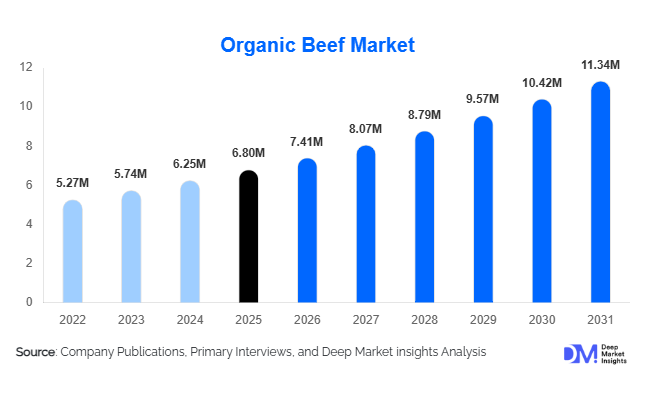
According to Deep Market Insights, the global organic beef market size was valued at USD 6.8 billion in 2026 and is projected to grow from USD 7.41 billion in 2027 to reach USD 11.34 billion by 2031, expanding at a CAGR of 8.9% during the forecast period (2026–2031). The market growth is primarily driven by rising consumer demand for antibiotic-free and hormone-free meat, increasing awareness of sustainable livestock farming practices, and the rapid expansion of premium organic food retail channels across developed and emerging economies.
Key Market Insights
- Fresh organic beef dominates consumption patterns globally, driven by strong consumer preference for minimally processed meat and higher perceived nutritional value.
- Supermarkets and hypermarkets remain the leading distribution channel, supported by strong product visibility and consumer trust in certified organic labeling.
- Household consumption accounts for the largest share of demand, reflecting growing home cooking trends and clean-label dietary preferences.
- North America leads global demand, supported by high disposable income and mature organic certification frameworks.
- Asia-Pacific is the fastest-growing region, driven by rising middle-class income and increasing imports of premium protein products.
- Technological advancements such as blockchain traceability and regenerative farming are reshaping production transparency and sustainability standards.
What are the latest trends in the global organic beef market?
Expansion of Sustainable and Regenerative Beef Production
Producers are increasingly adopting regenerative grazing systems and carbon-reduction farming practices to meet rising environmental expectations. Organic beef farms are integrating soil regeneration, methane reduction feed technologies, and water-efficient livestock systems. These practices not only enhance sustainability credentials but also allow producers to command premium pricing in export markets. Retailers and foodservice operators are increasingly favoring suppliers with verified low-carbon or carbon-neutral certifications, strengthening demand for sustainably produced organic beef globally.
Digitalization and Traceability Across the Supply Chain
The adoption of blockchain-based traceability systems and AI-driven livestock monitoring is improving transparency across the organic beef supply chain. Consumers increasingly demand full visibility into sourcing, feeding practices, and certification authenticity. Digital labeling systems and QR-code-enabled packaging are allowing buyers to verify organic claims instantly. This trend is especially strong in North America and Europe, where regulatory compliance and consumer awareness are highest.
What are the key drivers in the global organic beef market?
Rising Health-Conscious Protein Consumption
Consumers are increasingly shifting toward clean-label diets, prioritizing meat products that are free from antibiotics, synthetic hormones, and chemical additives. Organic beef is perceived as a safer and higher-quality protein source, which is driving demand across retail and foodservice sectors. This trend is particularly strong among urban populations and high-income households, where dietary awareness and willingness to pay premium prices are higher.
Expansion of Organic Certification and Regulatory Support
Government-backed organic certification frameworks such as USDA Organic and EU Organic have significantly improved market credibility and consumer trust. Subsidies and incentives for organic livestock farming are encouraging farmers to transition from conventional beef production. This regulatory support is accelerating supply chain formalization and improving global trade in certified organic beef products.
Growth of Premium Retail and Foodservice Demand
Luxury restaurants, premium hotel chains, and gourmet food outlets are increasingly incorporating organic beef into their offerings. This is driven by rising demand for high-quality dining experiences and sustainable menu sourcing. Foodservice demand is particularly strong in developed economies, where premiumization trends are reshaping protein consumption patterns.
What are the restraints for the global market?
High Production Costs and Limited Scalability
Organic beef production requires strict adherence to organic feed, land management, and animal welfare standards, significantly increasing production costs. Limited scalability of organic cattle farming results in supply shortages, which further elevates retail prices and restricts mass-market adoption.
Supply Chain Constraints and Certification Complexity
The certification process for organic beef is time-intensive and complex, often requiring multi-year transition periods for livestock farms. Limited availability of certified organic cattle and fragmented supply chains create inconsistencies in supply, leading to price volatility in several regions.
What are the key opportunities in the global organic beef industry?
Expansion of Organic Livestock Farming in Emerging Markets
Emerging economies such as Brazil, India, and parts of Southeast Asia present significant opportunities for scaling organic cattle farming. Government incentives and export-oriented agricultural policies are encouraging farmers to adopt organic practices. These regions are expected to become major suppliers of organic beef to North America and Europe.
Growth of Direct-to-Consumer (D2C) Organic Meat Platforms
The rise of e-commerce and subscription-based meat delivery services is transforming distribution models. Organic beef brands are increasingly bypassing traditional retail channels to improve margins and enhance customer engagement. D2C platforms also allow better storytelling around sustainability and farm-to-table transparency.
Rising Demand for Carbon-Neutral and ESG-Compliant Protein
Global corporations and foodservice chains are adopting ESG targets, driving demand for carbon-neutral beef sourcing. Organic beef producers that integrate renewable energy, regenerative grazing, and methane reduction technologies are gaining competitive advantage in securing long-term contracts with institutional buyers.
Report Scope
| Report Metric | Details |
|---|---|
| Market Size in 2025 | USD 6.8 Million |
| Market Size in 2026 | USD 7.41 Million |
| Market Size in 2031 | USD 11.34 Million |
| CAGR | 8.9% (2026-2031) |
| Base Year for Estimation | 2025 |
| Historical Data | 2022-2024 |
| Forecast Period | 2026-2031 |
| Report Coverage | Revenue Forecast, Competitive Landscape, Supply Chain Disruption, Growth Factors, Environment & Regulatory Landscape and Trends |
| Geographies Covered | North America, Europe, APAC, Middle East and Africa, LATAM |
| Countries Covered | U.S., Canada, U.K., Germany, France, Spain, Italy, Russia, Nordic, Benelux, Rest of Europe, China, Korea, Japan, India, Australia, Singapore, Taiwan, South East Asia, Rest of Asia-Pacific, UAE, Turky, Saudi Arabia, South Africa, Egypt, Nigeria, Rest of MEA, Brazil, Mexico, Argentina, Chile, Colombia, Rest of LATAM |
Explore more data points, trends and opportunities Download Free Sample Report
Product Type Insights
The global organic beef market is strongly led by the fresh organic beef segment, which accounts for approximately 55% of total market share in 2025. This dominance is fundamentally driven by a pronounced consumer shift toward minimally processed, clean-label food products that align with health-conscious and sustainability-oriented lifestyles. Fresh organic beef benefits from a perception of superior nutritional value, absence of synthetic additives, and adherence to stringent organic farming standards, all of which resonate strongly with modern consumers. The leading driver behind this segment’s growth is the increasing consumer demand for transparency in food sourcing and production practices. Consumers are not only seeking high-quality protein but are also prioritizing traceability, ethical animal treatment, and environmentally responsible farming methods, all of which are inherently associated with fresh organic beef offerings.The processed organic beef segment, which includes products such as sausages, burgers, deli meats, and ready-to-cook meals, is emerging as the fastest-growing category within the product type segmentation. The leading driver behind this growth is the rising demand for convenience foods, particularly among urban populations with busy lifestyles. Consumers are increasingly seeking time-saving meal solutions that align with their dietary preferences for organic and natural ingredients. This trend is further supported by the expansion of dual-income households and the growing influence of Western dietary patterns in emerging markets. Food manufacturers are responding to this demand by innovating with organic-certified processed meat products that combine convenience with health and sustainability attributes. Additionally, the integration of clean-label formulations, reduced preservatives, and eco-friendly packaging solutions is enhancing the appeal of processed organic beef products, thereby accelerating their market penetration.
Distribution Channel Insights
Supermarkets and hypermarkets continue to dominate the distribution landscape of the organic beef market, capturing approximately 40% of total market share. The leading driver for this segment is the strong consumer preference for one-stop shopping experiences, where a wide variety of organic products are available under a single roof. These retail formats offer significant advantages in terms of product visibility, competitive pricing, and the ability to compare different brands and certifications. Furthermore, supermarkets and hypermarkets have established robust supply chains and quality assurance mechanisms, which enhance consumer confidence in the authenticity of organic products. Promotional strategies such as in-store sampling, discounts, and loyalty programs further contribute to increased sales volumes within this channel.The foodservice channel, encompassing restaurants, hotels, and catering services, is also witnessing notable growth in organic beef procurement. The primary growth driver for this segment is the increasing demand for premium dining experiences that emphasize sustainability and health. Consumers dining out are increasingly seeking organic and ethically sourced menu options, prompting foodservice operators to incorporate organic beef into their offerings. This trend is particularly prominent in urban centers and tourist destinations, where consumers are more exposed to global food trends and sustainability initiatives. As a result, partnerships between organic beef producers and foodservice providers are becoming more common, further supporting market expansion.
End-Use Insights
Household consumption remains the dominant end-use segment in the organic beef market, accounting for approximately 60% of total demand. The leading driver behind this dominance is the increasing trend of home cooking, which has been reinforced by health awareness and the desire for greater control over food quality and ingredients. Consumers are increasingly adopting clean-label diets that emphasize organic, minimally processed foods, and organic beef fits well within this framework. The availability of diverse product formats, including fresh cuts, frozen options, and ready-to-cook items, further supports household consumption by catering to varying cooking preferences and time constraints.The industrial food processing segment, while relatively smaller in comparison, is experiencing steady growth. The primary driver for this segment is the increasing demand for organic ready meals and packaged food products. Food manufacturers are expanding their product portfolios to include organic-certified options, driven by consumer demand for healthier and more sustainable convenience foods. This trend is further supported by regulatory frameworks and certification standards that ensure product authenticity and quality, thereby enhancing consumer trust and market acceptance.
Explore more data points, trends and opportunities Download Free Sample Report
Organic Beef Market Segmentations
By Product Type
- Fresh Organic Beef
- Frozen Organic Beef
- Processed Organic Beef
By Cut Type
- Steaks
- Ground Beef
- Roasts
- Specialty Cuts
By Distribution Channel
- Supermarkets & Hypermarkets
- Specialty Organic Stores
- Online Retail / E-commerce
- Foodservice
By End-Use
- Household Consumption
- Foodservice Industry
- Industrial Food Processing
Regional Insights
North America
North America holds the largest share of the global organic beef market, accounting for approximately 38% of total demand. The region’s leadership is primarily driven by the United States and Canada, both of which have well-established organic food industries and strong consumer awareness. The key growth driver in North America is the high level of consumer awareness regarding health, sustainability, and animal welfare. Consumers in this region are highly informed and actively seek organic products as part of their lifestyle choices. Additionally, the presence of robust organic certification frameworks and regulatory standards ensures product authenticity, which further strengthens consumer confidence.Another significant driver is the advanced retail infrastructure, which facilitates widespread availability and accessibility of organic beef products. Supermarkets, specialty stores, and online platforms are well-developed, enabling efficient distribution and marketing. In the United States, the growing popularity of farm-to-table concepts and local sourcing initiatives is further boosting demand for organic beef. Canada, on the other hand, is witnessing growth through the expansion of organic livestock farming and increasing export opportunities, particularly to neighboring markets. Government support programs and incentives for organic farming are also contributing to regional market growth.
Europe
Europe accounts for approximately 30% of global organic beef demand, with key markets including Germany, the United Kingdom, and France. The leading driver in this region is the strong regulatory framework that promotes organic farming and sustainable food systems. European consumers are highly conscious of environmental issues and animal welfare, which significantly influences their purchasing decisions. The European Union’s stringent organic certification standards ensure high product quality and transparency, thereby fostering consumer trust.Germany leads the region in organic meat consumption, supported by a well-established organic food culture and extensive retail networks. The United Kingdom is experiencing rapid growth in the organic beef market, driven by increasing demand for premium foodservice offerings and the expansion of organic product lines in retail chains. France, known for its culinary heritage, is also embracing organic beef as part of its commitment to high-quality and sustainable food production. Additionally, government initiatives promoting organic agriculture and subsidies for organic farmers are further supporting market growth across the region.
Asia-Pacific
The Asia-Pacific region holds approximately 20% share of the global organic beef market and is the fastest-growing region. The primary growth driver here is the rapid increase in disposable incomes and changing dietary patterns in emerging economies such as China and India. As consumers become more affluent, there is a growing demand for premium food products, including organic meat. Additionally, rising awareness of food safety and quality issues is prompting consumers to shift toward organic alternatives.Japan and Australia play significant roles in the regional market, with Japan being a major importer of high-quality organic beef and Australia serving as a leading exporter. Australia’s extensive grass-fed cattle systems and strong organic certification standards make it a key supplier in the global market. In India, the growing urban population and increasing exposure to global food trends are driving demand for organic products, although the market is still in its nascent stages. The expansion of e-commerce platforms and modern retail formats is further facilitating market growth across the region.
Latin America
Latin America contributes approximately 7% to the global organic beef market, with Brazil and Argentina serving as key production hubs. The leading driver for this region is the abundance of natural resources and large cattle populations, which provide a strong foundation for organic livestock farming. Additionally, the increasing adoption of organic certification programs is enhancing the credibility and export potential of organic beef from this region.Export-oriented growth is a major trend in Latin America, as producers capitalize on the rising global demand for organic meat. Countries in this region are increasingly targeting high-value markets in North America and Europe, where demand for organic beef is strong. Government initiatives aimed at promoting sustainable agriculture and improving certification processes are also contributing to market development. Despite challenges such as infrastructure limitations and varying regulatory standards, the region holds significant growth potential due to its natural advantages and expanding production capabilities.
Middle East & Africa
The Middle East & Africa region accounts for approximately 5% of the global organic beef market. The primary growth driver in this region is the increasing demand for premium food products in high-income countries such as the United Arab Emirates and Saudi Arabia. The hospitality and tourism sectors in these countries are major consumers of organic beef, as they cater to international visitors who demand high-quality and sustainably sourced food options.In Africa, the organic beef market is gradually developing, supported by the availability of natural grazing land and growing interest in sustainable farming practices. The region is also witnessing an increase in intra-regional trade, driven by improving supply chain infrastructure and regional economic integration. While the market is still in its early stages, rising awareness of organic food benefits and increasing investments in agriculture are expected to drive future growth. Additionally, partnerships between local producers and international organizations are helping to enhance production standards and expand market access.
Key Players in the Global Organic Beef Market
- JBS S.A.
- Tyson Foods
- Cargill
- Danish Crown
- Marfrig Global Foods
- Minerva Foods
- Hormel Foods
- NH Foods Ltd.
- Perdue Farms
- Verde Farms