Organic Banana Market Size
According to Deep Market Insights, the global organic banana market size was valued at USD 8,560 million in 2025 and is projected to grow from USD 9,493.04 million in 2026 to reach USD 15,924.40 million by 2031, expanding at a CAGR of 10.9% during the forecast period (2026–2031). The organic banana market growth is primarily driven by rising consumer demand for pesticide-free fruits, increasing adoption of sustainable agriculture practices, and expanding retail penetration of certified organic produce across developed and emerging economies. Growing awareness regarding food safety, clean-label diets, and environmentally responsible farming continues to position organic bananas as a mainstream category within the global fresh produce industry.
Key Market Insights
- Organic bananas are transitioning from niche health-store products to mass retail staples, supported by supermarket private labels and improved global supply chains.
- Latin America dominates global production and exports, supplying the majority of organic bananas consumed in North America and Europe.
- Household consumption accounts for the largest demand share, driven by daily fruit consumption habits and growing health awareness.
- Asia-Pacific is emerging as the fastest-growing consumption region, supported by rising middle-class income and urban wellness trends.
- Infant nutrition and functional food industries are accelerating industrial demand, particularly for organic banana puree and powder.
- Digital traceability and sustainability certifications are becoming key competitive differentiators among exporters and global suppliers.
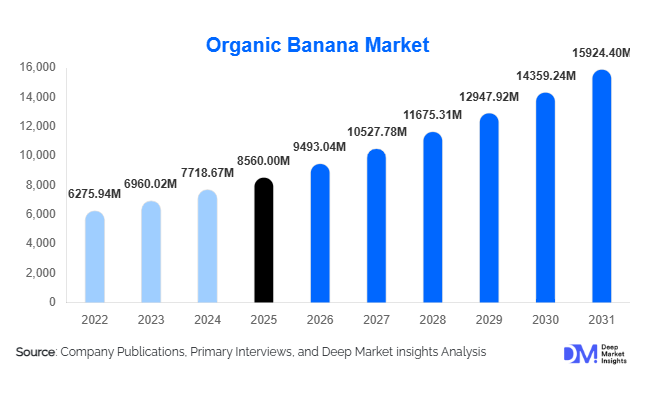
What are the latest trends in the organic banana market?
Premiumization and Certified Supply Chain Expansion
Organic banana demand is increasingly shaped by premiumization trends within the global food industry. Consumers are actively seeking products certified under USDA Organic, EU Organic, and Fairtrade standards, which assure environmental sustainability and ethical sourcing. Retailers are expanding shelf space dedicated to organic produce while investing in private-label organic fruit portfolios to improve affordability. Exporters are strengthening vertically integrated supply chains that include cooperative farming networks, digital tracking systems, and residue monitoring technologies. This transformation is improving transparency and consumer trust while enabling suppliers to secure long-term procurement contracts with multinational retailers and food manufacturers.
Growth of Processed Organic Banana Ingredients
Beyond fresh fruit consumption, organic bananas are gaining importance as ingredients in processed foods. Organic banana powder, puree, and freeze-dried formats are increasingly used in baby food, smoothies, plant-based snacks, and natural sweetener applications. Food manufacturers prefer bananas due to natural sweetness, clean-label positioning, and functional nutritional benefits. This trend is encouraging investments in processing facilities close to producing regions, reducing post-harvest waste and enhancing export value addition. As clean-label food innovation expands globally, processed organic banana formats are expected to record faster growth compared with traditional fresh fruit sales.
What are the key drivers in the organic banana market?
Rising Health and Food Safety Awareness
Consumers worldwide are prioritizing food safety and nutritional quality, leading to increased adoption of organic fruits. Organic bananas are perceived as safer alternatives due to reduced pesticide exposure and environmentally responsible cultivation methods. The growing popularity of plant-based diets and wellness-oriented lifestyles continues to strengthen demand across both developed and emerging markets. Increased awareness campaigns by retailers and governments promoting organic agriculture further reinforce consumption growth.
Expansion of Organized Retail and Private Labels
Large supermarket chains and hypermarkets are expanding organic produce offerings under private-label brands, improving price accessibility. Improved sourcing efficiencies and long-term supplier partnerships have narrowed the price gap between conventional and organic bananas. Enhanced cold-chain infrastructure and global logistics networks allow year-round availability, making organic bananas accessible to mainstream consumers rather than premium-only buyers.
What are the restraints for the global market?
Yield Volatility and Disease Management Challenges
Organic banana farming faces productivity challenges due to restrictions on synthetic pesticides and fertilizers. Diseases such as fungal infections can significantly impact crop yields, increasing operational risks for growers. Climate variability further intensifies production uncertainty, particularly in tropical regions dependent on stable rainfall patterns.
High Certification and Compliance Costs
Obtaining and maintaining organic certification involves strict audits, documentation, and multi-year soil transition requirements. These compliance costs can discourage small-scale farmers from entering the organic supply chain, limiting rapid expansion of certified cultivation areas. Supply constraints occasionally lead to price volatility in export markets.
What are the key opportunities in the organic banana industry?
Expansion of Organic Infant Nutrition Applications
The global baby food industry presents a significant opportunity for organic banana suppliers. Organic banana puree is widely used due to digestibility, natural sweetness, and allergen safety. Rising parental preference for clean-label infant nutrition products is encouraging manufacturers to secure certified organic fruit sourcing, creating stable long-term demand for producers.
Government Support for Organic Agriculture
Governments across Latin America, Asia, and Africa are promoting organic farming through subsidies, export incentives, and training programs. These initiatives encourage farmers to transition toward organic cultivation while improving export competitiveness. Sustainability-linked agricultural programs and regenerative farming incentives also attract ESG-focused investments into organic banana plantations.
Report Scope
| Report Metric | Details |
|---|---|
| Market Size in 2025 | USD 8560 Million |
| Market Size in 2026 | USD 9493.04 Million |
| Market Size in 2031 | USD 15924.40 Million |
| CAGR | 10.9% (2026-2031) |
| Base Year for Estimation | 2025 |
| Historical Data | 2022-2024 |
| Forecast Period | 2026-2031 |
| Report Coverage | Revenue Forecast, Competitive Landscape, Supply Chain Disruption, Growth Factors, Environment & Regulatory Landscape and Trends |
| Geographies Covered | North America, Europe, APAC, Middle East and Africa, LATAM |
| Countries Covered | U.S., Canada, U.K., Germany, France, Spain, Italy, Russia, Nordic, Benelux, Rest of Europe, China, Korea, Japan, India, Australia, Singapore, Taiwan, South East Asia, Rest of Asia-Pacific, UAE, Turky, Saudi Arabia, South Africa, Egypt, Nigeria, Rest of MEA, Brazil, Mexico, Argentina, Chile, Colombia, Rest of LATAM |
Explore more data points, trends and opportunities Download Free Sample Report
Product Type Insights
Fresh organic bananas continue to dominate the global market landscape, accounting for nearly 71% of global revenue share in 2025. Their leadership position is primarily supported by widespread daily consumption patterns, affordability compared to other organic fruits, and strong penetration across organized retail networks. Consumers increasingly perceive organic bananas as an accessible entry point into organic food consumption due to their nutritional value, pesticide-free cultivation, and suitability for all age groups. Supermarket expansion, improved cold-chain logistics, and year-round availability through global sourcing networks further reinforce the dominance of fresh organic bananas.The leading segment growth is driven by rising consumer preference for minimally processed, clean-label produce and growing awareness surrounding chemical-free farming practices. Fresh bananas also benefit from their versatility across breakfast meals, snacks, smoothies, and child nutrition, making them a staple purchase within organic food baskets. Retailers are increasingly prioritizing organic fruit shelf space, supported by private-label organic programs that enhance price competitiveness and accessibility for mass consumers.Beyond fresh consumption, processed organic banana formats are witnessing accelerating adoption as manufacturers seek functional, natural ingredients. Organic banana powder and puree are gaining strong traction in food processing industries, particularly within infant nutrition, bakery formulations, and plant-based food applications where natural sweetness and texture enhancement are required. Organic banana chips and frozen banana products are expanding within healthy snack categories, supported by consumer demand for convenient yet nutritious alternatives to traditional processed snacks. Investments in processing infrastructure across producing regions are enabling exporters to diversify revenue streams beyond raw fruit exports and capture higher value margins through ingredient-based applications, strengthening long-term market resilience.
Application Insights
Household consumption remains the leading application segment, contributing approximately 63% of overall market demand, driven by increasing adoption of organic diets and growing awareness of food safety and nutrition. Organic bananas are widely consumed as everyday fruit snacks, breakfast ingredients, and smoothie components, benefiting from strong family-oriented purchasing behavior and expanding availability across retail channels. The leading segment driver is the rising consumer shift toward preventive healthcare and natural food consumption, which positions organic bananas as a trusted and convenient nutritional option.While household demand continues to anchor market stability, rapid growth is emerging across infant nutrition and functional food manufacturing. Organic banana ingredients are increasingly utilized as natural sweeteners, fiber sources, and nutrient bases in baby food formulations, aligning with parental preference for chemical-free and minimally processed nutrition products. Regulatory support for organic certification and stricter labeling transparency are further encouraging manufacturers to incorporate certified organic fruit ingredients into infant and toddler food products.Bakery and confectionery manufacturers are incorporating banana powder into clean-label recipes to reduce refined sugar usage while maintaining flavor and texture quality. Smoothie and beverage brands are leveraging organic fruit positioning to attract health-conscious consumers seeking plant-based and natural energy solutions. Nutraceutical and wellness applications are also emerging as banana-derived nutrients such as potassium, resistant starch, and natural carbohydrates are increasingly used in energy formulations, meal replacements, and sports nutrition products. These expanding application areas are diversifying demand beyond traditional consumption patterns and supporting long-term market expansion.
Distribution Channel Insights
Supermarkets and hypermarkets represent the dominant distribution channel, accounting for about 54% of global sales, supported by rapid expansion of organized retail infrastructure and improvements in refrigerated logistics systems. The leading channel driver is consumer preference for one-stop shopping environments where certified organic products are easily accessible alongside conventional alternatives. Retail chains are expanding organic product portfolios through private-label offerings, promotional pricing strategies, and enhanced product visibility, which collectively encourage higher purchase frequency.Specialty organic retailers continue to play a critical role in serving premium consumer segments seeking verified certifications, traceable sourcing, and ethically produced goods. These stores often emphasize sustainability narratives and farmer transparency, strengthening consumer trust and brand loyalty within high-income urban populations.Online grocery platforms are emerging as one of the fastest-growing distribution avenues, driven by digital adoption, convenience-oriented purchasing behavior, and subscription-based organic produce delivery models. Direct-to-consumer platforms allow suppliers to reduce intermediaries while ensuring product freshness and consistent supply. Additionally, foodservice and institutional procurement channels are expanding steadily as restaurants, wellness cafés, and hospitality operators increasingly integrate organic ingredients into menus to align with evolving consumer health preferences.
End-Use Industry Insights
The food processing industry is evolving into a major growth engine for the organic banana market, supported by increasing demand for natural ingredients across packaged food manufacturing. Organic bananas are widely utilized in baby food, plant-based snacks, smoothie bases, and ready-to-eat formulations, where clean-label positioning is becoming a competitive necessity. The leading end-use driver is the global transition toward natural ingredient sourcing as manufacturers reformulate products to eliminate artificial additives and refined sugars.The infant nutrition industry is expanding at double-digit growth rates globally, significantly increasing demand for organic fruit inputs that meet strict safety and nutritional standards. Organic banana puree and powder are particularly valued due to their digestibility, natural sweetness, and nutrient density, making them suitable for early-stage nutrition products.Beverage manufacturers are incorporating banana puree into functional drinks, dairy alternatives, and meal replacement beverages targeting active lifestyles and wellness-oriented consumers. Export-driven demand remains strong as regions with limited organic cultivation capacity rely heavily on imports from tropical producing countries. Emerging applications in sports nutrition, energy snacks, and clean-label packaged foods are expected to further diversify industrial usage and create additional revenue streams across the value chain.
Explore more data points, trends and opportunities Download Free Sample Report
Organic Banana Market Segmentations
By Product Type
- Fresh Organic Bananas
- Organic Banana Puree
- Organic Banana Powder
- Organic Banana Chips
- Frozen Organic Bananas
By Application
- Household Consumption
- Infant Nutrition
- Food Processing Industry
- Bakery & Confectionery
- Beverages & Smoothies
- Nutraceutical & Functional Foods
By Distribution Channel
- Supermarkets & Hypermarkets
- Specialty Organic Stores
- Online Retail & E-Commerce
- Foodservice & Institutional Sales
By End Use Industry
- Retail Household Consumption
- Infant Food Manufacturers
- Food & Beverage Processing Companies
- Health & Wellness Product Manufacturers
Regional Insights
North America
North America accounts for approximately 18% of the global organic banana market, led primarily by the United States and Canada. The region benefits from high organic food penetration, mature retail ecosystems, and strong consumer willingness to pay premium prices for certified organic produce. Regional growth is driven by increasing health awareness, rising adoption of plant-based diets, and expanding private-label organic programs introduced by major supermarket chains. Subscription grocery services and online delivery platforms are accelerating repeat purchases, while sustainability-focused consumer behavior continues to favor ethically sourced tropical fruits. Strong cold-chain infrastructure and efficient import logistics enable consistent year-round availability, further supporting market expansion.
Europe
Europe holds nearly 29% market share, making it one of the most mature organic banana consumption regions globally. Growth across Germany, France, the Netherlands, and the United Kingdom is supported by stringent organic certification regulations, high environmental awareness, and government initiatives promoting sustainable agriculture. Regional demand is further driven by consumer preference for fair-trade and ethically sourced products, reinforcing long-term purchasing loyalty. Germany remains one of the largest import markets due to its highly developed organic retail network and strong supermarket participation in organic product promotion. Increasing adoption of climate-conscious diets and reduced pesticide exposure concerns continue to stimulate consistent consumption growth across European markets.
Asia-Pacific
Asia-Pacific represents the fastest-growing regional market, expanding at an estimated CAGR exceeding 13%. Rising disposable income levels, rapid urbanization, and growing middle-class populations across China, Japan, South Korea, and India are significantly increasing demand for premium and health-focused food products. Regional growth is strongly driven by expanding awareness of food safety following past contamination concerns, encouraging consumers to shift toward certified organic produce. E-commerce grocery platforms and modern retail expansion are improving accessibility to imported organic bananas. Additionally, increasing adoption of Western dietary patterns, fitness culture growth, and rising demand for convenient nutritious snacks are accelerating consumption across metropolitan areas. High import dependency creates substantial opportunities for global exporters and supply chain partnerships.
Latin America
Latin America dominates global organic banana production, accounting for roughly 46% share of global market supply. Countries including Ecuador, Peru, Colombia, and the Dominican Republic benefit from favorable tropical climates, fertile soil conditions, and export-oriented agricultural systems that enable large-scale organic cultivation. Regional growth is driven by increasing international demand, government support for organic farming certification, and investments in sustainable agricultural practices. Peru has emerged as one of the fastest-growing organic banana exporters globally, supported by smallholder farmer cooperatives and expanding trade agreements with Europe and North America. Improvements in port infrastructure and logistics efficiency continue to strengthen the region’s competitive export advantage.
Middle East & Africa
The Middle East & Africa region is emerging as a promising consumption market, led by the United Arab Emirates and Saudi Arabia where premium organic food demand is rising rapidly among affluent urban consumers. Regional growth is driven by increasing health awareness, expanding modern retail formats, and strong reliance on imported organic produce due to limited domestic cultivation capacity. The hospitality and tourism sectors are also contributing to demand as hotels and wellness-focused restaurants incorporate organic ingredients into premium dining experiences. In Africa, South Africa is gradually expanding domestic organic farming initiatives supported by sustainability programs and retail modernization, although imports remain essential to meet growing consumer demand across major urban centers.
Key Players in the Organic Banana Market
- Dole Food Company
- Chiquita Brands International
- Del Monte Fresh Produce Company
- Fyffes Limited
- Organics Unlimited
- AgroFair
- Equal Exchange
- BanaBay
- Pacific Organic Produce
- Earth University Foundation Farms
- Sol Organica
- Grupo HAME
- Uniban
- Tropical Fruit Exporters
- Ecuadorian Rainforest LLC