Octopus Market Size
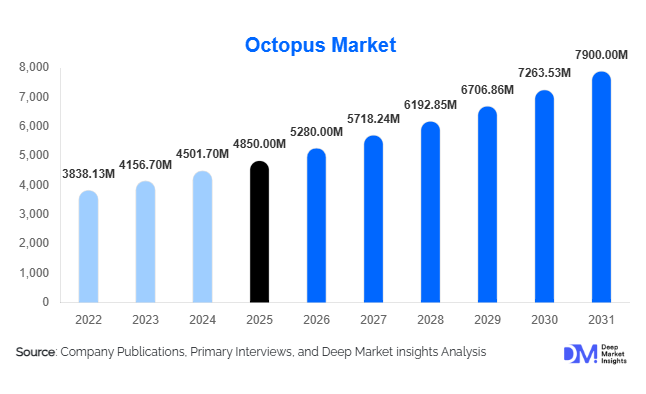
According to Deep Market Insights, the global octopus market size was valued at USD 4,850 million in 2025 and is projected to grow from USD 5,280 million in 2026 to reach USD 7,900 million by 2031, expanding at a CAGR of 8.3% during the forecast period (2026–2031). The market growth is primarily driven by rising global seafood consumption, increasing demand for premium protein sources, and the growing popularity of international cuisines such as Mediterranean, Japanese, and Korean dishes that heavily feature octopus. Expanding cold-chain logistics, rising seafood trade, and improved processing technologies are further strengthening global supply chains and enabling wider distribution of frozen and processed octopus products across non-coastal markets.
Key Market Insights
- Frozen octopus dominates global trade due to longer shelf life, export efficiency, and suitability for international distribution networks.
- Foodservice sector remains the largest demand generator, driven by seafood restaurants, sushi chains, and Mediterranean dining formats.
- Asia-Pacific leads global consumption, supported by strong demand in Japan, China, and South Korea.
- Wild-caught sourcing still dominates supply chains, though aquaculture development is emerging as a long-term solution.
- Europe remains a key import hub, especially Spain and Italy, driven by strong culinary integration of octopus.
- Export-driven economies in North Africa such as Morocco play a critical role in global supply stability.
What are the latest trends in the global octopus market?
Rising Demand for Processed and Ready-to-Eat Octopus Products
Consumer preferences are shifting toward convenience-based seafood consumption, leading to strong growth in processed octopus products such as marinated, grilled, and ready-to-eat formats. Urbanization and fast-paced lifestyles are driving demand in supermarkets and food delivery channels. This trend is particularly strong in North America and Europe, where consumers increasingly prefer pre-cooked seafood options. Food manufacturers are investing in value-added processing to improve shelf life, taste consistency, and global export suitability.
Expansion of Sustainable Seafood and Traceability Systems
Sustainability concerns are reshaping the octopus supply chain, with increasing adoption of certification programs and traceability technologies. Buyers are demanding verified sourcing from sustainable fisheries, pushing suppliers to adopt digital tracking systems and eco-label certifications. Governments are also tightening fishing regulations to prevent overexploitation of wild stocks. This is encouraging investment in responsible fishing practices and early-stage aquaculture development, particularly in Spain, Japan, and Mediterranean regions.
Cold Chain and Global Seafood Trade Expansion
Advancements in freezing, packaging, and refrigerated logistics are enabling long-distance trade of octopus from production hubs to global markets. Countries such as Morocco, Mauritania, and Indonesia are expanding export capacity through improved port infrastructure and cold storage systems. This has significantly reduced spoilage risks and increased the availability of octopus in non-coastal consumer markets worldwide.
What are the key drivers in the octopus market?
Rising Global Seafood Consumption and Health Awareness
Increasing awareness of the nutritional benefits of seafood, including high protein content and omega-3 fatty acids, is driving demand for octopus as a healthy alternative to red meat. Consumers are actively shifting toward marine-based diets, supporting long-term growth across both developed and emerging economies.
Growing Popularity of International Cuisine
The globalization of food culture has significantly increased octopus consumption, particularly in Mediterranean tapas, Japanese sushi, and Korean seafood dishes. Restaurant chains and premium dining establishments are expanding menu offerings, making octopus more mainstream across urban centers globally.
Expansion of Frozen Seafood Trade Infrastructure
Improved cold-chain logistics and processing technologies have enabled large-scale global distribution of frozen octopus. This has reduced dependency on local catch availability and allowed exporters to reach new markets in North America, Asia, and the Middle East.
What are the restraints for the global octopus market?
Dependence on Wild-Caught Supply
A major restraint is the heavy reliance on wild capture fisheries, which leads to seasonal fluctuations, supply shortages, and ecological concerns. This limits scalability and creates price instability in global markets.
Price Volatility and Supply Chain Disruptions
Octopus prices are highly sensitive to catch volumes, fuel costs, and export regulations. Unpredictable supply conditions in key producing regions such as North Africa can disrupt global trade flows and affect profitability across the value chain.
What are the key opportunities in the octopus industry?
Development of Octopus Aquaculture
Commercial octopus farming presents a major long-term opportunity to reduce reliance on wild fisheries. Although still in early stages, aquaculture advancements in Spain and Japan are showing promising results. Scalable farming could stabilize supply, reduce price volatility, and support year-round production.
Expansion of Premium Seafood Foodservice Demand
The rising popularity of seafood-focused restaurants, sushi chains, and Mediterranean cuisine is increasing octopus consumption in urban markets. Premium dining trends in Asia-Pacific and North America are driving higher-value product demand, particularly frozen and processed octopus offerings.
Growth in Export-Oriented Seafood Infrastructure
Investments in cold storage, seafood processing hubs, and export logistics in Africa and Southeast Asia are creating new supply corridors. Countries such as Morocco are strengthening their position as global export leaders, improving access to high-demand markets in Europe and Asia.
Report Scope
| Report Metric | Details |
|---|---|
| Market Size in 2025 | USD 4850 Million |
| Market Size in 2026 | USD 5280 Million |
| Market Size in 2031 | USD 7900 Million |
| CAGR | 8.3% (2026-2031) |
| Base Year for Estimation | 2025 |
| Historical Data | 2022-2024 |
| Forecast Period | 2026-2031 |
| Report Coverage | Revenue Forecast, Competitive Landscape, Supply Chain Disruption, Growth Factors, Environment & Regulatory Landscape and Trends |
| Geographies Covered | North America, Europe, APAC, Middle East and Africa, LATAM |
| Countries Covered | U.S., Canada, U.K., Germany, France, Spain, Italy, Russia, Nordic, Benelux, Rest of Europe, China, Korea, Japan, India, Australia, Singapore, Taiwan, South East Asia, Rest of Asia-Pacific, UAE, Turky, Saudi Arabia, South Africa, Egypt, Nigeria, Rest of MEA, Brazil, Mexico, Argentina, Chile, Colombia, Rest of LATAM |
Explore more data points, trends and opportunities Download Free Sample Report
Product Type Insights
The global octopus market is strongly influenced by product type segmentation, with frozen octopus emerging as the dominant category and accounting for approximately 46% of the total market share in 2025. This dominance is primarily attributed to its superior shelf stability, which significantly reduces the risk of spoilage and enables long-distance transportation across international markets. The frozen segment benefits from well-established cold chain infrastructure, allowing exporters from key producing regions to efficiently serve high-demand importing countries. Moreover, frozen octopus maintains much of its original texture and flavor when processed using advanced freezing technologies such as individual quick freezing (IQF), which further enhances its acceptance among foodservice operators and retailers. The leading driver behind this segment is the increasing globalization of seafood trade, which necessitates preservation methods that can ensure product quality over extended transit periods while meeting stringent food safety standards.Value-added octopus products, including marinated, pre-cooked, and ready-to-eat variants, represent the fastest-growing segment within the market. This growth is closely aligned with evolving consumer lifestyles characterized by increased urbanization, rising disposable incomes, and a preference for convenience-oriented food solutions. Foodservice operators and retail chains are increasingly incorporating these products into their offerings to reduce preparation time and enhance menu consistency. Technological advancements in food processing, packaging, and flavor enhancement are further supporting this segment’s expansion. The leading driver here is the rapid shift toward convenience foods and the integration of seafood into modern, ready-to-consume meal formats, particularly in developed and emerging urban markets.
End-Use Insights
The foodservice sector stands as the largest end-use segment in the global octopus market, accounting for nearly 57% of total demand in 2025. This dominance is driven by the widespread inclusion of octopus in diverse culinary traditions, ranging from Mediterranean dishes to Japanese sushi and Korean street food. Restaurants, hotels, and quick-service chains have increasingly incorporated octopus into their menus as consumers seek unique and premium seafood experiences. The expansion of international cuisines and the globalization of dining habits have further fueled demand within this segment. The leading driver is the rapid growth of the global foodservice industry, coupled with rising consumer interest in exotic and high-protein seafood options that enhance menu differentiation.Export-driven demand remains a critical component of the global octopus market, particularly in regions where domestic production is insufficient to meet consumption needs. European and East Asian markets exhibit high import dependency due to strong consumer demand and limited local supply. Export-oriented economies have capitalized on this trend by strengthening their fishing and processing capabilities to serve international markets. Trade agreements, improved logistics infrastructure, and rising global seafood consumption are further supporting export growth. The leading driver in this segment is the widening gap between supply and demand across regions, which necessitates robust international trade networks.
Explore more data points, trends and opportunities Download Free Sample Report
Octopus Market Segmentations
By Species
- Common Octopus
- Giant Pacific Octopus
- Atlantic Longarm Octopus
- Day Octopus
- Other Regional & Deep-Sea Species
By Product Form
- Fresh Octopus
- Frozen Octopus
- Dried Octopus
- Canned Octopus
- Processed & Value-Added Octopus
By Sourcing Type
- Wild-Caught Octopus
- Aquaculture / Farmed Octopus
By Distribution Channel
- Foodservice
- Retail
- Online Seafood Platforms
- Specialty Seafood Stores
By End Use
- Direct Human Consumption
- Food Processing Industry
- Hospitality & Culinary Services
- Export-Oriented Trade Supply
Regional Insights
Asia-Pacific
Asia-Pacific leads the global octopus market, accounting for approximately 38% of total consumption in 2025. The region’s dominance is underpinned by deeply rooted seafood consumption traditions, particularly in countries such as Japan, China, and South Korea. Japan represents a mature and premium market where octopus is a staple in traditional dishes such as sushi and takoyaki, driving consistent demand for high-quality imports. China plays a dual role as both a major consumer and a processing hub, leveraging its extensive seafood processing infrastructure to re-export value-added products to international markets. South Korea also contributes significantly through its vibrant street food culture and growing restaurant industry.India is emerging as a fast-growing market within the region, driven by increasing urbanization, rising disposable incomes, and a gradual shift toward diversified protein sources. The expansion of cold chain logistics and retail distribution networks is enhancing the availability of octopus products across urban centers. Additionally, growing awareness of seafood’s nutritional benefits is encouraging consumption among health-conscious consumers. The primary driver of regional growth in Asia-Pacific is the combination of strong cultural affinity for seafood, rapid economic development, and the expansion of foodservice and retail infrastructure, which collectively support sustained demand growth.
Europe
Europe holds a substantial 29% share of the global octopus market, with countries such as Spain, Italy, and Portugal serving as key consumption hubs. The region’s demand is deeply influenced by traditional cuisines that prominently feature octopus in dishes such as Spanish pulpo a la gallega and Italian seafood salads. Spain, in particular, functions as a central import and processing hub, sourcing raw octopus from exporting countries and distributing it across European markets. The presence of well-established seafood distribution networks and strong consumer purchasing power further reinforces the region’s market position.The European market is also characterized by stringent quality standards and sustainability regulations, which influence sourcing and processing practices. Increasing consumer awareness regarding sustainable seafood consumption is driving demand for certified and responsibly sourced products. The growth of tourism and the hospitality sector in Southern Europe further contributes to rising demand for octopus in restaurants and hotels. The leading driver for regional growth in Europe is the strong cultural integration of octopus in traditional diets, combined with high import dependency and a sophisticated foodservice ecosystem that continuously drives consumption.
North America
North America accounts for approximately 18% of the global octopus market, with the United States serving as the primary driver of regional demand. The market is experiencing steady growth, supported by the increasing popularity of international cuisines, particularly Japanese and Mediterranean dishes, which frequently incorporate octopus. The expansion of sushi chains, seafood restaurants, and fusion dining concepts is introducing octopus to a broader consumer base.Retail availability of octopus products is also improving, with supermarkets and specialty stores offering a variety of frozen and pre-cooked options. Consumer interest in high-protein, low-fat foods is further supporting demand, as octopus is perceived as a healthy seafood choice. Additionally, the rise of experiential dining and culinary exploration is encouraging consumers to try new ingredients and flavors. The leading driver of growth in North America is the diversification of culinary preferences and the increasing integration of global seafood dishes into mainstream dining culture.
Middle East & Africa
The Middle East & Africa region plays a pivotal role in the global octopus market, primarily as a major supply base rather than a consumption hub. Countries such as Morocco and Mauritania dominate global octopus production and exports, supplying significant volumes to European and Asian markets. Morocco, in particular, is recognized as one of the world’s largest exporters of octopus, supported by abundant marine resources and a well-developed fishing industry.The region’s strategic geographic location enables efficient access to key export markets, while government initiatives aimed at modernizing fisheries and improving sustainability practices are enhancing production capabilities. Investments in processing facilities and cold storage infrastructure are further strengthening the region’s position in the global supply chain. The leading driver for regional growth is the abundance of natural marine resources combined with strong export orientation and ongoing investments in fisheries management and infrastructure development.
Latin America
Latin America is emerging as a significant contributor to the global octopus market, with countries such as Chile and Peru gaining prominence as key suppliers. The region benefits from rich marine biodiversity and favorable oceanographic conditions that support octopus fisheries. Governments and industry stakeholders are increasingly focusing on expanding fishing capacity, improving processing technologies, and enhancing export capabilities to capitalize on growing international demand.Overall, the global octopus market is characterized by a dynamic interplay of product innovation, evolving consumption patterns, and regional trade dynamics. Each segment and region is influenced by distinct drivers, ranging from technological advancements and convenience trends to cultural preferences and resource availability. As the market continues to evolve, stakeholders across the value chain are expected to focus on sustainability, product diversification, and supply chain optimization to capture emerging growth opportunities and address the challenges associated with fluctuating supply and demand.
Key Players in the Global Octopus Market
- Maruha Nichiro Corporation
- Nippon Suisan Kaisha (Nissui)
- Thai Union Group
- Mitsubishi Corporation (Seafood Division)
- Dongwon Industries
- Cooke Inc.
- Austevoll Seafood ASA
- Pescanova S.A.
- Trident Seafoods
- Grupo Nueva Pescanova
- Leroy Seafood Group
- Sealord Group