Nut-Based Topping Ingredients Market Size
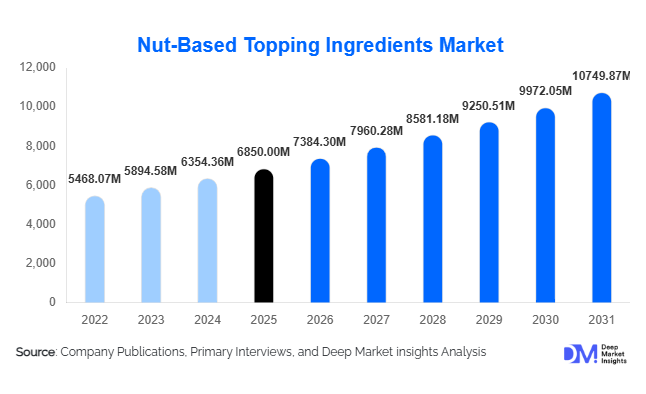
According to Deep Market Insights,the global nut-based topping ingredients market size was valued at USD 6,850 million in 2026 and is projected to grow from USD 7,384.30 million in 2026 to reach USD 10,749.87 million by 2031, expanding at a CAGR of 7.8% during the forecast period (2026–2031). The market growth is primarily driven by increasing demand for premium bakery and confectionery products, rising adoption of plant-based and protein-enriched desserts, and the growing consumer preference for clean-label, natural, and organic ingredients that enhance flavor and nutrition in food applications.
Key Market Insights
- Almond-based and mixed nut toppings dominate the market, offering both functional benefits and flavor versatility in bakery, confectionery, and plant-based dairy products.
- Chopped, sliced, and caramelized nut forms are gaining traction, driven by consumer preference for texture, taste enhancement, and convenience in home baking and industrial applications.
- North America leads the market, due to large-scale almond production, premium dessert consumption, and advanced bakery manufacturing facilities.
- Asia-Pacific is the fastest-growing region, fueled by urbanization, café culture, and increasing disposable income in countries like China and India.
- Technological integration in processing, including automated roasting, flavor-coating, and sorting systems, is improving product consistency, reducing wastage, and supporting scalable growth.
- Clean-label and organic nut toppings are emerging as high-value segments, aligning with global trends toward minimally processed and functional food ingredients.
What are the latest trends in the nut-based topping ingredients market?
Functional and Plant-Based Product Integration
Nut-based toppings are increasingly incorporated into plant-based dairy alternatives, protein bars, breakfast cereals, and snacks, driven by the rising demand for nutritious and high-protein products. Almonds, cashews, and hazelnuts are favored for their high protein, fiber, and healthy fat content. Manufacturers are launching specialty blends, low-sugar options, and allergen-segregated products to cater to clean-label and health-conscious consumers. Functional claims such as "heart-healthy" and "protein-enriched" are becoming critical marketing drivers.
Value-Added Nut Toppings and Flavored Variants
Caramelized, honey-roasted, salted, and flavored nut toppings are witnessing above-average growth as consumers seek premium and indulgent experiences. Bakery and confectionery segments are driving demand for these variants, particularly in developed markets. Innovative flavor profiles, such as spiced or chocolate-coated nuts, are increasingly used in desserts, ice creams, and gourmet cereals, further expanding product application and differentiation opportunities.
What are the key drivers in the nut-based topping ingredients market?
Expansion of Premium Bakery and Confectionery Industries
Global bakery and confectionery sectors, particularly in North America and Europe, are expanding rapidly. The demand for high-quality toppings to enhance aesthetics, flavor, and nutritional value in cakes, pastries, chocolates, and ice creams supports market growth. Premium dessert consumption, driven by urban populations and café culture, is fueling demand for sliced, chopped, and flavored nut toppings.
Clean-Label and Health-Conscious Consumption Trends
Consumers increasingly prefer natural, minimally processed, and functional ingredients. Nut toppings offer both taste and health benefits, fitting well into vegan, protein-enriched, and clean-label product lines. Organic-certified and non-GMO nut variants are witnessing higher adoption, with demand growing across bakery, breakfast cereals, dairy, and plant-based dessert applications.
Home Baking and E-Commerce Growth
Post-pandemic shifts toward at-home baking continue to drive retail demand for nut toppings. Online platforms and e-commerce channels facilitate easy access to premium, pre-packaged, or bulk nut toppings for consumers and small-scale food producers. Digital marketing, influencer campaigns, and recipe integration further boost awareness and adoption.
What are the restraints for the global market?
Raw Material Price Volatility
Nut prices fluctuate due to climate dependency, crop yield variations, and geopolitical issues affecting major producing countries. Almonds, cashews, and hazelnuts are particularly sensitive to weather conditions, impacting overall production costs. Price volatility directly affects profit margins for manufacturers and can influence consumer pricing.
Allergen Regulations and Compliance Costs
Stringent allergen labeling requirements, especially in Europe and North America, restrict mixed nut processing and necessitate dedicated facilities. Compliance with food safety standards increases operational costs and can limit expansion flexibility for manufacturers serving multiple segments.
What are the key opportunities in the nut-based topping ingredients market?
Plant-Based and Functional Food Integration
The rise in vegan, protein-rich, and functional foods offers significant opportunities for nut-based toppings. Inclusion in oat-based yogurts, almond ice creams, protein bowls, and snack clusters enables companies to cater to health-conscious consumers and premium product segments. Developing allergen-segregated and organic-certified facilities can provide a competitive edge.
Emerging Market Penetration
Asia-Pacific and the Middle East are witnessing rapid growth in urban café culture, bakery chains, and luxury dessert consumption. Countries like India, China, UAE, and Saudi Arabia offer high growth potential due to rising disposable income and increasing acceptance of Western-style bakery products. Halal-certified and locally flavored nut toppings also present niche opportunities.
Technological Advancements in Processing
Automation in roasting, flavor-coating, and sorting systems enhances product quality, consistency, and yield. Traceability solutions using blockchain, AI-assisted sorting, and energy-efficient roasting lines improve operational efficiency. Companies investing in these technologies can gain higher profitability and meet increasing demand for high-quality and clean-label toppings.
Report Scope
| Report Metric | Details |
|---|---|
| Market Size in 2025 | USD 6850 Million |
| Market Size in 2026 | USD 7384.30 Million |
| Market Size in 2031 | USD 10749.87 Million |
| CAGR | 7.8% (2026-2031) |
| Base Year for Estimation | 2025 |
| Historical Data | 2022-2024 |
| Forecast Period | 2026-2031 |
| Report Coverage | Revenue Forecast, Competitive Landscape, Supply Chain Disruption, Growth Factors, Environment & Regulatory Landscape and Trends |
| Geographies Covered | North America, Europe, APAC, Middle East and Africa, LATAM |
| Countries Covered | U.S., Canada, U.K., Germany, France, Spain, Italy, Russia, Nordic, Benelux, Rest of Europe, China, Korea, Japan, India, Australia, Singapore, Taiwan, South East Asia, Rest of Asia-Pacific, UAE, Turky, Saudi Arabia, South Africa, Egypt, Nigeria, Rest of MEA, Brazil, Mexico, Argentina, Chile, Colombia, Rest of LATAM |
Explore more data points, trends and opportunities Download Free Sample Report
Product Type Insights
Chopped, sliced, and caramelized nut forms dominate the market due to their versatility across bakery, confectionery, and dessert applications. Dry-roasted nuts account for the largest share, driven by their enhanced shelf life, intensified flavor, and suitability for both industrial and home baking. Organic and flavored variants are gaining traction in premium and functional segments, appealing to health-conscious and gourmet consumers. Globally, the trend toward value-added and gourmet nut toppings is growing at a CAGR of over 9%, fueled by increasing demand for high-quality ingredients in artisanal desserts and protein-rich snacks.
Application Insights
Bakery and confectionery applications lead market adoption, supported by rising consumer demand for cakes, pastries, chocolates, and specialty desserts. Ice cream and plant-based dessert segments are expanding rapidly, driven by consumer preference for indulgent yet nutritious options. Breakfast cereals, granola bars, and snack mixes also contribute significantly, leveraging the high protein, fiber, and antioxidant content of nuts. Innovations in functional ingredients, such as vitamin-fortified or low-sugar toppings, further strengthen market growth across applications.
Distribution Channel Insights
B2B industrial supply channels hold the majority of market volume, as large-scale food processors and confectionery manufacturers procure nuts in bulk for production efficiency. Online retail and e-commerce platforms are experiencing rapid growth, particularly in North America, Europe, and Asia-Pacific, catering to home bakers, artisanal chefs, and premium dessert enthusiasts. Modern retail, including hypermarkets and specialty stores, supports branded packaged nut toppings for convenience-seeking consumers. Regional growth is also fueled by omnichannel strategies and subscription-based gourmet product offerings.
End-Use Insights
Food processing manufacturers dominate demand, accounting for the largest market share due to high-volume requirements. The plant-based dessert industry represents the fastest-growing end-use segment, with CAGR exceeding 8%, driven by vegan, lactose-free, and health-conscious consumer trends. Gourmet and specialty dessert producers are exploring new applications in chocolate coatings, protein-enriched snacks, and breakfast bowls. Export-driven demand remains strong from the U.S., Germany, and Vietnam, supplying industrial ingredients to Europe, Asia, and the Middle East.
Explore more data points, trends and opportunities Download Free Sample Report
Nut-Based Topping Ingredients Market Segmentations
By Nut Type
- Almond-Based Toppings
- Peanut-Based Toppings
- Cashew-Based Toppings
- Hazelnut-Based Toppings
- Walnut-Based Toppings
- Pistachio-Based Toppings
- Mixed Nut Blends
- Other Specialty Nuts
By Form
- Whole Nuts
- Chopped/Crushed Nuts
- Sliced/Slivered Nuts
- Granulated Nut Pieces
- Nut Crumbles
- Candied/Caramelized Nuts
- Nut Powder/Meal
- Nut Butter Drizzles & Pastes
By Processing Type
- Raw
- Dry Roasted
- Oil Roasted
- Honey-Roasted/Flavored
- Caramelized/Glazed
- Salted/Seasoned
- Organic Certified
- Clean-Label/No Additives
By Application
- Bakery & Confectionery
- Ice Cream & Frozen Desserts
- Dairy Products
- Breakfast Cereals & Granola
- Plant-Based Desserts
- Foodservice & QSR
- Retail Home Baking
By Distribution Channel
- B2B Industrial Supply
- Foodservice Distributors
- Modern Retail
- Online Retail/E-Commerce
By End-Use Industry
- Food Processing Manufacturers
- HoReCa (Hotels, Restaurants, Cafés)
- Packaged Food Brands
- Artisan & Specialty Dessert Producers
Regional Insights
North America
North America leads the global market, with the U.S. contributing the largest volume thanks to high almond production, advanced bakery infrastructure, and strong premium dessert consumption. Canada demonstrates steady growth, driven by industrial bakery and retail demand. Key growth drivers include consumer preference for flavored and roasted toppings, organic certifications, clean-label products, and increased adoption in plant-based dessert innovations. E-commerce expansion and gourmet café culture further support market growth.
Europe
Europe is a major market, led by Germany, France, Italy, and the U.K., with strong demand for hazelnut, almond, and pistachio toppings in confectionery and chocolate production. Organic and non-GMO certifications are critical for European consumers, influencing purchasing decisions. Germany represents the largest importer, while France and Italy are growing industrial bakery hubs. Regional growth is supported by rising interest in premium desserts, increasing café culture, and export-oriented production for neighboring markets. Europe accounted for 27% of the global market share in 2025.
Asia-Pacific
Asia-Pacific is the fastest-growing region, driven by China and India. Urbanization, expanding café culture, rising disposable incomes, and growing awareness of nutrition drive mid-range and premium nut topping adoption. Japan and South Korea provide stable demand, particularly in premium desserts and confectionery applications. Regional growth is also fueled by increased investment in modern bakery infrastructure, rising popularity of western-style desserts, and the growing plant-based snack trend.
Latin America
Brazil and Mexico are emerging markets, with growth driven by bakery modernization, expanding retail channels, and increasing urbanization. Consumers in urban centers show rising interest in premium dessert toppings and convenience products. Key drivers include the growing café and dessert culture, rising disposable income, and demand for innovative flavors and roasted nuts.
Middle East & Africa
The Middle East, led by the UAE and Saudi Arabia, imports premium nut toppings driven by luxury hospitality, confectionery consumption, and halal-compliant product requirements. Africa remains a production hub for cashews, peanuts, and other nuts, while intra-African trade is expanding to supply industrial applications. Regional growth is supported by rising urbanization, foodservice expansion, and increasing adoption of imported gourmet products.
Key Players in the Nut-Based Topping Ingredients Market
- Olam Group
- Blue Diamond Growers
- Barry Callebaut
- Archer Daniels Midland Company
- John B. Sanfilippo & Son
- Borges Agricultural & Industrial Nuts
- Royal Nut Company
- Kanegrade Ltd.
- Mount Franklin Foods
- Treehouse Almonds
- Savencia SA
- Intersnack Group
- Germack Pistachio Company
- Besana Group
- Voicevale Limited