NPK Fertilizers (Feed Grade and Food Grade) Market Size
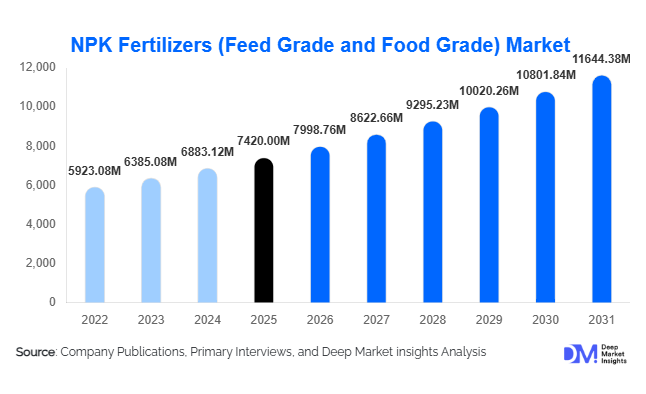
According to Deep Market Insights, the global NPK fertilizers (feed grade and food grade) market size was valued at USD 7,420 million in 2025 and is projected to grow from USD 7,998.76 million in 2026 to reach USD 11,644.38 million by 2031, expanding at a CAGR of 7.8% during the forecast period (2026–2031). Market expansion is primarily supported by rising global food demand, increasing adoption of nutrient-balanced crop management practices, expansion of fortified animal nutrition, and growing regulatory emphasis on food-grade mineral inputs across agricultural and food processing industries.
Key Market Insights
- Balanced nutrient management practices are accelerating adoption of NPK formulations across intensive agriculture systems worldwide.
- Food-grade phosphates and potassium compounds are gaining traction due to growth in processed foods, fortified nutrition, and regulated ingredient standards.
- Asia-Pacific dominates global demand, supported by large-scale agricultural output in China and India.
- Feed-grade fertilizers are witnessing rapid expansion driven by industrial livestock and aquaculture production.
- Precision agriculture and controlled nutrient-release technologies are improving fertilizer efficiency and pricing power.
- Government subsidy programs and soil health initiatives continue to influence purchasing behavior and regional demand patterns.
What are the latest trends in the NPK fertilizers market?
Shift Toward Precision and Specialty Nutrient Formulations
The NPK fertilizers market is transitioning from commodity nutrient blends toward customized formulations tailored to crop type, soil profile, and climatic conditions. Precision agriculture technologies including satellite soil monitoring, AI-driven nutrient mapping, and sensor-based fertilizer application systems are improving nutrient-use efficiency. Producers are increasingly manufacturing specialty grades such as low-chloride potassium blends, micro-granulated NPK, and water-soluble food-grade nutrients for high-value crops. These products command higher margins while reducing environmental nutrient runoff, aligning with sustainability regulations implemented across Europe and North America.
Integration of Food and Feed Nutrient Supply Chains
Another major trend is the convergence between agricultural fertilizer production and food/feed ingredient manufacturing. Food-grade phosphates and potassium salts are increasingly sourced from fertilizer-grade processing streams but refined under stricter purity standards. Growth in fortified foods, dairy processing, meat production, and aquaculture feed has expanded the addressable market beyond traditional crop farming. Companies are investing in purification technologies, traceability systems, and quality certification programs to comply with international food safety standards, enabling cross-sector demand growth.
What are the key drivers in the NPK fertilizers market?
Rising Global Food Production Requirements
Population growth and shrinking arable land are pushing farmers toward higher crop productivity, making balanced NPK fertilization essential. Governments worldwide are promoting nutrient optimization programs to enhance yield stability in cereals, oilseeds, fruits, and vegetables. Emerging economies are particularly dependent on NPK blends to sustain food security initiatives, directly supporting long-term market expansion.
Expansion of Industrial Livestock and Aquaculture
Feed-grade NPK compounds are increasingly used in feed mineral premixes and agricultural inputs supporting fodder cultivation. Rapid expansion of poultry, dairy, and aquaculture industries—especially in Asia-Pacific and Latin America—has created steady demand for nutrient inputs that enhance feed crop productivity and nutritional balance.
Soil Degradation and Nutrient Deficiency Management
Soil nutrient depletion has become a global agricultural challenge. Continuous monocropping and excessive nitrogen-only fertilization have created imbalances requiring phosphorus and potassium supplementation. Governments and agricultural organizations are promoting balanced fertilization programs, increasing adoption rates of integrated NPK formulations.
What are the restraints for the global market?
Volatility in Raw Material Prices
The NPK fertilizers market remains sensitive to fluctuations in phosphate rock, potash, and ammonia prices. Supply disruptions, mining constraints, and geopolitical trade restrictions periodically increase production costs, affecting pricing stability and farmer affordability.
Environmental Regulations and Nutrient Runoff Concerns
Strict environmental regulations aimed at reducing eutrophication and soil contamination are limiting fertilizer application volumes in several developed markets. Compliance costs related to emissions, waste handling, and nutrient discharge standards present operational challenges for manufacturers.
What are the key opportunities in the NPK fertilizers industry?
Bio-Enhanced and Controlled-Release Fertilizers
The integration of biological enhancers and controlled-release coatings presents a major opportunity for manufacturers. Enhanced-efficiency fertilizers reduce nutrient loss while improving yield performance, allowing producers to command premium pricing. Adoption is accelerating in North America and Europe where sustainability regulations favor reduced nutrient leakage.
Growth of High-Value Horticulture and Greenhouse Farming
Expansion of greenhouse cultivation, hydroponics, and protected agriculture is increasing demand for high-purity water-soluble NPK fertilizers. Food-grade nutrient formulations are increasingly used in controlled-environment agriculture, particularly for fruits, vegetables, and export-oriented crops.
Government-Led Agricultural Modernization Programs
Initiatives such as soil health missions, fertilizer subsidy reforms, and agricultural productivity programs across India, China, Brazil, and Southeast Asia are driving fertilizer adoption. Public-private partnerships supporting nutrient efficiency technologies offer strong entry opportunities for new players.
Report Scope
| Report Metric | Details |
|---|---|
| Market Size in 2025 | USD 7420 Million |
| Market Size in 2026 | USD 7998.76 Million |
| Market Size in 2031 | USD 11644.38 Million |
| CAGR | 7.8% (2026-2031) |
| Base Year for Estimation | 2025 |
| Historical Data | 2022-2024 |
| Forecast Period | 2026-2031 |
| Report Coverage | Revenue Forecast, Competitive Landscape, Supply Chain Disruption, Growth Factors, Environment & Regulatory Landscape and Trends |
| Geographies Covered | North America, Europe, APAC, Middle East and Africa, LATAM |
| Countries Covered | U.S., Canada, U.K., Germany, France, Spain, Italy, Russia, Nordic, Benelux, Rest of Europe, China, Korea, Japan, India, Australia, Singapore, Taiwan, South East Asia, Rest of Asia-Pacific, UAE, Turky, Saudi Arabia, South Africa, Egypt, Nigeria, Rest of MEA, Brazil, Mexico, Argentina, Chile, Colombia, Rest of LATAM |
Explore more data points, trends and opportunities Download Free Sample Report
Product Type Insights
Granular NPK fertilizers remain the dominant segment in the global market, accounting for approximately 42% of the 2025 market share. Their widespread adoption is driven by the ease of application, uniform nutrient distribution, and suitability for large-scale cereal cultivation, particularly in regions with intensive rice, wheat, and maize farming. Granular formulations also benefit from longer shelf life and compatibility with mechanized spreading equipment, making them ideal for both smallholder and commercial farms.Water-soluble NPK fertilizers are emerging as the fastest-growing product type. This growth is fueled by the increasing adoption of greenhouse farming, precision irrigation systems, and fertigation technologies, which enhance nutrient use efficiency and boost crop yields. The ability to deliver nutrients directly through drip or sprinkler systems reduces wastage and supports high-value horticultural crops, including vegetables, fruits, and ornamental plants, particularly in Asia-Pacific and North America.Liquid NPK formulations are gaining traction in mechanized and precision agriculture, especially in regions employing advanced fertigation systems. Their ability to provide rapid nutrient availability and facilitate controlled application directly to the plant root zone makes them suitable for high-value cash crops and greenhouse operations. Additionally, food-grade NPK compounds are witnessing steady growth, driven by stringent regulatory compliance, rising demand in processed food, fortified nutrition products, and functional foods across developed markets.
Application Insights
Agricultural crop production remains the largest application segment, contributing nearly 61% of total market demand in 2025. Intensive cultivation of staple crops such as rice, wheat, maize, and cereals, combined with government programs supporting high-yield and climate-resilient farming, underpins this dominance. Advances in crop-specific nutrient management and soil testing have further boosted the efficiency of NPK application, particularly in Asia-Pacific and Latin America.Feed-grade applications account for approximately 24% of the market, propelled by the rapid growth of livestock and poultry production in both developing and developed regions. Nutrient-enriched crops are increasingly used to produce high-quality feed, supporting the rising demand for meat, dairy, and poultry products. The expansion of industrial-scale feed mills and integration of fortified ingredients further drives this segment.Food-grade nutrient applications are growing rapidly as the processed food, beverage, and nutritional supplement industries increasingly rely on fortified ingredients to meet health-conscious consumer demands. Specialty horticulture applications, including high-value fruits, vegetables, and ornamental plants, are witnessing robust growth, particularly in export-oriented farming regions where quality, premium yields, and nutrient-specific formulations are essential.
Distribution Channel Insights
Direct sales to agricultural cooperatives and large-scale farming enterprises continue to dominate global distribution, representing nearly 48% of sales volume. These channels ensure bulk supply, reliable delivery, and consistent product quality for commercial farms. Retail agro-dealer networks remain critical in developing economies, providing smallholder farmers with timely access to fertilizers, along with advisory services on nutrient management.Industrial contracts with food and feed manufacturers are expanding, especially for high-purity and specialized nutrient formulations. Digital agriculture platforms are also emerging as innovative channels, offering farm management solutions, demand forecasting, subscription-based procurement, and precision application guidance. Such digital platforms enhance fertilizer accessibility, reduce supply chain inefficiencies, and support data-driven decision-making, particularly in North America and Europe.
End-Use Industry Insights
The agriculture sector remains the primary end-use industry for NPK fertilizers; however, the animal feed and food processing sectors are growing at an accelerated pace. Global animal feed production is expanding at over 5% annually, creating higher demand for nutrient-enriched crops to ensure quality livestock feed. Food processing industries are increasingly utilizing phosphate and potassium-based compounds for preservation, fortification, and functional food applications, driven by rising packaged food consumption and consumer preference for nutrient-enriched products.Export-oriented agriculture—especially in oilseeds, fruits, vegetables, and cereals—is further strengthening fertilizer consumption in emerging markets. High-value crop production for international markets incentivizes the adoption of precision nutrient management practices, ensuring quality, yield consistency, and compliance with international standards. The trend toward sustainable and organic production is gradually diversifying end-use applications, particularly in Europe and North America.
Explore more data points, trends and opportunities Download Free Sample Report
NPK Fertilizers (Feed Grade and Food Grade) Market Segmentations
By Product Grade
- Feed Grade NPK Fertilizers
- Food Grade NPK Fertilizers
By Nutrient Composition
- Balanced NPK
- Nitrogen-Dominant Blends
- Phosphorus-Dominant Blends
- Potassium-Dominant Blends
- Customized Crop-Specific Blends
By Formulation
- Granular NPK Fertilizers
- Liquid NPK Fertilizers
- Water-Soluble Powder NPK
- Controlled-Release & Slow-Release NPK
By Application
- Agriculture Crop Production
- Animal Feed Nutrient Fortification
- Food Processing & Nutrient Enrichment
- Hydroponics & Controlled Environment Farming
By Distribution Channel
- Direct Manufacturer Sales
- Agricultural Cooperatives
- Retail Agro Dealers & Specialty Stores
- Online & Digital Agriculture Platforms
Regional Insights
Asia-Pacific
Asia-Pacific dominates the global NPK fertilizer market, accounting for approximately 46% of global demand in 2025. China and India lead consumption due to intensive cereal and staple crop cultivation, robust government fertilizer subsidies, and soil health initiatives aimed at improving nutrient efficiency. Southeast Asian countries such as Indonesia, Vietnam, and Thailand are witnessing rising demand driven by rice cultivation, plantation crops like palm oil and rubber, and modernization of agricultural practices. The growth of greenhouse farming, adoption of precision nutrient management, mechanized equipment, and fertigation systems further accelerates market expansion in this region. Additionally, rising awareness of balanced fertilization and integrated nutrient management contributes to increasing adoption of specialized NPK formulations.
North America
North America represents nearly 18% of the global market share, primarily driven by the United States and Canada. High adoption of precision farming technologies, including variable rate application, GPS-guided equipment, and data-driven crop management, enhances nutrient use efficiency and supports large-scale cultivation of corn, soybeans, and wheat. The segment is further propelled by government initiatives promoting sustainable farming practices, soil conservation, and controlled-release fertilizers. Growing consumer interest in organic, specialty, and high-value crops also encourages the use of niche NPK products tailored for precision agriculture and greenhouse production.
Europe
Europe shows steady growth, led by countries including France, Germany, and Poland. Regulatory pressures and sustainability mandates, such as the European Union’s Farm to Fork strategy, are driving the adoption of environmentally compliant, specialty, and controlled-release fertilizers. Smart farming technologies, precision nutrient management, and research in bio-fertilizers support long-term growth, while increasing demand for high-quality horticultural and organic crops fuels market expansion. The trend toward sustainable and low-impact agriculture ensures consistent investment in efficient NPK application methods across the region.
Middle East & Africa
The Middle East & Africa (MEA) market is experiencing steady expansion, supported by national food security initiatives, large-scale irrigation projects, and mechanized agriculture. Key countries including Saudi Arabia, Egypt, and South Africa are implementing strategies to boost domestic crop production and reduce import dependency. Investments in high-efficiency fertilizers, soil improvement programs, and commercial horticulture are contributing to growing fertilizer consumption. Adoption of modern farming technologies and government-backed nutrient management policies further underpin the market growth across this region.
Latin America
Latin America is one of the fastest-growing regions in the global NPK fertilizer market, led by Brazil and Argentina. Large-scale cultivation of soybean, sugarcane, corn, and wheat, coupled with export-driven agribusiness, drives substantial fertilizer consumption. Government initiatives such as subsidies, crop insurance programs, and soil health research promote adoption of precision agriculture and mechanized farming practices. Additionally, the increasing focus on sustainable farming, high-yield crop production, and nutrient-efficient fertilization strategies further strengthens the region’s contribution to global NPK demand.
Key Players in the NPK Fertilizers Market
- Nutrien Ltd.
- The Mosaic Company
- Yara International ASA
- CF Industries Holdings
- ICL Group Ltd.
- EuroChem Group
- OCP Group
- PhosAgro
- Haifa Group
- Coromandel International Limited
- Israel Chemicals Ltd.
- OCI Global
- Sinofert Holdings Limited
- Indian Farmers Fertiliser Cooperative (IFFCO)
- K+S AG