Non-Alcoholic Drinks Market Size
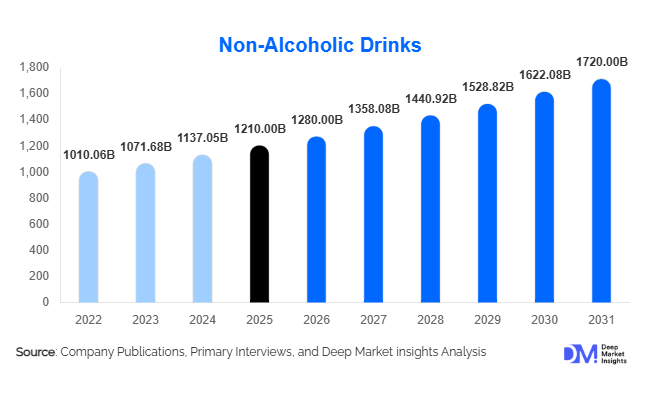
According to Deep Market Insights, the global non-alcoholic drinks market size was valued at USD 1,210.0 billion in 2025 and is projected to grow from USD 1,280.0 billion in 2026 to reach USD 1,720.0 billion by 2031, expanding at a CAGR of 6.1% during the forecast period (2026–2031). The market growth is primarily driven by rising health consciousness, increasing demand for functional beverages, and rapid expansion of organized retail and e-commerce distribution channels worldwide.
Key Market Insights
- Health-conscious consumption is reshaping the market, with consumers shifting toward low-sugar, natural, and functional beverages.
- Bottled water remains the dominant segment, accounting for nearly 28% of the global market due to rising concerns over safe drinking water.
- Asia-Pacific dominates the global market, contributing approximately 38% share, driven by population growth and rising disposable incomes.
- Functional beverages are the fastest-growing segment, supported by demand for energy, immunity, and hydration benefits.
- Off-trade distribution channels lead the market, accounting for nearly 70% of total sales globally.
- Sustainable packaging innovations, including recyclable PET and biodegradable materials, are becoming key differentiators.
Size
According to Deep Market Insights, the global non-alcoholic drinks market size was valued at USD 1,210 billion in 2025 and is projected to grow from USD 1,280 billion in 2026 to reach USD 1,720 billion by 2031, expanding at a CAGR of 6.1% during the forecast period (2026–2031). The market growth is primarily driven by rising health consciousness, increasing demand for functional beverages, and rapid expansion of organized retail and e-commerce distribution channels worldwide.
Key Market Insights
- Health-conscious consumption is reshaping the market, with consumers shifting toward low-sugar, natural, and functional beverages.
- Bottled water remains the dominant segment, accounting for nearly 28% of the global market due to rising concerns over safe drinking water.
- Asia-Pacific dominates the global market, contributing approximately 38% share, driven by population growth and rising disposable incomes.
- Functional beverages are the fastest-growing segment, supported by demand for energy, immunity, and hydration benefits.
- Off-trade distribution channels lead the market, accounting for nearly 70% of total sales globally.
- Sustainable packaging innovations, including recyclable PET and biodegradable materials, are becoming key differentiators.
What are the latest trends in the non-alcoholic drinks market?
Shift Toward Functional and Wellness Beverages
Consumers are increasingly seeking beverages that provide health benefits beyond basic hydration. Functional drinks enriched with vitamins, minerals, probiotics, and plant-based ingredients are gaining widespread popularity. Energy drinks, sports beverages, and fortified water products are expanding rapidly, particularly among younger demographics and fitness-conscious consumers. Manufacturers are investing heavily in research and development to introduce products targeting immunity, digestion, and mental well-being. Clean-label formulations and natural ingredient sourcing are further strengthening consumer trust and driving demand in both developed and emerging markets.
Premiumization and Clean-Label Innovation
The market is witnessing strong premiumization, with consumers willing to pay higher prices for organic, low-calorie, and sustainably produced beverages. Clean-label products with minimal additives and transparent ingredient sourcing are gaining traction. Premium juices, cold brew coffee, and plant-based drinks are becoming mainstream offerings in urban markets. This trend is supported by increasing awareness of lifestyle-related health conditions and a growing preference for high-quality, ethically sourced products.
What are the key drivers in the non-alcoholic drinks market?
Rising Health Awareness and Lifestyle Changes
The growing prevalence of lifestyle-related diseases such as obesity and diabetes has encouraged consumers to reduce sugar intake and adopt healthier beverage options. This has led to increased demand for low-calorie, sugar-free, and natural drinks, significantly boosting market growth. Governments and health organizations are also promoting healthier consumption habits, further accelerating this trend.
Expansion of Retail and E-commerce Channels
The rapid expansion of supermarkets, convenience stores, and online platforms has improved product accessibility and availability. E-commerce platforms, in particular, are enabling direct-to-consumer sales, enhancing brand visibility, and offering personalized product recommendations. This has significantly contributed to market expansion, especially in developing regions.
What are the restraints for the global market?
Regulatory Pressure on Sugar and Labeling
Governments worldwide are implementing stricter regulations on sugar content, labeling requirements, and advertising practices. Sugar taxes and compliance costs are impacting product pricing and profitability, forcing manufacturers to reformulate products and invest in regulatory compliance.
Volatility in Raw Material Prices
Fluctuations in the prices of key raw materials such as sugar, fruits, and packaging materials like aluminum and PET plastic pose significant challenges. These variations impact production costs and profit margins, particularly for small and medium-sized manufacturers.
What are the key opportunities in the non-alcoholic drinks industry?
Expansion in Emerging Markets
Rapid urbanization and rising disposable incomes in emerging economies such as India, China, and Southeast Asia present significant growth opportunities. Companies can tap into these markets by offering affordable products and localized flavors tailored to regional preferences.
Sustainable Packaging and Eco-Friendly Initiatives
Increasing environmental awareness is driving demand for sustainable packaging solutions. Companies adopting recyclable, biodegradable, and reusable packaging are gaining competitive advantages while aligning with regulatory requirements and consumer expectations.
Report Scope
| Report Metric | Details |
|---|---|
| Market Size in 2025 | USD 1210 Billion |
| Market Size in 2026 | USD 1280 Billion |
| Market Size in 2031 | USD 1720 Billion |
| CAGR | 6.1% (2026-2031) |
| Base Year for Estimation | 2025 |
| Historical Data | 2022-2024 |
| Forecast Period | 2026-2031 |
| Report Coverage | Revenue Forecast, Competitive Landscape, Supply Chain Disruption, Growth Factors, Environment & Regulatory Landscape and Trends |
| Geographies Covered | North America, Europe, APAC, Middle East and Africa, LATAM |
| Countries Covered | U.S., Canada, U.K., Germany, France, Spain, Italy, Russia, Nordic, Benelux, Rest of Europe, China, Korea, Japan, India, Australia, Singapore, Taiwan, South East Asia, Rest of Asia-Pacific, UAE, Turky, Saudi Arabia, South Africa, Egypt, Nigeria, Rest of MEA, Brazil, Mexico, Argentina, Chile, Colombia, Rest of LATAM |
Explore more data points, trends and opportunities Download Free Sample Report
Product Type Insights
The global non-alcoholic drinks market continues to be significantly shaped by evolving consumer preferences, health awareness, and convenience-driven consumption patterns. Among all product categories, bottled water maintains its dominant position, accounting for approximately 28% of the total market share in 2025. This leadership is primarily attributed to growing global concerns regarding water safety, especially in emerging economies where access to clean drinking water remains inconsistent. Additionally, the increasing inclination toward healthier lifestyles has encouraged consumers to substitute sugary beverages with safer and calorie-free hydration options. The convenience factor associated with bottled water, including portability and availability across diverse retail formats, further strengthens its position as a daily essential.In parallel, functional beverages have emerged as the fastest-growing segment within the market, driven by the rising consumer focus on wellness, energy, and performance enhancement. This category includes energy drinks, sports drinks, fortified juices, and beverages enriched with vitamins, minerals, probiotics, and adaptogens. The increasing adoption of fitness-oriented lifestyles, particularly among younger demographics and urban populations, has accelerated demand for such products. Consumers are not only seeking hydration but also additional functional benefits such as improved stamina, mental alertness, and immune support. The rapid innovation in flavors, ingredients, and formulations is further fueling the segment’s expansion, as manufacturers continuously introduce products tailored to specific health needs.Juices and ready-to-drink (RTD) beverages continue to maintain a stable presence in the market, benefiting from their perceived nutritional value and convenience. Premiumization trends are becoming increasingly evident within this segment, with consumers opting for cold-pressed, organic, and preservative-free juice options. Similarly, plant-based beverages such as almond, soy, and oat drinks are gaining traction as consumers shift toward dairy alternatives. Overall, the product type landscape is undergoing a transformation characterized by a clear shift from traditional sugary drinks to health-oriented, functional, and premium beverage offerings.
Application Insights
The application landscape of the global non-alcoholic drinks market is dominated by household consumption, which accounts for nearly 65% of total demand. This dominance is rooted in the integral role beverages play in daily dietary habits across cultures and regions. From basic hydration needs fulfilled by bottled water to the consumption of juices, teas, and soft drinks during meals and leisure activities, household demand remains consistent and expansive. The increasing penetration of packaged beverages in rural and semi-urban areas, particularly in emerging economies, is further reinforcing the growth of this segment. Additionally, rising disposable incomes and changing lifestyles are encouraging consumers to experiment with a wider variety of beverage options at home.Institutional applications, including airlines, corporate offices, hospitals, and educational institutions, are also emerging as significant contributors to overall demand. The need for convenient, hygienic, and ready-to-serve beverage solutions in these environments is driving steady growth. In corporate settings, for instance, the provision of packaged beverages as part of employee amenities is becoming increasingly common. Similarly, airlines and hospitality providers are focusing on enhancing passenger and guest experiences through curated beverage offerings. Although this segment represents a smaller share compared to household and foodservice applications, its consistent growth trajectory highlights its importance within the broader market ecosystem.
Distribution Channel Insights
Distribution channels play a critical role in shaping the accessibility and availability of non-alcoholic beverages across global markets. Off-trade channels dominate the landscape, accounting for approximately 70% of total sales. This segment includes supermarkets, hypermarkets, convenience stores, and retail chains, which collectively serve as the primary points of purchase for consumers. The dominance of off-trade channels can be attributed to the convenience of bulk purchasing, competitive pricing, and extensive product variety offered by these outlets. Supermarkets and hypermarkets, in particular, benefit from strong supply chain networks and promotional strategies that attract a broad consumer base.Online retail is emerging as the fastest-growing distribution channel, driven by the rapid digitalization of commerce and changing consumer shopping behaviors. The increasing penetration of smartphones, internet connectivity, and e-commerce platforms has enabled consumers to purchase beverages conveniently from the comfort of their homes. The availability of subscription models, doorstep delivery, and a wider assortment of niche and premium products is further enhancing the appeal of online channels. This growth is particularly pronounced in urban areas and among younger, tech-savvy consumers who prioritize convenience and time efficiency.The integration of omnichannel strategies is becoming increasingly important, as companies seek to provide seamless shopping experiences across both online and offline platforms. Investments in logistics, cold chain infrastructure, and digital marketing are enabling beverage manufacturers to expand their reach and enhance customer engagement across multiple touchpoints.
End-User Insights
Retail consumers represent the largest end-user segment in the global non-alcoholic drinks market, driven by the widespread demand for convenient, ready-to-drink beverages. The increasing pace of modern lifestyles, coupled with rising health consciousness, is encouraging consumers to opt for packaged beverages that offer both convenience and nutritional benefits. The availability of a diverse range of products catering to different taste preferences, dietary requirements, and lifestyle choices is further supporting the growth of this segment. Innovations in packaging, such as eco-friendly and resealable containers, are also enhancing consumer appeal.Institutional end-users, including corporate offices, educational institutions, healthcare facilities, and transportation services, are emerging as important contributors to market demand. The need for reliable, safe, and convenient beverage solutions in these settings is driving the adoption of packaged and ready-to-serve products. Additionally, the increasing focus on employee and consumer well-being is encouraging institutions to provide healthier beverage options, such as low-sugar drinks, fortified beverages, and bottled water. This trend is expected to gain further momentum as organizations prioritize health and sustainability in their operational practices.
Explore more data points, trends and opportunities Download Free Sample Report
Non-Alcoholic Drinks Segmentations
By Product Type
- Carbonated Soft Drinks
- Bottled Water
- Juices & Juice-Based Drinks
- RTD Tea & Coffee
- Functional & Wellness Drinks
- Dairy-Based Beverages
- Plant-Based Beverages
By Application / End-User
- Household Consumption
- Foodservice Industry
- Institutional Buyers
By Distribution Channel
- Supermarkets/Hypermarkets
- Convenience Stores
- Online Retail
- Specialty Stores
- On-Trade
By Packaging Type
- Plastic Bottles (PET)
- Glass Bottles
- Cans
- Cartons
- Flexible Packaging
Regional Insights
Asia-Pacific
Asia-Pacific leads the global non-alcoholic drinks market, accounting for approximately 38% of total market share in 2025. The region’s dominance is primarily driven by its large and growing population, rapid urbanization, and rising disposable incomes. Countries such as China and India serve as major growth engines, supported by expanding middle-class populations and increasing consumer spending on packaged goods. The demand for bottled water, juices, and functional beverages is particularly strong, reflecting growing health awareness and concerns regarding water quality.Key growth drivers in Asia-Pacific include favorable demographic trends, increasing health consciousness, government initiatives promoting safe drinking water, and the rapid development of retail infrastructure. The region’s dynamic economic environment and evolving consumer preferences make it a highly attractive market for both domestic and international beverage manufacturers.
North America
North America holds approximately 22% of the global market share, with the United States being the primary contributor. The region is characterized by high consumer awareness, advanced distribution networks, and a strong focus on product innovation. The demand for functional beverages, including energy drinks, sports drinks, and fortified products, is particularly high, driven by fitness trends and busy lifestyles.A notable trend in North America is the declining consumption of traditional carbonated soft drinks, primarily due to increasing concerns regarding sugar intake and associated health risks. This decline is being offset by the growing popularity of healthier alternatives, such as plant-based beverages, low-calorie drinks, and organic juices. The emphasis on clean-label products and transparency in ingredient sourcing is also influencing consumer purchasing decisions.Regional growth is further supported by strong research and development capabilities, aggressive marketing strategies, and the presence of leading global beverage companies. The increasing adoption of sustainable packaging solutions and environmentally friendly practices is also shaping market dynamics, as consumers become more environmentally conscious.
Europe
Europe accounts for approximately 20% of the global non-alcoholic drinks market, with key contributions from countries such as Germany, the United Kingdom, and France. The region is characterized by a mature market landscape and a strong emphasis on quality, sustainability, and health. Consumers in Europe are increasingly seeking organic, natural, and clean-label beverages, which has led to the growth of premium and niche product segments.Regulatory frameworks in the region play a significant role in shaping market trends. Stringent regulations related to sugar content, labeling, and environmental sustainability are encouraging manufacturers to innovate and reformulate their products. The growing demand for low-sugar, sugar-free, and plant-based beverages is a direct outcome of these regulatory measures and changing consumer preferences.Additional growth drivers in Europe include the rising popularity of functional beverages, increasing awareness of environmental issues, and the expansion of specialty retail channels. The region’s focus on sustainability is also driving the adoption of recyclable and biodegradable packaging solutions, further influencing market development.
Latin America
Latin America represents approximately 10% of the global market, with Brazil and Mexico serving as key contributors. The region is characterized by strong consumption of carbonated soft drinks and fruit-based beverages, supported by cultural preferences and climatic conditions. The growing middle-class population and increasing urbanization are driving demand for packaged and branded beverage products.Economic development and improving retail infrastructure are further supporting market growth, as consumers gain greater access to a variety of beverage options. The rising influence of global brands, coupled with local product innovations, is contributing to a dynamic and competitive market environment.Key growth drivers in Latin America include demographic expansion, increasing disposable incomes, and the growing popularity of convenient, ready-to-drink beverages. Additionally, the rising awareness of health and wellness is gradually shifting consumer preferences toward healthier alternatives, creating new opportunities for market players.
Middle East & Africa
The Middle East & Africa region accounts for approximately 10% of the global non-alcoholic drinks market and is experiencing steady growth. The region’s expansion is driven by increasing urbanization, rising tourism, and improving economic conditions in key countries such as the United Arab Emirates and Saudi Arabia. High temperatures and arid climatic conditions also contribute to strong demand for hydration products, particularly bottled water.The growing expatriate population and the expansion of modern retail formats are further enhancing market growth. Additionally, the increasing focus on health and wellness is driving demand for functional and low-sugar beverages. Investments in infrastructure, including logistics and distribution networks, are improving product availability across both urban and rural areas.Key regional growth drivers include rising disposable incomes, expanding hospitality and tourism sectors, and increasing consumer awareness regarding health and hygiene. The ongoing development of retail and e-commerce channels is also expected to play a crucial role in shaping the future of the non-alcoholic drinks market in the Middle East & Africa.
Key Players in the Non-Alcoholic Drinks Market
- The Coca-Cola Company
- PepsiCo Inc.
- Nestlé S.A.
- Danone S.A.
- Keurig Dr Pepper Inc.
- Red Bull GmbH
- Suntory Holdings Ltd.
- Asahi Group Holdings
- Monster Beverage Corporation
- National Beverage Corp.
- Tata Consumer Products Ltd.
- Unilever PLC
- Tingyi Holding Corp.
- Nongfu Spring Co. Ltd.
- Britvic PLC