Natural Bee Honey Market Size
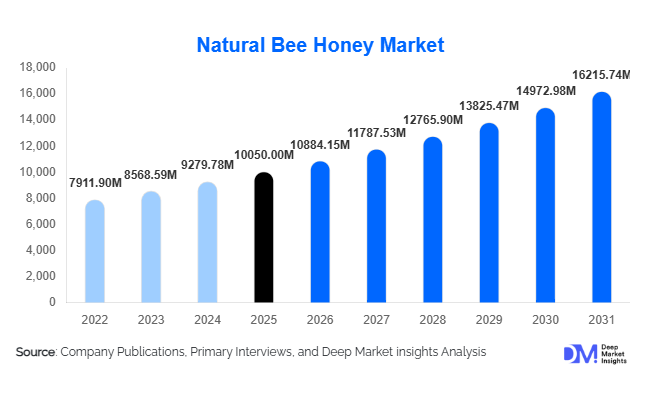
According to Deep Market Insights, the global natural bee honey market size was valued at USD 10,050 million in 2025 and is projected to grow from USD 10,884.15 million in 2026 to reach USD 16,215.74 million by 2031, expanding at a CAGR of 8.3% during the forecast period (2026–2031). The natural bee honey market growth is primarily driven by increasing consumer preference for natural sweeteners, rising demand for clean-label food ingredients, and expanding applications across food, healthcare, and personal care industries. The growing awareness regarding the health benefits of honey, including its antioxidant and antimicrobial properties, is further strengthening its global adoption.
Key Market Insights
- Natural sweeteners are replacing refined sugar, with honey emerging as a preferred alternative in both household and industrial applications.
- Premium honey segments such as organic and monofloral varieties are gaining traction, driven by higher consumer willingness to pay for quality and traceability.
- Asia-Pacific dominates the global market, supported by large-scale production and increasing domestic consumption.
- North America and Europe rely heavily on imports, creating strong export opportunities for developing economies.
- E-commerce channels are rapidly expanding, enabling direct-to-consumer sales and global market access for small producers.
- Functional food and nutraceutical integration is reshaping demand patterns, positioning honey as a health-oriented ingredient.
What are the latest trends in the natural bee honey market?
Premiumization and Monofloral Honey Demand
The market is witnessing a strong shift toward premium honey variants, particularly monofloral types such as acacia, manuka, and sidr. Consumers are increasingly prioritizing quality, origin, and purity over price, leading to higher demand for geographically indicated and specialty honey products. This trend is especially prominent in developed markets where consumers are willing to pay significantly higher prices for certified organic and raw honey. Branding, storytelling, and traceability are becoming critical factors influencing purchasing decisions, with companies investing in advanced labeling and certification to differentiate their offerings.
Expansion of Honey in Functional Foods and Nutraceuticals
Honey is increasingly being integrated into functional foods, dietary supplements, and herbal formulations due to its natural health benefits. The growing focus on immunity, preventive healthcare, and wellness has accelerated its use in nutraceutical products. Manufacturers are innovating by combining honey with herbs, vitamins, and probiotics to create value-added products. This trend is expanding honey’s application beyond traditional consumption, contributing to higher market value and diversification of demand.
What are the key drivers in the natural bee honey market?
Growing Demand for Clean-Label and Natural Ingredients
The shift toward clean-label products is a major driver of the natural bee honey market. Consumers are increasingly avoiding artificial additives and refined sugars, opting for natural alternatives such as honey. Food manufacturers are responding by reformulating products to include natural sweeteners, thereby boosting industrial demand. This trend is particularly strong in developed economies, where transparency and ingredient authenticity are key purchasing factors.
Rising Health Awareness and Medicinal Applications
Honey’s therapeutic properties, including its antibacterial and antioxidant effects, are driving its use in healthcare and traditional medicine. The increased focus on immunity following global health concerns has further accelerated demand for honey-based products. Pharmaceutical and nutraceutical companies are incorporating honey into formulations for cough syrups, wound care, and dietary supplements, expanding its role beyond food applications.
Growth of Organized Retail and E-commerce
The rapid expansion of supermarkets, hypermarkets, and online retail platforms has significantly improved product accessibility. E-commerce, in particular, is enabling producers to reach global consumers, promote premium products, and establish brand identity. Direct-to-consumer models are also gaining popularity, allowing beekeepers and small producers to capture higher margins and build customer loyalty.
What are the restraints for the global market?
Adulteration and Quality Concerns
One of the major challenges in the natural bee honey market is the prevalence of adulteration, which affects product quality and consumer trust. The presence of synthetic additives and sugar syrups in some products has led to increased regulatory scrutiny and consumer skepticism. Ensuring product authenticity and maintaining consistent quality standards remain critical challenges for market participants.
Supply Volatility and Environmental Risks
Honey production is highly dependent on environmental conditions and bee population health. Climate change, habitat loss, and declining bee populations are impacting production volumes, leading to supply fluctuations and price volatility. These factors pose significant risks to long-term market stability and require sustainable beekeeping practices to mitigate their impact.
What are the key opportunities in the natural bee honey industry?
Export Expansion from Emerging Economies
Developing countries such as India, Vietnam, and Argentina are emerging as key exporters of natural honey, supported by favorable climatic conditions and cost-effective production. Increasing global demand, particularly from North America and Europe, is creating significant export opportunities. Producers can enhance their competitiveness by adopting international quality standards and certifications, enabling them to access premium markets.
Innovation in Value-Added Honey Products
The development of infused and fortified honey products presents a major growth opportunity. Honey combined with ingredients such as herbs, spices, and superfoods is gaining popularity among health-conscious consumers. These value-added products offer higher margins and enable companies to differentiate themselves in a competitive market.
Report Scope
| Report Metric | Details |
|---|---|
| Market Size in 2025 | USD 10050 Million |
| Market Size in 2026 | USD 10884.15 Million |
| Market Size in 2031 | USD 16215.74 Million |
| CAGR | 8.3% (2026-2031) |
| Base Year for Estimation | 2025 |
| Historical Data | 2022-2024 |
| Forecast Period | 2026-2031 |
| Report Coverage | Revenue Forecast, Competitive Landscape, Supply Chain Disruption, Growth Factors, Environment & Regulatory Landscape and Trends |
| Geographies Covered | North America, Europe, APAC, Middle East and Africa, LATAM |
| Countries Covered | U.S., Canada, U.K., Germany, France, Spain, Italy, Russia, Nordic, Benelux, Rest of Europe, China, Korea, Japan, India, Australia, Singapore, Taiwan, South East Asia, Rest of Asia-Pacific, UAE, Turky, Saudi Arabia, South Africa, Egypt, Nigeria, Rest of MEA, Brazil, Mexico, Argentina, Chile, Colombia, Rest of LATAM |
Explore more data points, trends and opportunities Download Free Sample Report
Product Type Insights
Multifloral honey continues to dominate the global natural bee honey market, accounting for approximately 38% of the market share in 2025. Its leadership is primarily attributed to its widespread availability across diverse geographic landscapes, relatively lower production complexity, and cost-effectiveness compared to more specialized varieties. Multifloral honey is derived from the nectar of multiple flowering plants, which ensures consistent supply and stable pricing, making it highly suitable for large-scale commercial applications. It is extensively utilized in household consumption as well as in the food processing industry, where manufacturers prefer it as a natural sweetening agent due to its balanced flavor profile and functional versatility. The leading driver behind the dominance of multifloral honey is its ability to meet bulk demand at competitive pricing while maintaining acceptable nutritional and sensory quality, which aligns strongly with mass-market consumption patterns and industrial requirements.Organic honey and raw honey segments are also expanding rapidly, driven by the global shift toward clean-label and minimally processed food products. Organic honey is produced without the use of synthetic pesticides, antibiotics, or chemical treatments in beekeeping, which resonates strongly with health-conscious consumers seeking natural and environmentally sustainable alternatives. Raw honey, which is unprocessed and unpasteurized, retains higher levels of enzymes, pollen, and antioxidants, making it increasingly popular in wellness and nutraceutical applications. The primary driver for both segments is the growing demand for transparency in food sourcing, coupled with heightened awareness of the negative effects of processed sugars and artificial sweeteners. The expansion of organic certification programs and premium retail positioning further accelerates their adoption across both developed and emerging markets.
Application Insights
The food and beverages segment remains the dominant application area in the global honey market, contributing over 55% of the total market share. Honey is widely integrated into bakery products, dairy formulations, breakfast cereals, beverages, and confectionery items as a natural sweetener and flavor enhancer. The leading driver of this segment is the increasing consumer demand for natural sugar substitutes amid rising concerns regarding obesity, diabetes, and artificial sweetener consumption. Food manufacturers are actively reformulating products to incorporate honey as a clean-label ingredient that enhances both nutritional value and consumer appeal. Additionally, honey’s functional properties, such as moisture retention, texture enhancement, and natural preservation, make it highly valuable in processed food manufacturing, further strengthening its dominance in this segment.The cosmetics and personal care industry is also emerging as a significant application area, leveraging honey’s natural moisturizing, anti-aging, and antibacterial properties. It is widely used in skincare products such as creams, lotions, face masks, cleansers, and hair care formulations. The key driver for this segment is the rising consumer preference for natural and chemical-free cosmetic products, particularly in premium skincare categories. Honey’s ability to improve skin hydration, promote healing, and provide gentle exfoliation has made it a preferred ingredient among dermatological and cosmetic manufacturers. The growth of clean beauty trends and increasing demand for sustainable personal care products further reinforce honey’s role in this expanding application segment.
Distribution Channel Insights
Supermarkets and hypermarkets continue to dominate the global honey distribution landscape, accounting for around 36% of global sales. These retail formats provide consumers with extensive product variety, easy price comparison, and immediate product availability, making them a preferred shopping destination for packaged food products such as honey. The leading driver for this channel is strong consumer trust in organized retail environments, combined with aggressive product placement strategies and promotional activities undertaken by manufacturers. The visibility of multiple brands under one roof enhances consumer choice and encourages impulse purchasing, thereby strengthening the dominance of this distribution channel.Specialty stores focusing on organic, health-oriented, and gourmet food products are also gaining importance, particularly in developed economies. These stores cater to niche consumer segments that prioritize quality, authenticity, and product traceability over price sensitivity. The primary driver for this channel is the rising demand for premium and certified organic honey products, which require knowledgeable retail environments to educate consumers about product benefits. Specialty retailers often emphasize product origin, certification standards, and health attributes, thereby enhancing consumer confidence and supporting premium market growth.
End-Use Industry Insights
The food processing industry remains the largest end-use segment in the global honey market, driven by the increasing incorporation of honey in packaged foods, beverages, and processed culinary products. Food manufacturers are increasingly replacing refined sugar with honey to meet clean-label requirements and cater to health-conscious consumers. The leading driver for this segment is the global reformulation trend, where companies are actively seeking natural sweetening alternatives to align with regulatory guidelines and consumer expectations regarding healthier food options. Honey’s multifunctional properties, including flavor enhancement and natural preservation, further strengthen its role in industrial food processing.The cosmetics and personal care industry is also witnessing steady expansion in honey utilization, particularly in skincare and haircare formulations. The growth driver for this segment is the rising demand for natural beauty products that are free from harsh chemicals and synthetic additives. Honey’s ability to provide deep hydration, improve skin texture, and support healing processes makes it highly valuable in premium cosmetic formulations. The increasing popularity of organic beauty brands and sustainable sourcing practices further contributes to the expansion of this end-use segment.
Explore more data points, trends and opportunities Download Free Sample Report
Natural Bee Honey Market Segmentations
By Product Type
- Multifloral Honey
- Monofloral Honey
- Organic Certified Honey
- Raw/Unprocessed Honey
- Processed/Pasteurized Honey
By Form
- Liquid Honey
- Creamed/Whipped Honey
- Comb Honey
- Powdered/Granulated Honey
By Application
- Food & Beverages
- Nutraceuticals & Pharmaceuticals
- Cosmetics & Personal Care
- Household & Traditional Use
By Distribution Channel
- Supermarkets & Hypermarkets
- Specialty Stores
- Online Retail/E-commerce
- Direct Sales
- Convenience Stores
By End-Use Industry
- Food Processing Industry
- Retail/Household Consumption
- Healthcare & Pharmaceuticals
- Cosmetics & Personal Care
- Hospitality & Foodservice
Regional Insights
Asia-Pacific
Asia-Pacific leads the global natural bee honey market, accounting for approximately 38% of the market share in 2025. The region’s dominance is primarily driven by large-scale production capabilities and strong domestic consumption across countries such as China and India. China remains one of the largest global producers of honey, supported by advanced apiculture practices and strong export infrastructure, while India benefits from a rapidly expanding domestic market driven by rising health awareness and government initiatives promoting beekeeping under rural development programs. The key driver for regional growth is the strong integration of traditional medicine systems such as Ayurveda and Traditional Chinese Medicine, where honey is widely used for therapeutic purposes. Additionally, increasing disposable incomes, urbanization, and growing demand for natural sweeteners in processed foods are significantly contributing to market expansion across the region.
North America
North America holds around 22% of the global market share, driven by high per capita consumption and strong demand for premium, organic, and raw honey products. The United States represents the largest importer in the region, relying heavily on international suppliers to meet domestic demand. The primary growth driver is the increasing consumer shift toward natural and clean-label food products, particularly as awareness regarding artificial sweeteners and processed sugars continues to rise. The region also benefits from a well-developed retail infrastructure and strong presence of health-focused consumer segments that prioritize functional foods. Additionally, the popularity of organic certification and traceable sourcing practices further enhances demand for high-quality honey products.
Europe
Europe accounts for approximately 24% of the global market share, with major consumption concentrated in countries such as Germany, the United Kingdom, and France. The region is characterized by high consumer awareness regarding food quality, sustainability, and organic certification standards. The key driver for market growth is the strong preference for organic and sustainably sourced honey, supported by stringent regulatory frameworks and certification systems. However, limited domestic production capacity creates significant import dependence, particularly from Latin America and Asia-Pacific regions. Rising demand for premium artisanal honey varieties and increasing use in gourmet food applications further contribute to market expansion across Europe.
Latin America
Latin America is a major exporter of natural honey, with Argentina and Brazil playing leading roles in global supply chains. Argentina, in particular, is one of the largest honey exporters worldwide, supplying significant volumes to North America and Europe. The key driver for regional growth is favorable climatic conditions that support year-round beekeeping activities, along with well-established apiculture traditions. Additionally, low production costs and large-scale rural participation in beekeeping contribute to competitive export pricing. Increasing global demand for organic and traceable honey further strengthens Latin America’s position as a key supply hub in the global market.
Middle East & Africa
The Middle East and Africa region is experiencing steady growth, driven by increasing consumer awareness of honey’s health benefits and rising demand for premium varieties such as sidr honey. Countries like Saudi Arabia and the United Arab Emirates are major consumers, where honey is highly valued for both nutritional and cultural significance. The primary growth driver is the strong cultural affinity for natural remedies and traditional foods, combined with rising disposable incomes that support premium product consumption. In Africa, expanding beekeeping initiatives and growing export potential are supporting market development. Government and NGO-led programs promoting sustainable apiculture practices are further strengthening production capabilities and enhancing regional participation in global supply chains.
Key Players in the Natural Bee Honey Market
- Dabur India Ltd.
- Comvita Ltd.
- Capilano Honey Ltd.
- Barkman Honey LLC
- Dutch Gold Honey Inc.
- Bee Maid Honey Ltd.
- Sioux Honey Association Co-op
- Oha Honey LP
- Rowse Honey Ltd.
- Billy Bee Honey Products
- Little Bee Impex
- Apis India Ltd.
- Nature Nate’s Honey Co.
- Y.S. Eco Bee Farms
- Golden Acres Honey