Mooncake Market Size
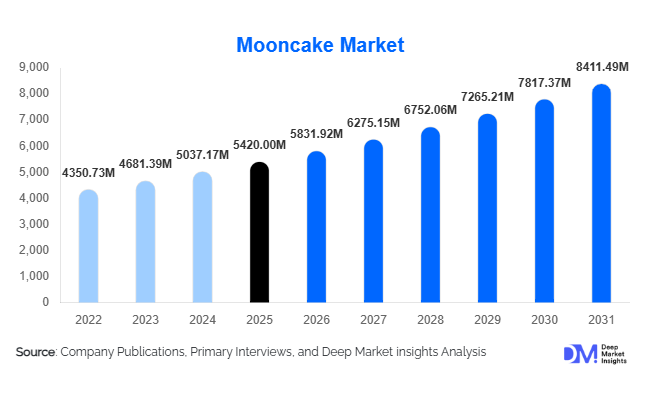
According to Deep Market Insights, the global mooncake market size was valued at USD 5,420 million in 2025 and is projected to grow from USD 5,831.92 million in 2026 to reach USD 8,411.49 million by 2031, expanding at a CAGR of 7.6% during the forecast period (2026–2031). The mooncake market growth is primarily driven by strong cultural demand during the Mid-Autumn Festival, increasing premium gifting trends, and rising global exposure to Asian confectionery products. Expanding e-commerce penetration and continuous innovation in flavors, packaging, and healthier variants are further supporting market expansion globally.
Key Market Insights
- Mooncakes are increasingly positioned as premium gifting products, especially in Asia-Pacific, where ornate packaging and luxury branding drive higher margins.
- Health-oriented mooncakes, including low-sugar, vegan, and organic variants, are gaining traction among younger and health-conscious consumers.
- Asia-Pacific dominates the global market, accounting for over 70% of total consumption, led by China and Southeast Asia.
- North America is the fastest-growing region, driven by Asian diaspora demand and increasing mainstream adoption.
- E-commerce and digital sales channels are rapidly transforming distribution, particularly for premium and customized mooncake offerings.
- Product innovation in flavors and formats, such as ice cream and chocolate mooncakes, is expanding consumer appeal beyond traditional segments.
What are the latest trends in the mooncake market?
Premiumization and Luxury Gifting Trends
Mooncakes have evolved from traditional festive food items into premium gifting products, particularly in markets such as China, Hong Kong, and Singapore. Manufacturers are investing heavily in high-end packaging, limited-edition collections, and collaborations with luxury brands to enhance perceived value. Corporate gifting plays a crucial role, with companies purchasing large volumes of premium mooncake boxes for employees and clients. The trend toward personalization, including customized packaging and curated assortments, is further strengthening the premium segment. This shift is enabling manufacturers to achieve higher profit margins and build stronger brand loyalty among affluent consumers.
Health-Conscious and Functional Mooncakes
Rising health awareness has led to growing demand for healthier mooncake options. Traditional mooncakes, often high in sugar and calories, are being reformulated to include low-sugar, low-fat, and plant-based ingredients. Functional mooncakes incorporating herbal extracts, protein-rich fillings, and gluten-free formulations are also emerging. This trend is particularly strong among urban consumers and younger demographics who prioritize wellness. Companies investing in research and development to balance taste and health benefits are gaining a competitive edge, as consumers increasingly seek guilt-free indulgence during festive occasions.
What are the key drivers in the mooncake market?
Cultural Significance and Globalization
The deep-rooted cultural importance of mooncakes during the Mid-Autumn Festival remains a primary driver of market growth. As Asian communities expand globally, the consumption of mooncakes is increasing in international markets. Cultural festivals, tourism, and social media exposure are further enhancing global awareness and adoption. This globalization of traditional foods is enabling manufacturers to tap into new markets while maintaining strong demand in core regions.
Product Innovation and Flavor Diversification
Continuous innovation in flavors and formats is significantly contributing to market growth. Manufacturers are introducing new fillings such as chocolate, matcha, fruit, and even savory options to cater to diverse consumer preferences. Non-traditional formats like snow skin and ice cream mooncakes are attracting younger consumers and expanding the product’s appeal beyond its traditional base. This diversification is helping companies reduce dependency on seasonal demand and increase year-round sales.
What are the restraints for the global market?
Seasonal Demand Concentration
The mooncake market is highly seasonal, with the majority of sales concentrated around the Mid-Autumn Festival. This creates challenges in inventory management, production planning, and revenue stability for manufacturers. Companies often face pressure to accurately forecast demand within a limited sales window, increasing operational risks.
Health Concerns and Dietary Restrictions
Traditional mooncakes are often associated with high sugar and calorie content, which can deter health-conscious consumers. Increasing awareness of lifestyle diseases such as diabetes and obesity is limiting frequent consumption. Regulatory scrutiny regarding labeling and nutritional content is also increasing, requiring manufacturers to adapt formulations and improve transparency.
What are the key opportunities in the mooncake industry?
Expansion into International Markets
The growing Asian diaspora in North America, Europe, and the Middle East presents significant export opportunities for mooncake manufacturers. Increasing interest in Asian cuisine among non-Asian consumers is further driving demand. E-commerce platforms and improved logistics are enabling cross-border sales, allowing brands to reach new customer bases. Companies that adapt flavors and marketing strategies to local preferences while maintaining authenticity are well-positioned to capitalize on this opportunity.
Corporate and Institutional Gifting
Corporate gifting is emerging as a major growth driver in the mooncake market. Businesses are increasingly purchasing premium mooncake boxes as part of employee engagement and client relationship strategies. This segment offers high-volume sales and stable demand, encouraging manufacturers to develop customized offerings and strengthen partnerships with corporate clients. The integration of branding and personalization features further enhances the appeal of mooncakes in this segment.
Report Scope
| Report Metric | Details |
|---|---|
| Market Size in 2025 | USD 5420.00 Million |
| Market Size in 2026 | USD 5831.92 Million |
| Market Size in 2031 | USD 8411.49 Million |
| CAGR | 7.6% (2026-2031) |
| Base Year for Estimation | 2025 |
| Historical Data | 2022-2024 |
| Forecast Period | 2026-2031 |
| Report Coverage | Revenue Forecast, Competitive Landscape, Supply Chain Disruption, Growth Factors, Environment & Regulatory Landscape and Trends |
| Geographies Covered | North America, Europe, APAC, Middle East and Africa, LATAM |
| Countries Covered | U.S., Canada, U.K., Germany, France, Spain, Italy, Russia, Nordic, Benelux, Rest of Europe, China, Korea, Japan, India, Australia, Singapore, Taiwan, South East Asia, Rest of Asia-Pacific, UAE, Turky, Saudi Arabia, South Africa, Egypt, Nigeria, Rest of MEA, Brazil, Mexico, Argentina, Chile, Colombia, Rest of LATAM |
Explore more data points, trends and opportunities Download Free Sample Report
Product Type Insights
The global mooncake market exhibits a highly diversified product structure, with traditional mooncakes continuing to dominate overall consumption patterns. In 2025, traditional mooncakes account for approximately 48% of the total market share, supported by their deep cultural heritage, symbolic significance, and strong association with Mid-Autumn Festival celebrations. Their enduring popularity is primarily driven by intergenerational consumer loyalty, where families continue to prioritize authenticity and heritage-based food consumption during festive periods. The continued dominance of traditional variants is further reinforced by premiumization trends, where manufacturers enhance packaging, ingredient quality, and presentation while maintaining conventional recipes. This combination of authenticity and luxury positioning ensures sustained demand across both mass and premium consumer segments.However, the market is undergoing a noticeable transformation as younger demographics increasingly influence product innovation. Snow skin and ice cream mooncakes are rapidly gaining traction, particularly among urban millennials and Gen Z consumers. These modern variants are characterized by lighter textures, innovative fillings such as matcha, chocolate mousse, fruit blends, and fusion-inspired flavors that deviate from conventional lotus seed paste or salted egg yolk fillings. The primary growth driver for these categories is experiential consumption, where consumers prioritize novelty, aesthetics, and taste experimentation over traditional symbolism. Social media influence and food content culture have further amplified demand for visually appealing and Instagram-friendly mooncake formats, making innovation a key competitive factor for manufacturers.Health-oriented mooncakes represent another high-growth sub-segment within product diversification. These include low-sugar, sugar-free, gluten-free, vegan, and organic formulations, designed to meet the rising global demand for healthier indulgence. The key driver behind this segment is the increasing prevalence of lifestyle-related health concerns such as obesity and diabetes, coupled with heightened awareness regarding nutritional intake. Consumers are increasingly seeking guilt-free festive indulgences, prompting manufacturers to reformulate traditional recipes without compromising taste authenticity. Additionally, regulatory encouragement for healthier food labeling in several regions is supporting product development in this category. As a result, the product landscape is evolving from a purely tradition-driven market to a hybrid model balancing heritage, innovation, and wellness-oriented consumption.
Application Insights
Festive gifting remains the most dominant application segment in the global mooncake market, accounting for approximately 45% of total demand. This segment is deeply rooted in cultural traditions, particularly across East and Southeast Asia, where mooncakes symbolize reunion, prosperity, and respect. The primary growth driver for this segment is the sustained cultural significance of the Mid-Autumn Festival, which continues to encourage large-scale consumer purchasing for family, friends, and social networks. Additionally, increasing disposable incomes have elevated gifting budgets, enabling consumers to shift from standard offerings to premium and luxury mooncake assortments. Packaging innovation, limited-edition collections, and brand collaborations further enhance the attractiveness of festive gifting products, reinforcing seasonal demand spikes.Corporate gifting represents one of the fastest-growing application segments, driven by increasing organizational emphasis on employee engagement, client retention, and brand relationship management. Companies across industries are investing significantly in festive gifting programs, where mooncakes are positioned as premium cultural gifts that symbolize goodwill and partnership. The key growth driver in this segment is the rising corporate culture of personalization and experiential gifting, where businesses prefer customized packaging, branded assortments, and curated gift sets. Furthermore, globalization of Asian festivals in multinational companies has expanded corporate demand beyond traditional markets, particularly in North America and Europe.Individual consumption continues to hold a stable and substantial share of the market, particularly in Asia-Pacific regions where mooncakes are consumed not only during festivals but also as seasonal treats. The growth driver for this segment is increasing urbanization and the rising popularity of ready-to-eat packaged desserts. Younger consumers are also driving year-round consumption patterns, particularly for modern variants such as snow skin and ice cream mooncakes.The hospitality and events segment is emerging as a key growth area, with hotels, luxury resorts, and fine-dining restaurants incorporating mooncakes into curated festival menus and experiential dining packages. The primary driver here is experiential tourism and premium hospitality positioning, where establishments use mooncakes to enhance cultural immersion and seasonal branding. High-end hotels often collaborate with luxury brands and celebrity chefs to create exclusive mooncake collections, further elevating demand in this segment.
Distribution Channel Insights
Offline retail channels continue to dominate the global mooncake market, contributing approximately 55% of total sales. Traditional bakeries, specialty confectionery stores, supermarkets, and department stores remain the primary points of purchase, largely due to consumer preference for physical inspection, freshness assurance, and brand trust. The key driver for offline dominance is the cultural importance of mooncakes, where consumers often prefer to evaluate packaging quality and product presentation in person before purchasing, especially for gifting purposes. Additionally, seasonal pop-up stores during festival periods significantly boost offline sales volumes, creating strong short-term demand surges.However, online retail channels are experiencing rapid expansion, fundamentally transforming the market landscape. E-commerce platforms, direct-to-consumer brand websites, and social commerce channels are driving increased accessibility and convenience. The primary growth driver in this segment is digitalization of consumer behavior, particularly among younger demographics who prefer online browsing and home delivery options. Furthermore, online platforms enable broader product variety, customization options, and promotional pricing strategies, which are not always available in offline stores. Influencer marketing, livestream commerce, and targeted digital campaigns are further accelerating online penetration, especially in international markets where physical availability is limited.The integration of omnichannel retail strategies is becoming increasingly important, where brands synchronize offline experience stores with online ordering systems. This hybrid model ensures wider reach and improved customer engagement across multiple touchpoints, supporting overall market expansion.
End-Use Insights
The end-use structure of the mooncake market is largely shaped by cultural consumption patterns and evolving commercial applications. Festive gifting remains the dominant end-use category, supported by deep-rooted traditions and seasonal demand spikes. The key driver for this segment is the symbolic importance of mooncakes in celebrating unity and prosperity during the Mid-Autumn Festival, which ensures consistent annual demand cycles.Corporate gifting is emerging as a high-growth end-use segment, with a projected CAGR exceeding 8%. This growth is primarily driven by increasing corporate investment in relationship-building initiatives and employee engagement programs. Organizations are increasingly adopting curated gifting strategies that incorporate premium mooncake assortments as part of broader festive outreach campaigns. Customization, branding, and luxury packaging are key differentiators driving demand in this segment.The hospitality sector is also witnessing expanding end-use demand, particularly in luxury hotels and international resorts. The main driver here is experiential dining and cultural storytelling, where mooncakes are integrated into seasonal menus and high-end festive experiences. Additionally, export-driven demand is rising significantly, fueled by diaspora populations across North America, Europe, and the Middle East. This has positioned mooncakes as both a cultural product and a global specialty food item, supporting sustained international market expansion.
Explore more data points, trends and opportunities Download Free Sample Report
Mooncake Market Segmentations
By Product Type
- Traditional Mooncakes
- Snow Skin Mooncakes
- Ice Cream Mooncakes
- Jelly Mooncakes
- Health-Oriented Mooncakes
By Filling Type
- Lotus Seed Paste
- Red Bean Paste
- Mixed Nuts & Seeds
- Egg Yolk
- Chocolate & Confectionery Fillings
- Fruit-Based Fillings
- Savory Fillings
By Distribution Channel
- Online Retail
- Supermarkets & Hypermarkets
- Specialty Stores
- Bakery Chains
- Convenience Stores
Regional Insights
Asia-Pacific
Asia-Pacific remains the dominant region in the global mooncake market, accounting for approximately 72% of total market share in 2025. China continues to be the largest contributor, representing more than half of global demand due to its massive population base, strong cultural heritage, and deeply embedded festival traditions. The key growth drivers in this region include rising disposable incomes, rapid urbanization, and the expansion of premium bakery and confectionery industries. Additionally, increasing demand for luxury gifting and branded festive products is significantly elevating market value. Countries such as Vietnam, Malaysia, Singapore, and Thailand are also experiencing steady growth, driven by multicultural celebrations and strong Chinese diaspora communities. The region also benefits from being the primary production hub, enabling cost efficiency and large-scale export capabilities.
North America
North America holds approximately 10% of the global market share, with the United States leading regional demand. The primary growth driver in this region is the large Asian diaspora population, which maintains strong cultural ties to traditional festivals. Additionally, increasing consumer interest in international cuisines and premium ethnic foods is expanding mainstream acceptance of mooncakes beyond diaspora communities. The rise of gourmet food culture, combined with strong e-commerce penetration, has made mooncakes more accessible to a wider consumer base. Seasonal promotions and luxury gifting trends are also contributing to market expansion, particularly in metropolitan areas.
Europe
Europe accounts for approximately 8% of the global market, with key demand concentrated in the United Kingdom, France, and Germany. The main driver of growth in this region is multicultural population diversity, which supports strong seasonal demand during the Mid-Autumn Festival. Additionally, increasing consumer curiosity toward global cuisines and artisanal food products is driving premiumization trends. European consumers are particularly attracted to high-quality, handcrafted, and gourmet-style mooncakes that align with broader trends in luxury food consumption. The presence of specialty Asian bakeries and premium retail chains further supports market penetration.
Middle East & Africa
The Middle East & Africa region holds around 5% of the global market, with the United Arab Emirates and Saudi Arabia emerging as key growth hubs. The primary driver in this region is the large expatriate Asian population, particularly in Gulf Cooperation Council (GCC) countries. Rising disposable incomes, coupled with strong demand for luxury gifting products, are further strengthening market growth. Premium hospitality sectors, including luxury hotels and international resorts, are also incorporating mooncakes into festive offerings, enhancing regional visibility and consumption.
Latin America
Latin America accounts for approximately 5% of the global market share, with Brazil leading regional demand. The key growth driver in this region is increasing cultural exchange and exposure to international food traditions through globalization and tourism. Rising interest in Asian cuisine, coupled with expanding retail distribution networks, is gradually supporting market penetration. Although still in an emerging phase, the region shows potential for long-term growth as awareness of festive Asian foods continues to expand.
Key Players in the Mooncake Market
- Maxim’s Caterers
- Guangzhou Restaurant Group
- Wing Wah
- Dao Xiang Cun
- Holiland
- Kee Wah Bakery
- Ganso Co., Ltd.
- Shanghai Xinghualou
- Taipan Bread & Cakes
- Peninsula Hotel Group
- Saint Honore Cake Shop
- Bestore Co., Ltd.
- Haidilao
- Starbucks
- Meixin Group