Modified Cassava Starch Market Size
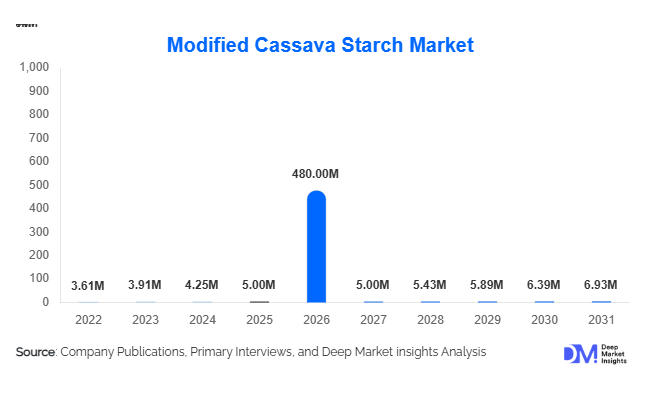
According to Deep Market Insights, the global modified cassava starch market size was valued at USD 5,480 million in 2025 and is projected to grow from USD 5,945.80 million in 2026 to reach USD 8,940.44 million by 2031, expanding at a CAGR of 8.5% during the forecast period (2026–2031). The market growth is primarily driven by rising demand for clean-label food ingredients, increasing adoption of bio-based industrial materials, and expanding applications in sustainable packaging and adhesives.
Modified cassava starch is widely utilized for its superior thickening, binding, stabilizing, and film-forming properties. Compared to other starch sources such as corn and potato, cassava offers neutral taste, gluten-free positioning, and higher paste clarity, making it highly suitable for food and pharmaceutical applications. Rapid industrialization in the Asia-Pacific and growing imports in North America and Europe further reinforce global trade flows. Additionally, sustainability mandates encouraging biodegradable and renewable raw materials are accelerating demand for cassava-derived modified starch in the paper, textile, and bioplastics industries.
Key Market Insights
- Asia-Pacific dominates the global market, accounting for nearly 48% of total revenue in 2025, supported by strong cassava cultivation and export infrastructure.
- Food & Beverage applications contribute 46% of total market demand, driven by processed food and gluten-free product expansion.
- Chemically modified starch leads by type, representing approximately 52% of global revenue.
- Paper & sustainable packaging is the fastest-growing application, expanding at over 9% CAGR due to bio-based material adoption.
- Direct B2B industrial sales dominate distribution, accounting for 63% of total transactions.
- The top five players hold nearly 38% market share, indicating moderate fragmentation with strong regional competition.
What are the latest trends in the modified cassava starch market?
Shift Toward Sustainable Bio-Based Materials
Governments and multinational corporations are increasingly replacing petroleum-derived materials with bio-based alternatives. Modified cassava starch is gaining traction in biodegradable packaging films, molded fiber products, and water-based adhesives. Packaging converters are integrating starch-based polymers into flexible films and compostable bags to meet sustainability mandates in Europe and parts of Asia. Food brands are also shifting toward recyclable and biodegradable packaging, further expanding demand for starch-based coatings and binders.
Premium Clean-Label and Functional Food Innovation
Consumers are demanding ingredient transparency and allergen-free formulations. Modified cassava starch aligns well with clean-label positioning, gluten-free claims, and non-GMO preferences. Food processors are increasingly adopting cross-linked and acetylated cassava starch variants to improve freeze-thaw stability in ready meals, dairy products, and sauces. The trend toward plant-based meat analogs is also supporting demand for functional binding and texturizing starch solutions.
What are the key drivers in the modified cassava starch market?
Expansion of the Processed Food Industry
Global processed food sales continue to rise, especially in emerging economies such as China, India, Indonesia, and Brazil. Modified cassava starch provides improved viscosity control, shelf-life stability, and texture enhancement, making it critical in soups, sauces, bakery fillings, and frozen foods. Urbanization and rising disposable income are key catalysts for food-grade starch demand.
Growth in Sustainable Packaging and Paper Industry
The paper and packaging sector is rapidly integrating starch-based adhesives and surface sizing agents. With rising restrictions on single-use plastics, demand for starch-modified coatings is accelerating, particularly in Europe and North America. Corrugated board manufacturers and paper mills are increasingly using modified cassava starch for bonding strength and printability enhancement.
What are the restraints for the global market?
Raw Material Price Volatility
Cassava cultivation is climate-sensitive, and yield fluctuations due to droughts or pests in Thailand, Vietnam, and Indonesia can increase raw material prices by 15–20%. Such volatility directly impacts producer margins and export pricing stability.
Competition from Corn-Based Modified Starch
Corn starch maintains strong dominance in developed markets due to established supply chains and scale efficiencies. Price competitiveness and customer familiarity with corn-based products remain key challenges for cassava starch manufacturers.
What are the key opportunities in the modified cassava starch industry?
Bioplastics and Compostable Packaging Integration
The global push toward compostable materials presents a significant opportunity. Modified cassava starch’s film-forming ability and biodegradability make it ideal for biofilms, trays, and molded packaging applications. Partnerships with packaging innovators and FMCG brands offer high-growth potential.
Industrial Adhesives and Textile Modernization
Emerging manufacturing hubs in Southeast Asia and Africa are increasing demand for cost-effective, high-performance adhesives and textile sizing agents. Cassava starch provides strong bonding properties at competitive prices, offering scalable growth in industrial applications.
Report Scope
| Report Metric | Details |
|---|---|
| Market Size in 2025 | USD 5480 Million |
| Market Size in 2026 | USD 5945.80 Million |
| Market Size in 2031 | USD 8940.44 Million |
| CAGR | 8.5% (2026-2031) |
| Base Year for Estimation | 2025 |
| Historical Data | 2022-2024 |
| Forecast Period | 2026-2031 |
| Report Coverage | Revenue Forecast, Competitive Landscape, Supply Chain Disruption, Growth Factors, Environment & Regulatory Landscape and Trends |
| Geographies Covered | North America, Europe, APAC, Middle East and Africa, LATAM |
| Countries Covered | U.S., Canada, U.K., Germany, France, Spain, Italy, Russia, Nordic, Benelux, Rest of Europe, China, Korea, Japan, India, Australia, Singapore, Taiwan, South East Asia, Rest of Asia-Pacific, UAE, Turky, Saudi Arabia, South Africa, Egypt, Nigeria, Rest of MEA, Brazil, Mexico, Argentina, Chile, Colombia, Rest of LATAM |
Explore more data points, trends and opportunities Download Free Sample Report
Modification Type Insights
Chemically modified cassava starch dominates the global market with approximately 52% share in 2025, making it the leading modification category. Its dominance is primarily driven by high-performance requirements in processed food, paper coating, and industrial adhesive applications. Cross-linked and acetylated cassava starch variants provide superior viscosity stability under high shear, extreme pH, and elevated temperature conditions. This makes them essential for ready-to-eat meals, canned foods, sauces, dairy desserts, and corrugated board adhesives. The growing demand for frozen and microwaveable foods in Asia-Pacific and North America has particularly strengthened the adoption of cross-linked starches, as they offer excellent freeze–thaw stability and improved texture retention.
Physically modified starch represents the second-largest segment, supported by strong demand in instant foods, bakery premixes, and convenience products. Pregelatinized cassava starch, which enables cold-water solubility and rapid thickening, is increasingly used in instant soups, infant foods, and quick-service restaurant formulations. Enzymatically modified starch, while smaller in volume, is gaining momentum in specialty applications such as pharmaceutical excipients and clean-label food formulations. Growth in this sub-segment is supported by regulatory preference for minimally processed ingredients and the rising adoption of enzymatic processing technologies that reduce chemical residues.
Application Insights
Food & Beverage applications account for approximately 46% of total market revenue in 2025, valued at nearly USD 2,520 million. This segment leads due to rising global consumption of processed and packaged foods, particularly in emerging economies. Modified cassava starch is widely used as a thickener, stabilizer, binder, and texturizer in bakery fillings, dairy desserts, sauces, gravies, processed meats, and gluten-free formulations. The expansion of plant-based food products has further strengthened demand, as starch plays a critical role in moisture retention and structural binding in meat alternatives.
Paper & Packaging is the fastest-growing major application, driven by global sustainability mandates and restrictions on single-use plastics. Modified cassava starch is extensively used in surface sizing, coating, and corrugated board adhesives to enhance bonding strength and printability. Growth in e-commerce and sustainable packaging solutions is accelerating starch consumption in this segment. Industrial applications such as textiles and adhesives collectively account for nearly 28% of global demand, supported by infrastructure development and export-oriented manufacturing in Southeast Asia. Pharmaceutical and personal care applications remain smaller in volume but generate higher margins due to demand for excipient-grade and cosmetic-grade starches.
End-Use Industry Insights
The food processing industry remains the largest end-use segment, contributing approximately 44% of global demand. Growth in this sector is driven by urbanization, rising disposable incomes, and increasing demand for convenience foods. Expansion of modern retail chains and quick-service restaurants across Asia and Latin America is further stimulating demand for modified starch ingredients. Food-grade starch producers are investing in high-purity and specialty variants to meet stringent safety and labeling standards.
The paper & packaging industry is the fastest-growing end-use sector, expanding at around 9.2% CAGR through 2031. The surge in corrugated packaging demand, driven by e-commerce logistics and eco-friendly packaging initiatives, is a major growth catalyst. Pharmaceutical end-use is witnessing steady expansion due to increasing tablet and capsule production globally. Additionally, emerging bio-based materials industries are integrating cassava starch polymers into molded fiber products and biodegradable plastic alternatives, positioning this segment as a long-term structural growth driver.
Explore more data points, trends and opportunities Download Free Sample Report
Modified Cassava Starch Market Segmentations
By Modification Type
- Chemically Modified Cassava Starch
- Physically Modified Cassava Starch
- Enzymatically Modified Cassava Starch
By Application
- Food & Beverage
- Paper & Packaging
- Industrial Applications
- Pharmaceuticals
- Personal Care & Cosmetics
- Animal Feed
By Distribution Channel
- Direct B2B Industrial Sales
- Specialty Ingredient Distributors
- Export Trading Companies
Regional Insights
Asia-Pacific
Asia-Pacific holds approximately 48% market share in 2025, maintaining its position as both the largest producer and consumer. Thailand, Vietnam, Indonesia, and China are key markets. Thailand alone contributes nearly 22% of global production value due to its extensive cassava cultivation, modern processing facilities, and export-oriented industry structure. Regional growth is driven by three primary factors: abundant raw material availability, cost-competitive labor, and strong export demand from Europe and North America. China represents a major consumption hub, importing modified cassava starch for food processing, paper manufacturing, and textile applications. Rapid industrialization and infrastructure expansion across Southeast Asia further reinforce regional demand.
North America
North America accounts for around 18% of global demand, led predominantly by the United States. Regional growth is fueled by increasing demand for gluten-free and clean-label food products, alongside sustainability-driven packaging innovation. The expansion of plant-based food manufacturers and pharmaceutical production capacity also supports starch consumption. Limited domestic cassava production means the region relies heavily on imports from Southeast Asia, strengthening international trade flows. Rising consumer awareness regarding biodegradable materials is accelerating adoption in packaging and industrial adhesives.
Europe
Europe captures nearly 20% market share, with Germany, France, and the Netherlands serving as key demand centers. Stringent environmental regulations and circular economy initiatives are strong regional growth drivers. The European Union’s sustainability policies and plastic reduction targets have accelerated the shift toward starch-based adhesives and biodegradable materials. Additionally, Europe’s advanced food processing industry demands high-quality modified starch for premium and organic food formulations. Import dependency from Asia remains high, particularly for specialty variants.
Latin America
Latin America holds approximately 9% of the global market, led by Brazil as both a producer and consumer. Regional growth is supported by expanding food processing capacity, rising exports of packaged food products, and government support for agricultural value addition. Brazil’s cassava cultivation base strengthens supply security, while growing industrial adhesive and textile manufacturing sectors contribute to demand. Increased foreign direct investment in food and beverage manufacturing is further stimulating consumption.
Middle East & Africa
The Middle East & Africa region represents around 5% of global demand but is the fastest-growing region, registering nearly 9.5% CAGR. Nigeria and South Africa are key growth markets. Regional expansion is driven by rising investments in food processing infrastructure, textile modernization, and import substitution policies. In Africa, cassava is widely cultivated, offering potential for domestic starch value addition. In the Middle East, strong demand for processed foods and packaging materials supports growth, particularly in the UAE and Saudi Arabia. Government-led industrial diversification programs are expected to accelerate starch-based material adoption in the coming years.
Key Players in the Modified Cassava Starch Market
- Cargill
- Ingredion Incorporated
- Tate & Lyle
- Roquette Frères
- AGRANA Beteiligungs-AG
- Thai Wah Public Company
- Emsland Group
- Avebe
- Visco Starch
- SPAC Starch Products
- Venus Starch Suppliers
- Sonish Starch Technology
- Universal Starch Chem Allied
- Asia Modified Starch Co.
- Banpong Tapioca Flour Industrial