Mochi Market Size
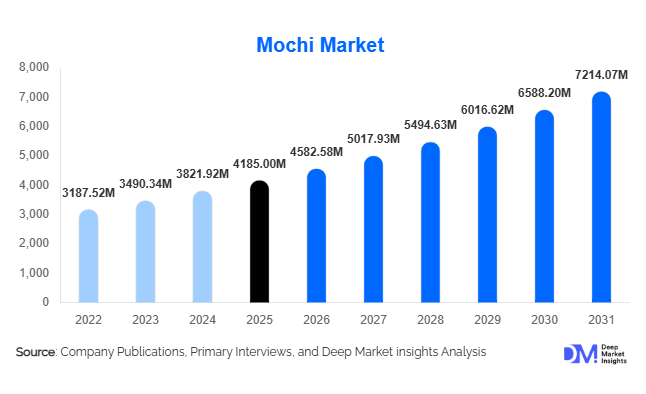
According to Deep Market Insights, the global mochi market size was valued at USD 4,185 million in 2025 and is projected to grow from USD 4,582.58 million in 2026 to reach USD 7,214.07 million by 2031, expanding at a CAGR of 9.5% during the forecast period (2026–2031). The mochi market growth is primarily driven by increasing global adoption of Asian desserts, rapid expansion of frozen dessert retail formats, and rising consumer demand for premium indulgent snacks with unique textures and flavors. Mochi, traditionally a Japanese rice-based confectionery, has transitioned from a culturally specific product into a globally recognized dessert category, supported by innovation in ice cream mochi, plant-based variants, and fusion flavors tailored to Western and emerging Asian markets.
Key Market Insights
- Frozen mochi ice cream dominates global revenue, accounting for the majority of international sales due to retail scalability and premium positioning.
- Asia-Pacific leads production and consumption, supported by strong cultural familiarity and expanding convenience retail networks.
- North America represents the fastest commercialization hub, driven by supermarket private labels and Asian dessert mainstreaming.
- Plant-based and low-sugar mochi variants are gaining traction as consumers prioritize healthier indulgence options.
- E-commerce and specialty dessert chains are accelerating global accessibility and brand visibility.
- Flavor innovation and cross-cultural fusion products are expanding mochi beyond traditional sweet applications.
What are the latest trends in the mochi market?
Premium Frozen Dessert Expansion
Mochi has increasingly positioned itself within the premium frozen dessert category, particularly through mochi ice cream products that combine chewy rice dough with artisanal ice cream fillings. Retailers are expanding freezer shelf space dedicated to globally inspired desserts, enabling mochi brands to compete directly with gelato and premium ice cream offerings. The rise of single-serve snack formats aligns with consumer preferences for portion-controlled indulgence, supporting repeat purchases. Innovation in flavors such as matcha, mango, salted caramel, and vegan chocolate continues to broaden consumer appeal across Western markets.
Health-Conscious Reformulation and Plant-Based Innovation
Manufacturers are reformulating mochi products to align with evolving dietary preferences. Gluten-free positioning, dairy-free fillings, reduced sugar content, and organic ingredients are becoming common product differentiators. Plant-based mochi ice cream using coconut, oat, and almond milk bases is expanding rapidly, particularly in North America and Europe. Functional ingredients such as collagen, probiotics, and natural sweeteners are also being introduced, transforming mochi from a novelty dessert into a better-for-you indulgence category.
What are the key drivers in the mochi market?
Globalization of Asian Cuisine
The rapid globalization of Japanese and broader Asian cuisine has significantly accelerated mochi consumption worldwide. Sushi chains, Asian dessert cafés, and social media exposure have familiarized consumers with mochi textures and flavors. Younger consumers increasingly seek experiential foods, making mochi’s unique chewy texture a strong differentiator in competitive dessert markets.
Growth of Frozen Food Retail Infrastructure
Expansion of modern retail and cold-chain logistics has enabled large-scale distribution of frozen mochi products. Supermarkets, hypermarkets, and online grocery platforms now offer wide frozen dessert assortments, allowing mochi brands to scale globally while maintaining product quality. Improvements in cold storage infrastructure across emerging economies are further expanding accessibility.
Snackification and Premium Treat Consumption
Consumers are shifting toward smaller, indulgent snacks consumed throughout the day rather than traditional desserts after meals. Mochi’s bite-sized format aligns perfectly with this behavioral shift. Premiumization trends encourage consumers to pay higher prices for artisanal desserts, supporting margin expansion for manufacturers.
What are the restraints for the global market?
Cold Chain Dependency and Shelf-Life Constraints
Frozen mochi products require consistent cold-chain logistics, increasing transportation and storage costs. Emerging markets with limited refrigeration infrastructure face slower adoption rates, restricting penetration outside urban centers.
Raw Material Price Volatility
Fluctuations in glutinous rice prices and dairy input costs impact production margins. Climate variability affecting rice production in Asia poses supply risks, requiring manufacturers to diversify sourcing strategies and optimize procurement models.
What are the key opportunities in the mochi industry?
Expansion into Emerging Markets
Rapid urbanization and rising disposable incomes in Southeast Asia, India, the Middle East, and Latin America present major growth opportunities. Modern retail penetration and exposure to global food culture are enabling mochi to transition from niche imports into locally produced desserts. Regional flavor customization, such as tropical fruit variants, is expected to accelerate adoption.
Foodservice and Quick-Service Dessert Integration
Restaurants and café chains are increasingly incorporating mochi into dessert menus, milk tea offerings, and fusion bakery products. Partnerships with bubble tea brands and dessert franchises create recurring demand channels and improve product visibility. Foodservice adoption also enables product experimentation before retail expansion.
Technological Innovation in Manufacturing
Automation in rice processing and freezing technology is improving production efficiency and consistency. Advanced freezing techniques enhance texture stability while extending shelf life, enabling exports across longer distances. Smart packaging solutions and sustainable materials further strengthen brand differentiation and regulatory compliance.
Report Scope
| Report Metric | Details |
|---|---|
| Market Size in 2025 | USD 4185 Million |
| Market Size in 2026 | USD 4582.58 Million |
| Market Size in 2031 | USD 7214.07 Million |
| CAGR | 9.5% (2026-2031) |
| Base Year for Estimation | 2025 |
| Historical Data | 2022-2024 |
| Forecast Period | 2026-2031 |
| Report Coverage | Revenue Forecast, Competitive Landscape, Supply Chain Disruption, Growth Factors, Environment & Regulatory Landscape and Trends |
| Geographies Covered | North America, Europe, APAC, Middle East and Africa, LATAM |
| Countries Covered | U.S., Canada, U.K., Germany, France, Spain, Italy, Russia, Nordic, Benelux, Rest of Europe, China, Korea, Japan, India, Australia, Singapore, Taiwan, South East Asia, Rest of Asia-Pacific, UAE, Turky, Saudi Arabia, South Africa, Egypt, Nigeria, Rest of MEA, Brazil, Mexico, Argentina, Chile, Colombia, Rest of LATAM |
Explore more data points, trends and opportunities Download Free Sample Report
Product Type Insights
The global mochi market is primarily led by mochi ice cream, which accounts for approximately 58% of total global revenue in 2025. The dominance of this segment is strongly linked to its successful positioning as a premium, portion-controlled frozen dessert that blends traditional Asian confectionery with modern indulgence trends. Mochi ice cream benefits from strong retail visibility, attractive packaging formats, and compatibility with evolving consumer preferences for novelty desserts that offer both texture differentiation and flavor variety. The leading driver for this segment is the rapid globalization of frozen dessert innovation, supported by expanding freezer infrastructure in modern retail outlets and the growing popularity of Asian-inspired desserts among younger consumers. Manufacturers continue to prioritize this category due to its scalability, higher margins compared to traditional confectionery, and strong potential for flavor innovation and seasonal product launches.Traditional sweet mochi represents nearly 24% of the global market share, supported by deeply rooted cultural consumption patterns across East Asian markets, particularly Japan, China, and South Korea. This segment maintains steady demand due to ceremonial usage, gifting traditions, and daily snack consumption. While growth remains moderate compared to frozen formats, product diversification through healthier fillings, reduced sugar formulations, and premium artisanal positioning is sustaining relevance among modern consumers seeking authenticity. The preservation of heritage food culture combined with modernization in packaging and shelf-life technology continues to support stable expansion.Savory mochi variants remain a relatively niche but evolving category, primarily gaining traction within foodservice environments such as fusion restaurants and specialty cafés. The expansion of experimental culinary concepts and cross-cultural menu innovation is gradually introducing savory fillings including cheese, seafood, and plant-based ingredients. Although the segment currently contributes a smaller revenue share, it reflects the broader industry transition toward versatility and culinary experimentation. Innovation-led frozen and ready-to-eat formats are expected to further expand commercialization opportunities as manufacturers explore new consumption occasions beyond desserts.
Flavor Insights
Flavor innovation plays a central role in shaping consumer engagement within the mochi market, with matcha emerging as the leading flavor, accounting for nearly 18% of global demand. The primary driver behind matcha’s leadership is the global expansion of Japanese culinary culture alongside increasing consumer perception of matcha as a premium and wellness-associated ingredient. Its distinct taste profile, antioxidant positioning, and strong visual appeal contribute to sustained popularity across both traditional and modern retail environments.Mango and chocolate flavors closely follow in market share due to their universal acceptance across diverse geographic regions. Mango benefits from strong appeal in tropical and emerging markets where fruit-based desserts resonate with local taste preferences, while chocolate continues to serve as an accessible entry point for first-time consumers unfamiliar with mochi textures. These flavors help bridge cultural gaps, enabling brands to localize products without losing authenticity.Fusion flavors combining Western dessert profiles with Asian ingredients are witnessing double-digit growth rates globally. Innovations such as cookies-and-cream mochi, salted caramel variants, and fruit-cheesecake combinations are expanding consumer demographics and encouraging repeat purchases. The leading growth driver within the flavor segment is experiential consumption, where consumers seek novelty, social media appeal, and premium sensory experiences. Limited-edition launches and seasonal flavor rotations are increasingly used as strategic tools to maintain consumer excitement and brand differentiation.
Distribution Channel Insights
Supermarkets and hypermarkets remain the dominant distribution channel, accounting for approximately 46% of total market share in 2025. The leading driver for this segment is the rapid expansion of frozen food infrastructure combined with impulse purchasing behavior influenced by in-store visibility and promotional bundling. Large retail chains provide consistent cold-chain reliability, enabling broader product availability and encouraging trial purchases among mainstream consumers. Enhanced freezer placements, private-label collaborations, and premium dessert aisles continue to strengthen retail penetration.Online retail represents the fastest-growing distribution channel, driven by advancements in temperature-controlled logistics and the rise of direct-to-consumer frozen delivery models. E-commerce platforms allow niche brands and artisanal producers to access wider audiences without traditional retail constraints. Subscription dessert boxes, specialty Asian food marketplaces, and quick-commerce platforms are accelerating adoption, particularly in urban regions where convenience-driven consumption patterns dominate. Digital marketing and influencer-led promotions further amplify online channel expansion by educating consumers about mochi products.
End-Use Insights
Retail household consumption dominates the market, accounting for nearly 62% of total global demand, reflecting mochi’s transformation from a culturally specific confection into a mainstream packaged snack. The leading driver behind this segment is the shift toward at-home indulgence and premium snacking occasions, supported by increasing freezer ownership and rising demand for portion-controlled desserts. Consumers increasingly view mochi as a convenient alternative to traditional ice cream servings, aligning with lifestyle trends emphasizing moderation and novelty.Foodservice applications are expanding rapidly as cafés, dessert chains, and quick-service restaurants integrate mochi-based offerings into menus. Urban dining culture and experiential dessert consumption are key growth contributors, with operators leveraging mochi’s unique texture and customizable flavor formats to differentiate menus. Mochi toppings for beverages, plated desserts, and fusion culinary applications are becoming increasingly common, particularly in metropolitan markets where international cuisine adoption is accelerating.
Explore more data points, trends and opportunities Download Free Sample Report
Mochi Market Segmentations
By Product Type
- Mochi Ice Cream
- Traditional Sweet Mochi
- Savory Mochi
- Frozen Ready-to-Eat Mochi Snacks
By Flavor
- Matcha
- Chocolate
- Mango
- Strawberry
- Red Bean
- Vanilla
- Fusion & Seasonal Flavors
By Distribution Channel
- Supermarkets & Hypermarkets
- Convenience Stores
- Online Retail & Direct-to-Consumer
- Specialty Dessert Stores
- Foodservice & HoReCa
By End Use
- Household Retail Consumption
- Foodservice & Restaurants
- Cafés & Dessert Chains
- Institutional Buyers
Regional Insights
Asia-Pacific
Asia-Pacific dominates the global mochi market, accounting for approximately 48% share in 2025, supported by strong cultural heritage, established manufacturing ecosystems, and high consumer familiarity. Japan remains the largest producer and consumer, benefiting from deep-rooted traditional consumption as well as continuous product innovation in premium frozen desserts. China is experiencing rapid expansion driven by premium retail modernization, rising disposable incomes, and the growing popularity of aesthetically appealing desserts among younger consumers. South Korea and Taiwan contribute significantly through vibrant café cultures and dessert-focused social trends that encourage frequent product experimentation. India is emerging as a high-growth market, fueled by increasing exposure to Asian cuisines through digital media, expansion of organized retail, and rising demand for premium frozen desserts among urban middle-class consumers. The region’s growth is further supported by strong supply chain capabilities and localized flavor development tailored to regional tastes.
North America
North America accounts for nearly 24% of global demand, led primarily by the United States where mochi ice cream has transitioned into a mainstream supermarket dessert category. Regional growth is driven by increasing multicultural food adoption, strong demand for gluten-free dessert options, and consumer openness toward globally inspired snacks. Health-conscious positioning, portion control benefits, and premium branding strategies continue to attract younger demographics. Canada follows a similar growth trajectory, supported by expanding Asian populations, specialty grocery retail expansion, and increased availability through both traditional supermarkets and online frozen delivery platforms.
Europe
Europe represents approximately 16% of global market share, with strong demand emerging across the United Kingdom, Germany, and France. Regional growth is primarily driven by premium dessert culture, rising experimentation with international cuisines, and strong consumer interest in plant-based and vegan alternatives. European consumers demonstrate high acceptance of innovative textures and artisanal dessert concepts, encouraging manufacturers to introduce organic, dairy-free, and sustainably sourced mochi products. Expanding Asian restaurant presence and specialty food retailers further accelerate product awareness and trial rates across major metropolitan areas.
Middle East & Africa
The Middle East & Africa region is witnessing steady expansion, led by the United Arab Emirates and Saudi Arabia where premium dessert consumption continues to rise alongside rapid urbanization. Growth drivers include high expatriate populations familiar with Asian cuisine, expanding luxury retail environments, and the proliferation of upscale dessert cafés and mall-based dining destinations. Increasing tourism and hospitality sector investments are also contributing to higher demand for innovative dessert offerings, positioning mochi as a premium experiential product within the region’s evolving foodservice landscape.
Latin America
Latin America remains an emerging but fast-developing market, with Brazil and Mexico leading regional adoption. Growth is primarily supported by increasing exposure to global dessert trends through social media, improving cold-chain logistics infrastructure, and expansion of modern retail formats. Younger consumers are demonstrating strong interest in novel international snacks, encouraging retailers to introduce imported and locally produced mochi varieties. Although market penetration remains at an early stage, accelerating urbanization, rising disposable incomes, and growing premium dessert experimentation are expected to drive sustained long-term growth across the region.
Key Players in the Mochi Market
- Lotte Corporation
- Bubbies Homemade Ice Cream & Desserts
- My/Mochi Ice Cream
- Royal Family Food Co., Ltd.
- Daifuku Co., Ltd.
- Little Moons
- Mikawaya
- Yuki & Love
- Sei Shonagon Co.
- Three Friends Mochi
- Maeda-en
- Wagashi Ichie
- Snowfox Group
- Yamato Seika
- Chikara Mochi