Global Milk Tea Market Size
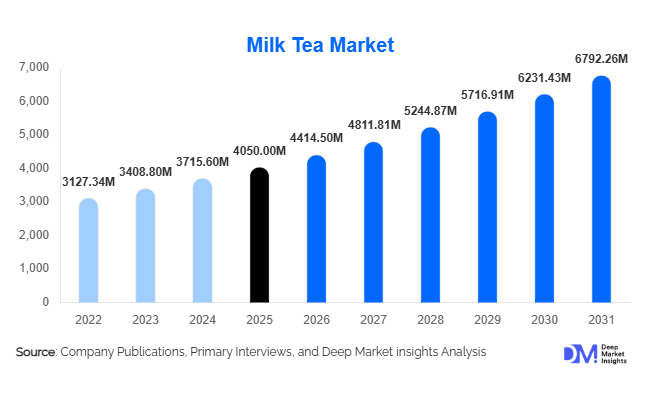
According to Deep Market Insights, the global milk tea market size was valued at USD 4,050 million in 2025 and is projected to grow from USD 4,414.50 million in 2026 to reach USD 6,792.26 million by 2031, expanding at a CAGR of 9.0% during the forecast period (2026–2031). The milk tea market growth is primarily driven by the rising global popularity of bubble tea culture, increasing café-based social consumption, rapid expansion of franchise beverage chains, and growing demand for customizable and premium flavored beverages across both developed and emerging economies.
Key Market Insights
- Bubble tea and pearl-based milk tea dominate global consumption, driven by strong youth appeal and high customization potential across flavors, toppings, and sweetness levels.
- Asia-Pacific remains the largest consumption hub, with China, Taiwan, Japan, South Korea, and India leading demand due to deep-rooted tea culture and rapid urbanization.
- Plant-based milk tea is rapidly expanding, supported by rising lactose intolerance awareness and vegan dietary adoption in North America and Europe.
- On-trade café and specialty tea shops dominate distribution, although online delivery platforms are growing fastest in urban markets.
- Health-conscious formulations are reshaping product innovation, with low-sugar, sugar-free, and functional milk teas gaining traction.
- Franchise expansion and digital ordering ecosystems are accelerating global scalability of milk tea brands.
What are the latest trends in the milk tea market?
Premiumization and Flavor Innovation
The milk tea market is witnessing strong premiumization, with brands introducing gourmet flavors, seasonal editions, and artisanal brewing techniques. Consumers are increasingly willing to pay more for unique experiences such as cheese foam teas, brown sugar pearl milk teas, and fruit-infused blends. This trend is particularly strong in urban Asia-Pacific and is gradually spreading to Western markets through franchise expansion and influencer-driven marketing.
Health-Oriented and Functional Beverages
Growing health awareness is pushing manufacturers to reformulate traditional milk tea offerings. Low-calorie, plant-based, and fortified milk teas enriched with collagen, probiotics, and vitamins are gaining traction. Sugar reduction policies in several countries are also encouraging brands to diversify into healthier alternatives without compromising taste or texture.
Digital-First Consumption Ecosystem
Online ordering platforms, mobile apps, and cloud kitchens are reshaping how milk tea is consumed. Delivery-first brands are expanding rapidly in densely populated cities, reducing dependency on physical store networks. AI-driven recommendation systems and personalized beverage customization are enhancing customer engagement and boosting repeat purchases.
What are the key drivers in the milk tea market?
Rising Global Café and Social Beverage Culture
Milk tea has become a social lifestyle beverage, especially among Gen Z and millennials. The influence of café culture, combined with Instagram-driven beverage trends, is significantly boosting consumption globally. Specialty tea shops are increasingly becoming social hubs in urban areas.
Rapid Franchise and Brand Expansion
Global milk tea brands are aggressively expanding through franchising models, particularly in North America, Europe, and Southeast Asia. Standardized operations, strong branding, and low-entry franchise systems are enabling rapid scalability and market penetration.
Customization and Product Personalization
Consumers now expect full control over sweetness, toppings, milk type, and flavor combinations. This high level of personalization is increasing average transaction value and strengthening brand loyalty across major milk tea chains.
What are the restraints for the global market?
Health Concerns Related to Sugar Content
High sugar levels and calorie density in traditional milk tea products are raising health concerns globally. Increasing regulatory pressure and consumer awareness around obesity and diabetes are limiting consumption frequency in developed markets.
High Operational and Franchise Costs
Premium milk tea outlets face high costs related to rent, staffing, and ingredient sourcing. These operational challenges restrict profitability, especially in high-cost urban regions, and create barriers for small-scale entrants.
What are the key opportunities in the milk tea industry?
Plant-Based and Functional Milk Tea Expansion
The shift toward vegan and health-conscious lifestyles presents a major opportunity. Plant-based milk teas using oat, almond, and soy milk are gaining strong traction, especially in Western markets. Functional beverages infused with wellness ingredients are further expanding the premium segment.
Emerging Market Penetration and Franchising
Regions such as Latin America, the Middle East, and Eastern Europe offer untapped potential for milk tea expansion. Rising disposable incomes and growing café culture are enabling international brands to enter these markets through franchise partnerships and localized product adaptation.
Digital and Cloud Kitchen Expansion
Delivery-only milk tea brands and cloud kitchen models are enabling rapid market entry with low capital investment. This model is particularly effective in densely populated cities, allowing brands to scale without heavy retail infrastructure.
Report Scope
| Report Metric | Details |
|---|---|
| Market Size in 2025 | USD 4050.00 Million |
| Market Size in 2026 | USD 4414.50 Million |
| Market Size in 2031 | USD 6792.26 Million |
| CAGR | 9% (2026-2031) |
| Base Year for Estimation | 2025 |
| Historical Data | 2022-2024 |
| Forecast Period | 2026-2031 |
| Report Coverage | Revenue Forecast, Competitive Landscape, Supply Chain Disruption, Growth Factors, Environment & Regulatory Landscape and Trends |
| Geographies Covered | North America, Europe, APAC, Middle East and Africa, LATAM |
| Countries Covered | U.S., Canada, U.K., Germany, France, Spain, Italy, Russia, Nordic, Benelux, Rest of Europe, China, Korea, Japan, India, Australia, Singapore, Taiwan, South East Asia, Rest of Asia-Pacific, UAE, Turky, Saudi Arabia, South Africa, Egypt, Nigeria, Rest of MEA, Brazil, Mexico, Argentina, Chile, Colombia, Rest of LATAM |
Explore more data points, trends and opportunities Download Free Sample Report
Product Type Insights
The global milk tea market is witnessing substantial diversification across product categories as evolving consumer preferences, premiumization trends, and international flavor adoption continue to reshape the competitive landscape. Among all product types, bubble or pearl milk tea continues to dominate the market and represents the leading revenue-generating segment globally. The dominance of bubble tea is strongly supported by its deep-rooted cultural relevance in Asia-Pacific markets, increasing visibility across social media platforms, and its highly customizable nature that appeals to younger demographics. Consumers increasingly prefer beverages that offer personalization in sweetness levels, toppings, flavors, and milk alternatives, making bubble tea one of the most adaptable beverage categories in the global non-alcoholic drinks industry. The rising influence of digital food culture, influencer-driven beverage trends, and visually appealing product presentation has further accelerated global demand for bubble tea products across both developed and emerging economies.The primary growth driver for traditional milk tea products is the enduring cultural attachment to tea consumption across Asia-Pacific and Middle Eastern markets. Increasing café modernization and premium tea house concepts are also helping traditional tea products evolve into premium offerings while maintaining authentic taste profiles. In addition, tourism-driven food experiences are encouraging international consumers to explore regional milk tea varieties, supporting global awareness and cross-cultural demand.Flavored milk tea products, including chocolate-infused, fruit-based, caramel, vanilla, taro, matcha, and specialty fusion beverages, are witnessing accelerated growth across North America and Europe. Consumers in these regions increasingly seek innovative beverage experiences that combine indulgence, novelty, and customization. Brands are leveraging limited-time flavors, fusion ingredients, and localized taste adaptations to strengthen consumer engagement and expand their customer base.The leading driver for flavored milk tea growth is the rising demand for innovative and experiential beverages among younger consumers seeking variety and premium café-style products. The influence of social media marketing and visually distinctive beverage presentations is further stimulating demand for colorful and specialty flavored milk teas. Additionally, collaborations between beverage brands and entertainment franchises are contributing to increased consumer interest and product experimentation.
Application Insights
The foodservice segment continues to dominate global milk tea consumption and remains the largest application category within the market. Specialty tea chains, cafés, quick-service restaurants, dessert outlets, and beverage kiosks collectively contribute a significant share of total market revenue. The popularity of milk tea as a social and experiential beverage has transformed tea shops into lifestyle-oriented destinations, particularly among younger consumers who prioritize social interaction, aesthetic presentation, and personalized beverage experiences. Foodservice operators are increasingly integrating digital ordering systems, loyalty applications, and AI-powered customer engagement platforms to improve operational efficiency and enhance customer retention.The leading driver for the foodservice segment is the growing consumer preference for customizable and experience-driven beverage consumption. Consumers increasingly value freshly prepared drinks with personalized toppings, sweetness levels, and ingredient combinations, which strongly supports café and tea shop demand. The rapid expansion of franchise-based milk tea brands across metropolitan cities and suburban markets is also significantly contributing to segment growth. In emerging economies, rising middle-class spending and urban café culture are further strengthening foodservice demand.The leading driver for institutional milk tea consumption is the increasing demand for premium ready-to-drink beverages in office and institutional environments. Employers and facility operators are increasingly focusing on employee wellness, convenience, and premium foodservice experiences, supporting adoption of tea-based beverages within corporate ecosystems.Export-driven demand from Asian manufacturers is also playing a major role in expanding the global milk tea market. Countries such as China, Taiwan, Thailand, and Vietnam are major exporters of tea ingredients, tapioca pearls, syrups, and ready-to-drink milk tea products. International trade is significantly improving product accessibility across emerging milk tea markets in Europe, Latin America, and the Middle East.
Distribution Channel Insights
On-trade distribution channels, including cafés, tea boutiques, quick-service restaurants, kiosks, and specialty beverage outlets, account for the largest share of the global milk tea market. The dominance of on-trade channels is strongly associated with the experiential nature of milk tea consumption. Consumers increasingly seek premium in-store experiences characterized by fresh preparation, aesthetic presentation, interactive ordering systems, and customized beverage options. Tea chains are also investing heavily in modern store designs, digital ordering technologies, and customer loyalty programs to enhance consumer engagement.The leading growth driver for on-trade distribution channels is the increasing popularity of experiential beverage consumption among urban youth populations. Social media-driven café culture and rising consumer demand for personalized beverages continue to support high foot traffic across tea shops and specialty beverage outlets. Additionally, the aggressive international expansion of franchise-operated milk tea chains is strengthening on-trade market penetration globally.The leading driver for online distribution growth is rapid digital adoption and increasing reliance on smartphone-based food ordering systems. The integration of artificial intelligence, loyalty rewards, and personalized recommendation systems within delivery platforms is further improving customer engagement and repeat purchases.Direct-to-consumer brand websites and proprietary mobile applications are also gaining importance as companies seek greater control over customer relationships and profit margins. These channels allow brands to gather consumer insights, launch exclusive promotions, and strengthen long-term brand loyalty through membership programs and personalized experiences.Franchise-operated stores remain one of the most important expansion models within the milk tea market. International and regional brands continue to leverage franchising strategies to accelerate geographic expansion while minimizing operational risks and capital requirements. Franchise models are particularly effective in emerging markets where local operators possess stronger understanding of regional consumer behavior and market dynamics.
Explore more data points, trends and opportunities Download Free Sample Report
Milk Tea Market Segmentations
By Product Type
- Traditional Milk Tea
- Flavored Milk Tea
- Bubble / Pearl Milk Tea
- Ready-to-Drink (RTD) Milk Tea
- Instant Milk Tea Powder Mix
By Distribution Channel
- On-Trade
- Off-Trade
- Online Delivery Platforms
By Ingredient Base
- Dairy-Based Milk Tea
- Plant-Based Milk Tea
By Sweetness Level
- Regular Sugar Milk Tea
- Low Sugar Milk Tea
- Sugar-Free / Diet Milk Tea
By Packaging Format
- Freshly Prepared
- Bottled / Packaged RTD
- Instant Sachets / Powder Packs
Regional Insights
Asia-Pacific
Asia-Pacific dominates the global milk tea market and accounts for approximately 55% of total market share in 2025. The region serves as both the cultural foundation and the largest consumption hub for milk tea products worldwide. China represents the largest market within the region, supported by the rapid expansion of domestic bubble tea chains, high urban population density, and strong digital food delivery ecosystems. Taiwan continues to hold strategic importance as the birthplace of modern bubble tea culture and remains a center for product innovation and premium tea concepts. Countries such as Japan and South Korea contribute significantly through premiumization trends, advanced beverage innovation, and strong café culture.The primary drivers supporting regional growth in Asia-Pacific include strong tea-drinking traditions, rapid franchise expansion, increasing smartphone penetration, rising food delivery adoption, and continuous product innovation. The region also benefits from highly developed supply chains for tea ingredients, tapioca pearls, dairy products, and packaging materials, enabling cost-efficient production and large-scale distribution. Additionally, social media influence and youth-oriented consumer trends continue to strengthen market expansion across both developed and emerging economies.
North America
North America accounts for nearly 20% of the global milk tea market share in 2025, led primarily by the United States and Canada. The market has experienced rapid expansion due to growing multicultural food adoption and the increasing influence of Asian diaspora communities. Major metropolitan areas including New York, Los Angeles, Toronto, Vancouver, and San Francisco have emerged as important hubs for bubble tea chains and specialty beverage concepts.The leading drivers for regional growth in North America include rising consumer interest in Asian-inspired beverages, increasing café culture adoption, strong social media influence, and expanding franchise investments by international milk tea brands. The rapid growth of food delivery applications and digital ordering platforms is also contributing significantly to regional market expansion.
Europe
Europe represents approximately 15% of the global milk tea market, with the United Kingdom, Germany, and France leading regional demand. The European market is experiencing strong momentum as younger consumers increasingly seek premium café experiences and globally inspired beverage options. Milk tea has gained popularity within urban centers, universities, shopping districts, and tourism-focused commercial areas.The primary drivers supporting regional growth in Europe include expanding café culture, rising multicultural food acceptance, increasing consumer interest in innovative beverages, and aggressive franchise expansion by international tea chains. Growth in online food delivery infrastructure and premium retail beverage categories is also contributing to increased market penetration across major European cities.
Latin America
Latin America accounts for approximately 4% of the global milk tea market, with Brazil and Mexico emerging as the leading regional markets. Although still at an early stage of development, the region demonstrates considerable long-term growth potential due to increasing urbanization, rising middle-class income levels, and expanding international foodservice investments.The major drivers for regional growth in Latin America include increasing disposable incomes, expansion of international franchise brands, growing digital food delivery penetration, and rising consumer exposure to global beverage trends. The development of modern retail infrastructure is also expected to improve accessibility for ready-to-drink milk tea products over the forecast period.
Middle East & Africa
The Middle East & Africa region holds approximately 6% market share, led by the UAE and Saudi Arabia. The region is characterized by rapidly expanding premium café culture, high consumer spending on luxury foodservice experiences, and increasing youth-oriented beverage consumption trends. International milk tea brands are increasingly entering Gulf markets through franchise partnerships and premium shopping mall locations.The primary drivers supporting growth in the Middle East & Africa include increasing tourism activity, rising café culture adoption, premiumization of non-alcoholic beverages, and growing influence of international foodservice brands. Rapid infrastructure development, rising smartphone usage, and expanding online delivery services are further accelerating regional market expansion.
Key Players in the Global Milk Tea Market
- HEYTEA
- Gong Cha
- Chatime
- CoCo Fresh Tea & Juice
- Kung Fu Tea
- Tiger Sugar
- YiFang Fruit Tea
- Sharetea
- The Alley
- Tealive
- Presotea
- Nayuki Tea
- Chagee
- KOI Thé
- Happy Lemon