Microbiological Testing of Water Market Size
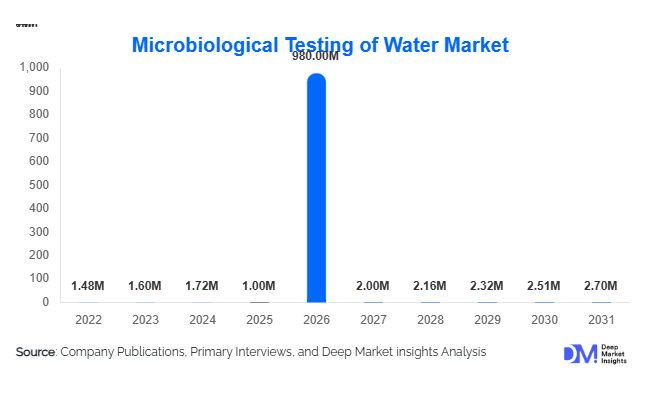
According to Deep Market Insights, the global microbiological testing of water market size was valued at USD 1,980 million in 2025 and is projected to grow from USD 2,134.44 million in 2026 to reach USD 3,107.26 million by 2031, expanding at a CAGR of 7.8% during the forecast period (2026–2031). Market growth is primarily driven by stringent regulatory mandates for drinking water safety, rising incidence of waterborne diseases, modernization of municipal water infrastructure, and increasing adoption of rapid microbiological methods (RMM) and PCR-based testing technologies.
Key Market Insights
- Municipal water authorities account for nearly 33% of total demand, driven by mandatory compliance testing for coliforms and pathogens.
- Culture-based testing methods dominate with approximately 42% market share, though molecular testing is expanding at a faster rate.
- North America leads the global market with around 34% share, supported by EPA regulations and infrastructure upgrades.
- Asia-Pacific is the fastest-growing region, registering growth above 9% CAGR due to urbanization and government-led water safety initiatives.
- Test kits and reagents contribute nearly 38% of global revenue, supported by recurring consumption and compliance-driven repeat testing.
- Technological integration, including automation, AI-assisted colony counting, and digital compliance reporting, is reshaping laboratory workflows.
What are the latest trends in the microbiological testing of water market?
Shift Toward Rapid and Molecular Testing Methods
Traditional culture-based methods remain foundational; however, rapid microbiological methods (RMM) and PCR-based testing are gaining strong traction. Laboratories are increasingly adopting qPCR and enzyme-substrate tests to reduce turnaround times from 24–48 hours to under 6 hours. This transition is particularly prominent in pharmaceutical-grade water testing and export-driven food & beverage production, where faster batch release is critical. Automation is further reducing manual intervention, improving accuracy, and enabling real-time microbial monitoring in high-risk facilities.
Digitalization and Smart Water Monitoring Integration
Water utilities and industrial operators are integrating microbiological testing systems with IoT-enabled monitoring platforms. Cloud-based laboratory information management systems (LIMS), automated colony counters, and AI-driven analytics are improving traceability and compliance reporting. Smart city initiatives are embedding digital water quality dashboards, allowing authorities to respond proactively to contamination risks. This trend is especially visible in North America, Europe, and parts of Asia-Pacific where infrastructure modernization programs are accelerating.
What are the key drivers in the microbiological testing of water market?
Stringent Regulatory Compliance Requirements
Governments worldwide enforce strict microbial limits in drinking water, wastewater discharge, bottled water, and pharmaceutical-grade water. Standards under EPA, WHO, ISO 9308, and EU Drinking Water Directive mandate routine coliform and pathogen testing. Non-compliance can result in heavy penalties, operational shutdowns, and reputational damage, making testing non-discretionary. Regulatory tightening in emerging markets is further expanding global testing volumes.
Rising Waterborne Disease Incidents and Public Awareness
Climate change, flooding, aging pipelines, and industrial discharge are increasing contamination risks. Outbreaks of Legionella, cholera, and E. coli have prompted proactive surveillance programs in hospitals, hospitality facilities, and industrial plants. Public awareness campaigns are increasing bottled water and municipal testing frequencies, driving recurring demand for kits and reagents.
What are the restraints for the global market?
High Capital Investment for Advanced Systems
Molecular testing platforms, automated incubators, and integrated data systems require significant upfront investment. Small laboratories and municipalities in developing economies often rely on conventional culture methods due to budget constraints, limiting rapid technology penetration.
Shortage of Skilled Laboratory Professionals
Advanced microbial testing requires trained microbiologists and quality control specialists. Workforce shortages in developing regions restrict adoption of complex molecular systems and automation platforms, impacting overall market scalability.
What are the key opportunities in the microbiological testing of water industry?
Infrastructure Modernization in Emerging Economies
Large-scale public investment programs in India, China, Southeast Asia, and the Middle East are upgrading water supply systems. Rural drinking water missions and desalination expansion projects are creating sustained testing demand. Suppliers offering cost-efficient, portable testing systems stand to benefit significantly.
Expansion in Pharmaceutical and Biologics Manufacturing
The global pharmaceutical industry, valued above USD 1.5 trillion, requires stringent microbial control of purified and sterile water. Growth in biologics, vaccines, and sterile injectables is increasing demand for high-precision microbial testing systems. Rapid release testing solutions offer strong revenue potential.
Report Scope
| Report Metric | Details |
|---|---|
| Market Size in 2025 | USD 1980 Million |
| Market Size in 2026 | USD 2134.44 Million |
| Market Size in 2031 | USD 3107.26 Million |
| CAGR | 7.8% (2026-2031) |
| Base Year for Estimation | 2025 |
| Historical Data | 2022-2024 |
| Forecast Period | 2026-2031 |
| Report Coverage | Revenue Forecast, Competitive Landscape, Supply Chain Disruption, Growth Factors, Environment & Regulatory Landscape and Trends |
| Geographies Covered | North America, Europe, APAC, Middle East and Africa, LATAM |
| Countries Covered | U.S., Canada, U.K., Germany, France, Spain, Italy, Russia, Nordic, Benelux, Rest of Europe, China, Korea, Japan, India, Australia, Singapore, Taiwan, South East Asia, Rest of Asia-Pacific, UAE, Turky, Saudi Arabia, South Africa, Egypt, Nigeria, Rest of MEA, Brazil, Mexico, Argentina, Chile, Colombia, Rest of LATAM |
Explore more data points, trends and opportunities Download Free Sample Report
Product Type Insights
Test kits and reagents represent the largest product category, contributing approximately 38% of total market revenue in 2025. The dominance of this segment is primarily driven by the recurring nature of microbiological testing, as regulatory frameworks mandate routine and repetitive monitoring of drinking water, wastewater, bottled water, and pharmaceutical-grade water. Unlike instruments, which involve one-time capital expenditure, reagents and kits generate continuous revenue streams due to batch-wise testing requirements. The increasing adoption of enzyme-substrate tests and rapid detection kits in municipal and industrial laboratories further strengthens this segment’s leadership. Additionally, export-oriented food and beverage manufacturers must conduct frequent compliance testing, significantly increasing consumption of ready-to-use test kits.
Instruments account for a substantial share of the market due to the rising deployment of automated incubators, PCR systems, colony counters, and integrated microbial detection platforms. Capital investments are particularly strong in developed markets where laboratories are modernizing to improve throughput and reduce turnaround times. Consumables such as culture media, petri dishes, and membrane filters provide steady recurring revenue, especially in culture-based testing environments. Meanwhile, third-party testing services are expanding rapidly in emerging economies, where manufacturers rely on certified laboratories to meet international export standards and regulatory documentation requirements.
Technology Insights
Culture-based methods hold around 42% of the global market share, maintaining dominance due to their long-standing regulatory acceptance as gold-standard methods for compliance testing. Regulatory agencies across North America, Europe, and Asia continue to require confirmatory culture tests for coliforms and pathogens, ensuring stable demand. The cost-effectiveness and standardized protocols of membrane filtration and multiple tube fermentation methods further reinforce this segment’s leadership, particularly in municipal laboratories.
However, molecular methods, including PCR and qPCR, represent the fastest-growing technology segment. Growth is driven by the need for rapid detection, higher sensitivity, and reduced incubation time. Pharmaceutical manufacturers and high-value industrial processors increasingly prefer molecular diagnostics to minimize production downtime. Rapid microbiological methods (RMM), such as ATP bioluminescence and automated detection systems, are gaining traction for screening and in-process monitoring. Automation, AI-driven colony counting, and digital integration with laboratory information systems (LIMS) are accelerating technological adoption across advanced markets.
Water Type Insights
Drinking water testing dominates the market, accounting for nearly 35% of global demand. This leadership is supported by mandatory municipal monitoring programs and strict microbial limits imposed by global health authorities. Urban population growth, aging pipeline infrastructure, and increasing contamination risks are driving higher testing frequencies worldwide.
Wastewater and effluent testing are experiencing accelerated growth due to tightening environmental discharge regulations and sustainability initiatives. Industrial sectors such as chemicals, mining, and power generation are investing in microbial monitoring to ensure regulatory compliance and avoid penalties. Pharmaceutical-grade water testing is expanding rapidly, driven by the growth of biologics, vaccines, and sterile injectables. Strict pharmacopeial requirements for purified water and water-for-injection (WFI) systems are increasing demand for high-precision microbial testing solutions.
End-Use Industry Insights
Municipal water authorities lead the market with approximately 33% market share, primarily due to statutory obligations for continuous microbial monitoring. Governments globally mandate routine testing of public water supplies, creating stable and recurring demand for both culture-based and rapid testing systems. Infrastructure modernization programs in developed economies and rural water supply missions in emerging markets are further strengthening municipal dominance.
The food and beverage industry represents a significant growth contributor, particularly in export-driven economies such as India, Brazil, and Vietnam. International buyers impose stringent microbial quality standards, requiring frequent water testing throughout processing cycles. The pharmaceutical and biotechnology sector is the fastest-growing end-use segment, expanding at nearly 9–10% CAGR. Rising biologics production, vaccine manufacturing, and regulatory scrutiny over sterile manufacturing environments are key growth drivers in this segment.
Explore more data points, trends and opportunities Download Free Sample Report
Microbiological Testing of Water Market Segmentations
By Product Type
- Instruments
- Test Kits & Reagents
- Consumables
- Software & Data Management Systems
- Third-Party Testing Services
By Technology
- Culture-Based Methods
- Molecular Methods
- Rapid Microbiological Methods (RMM)
- Immunoassay-Based Methods
- Biosensor-Based Detection
By Water Type
- Drinking Water (Municipal)
- Bottled Water
- Wastewater & Effluent
- Industrial Process Water
- Recreational Water (Pools & Spas)
- Pharmaceutical-Grade Water
By End-Use Industry
- Municipal Water Authorities
- Food & Beverage Industry
- Pharmaceutical & Biotechnology Industry
- Hospitals & Healthcare Facilities
- Environmental Monitoring Agencies
- Industrial Manufacturing (Chemicals, Power, Mining)
- Academic & Research Institutes
Regional Insights
North America
North America accounts for roughly 34% of global revenue, with the United States contributing the majority share. Regional growth is driven by strict EPA microbial standards, aging water infrastructure requiring modernization, and large-scale federal infrastructure funding programs. Investments in underwater system rehabilitation initiatives are increasing adoption of automated microbial monitoring systems. Additionally, strong pharmaceutical manufacturing activity and advanced laboratory infrastructure support continued market expansion. Canada maintains steady growth due to federal water quality regulations and increasing focus on wastewater management in urban areas.
Europe
Europe represents around 27% of the global market, led by Germany, the U.K., and France. The region’s growth is supported by the EU Drinking Water Directive, stringent wastewater discharge standards, and strong environmental sustainability policies. Investments in smart water management and green infrastructure projects are encouraging adoption of advanced testing technologies. Additionally, Europe’s robust pharmaceutical and food processing industries generate consistent demand for compliance testing. Eastern European countries are gradually increasing infrastructure spending, contributing to moderate but steady regional growth.
Asia-Pacific
Asia-Pacific is the fastest-growing region, expanding above 9% CAGR. China and India are major growth engines due to rapid urbanization, expanding industrialization, and large-scale rural drinking water programs. Government initiatives aimed at improving public health and reducing waterborne disease outbreaks are increasing testing frequency. Rising pharmaceutical production capacity, especially in India and China, is further boosting demand for pharmaceutical-grade water testing. Japan and South Korea contribute through technologically advanced laboratory infrastructure and early adoption of molecular diagnostics.
Latin America
Brazil and Mexico dominate regional demand, supported by strong food export industries and municipal water monitoring upgrades. Increasing regulatory enforcement and rising environmental awareness are encouraging broader adoption of microbial testing solutions. Industrial wastewater treatment upgrades in mining and energy sectors also contribute to regional growth. Gradual adoption of rapid testing technologies is expected to enhance efficiency and compliance across the region.
Middle East & Africa
GCC countries are investing heavily in desalination plants, wastewater recycling systems, and water safety infrastructure, driving demand for advanced microbial testing technologies. Saudi Arabia and the UAE are leading adopters of automated testing platforms due to large-scale infrastructure projects. In Africa, South Africa leads structured microbial testing demand due to established laboratory networks and regulatory oversight. Rising public health awareness, international development funding, and urban water supply improvements are gradually expanding market penetration across Sub-Saharan Africa.
Key Players in the Microbiological Testing of Water Market
- Thermo Fisher Scientific
- Danaher Corporation
- Merck KGaA
- Bio-Rad Laboratories
- IDEXX Laboratories
- Agilent Technologies
- Shimadzu Corporation
- PerkinElmer
- Sartorius AG
- Eurofins Scientific
- Hach Company
- Neogen Corporation
- Mettler-Toledo International
- Eppendorf SE
- Promega Corporation