Metagenics Fish Oil Market Size
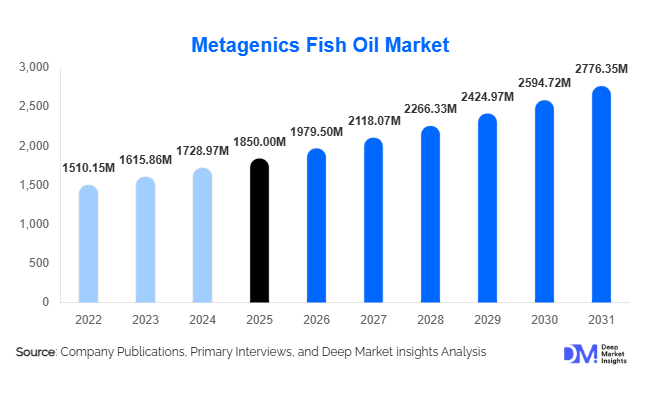
According to Deep Market Insights,the global metagenics fish oil market size was valued at USD 1,850 million in 2025 and is projected to grow from USD 1,979.50 million in 2026 to reach USD 2,776.35 million by 2031, expanding at a CAGR of 7.0% during the forecast period (2026–2031). The market growth is primarily driven by rising demand for clinically validated omega-3 supplements, increasing prevalence of cardiovascular and inflammatory disorders, and growing consumer preference for practitioner-recommended, high-purity nutraceutical formulations. Expanding awareness around preventive healthcare, coupled with strong e-commerce penetration and sustainability-driven sourcing practices, is further accelerating global adoption of premium fish oil products.
Key Market Insights
- High-concentration omega-3 formulations (≥60% EPA/DHA) are witnessing strong demand, particularly in cardiovascular and metabolic health applications.
- Practitioner-dispensed channels dominate distribution, reinforcing brand credibility and clinical positioning.
- North America holds the largest market share, supported by high supplement penetration and physician-driven recommendations.
- Asia-Pacific is the fastest-growing region, driven by rising middle-class income and preventive healthcare awareness.
- Sustainability and traceability certifications are becoming key competitive differentiators among leading brands.
- Technological advancements in re-esterified triglyceride (rTG) processing are improving bioavailability and product efficacy.
What are the latest trends in the metagenics fish oil market?
Shift Toward Ultra-High Purity and Clinical-Grade Formulations
Consumers and healthcare practitioners are increasingly preferring ultra-high concentration omega-3 formulations with ≥80% EPA/DHA content. Advances in molecular distillation, oxidation control, and re-esterified triglyceride processing have enabled manufacturers to deliver pharmaceutical-grade purity levels. This trend is particularly visible in North America and Europe, where practitioners recommend fish oil as part of integrated cardiovascular, cognitive, and inflammation management protocols. The positioning of fish oil supplements as clinically supported interventions rather than general wellness products is strengthening premium pricing strategies and long-term consumer loyalty.
Expansion of Direct-to-Consumer and Subscription Models
Digital health platforms and e-commerce channels are reshaping product accessibility. Subscription-based omega-3 supplement models are gaining traction, particularly among urban consumers seeking consistent preventive care routines. Online platforms provide transparent lab-testing certifications, sustainability claims, and consumer reviews, enabling informed purchasing decisions. Telehealth consultations are further integrating fish oil supplementation into personalized nutrition programs, expanding recurring revenue streams for brands operating in practitioner-driven ecosystems.
What are the key drivers in the metagenics fish oil market?
Rising Cardiovascular Disease Prevalence
Cardiovascular disorders remain one of the leading global health concerns, significantly increasing demand for omega-3 supplements known to support triglyceride reduction and heart health. Aging populations in the U.S., Europe, and Japan are particularly driving sustained demand for high-concentration EPA formulations. Increasing clinical endorsement and integration into preventive care protocols are reinforcing market growth.
Growing Preventive Healthcare Awareness
Consumers worldwide are shifting from reactive treatment toward preventive health strategies. Fish oil supplements are widely recognized for supporting cognitive function, joint health, prenatal development, and immune balance. Rising disposable income in emerging economies such as China and India is enabling greater adoption of premium nutraceutical products. Preventive health campaigns and healthcare modernization initiatives are further strengthening long-term demand.
What are the restraints for the global market?
Raw Material Price Volatility
The fish oil supply chain is highly dependent on marine fisheries such as anchovy and sardine catches. Climate fluctuations, sustainability regulations, and seasonal variations can create supply constraints and pricing volatility. These fluctuations directly impact production costs and profit margins for manufacturers.
Regulatory and Quality Compliance Challenges
Strict quality standards related to heavy metal contamination, oxidation limits, and labeling requirements necessitate continuous investment in testing and certification. Smaller players may struggle to maintain compliance with evolving global nutraceutical regulations, potentially limiting market entry and expansion.
What are the key opportunities in the metagenics fish oil industry?
Emerging Asia-Pacific Market Expansion
Asia-Pacific is projected to grow at over 8% CAGR through 2031, driven by expanding middle-class populations in China, India, and Southeast Asia. Preventive healthcare adoption and rising e-commerce penetration present strong opportunities for global brands to localize manufacturing and strengthen distribution partnerships in the region.
Sustainable and Traceable Marine Sourcing
Consumers increasingly demand eco-certified, sustainably sourced fish oil products. Investments in certified fisheries, carbon-neutral processing, and blockchain-enabled traceability systems can enhance brand credibility and attract environmentally conscious buyers. Sustainability positioning is expected to become a decisive purchasing factor over the forecast period.
Report Scope
| Report Metric | Details |
|---|---|
| Market Size in 2025 | USD 1850 Million |
| Market Size in 2026 | USD 1979.50 Million |
| Market Size in 2031 | USD 2776.35 Million |
| CAGR | 7.0% (2026-2031) |
| Base Year for Estimation | 2025 |
| Historical Data | 2022-2024 |
| Forecast Period | 2026-2031 |
| Report Coverage | Revenue Forecast, Competitive Landscape, Supply Chain Disruption, Growth Factors, Environment & Regulatory Landscape and Trends |
| Geographies Covered | North America, Europe, APAC, Middle East and Africa, LATAM |
| Countries Covered | U.S., Canada, U.K., Germany, France, Spain, Italy, Russia, Nordic, Benelux, Rest of Europe, China, Korea, Japan, India, Australia, Singapore, Taiwan, South East Asia, Rest of Asia-Pacific, UAE, Turky, Saudi Arabia, South Africa, Egypt, Nigeria, Rest of MEA, Brazil, Mexico, Argentina, Chile, Colombia, Rest of LATAM |
Explore more data points, trends and opportunities Download Free Sample Report
Product Type Insights
Softgel capsules dominate the global metagenics fish oil market, accounting for approximately 48% of the 2025 market share. The segment’s leadership is primarily driven by superior consumer compliance, enhanced bioavailability, precise dosage accuracy, and improved oxidation protection compared to traditional liquid formulations. Softgels offer extended shelf stability and odor masking, which are critical in maintaining product integrity in omega-3 supplements. Technological advancements in encapsulation processes, including nitrogen flushing and advanced gelatin matrices, further support their market dominance. While enteric-coated capsules are gaining traction among consumers sensitive to gastrointestinal discomfort due to reduced reflux and improved intestinal absorption, liquid formulations continue to serve niche segments such as pediatric supplementation, geriatric nutrition, and high-dose therapeutic protocols where flexible dosing is required.
Concentration & Purity Insights
High-concentration omega-3 formulations containing ≥60% EPA/DHA lead the market with nearly 42% of total revenue in 2025. The segment’s growth is strongly driven by increasing clinical validation supporting the role of concentrated omega-3 in cardiovascular risk reduction, triglyceride management, and systemic inflammation control. Healthcare practitioners increasingly prefer higher potency formulations to deliver therapeutic benefits with fewer capsules per serving, thereby improving patient adherence. Ultra-high concentration and pharmaceutical-grade purity variants are gaining steady traction, particularly in developed healthcare markets, where regulatory compliance, molecular distillation processes, and contaminant-free certifications are essential purchasing criteria. Growing consumer demand for transparency, sustainability certifications, and third-party testing further reinforces the shift toward premium purified formulations.
Application Insights
Cardiovascular health remains the leading application segment, contributing approximately 36% of the 2025 market share. The segment’s dominance is driven by extensive long-term clinical research validating omega-3 fatty acids for triglyceride reduction, blood pressure regulation, and overall heart health maintenance. Rising global prevalence of cardiovascular diseases, sedentary lifestyles, and aging populations continue to strengthen demand for preventive nutritional interventions. Beyond cardiovascular applications, cognitive health is expanding rapidly due to increasing awareness of DHA’s role in brain development and age-related cognitive support. Joint health and anti-inflammatory applications are also witnessing consistent growth, particularly among aging demographics and physically active populations seeking recovery support.
Distribution Channel Insights
Practitioner-dispensed channels account for nearly 39% of total sales in 2025, underscoring the clinically positioned nature of metagenics fish oil products. The leading driver for this segment is growing trust in healthcare professional recommendations, particularly for therapeutic-grade omega-3 formulations. Integrative medicine clinics, functional health practitioners, and specialty nutrition providers continue to expand product accessibility through personalized prescription models. Simultaneously, online retail and subscription-based distribution channels are growing rapidly, supported by digital health adoption, telehealth consultations, and recurring purchase behavior among preventive health consumers. E-commerce platforms also enable broader geographic reach, competitive pricing transparency, and direct-to-consumer brand engagement.
End-Use Industry Insights
The nutraceutical and dietary supplement industry dominates end-use consumption, representing approximately 55% of global revenue in 2025. The segment’s leadership is driven by rising consumer preference for preventive healthcare, self-directed wellness management, and natural supplementation solutions. Increasing integration of omega-3 products into daily wellness regimens, sports nutrition, and immunity-focused formulations further supports sustained demand. Clinical and therapeutic nutrition applications are expanding significantly, particularly in metabolic disorder management, obesity care, and inflammation-related conditions. Pharmaceutical-grade omega-3 derivatives are gradually emerging as high-value niche applications due to regulatory-backed therapeutic claims, while the pet nutrition segment is witnessing accelerated growth as awareness regarding companion animal cardiovascular and joint health increases.
Explore more data points, trends and opportunities Download Free Sample Report
Metagenics Fish Oil Market Segmentations
By Product Form
- Softgel Capsules
- Liquid Fish Oil
- Powdered Fish Oil
- Enteric-Coated Capsules
- Emulsified Fish Oil Formulations
By Concentration & Purity Level
- Standard Concentration
- High-Concentration
- Ultra-High Concentration
- Re-Esterified Triglyceride (rTG) Form
- Ethyl Ester (EE) Form
- Triglyceride (TG) Form
By Application
- Cardiovascular Health
- Cognitive & Brain Health
- Joint & Inflammation Support
- Prenatal & Maternal Health
- Eye Health
- Sports Nutrition & Recovery
By Distribution Channel
- Practitioner-Dispensed Channels
- Pharmacies & Drug Stores
- Online Retail & E-commerce
- Specialty Health Stores
- Direct-to-Consumer Subscription Models
By End-Use Industry
- Nutraceutical & Dietary Supplements
- Functional Foods & Beverages
- Clinical & Therapeutic Nutrition
- Pharmaceutical Formulations
- Animal & Pet Nutrition
Regional Insights
North America
North America holds approximately 34% of the 2025 global market share, led by the United States, with Canada contributing steady growth. Regional expansion is primarily driven by high dietary supplement penetration, strong clinical advocacy for omega-3 supplementation, and advanced healthcare infrastructure supporting preventive care models. Growing incidence of cardiovascular disorders, obesity, and metabolic syndrome further reinforces product demand. The presence of established nutraceutical manufacturers, widespread practitioner networks, and high consumer awareness regarding product purity and sustainability standards sustain premium pricing and product innovation across the region.
Europe
Europe accounts for nearly 29% of the 2025 market share, with Germany, the U.K., France, Italy, and Nordic countries leading adoption. Regional growth is supported by stringent regulatory frameworks that enhance consumer trust in clinically validated supplements. High awareness of cardiovascular prevention, aging population demographics, and increasing preference for pharmaceutical-grade nutraceuticals drive sustained demand. Additionally, Europe’s strong emphasis on sustainability, traceability of marine sourcing, and clean-label formulations encourages innovation in high-purity and environmentally responsible fish oil products.
Asia-Pacific
Asia-Pacific represents the fastest-growing regional market, projected to expand at over 8% CAGR through 2031. Growth is driven by expanding middle-class income, rapid urbanization, and improving healthcare infrastructure across China and India. Rising lifestyle-related diseases, growing awareness of preventive healthcare, and government-led health modernization initiatives support omega-3 adoption. Japan remains a mature, high-consumption market due to longstanding familiarity with marine-based nutrition, while Southeast Asian countries are witnessing increased product availability through digital commerce and pharmacy expansion. The region’s large population base presents significant long-term growth potential for therapeutic-grade omega-3 supplementation.
Latin America
Brazil and Mexico serve as key growth engines in Latin America, supported by increasing urban health awareness, expanding retail pharmacy chains, and improving access to premium supplements via digital platforms. Rising disposable incomes and growing demand for preventive health products contribute to steady market expansion. Regional manufacturers are increasingly focusing on affordability and localized marketing strategies to strengthen penetration in emerging consumer segments.
Middle East & Africa
The Middle East & Africa region demonstrates gradual yet promising growth potential. The UAE and Saudi Arabia represent high-income markets with increasing demand for premium nutraceutical products, supported by strong retail infrastructure and rising lifestyle-related health concerns. South Africa leads regional adoption in Africa due to expanding pharmacy networks and growing consumer awareness regarding cardiovascular and metabolic health. Increasing disposable income, urbanization, and government-led health diversification initiatives across Gulf Cooperation Council countries are expected to support continued regional expansion.
Key Players in the Metagenics Fish Oil Market
- Metagenics Inc.
- Nordic Naturals
- Pharmavite LLC
- NOW Foods
- Nature's Bounty Co.
- Carlson Laboratories
- Amway Corp.
- Herbalife Ltd.
- Blackmores Ltd.
- GNC Holdings LLC
- Orkla Health
- Solgar Inc.
- Kirkland Signature
- Garden of Life
- Thorne HealthTech