Melon Market Size
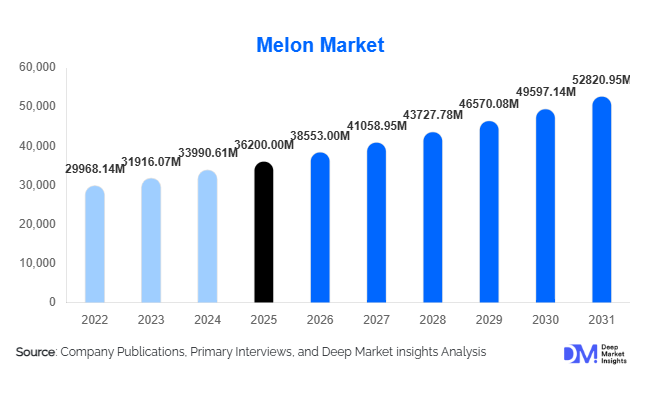
According to Deep Market Insights, the global melon market size was valued at USD 36,200 million in 2025 and is projected to grow from USD 38,553 million in 2026 to reach USD 52,820.95 million by 2031, expanding at a CAGR of 6.5% during the forecast period (2026–2031). The melon market growth is primarily driven by rising consumer demand for hydrating and nutrient-rich fruits, expanding global trade networks, and increasing adoption of value-added fruit products such as pre-cut melons and juices.
Key Market Insights
- Fresh watermelon dominates global consumption, accounting for over 50% of total market share due to affordability and widespread cultivation.
- Asia-Pacific leads global production and consumption, with China and India as major contributors to supply and demand.
- Pre-cut and ready-to-eat melon products are rapidly gaining traction, especially in urban retail environments.
- Supermarkets and hypermarkets dominate distribution, supported by organized retail expansion globally.
- Organic melon farming is the fastest-growing cultivation segment, driven by premium pricing and health-conscious consumers.
- Cold chain and logistics advancements are enabling year-round availability and boosting international trade.
What are the latest trends in the melon market?
Rising Demand for Ready-to-Eat and Value-Added Products
Consumer lifestyles are increasingly shifting toward convenience, leading to strong demand for fresh-cut, pre-packaged melon products. Retailers are investing in attractive packaging, extended shelf-life technologies, and portion-controlled offerings to cater to busy urban populations. Additionally, melon-based juices, smoothies, and desserts are gaining popularity across foodservice and beverage industries, expanding revenue streams beyond traditional fresh fruit sales.
Expansion of Sustainable and Organic Farming Practices
There is a growing shift toward organic melon cultivation, particularly in Europe and North America, where consumers are willing to pay a premium for chemical-free produce. Governments and agricultural bodies are supporting this transition through subsidies and certification programs. Sustainable farming techniques, including drip irrigation and controlled-environment agriculture, are also improving yield efficiency while reducing environmental impact.
What are the key drivers in the melon market?
Growing Health Consciousness Among Consumers
The increasing focus on healthy diets is a major driver of melon consumption. Melons are rich in vitamins, antioxidants, and water content, making them a preferred choice among health-conscious consumers. The post-pandemic shift toward immunity-boosting foods has further accelerated demand for fresh fruits, including melons.
Expansion of Organized Retail and E-Commerce
The rapid growth of supermarkets, hypermarkets, and online grocery platforms has significantly improved accessibility to melons. Consumers now have access to a wide variety of melon types and formats, including premium and imported varieties. E-commerce platforms are also enabling direct farm-to-consumer models, enhancing supply chain efficiency.
Advancements in Agricultural and Supply Chain Technologies
Technological advancements such as precision farming, improved seed varieties, and cold storage infrastructure are enhancing productivity and reducing post-harvest losses. These developments are enabling consistent supply and improving product quality, thereby supporting market growth.
What are the restraints for the global market?
High Perishability and Post-Harvest Losses
Melons are highly perishable, leading to significant losses during storage and transportation, especially in regions lacking adequate cold chain infrastructure. This increases operational costs and affects profitability for producers and distributors.
Seasonal Production and Price Volatility
The melon market is heavily dependent on climatic conditions, making it vulnerable to weather fluctuations, droughts, and pest infestations. These factors contribute to supply instability and price volatility, posing challenges for market participants.
What are the key opportunities in the melon industry?
Expansion into Export Markets
Improved logistics and cold chain systems have enabled melon exporters to access distant markets. Countries such as Spain, Brazil, and Turkey are expanding exports to Europe and the Middle East, where domestic production is limited. This trend is expected to create new growth avenues for producers.
Growth of Organic and Premium Melon Segments
The increasing demand for organic and specialty melons presents significant opportunities for growers and retailers. Premium varieties such as Galia and honeydew melons are gaining popularity in high-income markets, offering higher margins compared to conventional varieties.
Technological Integration in Farming
The adoption of precision agriculture, greenhouse farming, and AI-based crop monitoring systems is enhancing productivity and quality. These technologies enable better resource management and consistent supply, creating competitive advantages for producers.
Report Scope
| Report Metric | Details |
|---|---|
| Market Size in 2025 | USD 36200 Million |
| Market Size in 2026 | USD 38553 Million |
| Market Size in 2031 | USD 52820.95 Million |
| CAGR | 6.5% (2026-2031) |
| Base Year for Estimation | 2025 |
| Historical Data | 2022-2024 |
| Forecast Period | 2026-2031 |
| Report Coverage | Revenue Forecast, Competitive Landscape, Supply Chain Disruption, Growth Factors, Environment & Regulatory Landscape and Trends |
| Geographies Covered | North America, Europe, APAC, Middle East and Africa, LATAM |
| Countries Covered | U.S., Canada, U.K., Germany, France, Spain, Italy, Russia, Nordic, Benelux, Rest of Europe, China, Korea, Japan, India, Australia, Singapore, Taiwan, South East Asia, Rest of Asia-Pacific, UAE, Turky, Saudi Arabia, South Africa, Egypt, Nigeria, Rest of MEA, Brazil, Mexico, Argentina, Chile, Colombia, Rest of LATAM |
Explore more data points, trends and opportunities Download Free Sample Report
Product Type Insights
The global melon market continues to be significantly driven by the dominance of watermelon, which accounts for approximately 52% of the total market share in 2025. This leadership position is primarily attributed to watermelon’s high agricultural yield, cost-effectiveness, and widespread consumer acceptance across both developed and developing economies. Its adaptability to diverse climatic conditions, coupled with shorter growing cycles compared to other melons, makes it a preferred choice among farmers, particularly in regions with large-scale agricultural activities. Additionally, watermelon’s high water content and refreshing taste make it a staple fruit in warmer climates, further reinforcing its demand.Cantaloupe and honeydew melons follow watermelon in terms of market share, with their demand steadily increasing, particularly in premium and health-conscious markets. These melons are often associated with higher nutritional value, including vitamins A and C, and are widely used in salads, desserts, and gourmet dishes. The leading driver for this segment is the growing consumer preference for nutrient-dense and visually appealing fruits, especially in developed regions where consumers are willing to pay a premium for quality and taste. Retailers are also promoting these varieties through curated fruit assortments and pre-packaged offerings, enhancing their visibility and accessibility.Specialty melons, including exotic and hybrid varieties, are emerging as niche but high-value segments within the market. These melons are gaining traction in developed economies such as North America and Europe, where consumers are increasingly seeking unique flavors, textures, and premium-quality produce. The leading driver for specialty melons is the rising demand for product differentiation and culinary experimentation. High-end restaurants, specialty stores, and gourmet food chains are incorporating these varieties into their offerings, further boosting their market presence. Although their share remains relatively small, their higher price points contribute significantly to overall market revenue.
Application Insights
Fresh consumption continues to dominate the melon market, accounting for over 60% of the total share. This dominance is deeply rooted in traditional dietary habits, where melons are consumed as standalone fruits or as part of meals and snacks. The leading driver for this segment is the increasing global awareness of healthy eating habits, with consumers prioritizing natural, low-calorie, and hydrating food options. Melons, being rich in water content and essential nutrients, align perfectly with these preferences, making them a staple in daily diets.However, the processed application segment is witnessing faster growth, driven by evolving consumer lifestyles and the rising demand for convenience foods. Melons are increasingly being used in juices, smoothies, desserts, and fruit-based snacks, expanding their application scope beyond traditional consumption. The leading driver for this segment is the rapid expansion of the beverage industry, which is leveraging melon flavors to create innovative and refreshing products. Functional beverages, in particular, are incorporating melon extracts for their perceived health benefits, including hydration and antioxidant properties.The growing popularity of ready-to-drink beverages and packaged fruit products is further accelerating demand in this segment. Urbanization and busy lifestyles are encouraging consumers to opt for convenient, on-the-go food options, which is boosting the adoption of processed melon products. Additionally, advancements in food processing technologies are enabling manufacturers to preserve the flavor, texture, and nutritional value of melons, enhancing their appeal in processed forms.
Distribution Channel Insights
Supermarkets and hypermarkets dominate the distribution landscape, accounting for approximately 46% of global sales. These retail formats offer a wide variety of melon products, including fresh, packaged, and processed options, under one roof. The leading driver for this segment is the enhanced product visibility and quality assurance provided by organized retail channels. Consumers tend to trust supermarkets for their standardized quality, proper storage conditions, and availability of multiple varieties, which significantly influences purchasing decisions.In addition to quality assurance, supermarkets and hypermarkets also benefit from strong supply chain networks and efficient logistics, ensuring a consistent supply of fresh produce. Promotional activities, in-store displays, and seasonal discounts further contribute to increased sales through these channels. As urbanization continues to expand globally, the penetration of organized retail is expected to grow, reinforcing its dominance in the market.Moreover, the COVID-19 pandemic has accelerated the adoption of online grocery shopping, a trend that continues to persist. Retailers are investing in cold chain logistics and last-mile delivery solutions to ensure the freshness and quality of melons during transit. Subscription-based models and doorstep delivery services are further boosting the growth of online retail in the melon market.
End-Use Insights
Household consumption remains the dominant end-use segment, accounting for approximately 58% of the market share. This dominance reflects the strong preference for direct consumption of fresh fruits in daily diets. The leading driver for this segment is the increasing health consciousness among consumers, who are incorporating fruits like melons into their meals as a natural source of hydration and nutrition. The affordability and availability of melons further support their widespread consumption at the household level.The food processing and beverage industries are the fastest-growing end-use segments, driven by the rising demand for natural and fruit-based products. The leading driver for these segments is the growing trend of clean-label and minimally processed foods, where consumers seek products with natural ingredients and no artificial additives. Melons, with their natural sweetness and refreshing flavor, are ideal for use in a variety of processed products, including juices, smoothies, desserts, and snacks.The HoReCa (Hotels, Restaurants, and Catering) sector is also contributing significantly to market growth. The increasing demand for pre-cut and premium-quality melons in restaurants and hotels is driving this segment. The leading driver here is the expansion of the hospitality industry and the growing trend of dining out, particularly in urban areas. Chefs and food service providers are incorporating melons into innovative dishes, salads, and beverages, enhancing their appeal among consumers.
Explore more data points, trends and opportunities Download Free Sample Report
Melon Market Segmentations
By Type
- Watermelon
- Cantaloupe
- Honeydew
- Galia Melon
- Canary Melon
- Other Specialty Melons
By Form
- Fresh Whole Melons
- Fresh Cut/Pre-Packaged Melons
- Frozen Melons
- Processed Melon Products
By Distribution Channel
- Supermarkets & Hypermarkets
- Convenience Stores
- Online Retail
- Traditional Grocery Stores/Wet Markets
Regional Insights
Asia-Pacific
Asia-Pacific dominates the global melon market, accounting for approximately 48% of the total share in 2025. The region’s leadership is primarily driven by countries such as China and India, which are among the largest producers and consumers of melons worldwide. China, in particular, benefits from extensive agricultural land, advanced farming techniques, and strong domestic demand, making it the leading contributor to the market.The key drivers for regional growth in Asia-Pacific include favorable climatic conditions, large-scale agricultural production, and a rapidly growing population. The region’s warm climate is ideal for melon cultivation, enabling multiple harvest cycles and high yields. Additionally, rising disposable incomes and increasing health awareness are encouraging consumers to include fruits like melons in their diets. Government initiatives supporting agricultural development and investments in modern farming technologies are further boosting production and supply.
Europe
Europe accounts for approximately 18% of the global melon market, with countries such as Spain, Italy, and France serving as major producers. Spain, in particular, plays a crucial role as a key exporter, supplying melons to various European countries and beyond. The region is characterized by high-quality production standards and a strong emphasis on premium fruit varieties.The primary drivers for regional growth in Europe include increasing consumer demand for organic and high-quality produce, as well as the region’s well-established supply chain infrastructure. European consumers are highly health-conscious and prefer sustainably sourced fruits, which is driving the demand for premium and specialty melons. Additionally, favorable trade policies and strong export networks are enabling producers to expand their reach in international markets.
North America
North America holds approximately 15% of the global market share, with the United States leading consumption. The region is characterized by a well-developed retail infrastructure and a high level of consumer awareness regarding health and nutrition.The key drivers for growth in North America include the increasing demand for fresh and healthy food options, as well as the strong presence of organized retail and e-commerce platforms. Health-conscious consumers are actively seeking low-calorie and nutrient-rich fruits, which is boosting the demand for melons. Additionally, the availability of pre-cut and packaged fruit products is enhancing convenience, further driving consumption. Technological advancements in cold storage and transportation are also ensuring the year-round availability of melons in the region.
Latin America
Latin America serves as a major export hub for melons, with countries such as Brazil and Mexico playing a significant role in global supply. The region benefits from favorable climatic conditions that support large-scale melon cultivation, making it a key contributor to international markets.The leading drivers for regional growth include increasing agricultural investments, export-oriented production, and the availability of fertile land. Governments and private players are investing in modern farming techniques and infrastructure to enhance productivity and quality. Additionally, the region’s proximity to major markets such as North America provides a strategic advantage in terms of logistics and transportation. Growing global demand for fresh and high-quality fruits is further encouraging exports from Latin America.
Middle East & Africa
The Middle East & Africa region is the fastest-growing market for melons, with growth rates exceeding 7.5%. This growth is driven by increasing imports, rising disposable incomes, and the expansion of retail infrastructure in countries such as the UAE and Saudi Arabia.The primary drivers for regional growth include rapid urbanization, changing dietary preferences, and a growing expatriate population with diverse food habits. The region’s harsh climatic conditions limit local production, leading to a strong reliance on imports, which is boosting international trade. Additionally, the expansion of modern retail formats such as supermarkets and hypermarkets is improving the availability and accessibility of melons. Rising consumer awareness regarding health and nutrition is also contributing to increased consumption in the region.
Key Players in the Melon Market
- Dole Food Company
- Fresh Del Monte Produce
- Chiquita Brands International
- Fyffes
- Greenyard NV
- Total Produce Plc
- T&G Global
- Capespan Group
- Oppy (The Oppenheimer Group)
- Costa Group
- Westfalia Fruit
- Bonduelle Group
- Itochu Corporation
- Mirak Group
- Driscoll’s