Meals Ready To Eat (MRE) Market Size
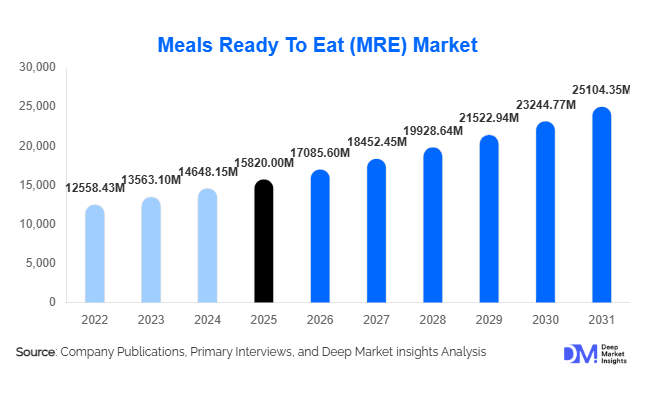
According to Deep Market Insights, the global Meals Ready To Eat (MRE) market size was valued at USD 15,820 million in 2025 and is projected to grow from USD 17,085.60 million in 2026 to reach approximately USD 25,104.35 million by 2031, expanding at a CAGR of 8.0% during the forecast period (2026–2031). The MRE market growth is primarily supported by increasing military modernization programs, rising demand for convenient long-shelf-life food products, expanding disaster preparedness initiatives, and growing consumer adoption of ready-to-eat meal solutions across outdoor recreation, emergency response, and civilian retail channels.
Key Market Insights
- Defense procurement programs remain the largest demand contributor, accounting for a substantial portion of global MRE consumption due to operational mobility requirements.
- Commercial and civilian emergency preparedness demand is expanding rapidly, particularly in North America and Asia-Pacific regions.
- Freeze-dried and retort packaging technologies are improving shelf life beyond five years while maintaining nutritional value and taste.
- Asia-Pacific is emerging as the fastest-growing regional market, driven by disaster preparedness policies and growing outdoor recreation participation.
- Private-label and e-commerce distribution channels are accelerating adoption among civilian consumers.
- Nutrition-focused innovation, including high-protein, plant-based, and functional meals, is reshaping product development strategies.
What are the latest trends in the Meals Ready To Eat (MRE) market?
Expansion Beyond Military Applications
The MRE industry is undergoing a structural transition from being primarily defense-driven toward diversified commercial adoption. Historically dominated by military procurement contracts, manufacturers are now targeting civilian consumers including campers, hikers, disaster-preparedness households, humanitarian agencies, and remote workforce operators. Growth in outdoor recreation and survival preparedness culture has significantly expanded retail-ready MRE offerings. Companies are introducing consumer-friendly packaging, smaller portion formats, and improved taste profiles aligned with mainstream food expectations. Retail availability through online marketplaces and specialty outdoor stores has transformed MREs into everyday emergency food solutions rather than niche defense supplies.
Technology-Driven Shelf-Life and Nutrition Improvements
Advancements in retort sterilization, high-pressure processing, and freeze-drying technologies are improving nutritional retention and extending shelf life while reducing preservatives. Manufacturers are integrating functional ingredients such as electrolytes, protein enrichment, and micronutrient fortification to meet endurance and health-focused consumption trends. Smart packaging innovations, including oxygen absorbers and temperature-stable materials, are enhancing product durability across extreme climates. These technological upgrades are increasing acceptance among both government buyers and commercial consumers, positioning MREs as reliable long-term food security solutions.
What are the key drivers in the Meals Ready To Eat (MRE) market?
Military Modernization and Defense Logistics Demand
Global defense spending growth has significantly influenced MRE demand, particularly across NATO countries, Asia-Pacific defense expansion programs, and Middle Eastern security investments. Modern armed forces prioritize lightweight, nutritionally balanced meal systems that reduce logistical complexity while supporting extended missions. Governments are increasingly awarding multi-year procurement contracts to ensure uninterrupted supply, driving predictable revenue streams for manufacturers.
Growth in Disaster Preparedness and Humanitarian Aid Programs
Climate-related disasters, geopolitical disruptions, and emergency response planning have elevated demand for shelf-stable food reserves. Governments and humanitarian organizations are expanding stockpiles of ready meals to support rapid deployment during crises. Relief agencies require standardized, nutritionally complete meal solutions that require minimal preparation, further reinforcing MRE adoption globally.
Rising Consumer Preference for Convenience Foods
Urbanization and changing lifestyles are accelerating demand for convenient meal solutions. Consumers increasingly seek ready-to-consume foods requiring no refrigeration or preparation. MREs are benefiting from this trend, particularly among travelers, students, remote workers, and outdoor enthusiasts. Premium taste improvements and diversified cuisines are helping brands overcome historical perceptions regarding quality.
What are the restraints for the global market?
High Production and Packaging Costs
Advanced preservation technologies, military-grade packaging materials, and stringent quality testing increase manufacturing costs compared to traditional packaged foods. These cost pressures limit affordability in price-sensitive regions and challenge large-scale civilian adoption.
Consumer Perception and Taste Limitations
Despite improvements, some consumers still associate MREs with emergency-only usage and lower sensory quality. Overcoming perception barriers through innovation in flavor variety and premium positioning remains a critical industry challenge.
What are the key opportunities in the Meals Ready To Eat (MRE) industry?
Commercial Retail and E-Commerce Expansion
One of the most significant opportunities lies in expanding civilian retail penetration. Online direct-to-consumer platforms allow manufacturers to bypass traditional procurement cycles and target preparedness-focused households. Subscription emergency food kits and customizable meal packs are gaining traction, creating recurring revenue opportunities. Emerging middle-class consumers in Asia and Latin America represent untapped markets for affordable shelf-stable meals.
Integration of Functional and Specialized Nutrition
Manufacturers are increasingly developing performance-oriented meals tailored for athletes, rescue workers, and health-conscious consumers. High-protein, keto-friendly, vegan, and allergen-free MRE variants are expanding addressable markets. Functional nutrition integration positions MREs within broader health and wellness food categories, opening collaboration opportunities with nutrition science and sports performance sectors.
Government Food Security and Strategic Reserves Programs
Food security policies worldwide are creating large procurement opportunities. Governments are investing in national emergency food reserves to mitigate supply chain disruptions and climate risks. Long-shelf-life meals offer strategic advantages due to minimal storage requirements. New entrants capable of meeting regulatory compliance standards can benefit from long-term institutional contracts.
Report Scope
| Report Metric | Details |
|---|---|
| Market Size in 2025 | USD 15820 Million |
| Market Size in 2026 | USD 17085.60 Million |
| Market Size in 2031 | USD 25104.35 Million |
| CAGR | 8% (2026-2031) |
| Base Year for Estimation | 2025 |
| Historical Data | 2022-2024 |
| Forecast Period | 2026-2031 |
| Report Coverage | Revenue Forecast, Competitive Landscape, Supply Chain Disruption, Growth Factors, Environment & Regulatory Landscape and Trends |
| Geographies Covered | North America, Europe, APAC, Middle East and Africa, LATAM |
| Countries Covered | U.S., Canada, U.K., Germany, France, Spain, Italy, Russia, Nordic, Benelux, Rest of Europe, China, Korea, Japan, India, Australia, Singapore, Taiwan, South East Asia, Rest of Asia-Pacific, UAE, Turky, Saudi Arabia, South Africa, Egypt, Nigeria, Rest of MEA, Brazil, Mexico, Argentina, Chile, Colombia, Rest of LATAM |
Explore more data points, trends and opportunities Download Free Sample Report
Product Type Insights
Retort pouch meals continue to dominate the global Meals Ready-to-Eat (MRE) market, accounting for approximately 46% of total revenue share in 2025. The leading position of this segment is primarily supported by its superior balance of affordability, long shelf life, and operational efficiency in large-scale deployments. Retort packaging enables thermal sterilization while preserving nutritional quality and taste, making it highly suitable for military logistics where storage stability and rapid distribution are essential. Additionally, the reduced need for refrigeration significantly lowers transportation and warehousing costs, reinforcing adoption among defense organizations and emergency stockpiling agencies worldwide. Freeze-dried meals represent the fastest-growing product category, driven by increasing participation in outdoor recreation and expedition-based tourism where lightweight food solutions are critical. These meals offer extended preservation without compromising nutritional value, attracting both civilian consumers and specialized institutional buyers. Self-heating meals are gaining increasing traction across defense forces and disaster relief operations as they eliminate dependence on cooking infrastructure, improving operational readiness during emergencies and field missions. Furthermore, vegetarian, plant-based, and specialized dietary MREs are expanding rapidly as governments and manufacturers respond to evolving nutritional standards, religious dietary requirements, and growing consumer preference for healthier and sustainable meal alternatives.
Application Insights
Military applications remain the dominant application segment, contributing nearly 52% of global market demand in 2025. The leadership of this segment is primarily driven by sustained defense procurement programs, long-term supply contracts, and modernization initiatives focused on improving soldier nutrition, mobility, and operational endurance. Increasing geopolitical tensions and expanded peacekeeping operations continue to reinforce consistent purchasing cycles among national defense agencies. Civilian emergency preparedness represents a rapidly expanding application area as climate-related disasters, extreme weather events, and infrastructure disruptions encourage governments and households to maintain emergency food reserves. Outdoor recreation applications are experiencing steady expansion supported by rising global interest in hiking, trekking, camping, and adventure tourism, particularly among younger demographics seeking convenient and portable nutrition solutions. Humanitarian relief operations remain a structurally stable demand segment, with international aid organizations relying on standardized, shelf-stable meals for rapid deployment during refugee crises, natural disasters, and conflict-related emergencies.
Distribution Channel Insights
Government procurement continues to dominate distribution channels, representing approximately 48% of global sales, supported by multi-year defense supply agreements, disaster preparedness contracts, and institutional food reserve programs. The leading role of this channel is driven by centralized purchasing systems that prioritize reliability, compliance with nutritional standards, and large-volume sourcing efficiency. Online retail channels are emerging as the fastest-growing distribution pathway due to increasing consumer awareness surrounding emergency preparedness and survival planning, alongside the convenience of direct-to-consumer purchasing models. Digital marketplaces have enabled manufacturers to reach recreational users and preparedness-focused households more effectively, expanding market penetration beyond traditional institutional buyers. Specialty outdoor retailers maintain strong relevance among adventure and expedition consumers who prioritize performance-focused nutrition solutions, while supermarkets and private-label brands are gradually introducing consumer-friendly MRE formats designed for everyday convenience, travel use, and emergency storage.
End-Use Insights
Defense forces remain the primary end-use sector within the global MRE market, supported by ongoing investments in troop readiness and field sustainability. However, civilian households and disaster management agencies are experiencing the fastest growth rates as awareness of food security and emergency resilience increases globally. Emergency management authorities are expanding national and regional food reserve inventories to improve response capacity during natural disasters and public emergencies. Simultaneously, the outdoor recreation industry is generating expanding retail demand as consumers seek compact, high-calorie meal solutions for remote activities. Export-driven demand is also rising steadily as humanitarian organizations procure standardized meal solutions suitable for cross-border distribution. In addition, growth in remote industrial operations, including mining, oil and gas exploration, offshore energy platforms, and infrastructure development projects, is creating new commercial use cases where reliable long-shelf-life meals are essential for workforce sustenance in isolated environments.
Explore more data points, trends and opportunities Download Free Sample Report
Meals Ready To Eat (MRE) Market Segmentations
By Product Type
- Retort Pouch Meals
- Freeze-Dried Meals
- Self-Heating Meals
- Vegetarian & Specialized Diet MREs
By Application
- Military & Defense
- Civilian Emergency Preparedness
- Outdoor Recreation
- Humanitarian Relief Operations
By Distribution Channel
- Government Procurement
- Online Retail / D2C Platforms
- Specialty Outdoor Retail Stores
- Supermarkets & Hypermarkets
- Private Label & Subscription Services
Regional Insights
North America
North America held approximately 34% of global market share in 2025, led primarily by the United States, which accounts for the majority of regional demand due to large-scale defense procurement programs and advanced military ration modernization initiatives. Regional growth is further supported by strong government investment in emergency preparedness infrastructure, driven by increasing occurrences of wildfires, hurricanes, and extreme weather events that necessitate strategic food reserves. Canada contributes to market expansion through military capability upgrades and nationwide disaster response frameworks. Additionally, a well-established outdoor recreation culture, high consumer awareness regarding survival preparedness, and widespread adoption of e-commerce platforms continue to strengthen civilian demand across the region.
Europe
Europe accounted for nearly 24% of global demand, supported by defense modernization programs across major economies including the United Kingdom, Germany, France, and Poland. Regional growth is driven by heightened geopolitical security concerns, NATO operational readiness requirements, and expanded cross-border humanitarian logistics activities. Governments across Europe are increasingly investing in resilient supply chains and emergency stockpiling strategies to strengthen crisis response capabilities. Furthermore, strong consumer preference for sustainable, organic, and plant-based food solutions is influencing innovation in MRE formulations, encouraging manufacturers to develop environmentally responsible packaging and nutritionally balanced meal options aligned with regional sustainability regulations.
Asia-Pacific
Asia-Pacific represents the fastest-growing regional market, led by China, India, Japan, and South Korea. Growth is primarily driven by rising defense budgets, expanding military personnel bases, and increasing emphasis on disaster preparedness across disaster-prone nations. India’s ongoing military modernization initiatives and large-scale disaster relief programs are significantly supporting procurement expansion, while Japan’s stringent earthquake preparedness policies continue to drive widespread emergency food stockpiling. Rapid growth in trekking tourism, mountaineering activities, and adventure travel across Southeast Asia further contributes to commercial demand. Additionally, rising urbanization, improving retail infrastructure, and increasing domestic manufacturing capabilities are strengthening regional supply chains and accelerating adoption of ready-to-eat meal solutions.
Middle East & Africa
The Middle East demonstrates strong market demand supported by elevated defense spending in countries such as Saudi Arabia and the United Arab Emirates, where military readiness and food logistics resilience remain strategic priorities. Regional growth is further reinforced by the presence of major humanitarian logistics hubs that facilitate large-scale aid distribution across neighboring regions. In Africa, demand expansion is driven by peacekeeping missions, disaster relief operations, and ongoing support from international NGOs and multilateral organizations. Improvements in supply chain connectivity and increased government focus on food security initiatives are gradually strengthening regional market penetration.
Latin America
Latin America is emerging as a developing market for MRE products, led by Brazil, Mexico, and Chile. Regional growth is supported by strengthening national disaster preparedness frameworks aimed at addressing hurricanes, floods, and seismic risks. Governments are increasingly investing in emergency response systems and food reserve programs, creating new institutional procurement opportunities. At the same time, expanding outdoor recreation participation and growing awareness of emergency preparedness among consumers are supporting commercial adoption. Although regional demand remains comparatively smaller than mature markets, improving logistics infrastructure, expanding retail distribution networks, and rising local manufacturing capabilities are expected to drive steady long-term growth.
Key Players in the Meals Ready To Eat (MRE) Market
- Sopakco Inc.
- AmeriQual Group LLC
- Wornick Company
- Meal Kit Supply LLC
- XMRE (XMRE Meals)
- Bridgford Foods Corporation
- ReadyWise
- Katadyn Group
- Mountain House (OFD Foods LLC)
- WISE Company Inc.
- MREStar
- Sure-Pak Meals
- Lyo Food
- Blå Band (Orkla ASA)
- Eversafe Foods