Mango Puree Market Size
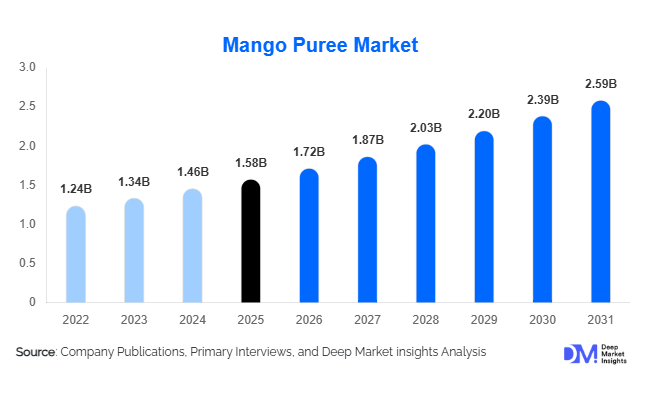
According to Deep Market Insights, the global Mango Puree Market size was valued at USD 1.58 billion in 2025 and is projected to grow from USD 1.72 billion in 2026 to reach USD 2.59 billion by 2031, expanding at a CAGR of 8.6% during the forecast period (2026–2031). The mango puree market growth is primarily driven by rising demand for natural fruit ingredients, increasing consumption of tropical fruit beverages, and expanding applications across dairy, infant nutrition, bakery, and convenience food industries. Growing consumer preference for clean-label products and the replacement of artificial flavoring agents with fruit-based alternatives are further accelerating global market expansion.
Key Market Insights
- Aseptic mango puree dominates the global market, supported by longer shelf life, export suitability, and strong demand from beverage and dairy manufacturers.
- India remains the largest producer and exporter globally, benefiting from abundant Totapuri and Alphonso mango cultivation and extensive aseptic processing infrastructure.
- Beverage applications account for the largest market share, driven by increasing consumption of smoothies, tropical juices, flavored dairy beverages, and functional drinks.
- Organic mango puree is witnessing rapid growth, supported by rising clean-label and premium baby food demand across Europe and North America.
- Asia-Pacific dominates global market revenue, while Europe represents one of the fastest-growing import-dependent consumption regions.
- Technological advancements in aseptic packaging and high-pressure processing are improving shelf stability, flavor retention, and export competitiveness.
Mango Puree Market Latest Trends
Clean-Label and Natural Fruit Ingredient Adoption Accelerating
Food and beverage manufacturers are increasingly reformulating products using natural fruit ingredients to align with changing consumer preferences for clean-label foods. Mango puree is gaining strong traction as a natural alternative to artificial sweeteners, synthetic flavors, and chemical colorants. Demand is particularly high within yogurt products, smoothies, infant nutrition, fruit snacks, and premium desserts. Consumers are actively seeking minimally processed fruit-based formulations with recognizable ingredients, encouraging manufacturers to expand mango-based product portfolios. Organic mango puree variants are also gaining momentum, particularly in Europe and North America, where consumers are willing to pay premium prices for certified natural and sustainably sourced products.
Advanced Processing and Aseptic Packaging Technologies Expanding
Manufacturers are increasingly investing in advanced processing technologies such as high-pressure processing (HPP), vacuum concentration, and aseptic packaging systems to improve product stability and preserve nutritional value. Aseptic mango puree has emerged as the preferred format for industrial buyers because it offers longer shelf life without refrigeration during transportation. Export-oriented processors are also utilizing automated pulp extraction systems and digital traceability solutions to comply with strict international food safety regulations. These technological advancements are helping manufacturers reduce spoilage rates, improve export competitiveness, and expand supply chain efficiency across global markets.
Mango Puree Market Drivers
Rising Demand for Fruit-Based Beverages
The increasing global shift toward natural and fruit-based beverages is one of the major drivers supporting mango puree market growth. Consumers are reducing consumption of synthetic carbonated drinks and increasingly preferring smoothies, tropical juices, probiotic beverages, and wellness drinks. Mango puree is widely utilized because it provides natural sweetness, texture enhancement, and flavor consistency. Beverage companies are expanding tropical fruit offerings to capitalize on evolving consumer taste preferences, significantly increasing industrial demand for mango puree worldwide. The rapid expansion of ready-to-drink beverage categories across North America, Europe, and Asia-Pacific continues to create long-term opportunities for puree manufacturers.
Expansion of Processed Food and Dairy Industries
Urbanization, changing lifestyles, and increasing disposable incomes are driving growth within convenience food and dairy sectors globally. Mango puree is extensively used in yogurt formulations, flavored milk products, frozen desserts, bakery fillings, sauces, confectionery products, and fruit preparations. The dairy industry, particularly fruit-on-the-bottom yogurt and premium dessert categories, represents a major consumer segment. Foodservice expansion and organized retail growth are also accelerating utilization of industrial fruit ingredients. Manufacturers prefer mango puree because it improves product texture, enhances flavor profiles, and supports natural ingredient positioning in processed food applications.
Global Market Restraints
Seasonal Raw Material Availability and Price Volatility
Mango production remains highly seasonal and vulnerable to climatic fluctuations, including irregular rainfall, drought conditions, pest infestations, and temperature changes. Poor harvest seasons can significantly impact raw mango availability and increase procurement costs for processors. This creates pricing volatility across the value chain and affects profit margins for manufacturers operating under long-term supply agreements. Export-oriented processors are particularly exposed to fluctuations in mango harvest yields, making supply chain management a critical challenge for the industry.
High Storage and Logistics Costs
Mango puree requires specialized storage, aseptic handling systems, and food-grade packaging to maintain quality during transportation and exports. Maintaining cold-chain infrastructure and compliance with stringent international food safety regulations significantly increases operational expenses for manufacturers. Smaller processors in developing countries often face infrastructure limitations and high capital expenditure requirements, restricting their ability to compete internationally. In addition, export markets such as Europe and North America impose strict pesticide residue and traceability standards, increasing compliance costs for suppliers.
Mango Puree Industry Key Opportunities
Growth in Functional and Premium Beverage Categories
The expanding global market for functional beverages and wellness drinks presents strong opportunities for mango puree manufacturers. Consumers increasingly prefer beverages enriched with vitamins, antioxidants, probiotics, and natural fruit ingredients. Mango puree is highly suitable for smoothies, sports recovery beverages, immunity-boosting drinks, and probiotic dairy beverages because of its nutritional profile and flavor versatility. Beverage brands are continuously launching premium tropical fruit blends to differentiate products and attract health-conscious consumers. This trend is expected to create sustained demand for high-quality and organic puree products globally.
Expansion of Infant Nutrition and Organic Food Applications
The infant nutrition sector is emerging as one of the fastest-growing applications for mango puree. Parents increasingly prefer natural fruit ingredients in baby food formulations due to concerns regarding artificial additives and preservatives. Organic mango puree is gaining strong acceptance within premium baby food products because of its digestibility and nutritional benefits. Food manufacturers are also expanding puree applications across clean-label snacks, fruit pouches, and nutritional supplements. Rising demand for minimally processed and sustainably sourced ingredients is expected to further strengthen opportunities for certified organic puree producers.
Nature Insights
Conventional mango puree continues to dominate the global market due to lower production costs and extensive industrial adoption across beverage, dairy, and bakery sectors. Large-scale manufacturers prefer conventional puree because it offers higher supply consistency and cost efficiency for mass-market applications. However, organic mango puree is emerging as the fastest-growing segment, particularly in Europe and North America, where premium consumers increasingly prioritize pesticide-free and sustainably sourced fruit ingredients. Organic variants are witnessing strong demand within infant nutrition, wellness beverages, and premium dairy categories, encouraging processors to expand certified organic production capacities.
Report Scope
| Report Metric | Details |
|---|---|
| Market Size in 2025 | USD 1.58 Billion |
| Market Size in 2026 | USD 1.72 Billion |
| Market Size in 2031 | USD 2.59 Billion |
| CAGR | 8.6% (2026-2031) |
| Base Year for Estimation | 2025 |
| Historical Data | 2022-2024 |
| Forecast Period | 2026-2031 |
| Report Coverage | Revenue Forecast, Competitive Landscape, Supply Chain Disruption, Growth Factors, Environment & Regulatory Landscape and Trends |
| Geographies Covered | North America, Europe, APAC, Middle East and Africa, LATAM |
| Countries Covered | U.S., Canada, U.K., Germany, France, Spain, Italy, Russia, Nordic, Benelux, Rest of Europe, China, Korea, Japan, India, Australia, Singapore, Taiwan, South East Asia, Rest of Asia-Pacific, UAE, Turky, Saudi Arabia, South Africa, Egypt, Nigeria, Rest of MEA, Brazil, Mexico, Argentina, Chile, Colombia, Rest of LATAM |
Explore more data points, trends and opportunities Download Free Sample Report
Product Type Insights
Aseptic mango puree represents the leading product type in the global mango puree market, accounting for nearly 38% of total market demand in 2025. The segment continues to dominate due to its extended shelf life, superior microbial safety, and compatibility with large-scale international trade operations. Food and beverage manufacturers increasingly prefer aseptic mango puree because it minimizes refrigeration requirements, reduces spoilage risks during transportation, and ensures consistent product quality throughout the supply chain. The growing expansion of global beverage manufacturing and cross-border fruit ingredient trade is further strengthening demand for aseptic processing technologies. In addition, rising investments in advanced aseptic packaging infrastructure across major mango-producing countries are improving export capabilities and industrial adoption.Frozen mango puree products are steadily gaining popularity across foodservice, bakery, dessert, and premium beverage applications where flavor preservation, freshness retention, and seasonal availability are critical purchasing considerations. The frozen category is particularly benefiting from the rapid growth of smoothie chains, artisanal dessert manufacturers, and quick-service restaurants seeking high-quality tropical fruit ingredients with minimal flavor degradation. Rising consumer preference for natural fruit-based frozen products and minimally processed ingredients is further accelerating demand for frozen puree formats globally.
Application Insights
Beverage processing remains the largest application segment in the global mango puree market, accounting for approximately 41% of worldwide demand in 2025. The segment’s dominance is primarily driven by rising global consumption of tropical fruit beverages, smoothies, nectar juices, flavored milk drinks, fruit cocktails, and functional wellness beverages. Beverage manufacturers increasingly incorporate mango puree into premium formulations due to its natural sweetness, vibrant color profile, and strong consumer appeal in exotic fruit categories. Growing health consciousness among consumers and increasing demand for clean-label beverages with real fruit content continue to support strong industrial demand for mango puree across both developed and emerging markets.Bakery and confectionery manufacturers are increasingly incorporating mango puree into pastries, fillings, toppings, cakes, candies, and snack products to improve flavor differentiation and clean-label appeal. Consumers are showing stronger preference for naturally flavored bakery products over artificial fruit additives, encouraging food manufacturers to adopt fruit-based ingredients in product innovation strategies. Expanding demand for premium artisanal bakery products and fruit-enriched confectionery items is expected to create additional growth opportunities across the segment.
Packaging Insights
Aseptic bags and industrial drums collectively account for the largest share of global mango puree packaging demand due to their operational efficiency in bulk transportation, export logistics, and industrial food manufacturing applications. These packaging solutions are widely preferred by multinational beverage companies, ingredient suppliers, and food processors because they provide enhanced product protection, lower contamination risks, and cost-efficient long-distance shipping capabilities. The rapid expansion of international mango puree trade and increasing industrial-scale procurement by beverage manufacturers continue to strengthen demand for bulk aseptic packaging formats.Bag-in-box packaging is gaining significant traction among medium-scale dairy manufacturers, foodservice operators, and beverage processors seeking improved dispensing efficiency, reduced packaging waste, and better storage convenience. The segment is also benefiting from rising demand for semi-industrial packaging solutions within hospitality and quick-service restaurant sectors.Retail-oriented packaging formats including pouches, PET bottles, and ready-to-use containers are witnessing moderate but steady growth within household consumption and premium convenience product categories. Rising urbanization, increasing disposable incomes, and growing consumer preference for convenient fruit ingredients are supporting the expansion of retail mango puree packaging globally.
End-Use Industry Insights
The food and beverage manufacturing industry remains the dominant end-use sector in the global mango puree market, accounting for nearly 62% of overall demand in 2025. The segment’s leadership is driven by rising industrial utilization of mango puree in beverages, dairy products, desserts, sauces, confectionery, and processed foods. Beverage manufacturers continue representing the largest industrial buyers as consumer demand for tropical fruit drinks, natural smoothies, and functional wellness beverages continues increasing worldwide. The growing shift toward clean-label formulations and natural fruit ingredients is further strengthening procurement activities among global food and beverage companies.Infant nutrition is emerging as one of the fastest-growing end-use industries due to increasing consumer preference for clean-label baby foods, organic fruit ingredients, and minimally processed nutritional products. Parents are increasingly favoring natural fruit-based formulations over synthetic flavoring ingredients, encouraging baby food manufacturers to expand mango-based product offerings.Nutraceutical and wellness applications are also expanding steadily as fruit-based nutrition supplements, functional beverages, and immunity-support products gain popularity among health-conscious consumers. The growing focus on natural vitamins, antioxidants, and plant-based nutrition ingredients is expected to create additional long-term growth opportunities for mango puree manufacturers globally.
Explore more data points, trends and opportunities Download Free Sample Report
Mango Puree Market Segmentations
By Nature
- Conventional Mango Puree
- Organic Mango Puree
By Product Type
- Single Strength Mango Puree
- Concentrated Mango Puree
- Aseptic Mango Puree
- Frozen Mango Puree
- Clarified Mango Puree
By Application
- Beverages
- Dairy Products
- Bakery & Confectionery
- Infant Nutrition
- Frozen Desserts & Ice Cream
- Foodservice & Hospitality
- Nutraceuticals & Functional Foods
By Packaging Type
- Aseptic Bags
- Drums & Barrels
- Bag-in-Box Packaging
- Pouches
- PET Bottles
- Cans
By Distribution Channel
- Direct/B2B Sales
- Food Ingredient Distributors
- Online Ingredient Platforms
- Modern Trade & Retail
- Specialty Food Ingredient Suppliers
Regional Insights
Asia-Pacific
Asia-Pacific dominates the global mango puree market with approximately 43% market share in 2025, led primarily by India, China, Thailand, Indonesia, and the Philippines. India remains the world’s largest producer and exporter due to abundant mango cultivation, favorable climatic conditions, lower labor costs, and strong aseptic processing infrastructure. The extensive availability of Totapuri and Alphonso mango varieties supports large-scale industrial puree production and export activities. Regional market growth is being driven by expanding fruit processing industries, increasing investments in cold chain and aseptic packaging infrastructure, and rising export demand from North America and Europe.
North America
North America accounts for nearly 21% of global mango puree market revenue, with the United States representing the largest importer in the region. Rising demand for natural fruit beverages, smoothies, frozen desserts, and clean-label processed foods continues supporting strong mango puree consumption. Consumers across the region are increasingly preferring tropical fruit flavors in premium dairy products, wellness beverages, and plant-based nutritional products. The growing popularity of health-focused diets and functional beverages containing real fruit ingredients is serving as a major market growth driver.Canada is also witnessing increasing demand from multicultural foodservice industries, specialty beverage manufacturers, and premium dessert producers. The expansion of organic food retail channels and rising consumer preference for minimally processed ingredients are accelerating market penetration across both the United States and Canada. Additionally, strong innovation within ready-to-drink beverages, fruit snacks, and premium smoothie categories continues generating substantial industrial demand for mango puree imports.
Europe
Europe represents one of the fastest-growing import-dependent regions in the global mango puree market, accounting for nearly 24% of total demand in 2025. Germany, France, the United Kingdom, Italy, and Spain remain major consumption centers supported by strong demand from smoothie manufacturers, premium dairy producers, infant nutrition companies, and functional beverage brands. Regional growth is primarily driven by increasing consumer preference for organic, clean-label, and naturally sourced fruit ingredients.European consumers are showing strong interest in tropical fruit-based health products, encouraging food manufacturers to launch innovative yogurt, beverage, and dessert formulations utilizing mango puree. The infant nutrition industry is emerging as a particularly important demand generator due to stringent quality standards and growing preference for fruit-based baby food products. Additionally, expanding vegan and plant-based food consumption across Europe is increasing the use of mango puree in dairy alternatives, fruit preparations, and nutritional beverages.
Latin America
Latin America is emerging as both a major production and export hub for mango puree, particularly across Mexico, Peru, and Brazil. Mexico benefits significantly from geographic proximity and strong export trade relationships with the United States, enabling efficient supply chain operations and lower logistics costs. Peru continues expanding premium fruit exports to Europe and Asia through growing investments in high-quality fruit processing infrastructure and export-oriented agricultural development.Regional market growth is also being supported by increasing domestic utilization of mango puree in beverages, desserts, confectionery, and processed foods. Rising government support for agricultural modernization, expanding fruit cultivation activities, and improving cold chain logistics are strengthening export competitiveness among Latin American producers. In addition, increasing participation of regional suppliers in global food ingredient trade networks is creating new long-term market opportunities.
Middle East & Africa
The Middle East & Africa region is witnessing steady growth in the mango puree market due to increasing demand from hospitality, beverage, foodservice, and premium retail industries. The United Arab Emirates and Saudi Arabia remain major import-dependent markets supported by expanding tourism activities, rising disposable incomes, and strong demand for premium food and beverage products. Rapid urbanization and changing consumer dietary preferences are also contributing to increased consumption of tropical fruit-based beverages and desserts across the region.South Africa is strengthening domestic fruit processing activities and regional trade networks through growing investments in food manufacturing infrastructure and agricultural processing capabilities. The expansion of café culture, quick-service restaurants, and international foodservice chains is positively influencing industrial demand for mango puree throughout the region. Additionally, increasing product innovation within fruit beverages, smoothies, and frozen desserts is expected to support continued market expansion across Middle Eastern and African countries.
Key Players in the Mango Puree Market
- Döhler Group
- AGRANA Beteiligungs-AG
- Jain Irrigation Systems Ltd.
- SVZ International B.V.
- Tree Top Inc.
- Keventer Agro Ltd.
- ABC Fruits
- Shimla Hills Offerings Pvt. Ltd.
- Kagome Co., Ltd.
- Galla Foods