Mango Pulp Market Size
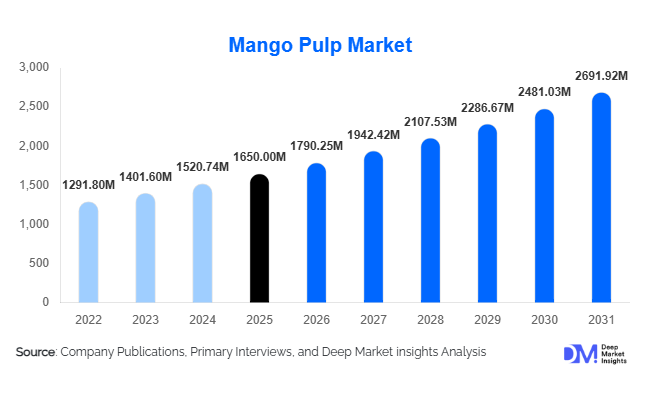
According to Deep Market Insights, the global mango pulp market size was valued at USD 1,650 million in 2025 and is projected to grow from USD 1,790.25 million in 2026 to reach USD 2,691.92 million by 2031, expanding at a CAGR of 8.5% during the forecast period (2026–2031). The mango pulp market growth is primarily driven by rising demand for natural fruit-based ingredients, increasing consumption of ready-to-drink beverages, and expanding applications across dairy, bakery, and nutraceutical industries. The shift toward clean-label and minimally processed foods is further accelerating adoption, particularly in developed markets, while strong export capabilities from producing countries continue to strengthen global supply chains.
Key Market Insights
- Mango pulp demand is increasingly driven by clean-label and natural ingredient trends, as consumers shift away from artificial additives in food and beverages.
- Aseptic processing technology is transforming global trade, enabling longer shelf life and cost-efficient transportation across regions.
- Asia-Pacific dominates production and exports, with India leading global supply due to large-scale mango cultivation.
- Beverages remain the largest application segment, supported by strong demand for juices, smoothies, and RTD drinks.
- Middle East & Africa is the fastest-growing region, driven by rising imports and increasing processed food consumption.
- Technological advancements in cold chain logistics and packaging are improving product quality and reducing wastage globally.
What are the latest trends in the mango pulp market?
Growing Demand for Organic and Clean-Label Products
The mango pulp market is witnessing a strong shift toward organic and clean-label products, particularly in North America and Europe. Consumers are increasingly seeking food products that are free from preservatives, synthetic additives, and artificial flavoring agents. This has encouraged manufacturers to invest in organic mango pulp production, sustainable farming practices, and certification processes. Retail brands are also positioning organic mango pulp as a premium offering, catering to health-conscious consumers. This trend is expected to expand further as regulatory bodies tighten food safety norms and consumers become more aware of ingredient transparency.
Expansion of Aseptic Processing and Export Capabilities
Aseptic processing technology is revolutionizing the mango pulp market by extending product shelf life without refrigeration. This advancement has significantly boosted international trade, allowing exporters to ship mango pulp across long distances without compromising quality. Countries like India, Thailand, and Mexico are investing heavily in aseptic processing facilities, enabling them to cater to global demand more efficiently. The adoption of advanced packaging solutions, such as aseptic bags and drums, is further enhancing export capabilities and reducing logistical costs.
What are the key drivers in the mango pulp market?
Rising Demand for Ready-to-Drink Beverages
The global surge in demand for ready-to-drink beverages is a major driver for the mango pulp market. Mango pulp is widely used in juices, smoothies, and flavored drinks due to its natural sweetness and rich flavor profile. The growing urban population, changing lifestyles, and increasing preference for convenience foods are fueling the expansion of the beverage industry, directly impacting mango pulp consumption. Emerging markets in Asia and Africa are witnessing particularly strong growth in this segment.
Increasing Preference for Natural Ingredients
Consumers are increasingly favoring natural and minimally processed food ingredients, driving demand for mango pulp as a natural flavoring and coloring agent. Food manufacturers are replacing synthetic additives with fruit-based alternatives to meet consumer expectations and regulatory requirements. Mango pulp’s nutritional benefits, including high vitamin content and antioxidant properties, further enhance its appeal across multiple applications.
What are the restraints for the global market?
Seasonality and Supply Chain Constraints
Mango production is highly seasonal, which creates challenges in maintaining a consistent supply of raw materials throughout the year. Fluctuations in harvest yields due to climatic conditions can lead to price volatility and supply disruptions. This dependency on seasonal availability poses a significant challenge for manufacturers and exporters, requiring efficient storage and processing solutions.
Competition from Alternative Fruit Pulps
The mango pulp market faces competition from other fruit pulps such as apple, banana, and peach, particularly in cost-sensitive markets. These alternatives often offer lower prices and year-round availability, making them attractive substitutes for manufacturers. Price fluctuations in mango supply further intensify competition, impacting overall market growth.
What are the key opportunities in the mango pulp industry?
Expansion into Emerging Export Markets
Emerging markets in the Middle East, Africa, and Eastern Europe present significant growth opportunities for mango pulp exporters. Rising urbanization, increasing disposable incomes, and growing demand for processed foods are driving consumption in these regions. Favorable trade agreements and improved logistics infrastructure are further facilitating market entry for exporters, enabling them to expand their global footprint.
Integration into Functional Foods and Nutraceuticals
The growing health and wellness trend is opening new avenues for mango pulp in functional foods and nutraceutical applications. Mango pulp is increasingly being used in fortified beverages, dietary supplements, and baby food products due to its nutritional profile. This diversification into health-focused segments is expected to generate new revenue streams and enhance market growth potential.
Report Scope
| Report Metric | Details |
|---|---|
| Market Size in 2025 | USD 1650.00 Million |
| Market Size in 2026 | USD 1790.25 Million |
| Market Size in 2031 | USD 2691.92 Million |
| CAGR | 8.5% (2026-2031) |
| Base Year for Estimation | 2025 |
| Historical Data | 2022-2024 |
| Forecast Period | 2026-2031 |
| Report Coverage | Revenue Forecast, Competitive Landscape, Supply Chain Disruption, Growth Factors, Environment & Regulatory Landscape and Trends |
| Geographies Covered | North America, Europe, APAC, Middle East and Africa, LATAM |
| Countries Covered | U.S., Canada, U.K., Germany, France, Spain, Italy, Russia, Nordic, Benelux, Rest of Europe, China, Korea, Japan, India, Australia, Singapore, Taiwan, South East Asia, Rest of Asia-Pacific, UAE, Turky, Saudi Arabia, South Africa, Egypt, Nigeria, Rest of MEA, Brazil, Mexico, Argentina, Chile, Colombia, Rest of LATAM |
Explore more data points, trends and opportunities Download Free Sample Report
Product Type Insights
The global mango pulp market is strongly influenced by the dominance of Alphonso mango pulp, which accounts for approximately 32% of the total market share in 2025. This leadership position is primarily attributed to its exceptional sensory profile, including a rich flavor, vibrant color, and distinctive aroma that appeals to premium product manufacturers and consumers alike. Alphonso pulp is widely preferred in high-end beverage formulations, desserts, and export-oriented products where quality differentiation is critical. Its strong brand recognition, particularly in international markets, further enhances its demand, positioning it as the leading segment in the product type category. The key driver for this segment remains the rising global demand for premium fruit ingredients, especially in developed economies where consumers are increasingly willing to pay more for authentic and high-quality tropical fruit experiences.In contrast, other mango varieties such as Totapuri and Kesar play a crucial role in balancing the market by catering to large-scale industrial applications. Totapuri mango pulp is widely utilized due to its relatively lower cost, consistent supply, and suitability for processing, making it a preferred choice for juice manufacturers and bulk food processors. Kesar mango pulp, known for its sweetness and appealing color, finds application in both domestic and export markets, particularly in processed dairy and confectionery products. The diversification of mango varieties is becoming increasingly important as manufacturers seek to optimize cost structures while maintaining product quality. This trend is also driven by the need to mitigate risks associated with seasonal production and regional crop variations.
Application Insights
The application landscape of the mango pulp market is predominantly led by the beverages segment, which contributes approximately 45% of the global market share. This segment’s dominance is driven by the widespread use of mango pulp in fruit juices, nectars, smoothies, and ready-to-drink (RTD) beverages. The leading driver for this segment is the increasing global demand for natural, fruit-based, and clean-label beverages, as consumers shift away from carbonated drinks toward healthier alternatives. Mango pulp’s natural sweetness, rich texture, and nutritional value make it an ideal ingredient for beverage formulations, particularly in markets where tropical flavors are gaining popularity.The bakery and confectionery segment is also experiencing notable expansion, driven by the increasing use of fruit-based fillings, toppings, and flavoring agents. Mango pulp is being utilized in cakes, pastries, jams, and confectionery items, reflecting the broader trend of incorporating exotic fruit flavors into traditional baked goods. This trend is particularly prominent in urban markets, where consumers are seeking innovative and premium food experiences.Furthermore, the foodservice sector is emerging as a key contributor to application growth, as restaurants, cafes, and quick-service outlets increasingly incorporate mango-based products into their menus. The versatility of mango pulp allows it to be used in a wide range of culinary applications, from beverages and desserts to sauces and marinades, thereby expanding its market potential across diverse food categories.
Distribution Channel Insights
Distribution channels in the mango pulp market are heavily dominated by direct B2B sales, which account for over 65% of total market revenue. This dominance is largely due to the industrial nature of mango pulp consumption, where food and beverage manufacturers procure pulp in bulk quantities for further processing. The leading driver for this segment is the strong and consistent demand from large-scale manufacturers who require reliable supply chains, standardized quality, and cost efficiency. Direct sourcing from producers or processors enables these companies to maintain better control over product specifications and pricing, thereby reinforcing the importance of B2B distribution.At the same time, retail distribution channels are gaining traction, supported by the growing availability of packaged mango pulp products in supermarkets, hypermarkets, and convenience stores. Consumers are increasingly purchasing mango pulp for home use, driven by the convenience of ready-to-use products and the desire to replicate restaurant-style beverages and desserts at home. This shift is particularly evident in urban areas, where busy lifestyles and increasing disposable incomes are influencing purchasing behavior.Additionally, the integration of advanced logistics and cold chain infrastructure is improving the efficiency of distribution networks, ensuring the preservation of product quality during transportation and storage. This development is particularly important for export-oriented markets, where maintaining product integrity is critical to meeting international standards and customer expectations.
End-Use Industry Insights
The food and beverage industry remains the largest end-use segment in the mango pulp market, accounting for approximately 60% of the global market share. The leading driver for this segment is the extensive utilization of mango pulp as a key ingredient in a wide variety of products, including beverages, dairy items, bakery goods, and processed foods. The industry’s continuous innovation and product development efforts are further fueling demand, as manufacturers seek to introduce new and appealing offerings that cater to evolving consumer preferences.The dairy industry also represents a significant end-use sector, driven by the increasing demand for flavored and value-added dairy products. Mango pulp is widely used to enhance the taste and visual appeal of dairy items, making them more attractive to consumers, particularly in regions with high consumption of yogurt and ice cream. The growing popularity of functional dairy products, which combine taste with health benefits, is expected to further boost demand for mango pulp in this segment.Export-oriented industries also play a crucial role in shaping the market dynamics, particularly in regions where domestic production is limited. The global trade of mango pulp is driven by strong demand from countries with high consumption of processed foods and beverages, creating significant opportunities for exporters in major producing regions. The expansion of international trade agreements and improvements in supply chain infrastructure are further facilitating market growth.
Explore more data points, trends and opportunities Download Free Sample Report
Mango Pulp Market Segmentations
By Product Type
- Alphonso Mango Pulp
- Totapuri Mango Pulp
- Kesar Mango Pulp
- Tommy Atkins Mango Pulp
- Kent Mango Pulp
- Others
By Nature
- Conventional
- Organic
By Processing Method
- Hot Break Processing
- Cold Break Processing
- Aseptic Processing
By Form
- Liquid Mango Pulp
- Concentrated Mango Pulp
- Frozen Mango Pulp
- Powdered Mango Pulp
By Distribution Channel
- Direct/B2B
- Retail Stores
- Online Retail
- Specialty Stores
Regional Insights
Asia-Pacific
Asia-Pacific dominates the global mango pulp market, accounting for approximately 52% of the total market share in 2025. The region’s leadership is primarily driven by its status as the largest producer and consumer of mangoes, with countries such as India, Thailand, and the Philippines playing a central role. India, in particular, stands out as the leading producer and exporter, benefiting from favorable climatic conditions, extensive cultivation areas, and a diverse range of mango varieties. The key drivers of regional growth include strong domestic consumption, increasing export demand, and the availability of cost-effective raw materials. Additionally, government initiatives supporting agricultural development and food processing industries are further enhancing production capabilities and export competitiveness.
North America
North America holds approximately 18% of the global mango pulp market, with the United States being the प्रमुख contributor to regional demand. The growth of this market is primarily driven by the increasing popularity of tropical fruit-based beverages and the rising preference for clean-label and natural products. Consumers in the region are increasingly seeking healthier alternatives to traditional sugary drinks, which has led to a surge in demand for mango-based juices and smoothies.Another significant driver is the region’s strong reliance on imports from major producing countries, ensuring a steady supply of mango pulp throughout the year. The presence of advanced food processing industries and a well-developed retail network further supports market growth. Additionally, the growing influence of multicultural cuisines and the popularity of exotic flavors are contributing to the increasing incorporation of mango pulp in a wide range of food and beverage products.
Europe
Europe accounts for approximately 15% of the global market share, with key markets including Germany, the United Kingdom, and France. The region’s growth is driven by the rising demand for exotic and premium fruit flavors, as well as the increasing popularity of organic and sustainably sourced products. European consumers are particularly inclined toward high-quality and ethically produced food items, which is encouraging manufacturers to focus on certification and compliance with stringent food safety standards.The leading drivers for this region include the growing trend of health-conscious consumption, the expansion of the beverage and dairy industries, and the increasing availability of mango pulp through established import channels. Furthermore, the region’s strong regulatory framework ensures product quality and safety, which enhances consumer confidence and supports market expansion.
Middle East & Africa
The Middle East & Africa region represents approximately 8% of the global market and is the fastest-growing region, with a CAGR exceeding 9%. The primary drivers of growth in this region include high import dependency, rapid urbanization, and the increasing consumption of processed and convenience foods. The expanding hospitality and foodservice sectors are also contributing significantly to the demand for mango pulp, particularly in beverages and desserts.Additionally, rising disposable incomes and changing consumer lifestyles are driving the adoption of premium and exotic food products. The region’s strategic location as a trade hub further facilitates the import and distribution of mango pulp, enabling suppliers to cater to a diverse and growing consumer base.
Latin America
Latin America holds around 7% of the global market share, with countries such as Brazil and Mexico serving as both producers and consumers of mango pulp. The region’s growth is driven by its strong agricultural base, favorable climatic conditions, and increasing focus on export-oriented production. Mexico, in particular, plays a significant role in supplying mango pulp to North America, benefiting from its geographical proximity and established trade relationships.Key drivers for this region include the expansion of food processing industries, rising domestic consumption of fruit-based products, and increasing investments in agricultural infrastructure. The growing emphasis on value-added products and the development of export markets are expected to further enhance the region’s contribution to the global mango pulp market.
Key Players in the Mango Pulp Market
- Jain Irrigation Systems Ltd.
- ABC Fruits
- Capricorn Food Products India Ltd.
- Allanasons Pvt Ltd.
- Mother India Farms
- Shimla Hills Offerings Pvt Ltd.
- SVZ International BV
- Tree Top Inc.
- Döhler Group
- Kiril Mischeff Ltd.
- AGRANA Beteiligungs AG
- ITC Limited
- Frutex Australia
- Sun Impex International Foods LLC
- Capricorn Food Products