Mango Juice Market Size
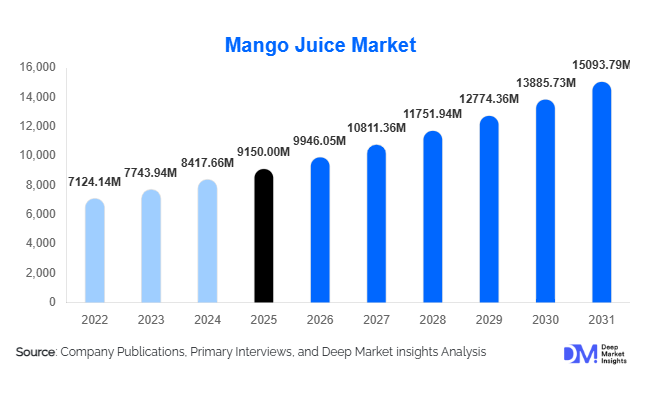
According to Deep Market Insights, the global mango juice market size was valued at USD 9,150 million in 2025 and is projected to grow from USD 9,946.05 million in 2026 to reach USD 15,093.79 million by 2031, expanding at a CAGR of 8.7% during the forecast period (2026–2031). The mango juice market growth is primarily driven by rising consumer preference for fruit-based beverages, increasing health awareness, and expanding distribution networks across emerging economies. Additionally, growing investments in food processing infrastructure and innovations in packaging and preservation technologies are further supporting market expansion globally.
Key Market Insights
- Mango juice consumption is shifting toward healthier and natural beverage alternatives, driven by increasing awareness of nutritional benefits and reduced sugar formulations.
- Asia-Pacific dominates the global mango juice market, supported by high mango production and strong domestic consumption in countries such as India and China.
- Carton packaging formats are gaining traction globally, offering longer shelf life, convenience, and sustainability advantages.
- Organic and cold-pressed mango juice variants are witnessing rapid growth, especially in developed markets with health-conscious consumers.
- E-commerce and online grocery platforms are emerging as high-growth distribution channels, enhancing accessibility and product visibility.
- Export-driven demand for mango juice is increasing, particularly from producing nations to North America and Europe.
What are the latest trends in the mango juice market?
Premiumization and Functional Beverage Innovation
The mango juice market is increasingly witnessing premiumization, with manufacturers introducing high-quality variants such as organic, cold-pressed, and not-from-concentrate juices. These products are often enriched with vitamins, antioxidants, and probiotics to cater to health-conscious consumers. Functional beverages that combine mango juice with immunity-boosting ingredients are gaining traction, particularly after the global shift toward preventive healthcare. Brands are also focusing on clean-label products with minimal additives, enhancing consumer trust and brand loyalty.
Sustainable Packaging and Eco-Friendly Production
Sustainability has become a key focus area in the mango juice market, with companies adopting eco-friendly packaging solutions such as recyclable cartons and biodegradable materials. Manufacturers are also investing in energy-efficient processing technologies and reducing water usage during production. These initiatives align with global environmental goals and appeal to environmentally conscious consumers. Additionally, sustainable sourcing of mangoes and fair-trade practices are gaining importance, particularly in export-oriented markets.
What are the key drivers in the mango juice market?
Growing Demand for Natural Beverages
Consumers worldwide are increasingly shifting away from carbonated drinks toward natural fruit-based beverages. Mango juice, being rich in essential nutrients and offering a refreshing taste, is benefiting significantly from this trend. The perception of fruit juices as healthier alternatives is a major factor driving demand across both developed and developing regions.
Expansion of Retail and Distribution Networks
The rapid growth of supermarkets, hypermarkets, and online retail platforms has significantly improved the availability of mango juice products. Organized retail chains provide a wide variety of options, while e-commerce platforms enable convenient purchasing and doorstep delivery. This expansion has enhanced market penetration, particularly in urban and semi-urban areas.
Increasing Mango Production and Processing Capabilities
Major mango-producing countries are investing in processing infrastructure to convert raw mangoes into pulp and juice products. This has improved supply chain efficiency and reduced post-harvest losses. Enhanced processing capabilities are enabling manufacturers to produce mango juice at scale, ensuring consistent quality and competitive pricing.
What are the restraints for the global market?
Seasonal Availability and Price Volatility
The production of mango juice is highly dependent on seasonal mango harvests. Fluctuations in weather conditions, pest attacks, and crop yield variability can impact raw material availability and pricing. This creates uncertainty for manufacturers and affects overall profit margins.
Competition from Alternative Beverages
The mango juice market faces increasing competition from other beverage categories such as flavored water, plant-based drinks, and functional beverages. These alternatives often promote low-sugar and health-focused benefits, attracting a growing segment of consumers and posing a challenge to traditional fruit juice consumption.
What are the key opportunities in the mango juice industry?
Expansion in Emerging Markets
Emerging economies in Asia-Pacific, Africa, and Latin America present significant growth opportunities for mango juice manufacturers. Rising disposable incomes, urbanization, and changing dietary preferences are driving increased consumption of packaged beverages. Companies can capitalize on these trends by expanding distribution networks and introducing affordable product variants tailored to local markets.
Export and Global Trade Opportunities
The increasing demand for tropical fruit beverages in North America and Europe is creating export opportunities for mango juice producers. Countries with strong mango production capabilities are leveraging international trade agreements and logistics improvements to expand their global footprint. Private-label manufacturing and cross-border e-commerce are further supporting this growth.
Report Scope
| Report Metric | Details |
|---|---|
| Market Size in 2025 | USD 9150 Million |
| Market Size in 2026 | USD 9946.05 Million |
| Market Size in 2031 | USD 15093.79 Million |
| CAGR | 8.7% (2026-2031) |
| Base Year for Estimation | 2025 |
| Historical Data | 2022-2024 |
| Forecast Period | 2026-2031 |
| Report Coverage | Revenue Forecast, Competitive Landscape, Supply Chain Disruption, Growth Factors, Environment & Regulatory Landscape and Trends |
| Geographies Covered | North America, Europe, APAC, Middle East and Africa, LATAM |
| Countries Covered | U.S., Canada, U.K., Germany, France, Spain, Italy, Russia, Nordic, Benelux, Rest of Europe, China, Korea, Japan, India, Australia, Singapore, Taiwan, South East Asia, Rest of Asia-Pacific, UAE, Turky, Saudi Arabia, South Africa, Egypt, Nigeria, Rest of MEA, Brazil, Mexico, Argentina, Chile, Colombia, Rest of LATAM |
Explore more data points, trends and opportunities Download Free Sample Report
Product Type Insights
The global mango juice market demonstrates a diverse product portfolio, with mango nectar continuing to dominate due to its strong balance between affordability, taste, and accessibility. In 2025, mango nectar accounts for approximately 38% of the total market share, primarily because it contains a lower percentage of pure mango pulp compared to 100% juice, making it more cost-effective for mass production and consumption. This affordability is especially crucial in price-sensitive markets across Asia, Africa, and parts of Latin America, where consumers prioritize value-driven purchases. Additionally, mango nectar benefits from a longer shelf life due to added preservatives and stabilizers, making it highly suitable for distribution in regions with developing cold chain infrastructure. The wide availability of mango nectar across retail formats further strengthens its position as the leading product segment.Meanwhile, 100% mango juice is witnessing steady growth, particularly in premium and health-conscious segments. Consumers are increasingly gravitating toward products that are perceived as natural, minimally processed, and free from added sugars or artificial ingredients. This shift is strongly influenced by growing awareness of health and wellness, as well as the rising prevalence of lifestyle-related conditions such as obesity and diabetes. The leading driver for this segment is the increasing demand for clean-label beverages that provide authentic nutritional value. Although the higher price point of 100% mango juice limits its penetration in lower-income markets, it continues to gain popularity in developed regions and among affluent urban populations globally.
Application Insights
In terms of application, household consumption remains the dominant segment, contributing nearly 60% of the global mango juice market share. This dominance is primarily driven by the widespread integration of fruit juices into daily diets, particularly in emerging economies where mango juice is often consumed as a staple beverage. In Asia-Pacific, for instance, mango juice is frequently included in breakfast routines and family meals, supported by cultural familiarity with mango as a fruit. The leading driver for this segment is the consistent daily consumption pattern combined with increasing availability of affordable packaged options. Additionally, the convenience of ready-to-drink formats has significantly enhanced adoption among busy urban households.Furthermore, the food processing industry is witnessing increasing utilization of mango juice as an ingredient in a wide range of products, including desserts, dairy items such as yogurt and ice cream, bakery products, and confectionery. The natural sweetness and vibrant flavor of mango make it an ideal component in processed foods. This segment is driven by the rising demand for fruit-infused and flavored products, as well as the growing trend of incorporating natural ingredients into packaged foods. As food manufacturers continue to innovate and diversify their offerings, the demand for mango juice as a raw material is expected to grow steadily.
Distribution Channel Insights
The distribution landscape of the mango juice market is characterized by the dominance of supermarkets and hypermarkets, which collectively hold approximately 35% of the market share. These retail formats serve as one-stop destinations for consumers, offering a wide variety of brands, product types, and price points. The leading driver for this segment is the ability to provide extensive product visibility combined with promotional pricing strategies, discounts, and bundled offers. Consumers often prefer supermarkets and hypermarkets for their convenience, product assortment, and trust in quality standards, making them a key channel for mango juice sales.Specialty stores and convenience outlets continue to play a supporting yet significant role in the distribution ecosystem. Specialty stores cater to niche markets, offering premium, organic, and artisanal mango juice products that appeal to health-conscious and high-income consumers. Convenience stores, on the other hand, are strategically located to capture impulse purchases and on-the-go consumption, particularly in urban areas. These channels contribute to overall market growth by addressing specific consumer needs and preferences.
Processing Technology Insights
Processing technology plays a critical role in determining the quality, shelf life, and nutritional value of mango juice products. Pasteurized mango juice remains the leading segment, accounting for approximately 55% of the market share. The primary driver for this dominance is its cost-effectiveness and extended shelf life, which make it suitable for mass production and distribution across diverse markets. Pasteurization effectively eliminates harmful microorganisms, ensuring product safety while maintaining acceptable taste and nutritional quality. This technology is widely adopted by manufacturers due to its scalability and compatibility with existing production infrastructure.The adoption of innovative processing techniques is also influenced by advancements in food technology and increasing investments in research and development. Manufacturers are focusing on improving efficiency, reducing waste, and enhancing product quality to gain a competitive edge. As consumer preferences continue to evolve toward healthier and more natural options, the demand for advanced processing technologies is expected to rise.
Explore more data points, trends and opportunities Download Free Sample Report
Mango Juice Market Segmentations
By Product Type
- 100% Mango Juice
- Mango Juice from Concentrate
- Mango Nectar
- Mango Juice Blends
By Packaging Type
- Bottles
- Cartons
- Cans
- Pouches
- Bulk Packaging
By Distribution Channel
- Supermarkets/Hypermarkets
- Convenience Stores
- Online Retail/E-commerce
- Specialty Stores
- Foodservice (HoReCa)
Processing Technology
- Pasteurized Juice
- Cold-Pressed Juice
- Aseptic Processing
- High Pressure Processing (HPP)
By Nature
- Conventional
- Organic
By End-Use
- Household/Retail Consumption
- Foodservice Industry
- Food Processing Industry
- Institutional Buyers
Regional Insights
Asia-Pacific
Asia-Pacific dominates the global mango juice market, accounting for approximately 48% of total demand in 2025. The region’s leadership is primarily driven by its abundant mango production, strong cultural affinity for mango-based products, and large population base. India stands out as the largest producer and consumer of mangoes, benefiting from favorable climatic conditions and extensive agricultural practices. The widespread availability of raw materials significantly reduces production costs, enabling manufacturers to offer competitively priced products.Southeast Asian countries, including Indonesia and Thailand, are also contributing significantly to regional growth. These countries benefit from strong tourism industries, which drive demand for tropical beverages, as well as growing domestic markets. Government initiatives to support agricultural production and food processing industries further strengthen the market. Overall, the combination of supply-side advantages and demand-side dynamics makes Asia-Pacific the most influential region in the global mango juice market.
North America
North America accounts for nearly 18% of the global mango juice market, with the United States leading regional demand. The market is characterized by a strong preference for diverse and exotic flavors, reflecting the multicultural composition of the population. One of the primary drivers of growth in this region is the increasing demand for functional and health-oriented beverages. Consumers are actively seeking products that offer nutritional benefits, such as vitamins, antioxidants, and natural ingredients, which mango juice provides.The presence of well-established beverage companies and advanced distribution networks further supports market expansion. Supermarkets, health food stores, and online platforms ensure widespread availability of mango juice products. Additionally, the growing popularity of smoothies, juice bars, and wellness-focused lifestyles is boosting consumption. Innovation in product formulations, including organic, non-GMO, and cold-pressed variants, is also driving growth in the premium segment.
Europe
Europe represents approximately 16% of the global mango juice market, with key countries such as Germany, the United Kingdom, and France leading consumption. The region is characterized by a strong emphasis on quality, sustainability, and health. One of the major drivers of growth is the increasing demand for organic and clean-label products. European consumers are highly conscious of ingredient transparency and environmental impact, prompting manufacturers to adopt sustainable sourcing and eco-friendly packaging practices.Additionally, the growing trend of plant-based and natural beverages is supporting the adoption of mango juice as a healthier alternative to carbonated drinks. The presence of stringent food safety regulations ensures high product quality, further enhancing consumer trust. The expansion of premium retail channels and specialty stores also contributes to market growth by offering high-quality and artisanal products.
Latin America
Latin America contributes around 12% to the global mango juice market, with Brazil and Mexico emerging as key players. The region benefits from favorable climatic conditions for mango cultivation, ensuring a steady supply of raw materials. One of the primary drivers of growth is the increasing domestic consumption of fruit-based beverages, supported by cultural preferences for natural and tropical flavors.Export opportunities also play a significant role in regional growth, particularly to North America, where demand for tropical juices is high. Investments in food processing infrastructure and government support for agricultural development are further enhancing market potential. Additionally, the rising middle-class population and improving retail networks are driving the adoption of packaged mango juice products.
Middle East & Africa
The Middle East & Africa region is the fastest-growing market for mango juice, with a CAGR exceeding 9.5%. Rapid urbanization, population growth, and increasing disposable incomes are key factors driving demand. Countries such as the United Arab Emirates and Saudi Arabia are witnessing a surge in consumption of packaged beverages, supported by a large expatriate population and a thriving hospitality sector.Overall, the Middle East & Africa region presents significant growth potential due to its evolving consumer landscape and increasing adoption of modern retail formats. As economic conditions improve and awareness of packaged beverages rises, the demand for mango juice is expected to grow at a robust pace.
Key Players in the Mango Juice Market
- PepsiCo Inc.
- The Coca-Cola Company
- Dabur India Ltd.
- Parle Agro Pvt. Ltd.
- Del Monte Foods Inc.
- Nestlé S.A.
- ITC Limited
- Tropicana Products Inc.
- Campbell Soup Company
- The Kraft Heinz Company
- Welch’s
- Ocean Spray Cranberries Inc.
- Jain Irrigation Systems Ltd.
- Manpasand Beverages Ltd.
- Britvic plc