Global Malt Extract Market Size
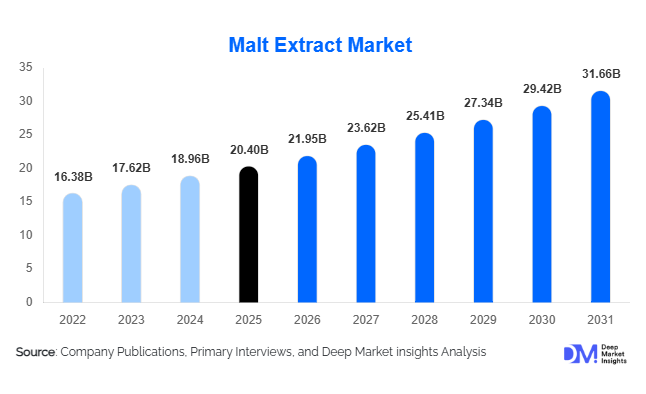
According to Deep Market Insights, the global malt extract market size was valued at USD 20.4 billion in 2025 and is projected to grow from USD 21.95 billion in 2026 to reach USD 31.66 billion by 2031, expanding at a CAGR of 7.6% during the forecast period (2026–2031). The malt extract market growth is primarily driven by the rising demand for craft beer production, increasing adoption of clean-label food ingredients, and growing consumption of malt-based nutritional beverages across both developed and emerging economies.
Key Market Insights
- Brewing applications continue to dominate global malt extract consumption, supported by expanding craft brewery operations and premium beer demand worldwide.
- Clean-label food manufacturing is accelerating adoption of malt extract as a natural sweetener, flavor enhancer, and browning agent in bakery and processed food products.
- Europe remains the leading regional market, benefiting from strong brewing traditions, advanced malt processing infrastructure, and extensive barley cultivation.
- Asia-Pacific is the fastest-growing regional market, driven by rising beer consumption, urbanization, and increasing demand for functional malt beverages in China and India.
- Liquid malt extract accounts for the largest market share, owing to its ease of use and high compatibility with industrial brewing processes.
- Technological advancements in spray drying and enzymatic processing are improving product shelf life, flavor consistency, and operational efficiency across manufacturing facilities.
Global Malt Extract Market Latest Trends
Growing Demand for Specialty and Craft Brewing Ingredients
The rapid global expansion of craft breweries is significantly reshaping demand patterns within the malt extract market. Breweries are increasingly seeking customized malt extracts with distinct flavor profiles, color characteristics, and fermentation properties to differentiate their products in competitive beer markets. Specialty malt extracts such as caramel, roasted, wheat, and rye malt extracts are gaining popularity among craft brewers aiming to develop premium and experimental beer variants. Small-batch brewing trends across North America, Europe, and Asia-Pacific are also encouraging suppliers to expand tailored ingredient offerings. Additionally, collaborations between breweries and malt ingredient manufacturers are becoming increasingly common, enabling breweries to secure exclusive malt formulations for limited-edition and premium beverage launches.
Rising Penetration of Clean-Label and Functional Food Ingredients
Malt extract is increasingly being adopted by food manufacturers as consumers shift toward natural, minimally processed, and clean-label food products. Bakery manufacturers are replacing artificial sweeteners and refined sugar syrups with malt extract to improve flavor, texture, and product coloration while maintaining clean ingredient labels. Functional food applications are also expanding rapidly, particularly within nutritional beverages, breakfast cereals, energy bars, and plant-based formulations. Consumers are increasingly attracted to malt extract due to its natural carbohydrate composition, vitamin B content, and mineral profile. Organic and non-GMO malt extract variants are witnessing growing demand, particularly across Europe and North America, where health-conscious purchasing behavior continues to influence food industry reformulation strategies.
Global Malt Extract Market Drivers
Expansion of the Global Brewing Industry
The brewing industry remains the largest growth driver for the global malt extract market. Rising global beer consumption, premiumization trends, and increasing consumer preference for craft and flavored beers are significantly supporting demand for brewing-grade malt extract. Craft brewery expansion across the United States, Germany, the United Kingdom, China, and India is creating substantial demand for specialty malt formulations with customized fermentation and flavor profiles. Breweries increasingly rely on liquid and dry malt extracts to improve production efficiency, maintain consistency, and reduce processing complexity. The growth of non-alcoholic and low-alcohol beer segments is also supporting demand for specialty malt extracts capable of preserving authentic beer flavor characteristics.
Increasing Demand for Natural and Clean-Label Ingredients
Food manufacturers are increasingly incorporating malt extract into processed food products due to rising consumer preference for natural ingredients and reduced artificial additives. Malt extract serves as a natural sweetener, coloring agent, and flavor enhancer across bakery products, cereals, confectionery, and dairy applications. Consumers globally are showing heightened awareness regarding ingredient transparency and nutritional quality, encouraging manufacturers to reformulate products using clean-label alternatives. Malt extract’s ability to improve flavor complexity and extend product shelf life while supporting clean-label claims is making it an increasingly preferred ingredient in premium food formulations.
Global Market Restraints
Volatility in Barley and Grain Prices
One of the major restraints affecting the global malt extract market is the fluctuation in barley and cereal grain prices. Since barley is the primary raw material used in malt production, disruptions caused by adverse weather conditions, changing agricultural yields, geopolitical uncertainties, and export restrictions can significantly impact raw material availability and procurement costs. Price volatility creates challenges for manufacturers attempting to maintain stable production costs and profit margins, particularly in highly competitive brewing and food ingredient markets.
High Energy and Production Costs
Malt extract manufacturing involves energy-intensive processes such as germination, kilning, evaporation, and spray drying. Rising industrial electricity and fuel costs, especially in Europe, have increased operational expenses for manufacturers. Smaller regional producers often face difficulties in maintaining profitability while competing with large multinational suppliers benefiting from economies of scale. Additionally, investments required for advanced processing technologies and sustainability upgrades can create financial pressure for medium-sized malt processors.
Global Malt Extract Industry Key Opportunities
Growth of Non-Alcoholic and Functional Beverages
The rapid expansion of non-alcoholic beer and functional beverage industries presents a major opportunity for malt extract manufacturers. Consumers increasingly prefer beverages with lower alcohol content, natural energy ingredients, and nutritional benefits. Malt extract plays a critical role in preserving flavor authenticity in alcohol-free beer formulations while also providing natural carbohydrates and micronutrients in health-oriented beverages. Functional malt-based beverages are witnessing particularly strong demand across Asia-Pacific, the Middle East, and Africa, where fortified malt drinks are widely consumed among younger populations and health-conscious consumers.
Export-Oriented Expansion in Emerging Economies
Emerging economies such as India, Vietnam, Brazil, and Indonesia are becoming increasingly important growth hubs for malt extract consumption due to expanding food processing industries and rising premium beverage demand. Several global manufacturers are investing in export-oriented production facilities and regional supply chain networks to capitalize on these high-growth markets. Government initiatives promoting agro-processing, food manufacturing modernization, and export incentives are further encouraging industrial investments. Companies capable of offering customized specialty malt solutions for regional brewing and food applications are expected to benefit significantly from this expansion trend.
Report Scope
| Report Metric | Details |
|---|---|
| Market Size in 2025 | USD 20.40 Billion |
| Market Size in 2026 | USD 21.95 Billion |
| Market Size in 2031 | USD 31.66 Billion |
| CAGR | 7.6% (2026-2031) |
| Base Year for Estimation | 2025 |
| Historical Data | 2022-2024 |
| Forecast Period | 2026-2031 |
| Report Coverage | Revenue Forecast, Competitive Landscape, Supply Chain Disruption, Growth Factors, Environment & Regulatory Landscape and Trends |
| Geographies Covered | North America, Europe, APAC, Middle East and Africa, LATAM |
| Countries Covered | U.S., Canada, U.K., Germany, France, Spain, Italy, Russia, Nordic, Benelux, Rest of Europe, China, Korea, Japan, India, Australia, Singapore, Taiwan, South East Asia, Rest of Asia-Pacific, UAE, Turky, Saudi Arabia, South Africa, Egypt, Nigeria, Rest of MEA, Brazil, Mexico, Argentina, Chile, Colombia, Rest of LATAM |
Explore more data points, trends and opportunities Download Free Sample Report
Product Type Insights
Non-diastatic malt extract continues to dominate the global malt extract market, accounting for nearly 38% of total demand due to its extensive utilization across bakery, confectionery, dairy, beverage, and processed food applications. The segment’s leadership is primarily driven by its ability to improve flavor profiles, impart natural sweetness, enhance product coloration, and contribute to desirable texture characteristics without introducing significant enzymatic activity during production. Food manufacturers increasingly prefer non-diastatic variants because they support clean-label product positioning and enable the replacement of artificial sweeteners, flavor enhancers, and caramel coloring agents. Growing global demand for premium baked goods, malt-flavored beverages, breakfast cereals, and confectionery products continues to strengthen the commercial adoption of non-diastatic malt extracts across both developed and emerging markets. In addition, manufacturers are increasingly introducing customized flavor profiles and specialty blends to cater to evolving consumer preferences for artisanal and premium food products.Diastatic malt extract maintains strong demand within bakery and fermentation-based applications due to its natural enzyme activity, which enhances dough fermentation, improves bread volume, supports crust development, and extends product softness. Commercial bakeries increasingly utilize diastatic malt extract to improve process consistency and optimize large-scale bread production efficiency. Meanwhile, specialty malt extracts, including roasted, caramelized, smoked, and dark malt variants, are experiencing accelerated growth due to expanding craft brewing activities and rising demand for differentiated flavor profiles in premium beverages and gourmet food products. Craft breweries and specialty food manufacturers continue to invest in unique malt formulations that deliver richer aromas, enhanced mouthfeel, and distinctive sensory characteristics, thereby creating additional growth opportunities for high-value specialty malt extract categories.
Application Insights
Brewing remains the largest application segment within the global malt extract market, accounting for approximately 46% of total market demand in 2025. The segment’s dominance is primarily supported by rising global beer production, rapid expansion of craft brewing operations, and increasing consumer preference for premium and flavored alcoholic beverages. Commercial breweries extensively utilize both liquid and dry malt extracts to improve production efficiency, reduce mashing complexity, maintain batch-to-batch flavor consistency, and accelerate fermentation performance. Growing consumer interest in craft beer varieties, low-alcohol beverages, and specialty brews continues to strengthen demand for customized malt extract formulations across developed and emerging economies.Bakery applications represent another major source of market demand, supported by increasing global consumption of clean-label baked goods, artisanal bread products, and premium confectionery items. Malt extract is increasingly incorporated into bread, biscuits, cookies, and breakfast cereals to enhance flavor, improve texture, extend shelf life, and provide natural sweetness. Rising health consciousness among consumers is further driving the adoption of malt extract in nutritional beverages, functional foods, and energy products due to its natural carbohydrate content, micronutrient profile, and perceived health benefits. In addition, confectionery manufacturers are increasingly utilizing malt extract to achieve caramelized flavor characteristics and natural coloring properties in candies, chocolate fillings, snack bars, and dessert applications. The growing popularity of fortified foods and convenience-oriented processed products is expected to further expand the application scope of malt extract globally.
Form Insights
Liquid malt extract holds the largest share of the global malt extract market, representing nearly 58% of total consumption in 2025. The segment’s leadership is primarily driven by its widespread adoption within breweries due to ease of handling, rapid fermentability, efficient blending characteristics, and lower processing complexity compared to dry alternatives. Large-scale breweries prefer liquid malt extract because it enables streamlined production processes, improves operational efficiency, and supports consistent flavor development across high-volume beer manufacturing operations. The growing expansion of industrial brewing facilities worldwide continues to reinforce strong demand for liquid formulations.At the same time, dry malt extract is witnessing increasing popularity due to its longer shelf life, reduced transportation costs, superior storage stability, and convenience in small-scale brewing and food processing applications. Home brewers, craft breweries, and specialty beverage producers increasingly prefer dry formulations because of easier measurement, improved portability, and enhanced formulation flexibility. Powdered and spray-dried malt extracts are also gaining traction across nutraceutical, infant nutrition, and processed food industries due to their improved solubility, ease of incorporation into dry mixes, and compatibility with advanced food manufacturing systems. Manufacturers are actively investing in advanced spray-drying and moisture-control technologies to improve product stability, extend shelf life, and minimize storage-related quality degradation, thereby enhancing the commercial viability of dry malt extract products.
End-Use Industry Insights
Breweries remain the largest end-use industry within the global malt extract market, accounting for approximately 49% of total market demand in 2025. The segment’s dominance is strongly supported by rising global beer consumption, continuous expansion of craft brewing operations, and increasing demand for premium alcoholic beverages with differentiated flavor profiles. Breweries increasingly rely on specialty malt extracts to enhance aroma complexity, optimize fermentation performance, and create distinctive beer formulations targeted toward evolving consumer preferences. The growing popularity of seasonal beers, flavored ales, and craft lagers is further accelerating demand for high-quality malt-based brewing ingredients.Food processing companies represent the second-largest end-user segment due to expanding utilization of malt extract across bakery products, cereals, dairy beverages, confectionery items, nutritional snacks, and ready-to-eat foods. Food manufacturers are increasingly incorporating malt extract as a natural sweetener, flavor enhancer, and clean-label ingredient to meet rising consumer demand for minimally processed food products. Nutraceutical manufacturers are emerging as a rapidly growing customer base as malt extract gains adoption within sports nutrition products, functional beverages, dietary supplements, and energy formulations owing to its nutritional composition and natural energy-enhancing properties. Additionally, animal feed applications are gradually gaining traction as premium livestock feed manufacturers incorporate malt-based ingredients to improve feed palatability, digestibility, and nutritional value. Increasing industrial diversification of malt extract applications is expected to support long-term market expansion across multiple end-use industries.
Distribution Channel Insights
Direct B2B sales continue to dominate the global malt extract market, particularly among large breweries, multinational food manufacturers, and industrial ingredient processors that rely on long-term procurement agreements and stable ingredient supply chains. The segment’s leadership is driven by the need for consistent product quality, large-volume purchasing efficiency, customized ingredient specifications, and reliable logistics management. Major malt extract manufacturers increasingly establish strategic partnerships with breweries and food processing companies to ensure uninterrupted supply and strengthen long-term commercial relationships.Ingredient distributors also play a critical role in expanding market penetration by serving regional breweries, mid-sized bakeries, nutraceutical manufacturers, and specialty food processors that require flexible order volumes and broader product accessibility. Online ingredient procurement platforms are witnessing rising adoption among small-scale brewers, artisanal food manufacturers, and home-brewing enthusiasts due to transparent pricing structures, wider product availability, simplified supplier comparison, and faster purchasing processes. Retail sales through specialty brewing supply stores and food ingredient outlets are steadily expanding alongside the growing popularity of home brewing and artisanal beverage preparation. Furthermore, digital procurement systems, integrated inventory management solutions, and automated supply chain platforms are significantly improving transaction efficiency, supplier coordination, and global distribution capabilities across the malt extract industry.
Explore more data points, trends and opportunities Download Free Sample Report
Malt Extract Market Segmentations
By Product Type
- Light Malt Extract
- Amber Malt Extract
- Dark Malt Extract
- Diastatic Malt Extract
- Non-Diastatic Malt Extract
- Specialty Malt Extract
By Source Grain
- Barley-Based Malt Extract
- Wheat-Based Malt Extract
- Rye-Based Malt Extract
- Rice-Based Malt Extract
- Corn-Based Malt Extract
- Multi-Grain Malt Extract
By Form
- Liquid Malt Extract
- Dry Malt Extract
- Powdered Malt Extract
- Syrup Malt Extract
By Application
- Brewing
- Bakery Products
- Confectionery
- Dairy Products
- Nutritional Beverages
- Breakfast Cereals
- Functional Foods
- Animal Feed
By Distribution Channel
- Direct B2B Sales
- Ingredient Distributors
- Online Platforms
- Specialty Brewing Suppliers
- Retail Stores for Home Brewing
Regional Insights
Europe
Europe accounted for approximately 34% of the global malt extract market in 2025, maintaining its leadership position due to strong brewing traditions, advanced malting infrastructure, extensive barley cultivation, and the presence of globally recognized beer manufacturers. Regional growth is primarily driven by increasing demand for premium craft beer, rising consumption of clean-label bakery products, and strong consumer preference for natural food ingredients. Germany remains one of the world’s largest producers and exporters of malt extract, supported by its technologically advanced brewing ecosystem, highly efficient malting facilities, and stable barley supply chains. The United Kingdom, Belgium, and France also contribute substantially to regional demand through established beer production industries, expanding artisanal bakery sectors, and rising adoption of specialty malt ingredients in gourmet food applications. In addition, increasing investments in organic food manufacturing, sustainable agricultural practices, and premium beverage innovation continue to support long-term market growth across Europe. Growing consumer demand for non-artificial sweeteners and naturally derived flavoring ingredients is further strengthening regional adoption of malt extract across multiple food and beverage categories.
Asia-Pacific
Asia-Pacific represented nearly 29% of the global malt extract market in 2025 and is projected to be the fastest-growing regional market through 2031. Rapid urbanization, rising disposable incomes, expanding middle-class populations, and growing consumption of processed foods and alcoholic beverages are the primary factors driving regional market growth. China dominates regional demand due to large-scale beer production, strong expansion of food processing industries, and increasing investment in industrial brewing infrastructure. India is emerging as a major high-growth market driven by rising popularity of malt-based health drinks, premium beer consumption, expanding bakery industries, and increasing consumer preference for fortified nutritional products. Japan and South Korea continue to import premium specialty malt extracts for high-quality beverage, bakery, and confectionery applications due to strong demand for premium food products and innovative flavor formulations. Additionally, Southeast Asian countries including Vietnam, Thailand, and Indonesia are witnessing increasing industrial demand as rapid urbanization, westernized dietary patterns, and growth in modern retail channels continue to accelerate processed food and beverage consumption across the region.
North America
North America remains a significant market for malt extract, supported primarily by the continued expansion of the craft brewing industry and rising demand for premium beverage products across the United States and Canada. Regional growth is being driven by increasing consumer preference for artisanal beer varieties, functional beverages, clean-label foods, and natural sweetening ingredients. The United States accounts for the majority of regional demand due to the strong presence of independent breweries, high craft beer consumption, and ongoing innovation in specialty brewing formulations. Specialty malt extracts are increasingly utilized by breweries seeking differentiated flavor profiles, improved product complexity, and premium positioning strategies. Canada also contributes significantly to regional demand through growing applications in brewing, bakery, nutritional beverages, and nutraceutical products. Rising investments in functional food innovation, increasing health-conscious consumer behavior, and growing demand for organic and minimally processed ingredients continue to support long-term market expansion throughout North America.
Latin America
Latin America is witnessing steadily growing demand for malt extract due to rising beer production, increasing processed food consumption, and continued expansion of regional food and beverage manufacturing industries. Regional market growth is primarily supported by urbanization, rising disposable incomes, expanding middle-class populations, and increasing consumer preference for premium alcoholic beverages. Brazil and Mexico remain the leading regional markets due to their large brewing industries and strong growth in food processing activities. Mexico is further strengthening its position as a major export-oriented beer production hub, creating sustained demand for brewing-grade malt ingredients and specialty malt extracts. Increasing westernization of dietary habits and rapid expansion of convenience food consumption are also encouraging broader adoption of malt extract across bakery, confectionery, cereal, and nutritional beverage applications. Furthermore, improving industrial infrastructure and increasing foreign investments in beverage manufacturing continue to create favorable growth opportunities for the regional market.
Middle East & Africa
The Middle East & Africa region is gradually emerging as a promising market for malt extract, supported by rising consumption of non-alcoholic malt beverages, fortified nutritional drinks, and processed food products. Regional market growth is primarily driven by rapid urban population growth, improving retail infrastructure, rising health awareness, and increasing investment in food and beverage manufacturing capacity. Saudi Arabia and the UAE represent important import markets for premium malt beverage ingredients due to strong demand for non-alcoholic malt drinks and functional nutritional beverages. South Africa remains the largest brewing market within Africa, supported by established beer production industries and growing adoption of specialty malt ingredients in premium beverages. Nigeria is witnessing rising demand for malt-based health drinks due to expanding urban consumer populations, increasing youth demographics, and growing awareness regarding nutritional beverage products. In addition, ongoing investments in regional food processing infrastructure, industrial beverage manufacturing, and import distribution networks are expected to support future market expansion across the Middle East & Africa region.
Key Players in the Global Malt Extract Market
- Muntons Plc
- Malteurop Group
- Boortmalt
- Cargill Incorporated
- Briess Malt & Ingredients
- Soufflet Malt
- Simpsons Malt
- GrainCorp Malt
- Rahr Corporation
- Viking Malt