Lycopene Market Size
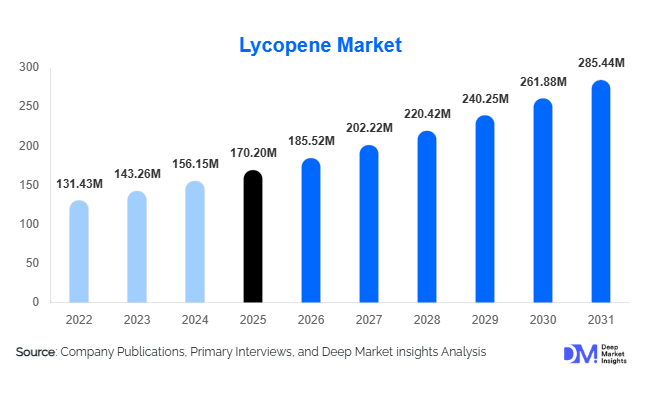
According to Deep Market Insights,the global lycopene market size was valued at USD 170.2 million in 2025 and is projected to grow from USD 185.52 million in 2026 to reach USD 285.44 million by 2031, expanding at a CAGR of 9.0% during the forecast period (2026–2031). Market growth is primarily driven by rising demand for antioxidant-rich nutraceutical ingredients, increasing adoption of natural food colorants, and expanding applications of carotenoids across dietary supplements, functional foods, and cosmetic formulations. Growing consumer awareness regarding preventive healthcare and clean-label products is accelerating the shift toward plant-derived bioactive compounds, positioning lycopene as a high-value functional ingredient across multiple industries.
Key Market Insights
- Natural lycopene derived from tomatoes dominates global supply, supported by strong clinical validation and clean-label consumer preference.
- Dietary supplements remain the largest application segment, driven by cardiovascular and antioxidant health positioning.
- Asia-Pacific leads global production and consumption, supported by large-scale tomato processing and expanding nutraceutical markets.
- Microencapsulation and bioavailability enhancement technologies are improving ingredient stability and expanding pharmaceutical applications.
- Functional foods and beverages are emerging as high-growth adoption areas, particularly antioxidant-enriched drinks and fortified products.
- Cosmetics and personal care applications are growing rapidly, driven by demand for anti-aging and UV-protection formulations.
What are the latest trends in the lycopene market?
Shift Toward Natural and Clean-Label Ingredients
Consumers increasingly prefer natural ingredients over synthetic additives, pushing food manufacturers and nutraceutical companies to adopt plant-derived lycopene. Regulatory pressure and transparency requirements are accelerating the replacement of artificial colorants with natural carotenoids. Tomato-derived lycopene offers dual functionality as both a nutritional antioxidant and natural coloring agent, making it attractive for clean-label formulations. Brands are emphasizing traceability, non-GMO sourcing, and sustainability certifications, strengthening market penetration across developed economies.
Technology-Driven Bioavailability Improvements
Technological innovation is transforming lycopene applications through advanced delivery systems such as microencapsulation, nano-emulsions, and lipid-based carriers. These technologies enhance absorption and stability, enabling use in pharmaceuticals, beverages, and skincare products. Ingredient manufacturers are investing in fermentation-based production methods to ensure consistent quality while reducing agricultural dependency. Improved formulation compatibility is allowing lycopene integration into complex functional products, including sports nutrition and clinical nutrition solutions.
What are the key drivers in the lycopene market?
Rising Demand for Preventive Healthcare Products
Global consumers are increasingly adopting preventive health solutions to manage chronic diseases. Lycopene’s association with cardiovascular health, prostate wellness, and anti-inflammatory benefits has driven strong demand in dietary supplements. Aging populations and higher healthcare awareness are encouraging long-term consumption of antioxidant ingredients, supporting sustained market expansion.
Expansion of Functional Food and Beverage Industry
The rapid growth of functional foods has created new opportunities for lycopene integration. Food manufacturers are incorporating antioxidant ingredients into juices, dairy alternatives, snacks, and plant-based products to enhance nutritional value. Lycopene’s natural pigmentation further strengthens its appeal as a multifunctional ingredient capable of delivering both visual and health benefits.
What are the restraints for the global market?
Raw Material Price Volatility
Lycopene production relies heavily on tomato processing, making the market vulnerable to climate variability, crop yield fluctuations, and seasonal supply constraints. Variations in agricultural output can impact raw material pricing and production planning, affecting profit margins for manufacturers.
Stability and Formulation Challenges
Lycopene is highly sensitive to heat, oxygen, and light exposure, leading to degradation during processing and storage. Manufacturers must invest in stabilization technologies, which increases production costs and creates formulation complexity, particularly for beverage and pharmaceutical applications.
What are the key opportunities in the lycopene industry?
Natural Food Colorant Replacement
Food producers are increasingly replacing synthetic dyes with natural alternatives due to consumer scrutiny and regulatory pressures. Lycopene provides vibrant red coloration while delivering nutritional benefits, creating strong opportunities in plant-based meat products, sauces, and functional beverages. Companies that develop stable, food-grade formulations are likely to capture growing demand from clean-label product manufacturers.
Biotechnology and Fermentation-Based Production
Fermentation-derived lycopene is emerging as a transformative opportunity. Biotechnology enables scalable production independent of agricultural cycles, ensuring consistent purity and supply stability. Governments supporting bio-manufacturing initiatives are encouraging investments in microbial biosynthesis facilities, opening pathways for new entrants and technological differentiation.
Report Scope
| Report Metric | Details |
|---|---|
| Market Size in 2025 | USD 170.2 Million |
| Market Size in 2026 | USD 185.52 Million |
| Market Size in 2031 | USD 285.44 Million |
| CAGR | 9% (2026-2031) |
| Base Year for Estimation | 2025 |
| Historical Data | 2022-2024 |
| Forecast Period | 2026-2031 |
| Report Coverage | Revenue Forecast, Competitive Landscape, Supply Chain Disruption, Growth Factors, Environment & Regulatory Landscape and Trends |
| Geographies Covered | North America, Europe, APAC, Middle East and Africa, LATAM |
| Countries Covered | U.S., Canada, U.K., Germany, France, Spain, Italy, Russia, Nordic, Benelux, Rest of Europe, China, Korea, Japan, India, Australia, Singapore, Taiwan, South East Asia, Rest of Asia-Pacific, UAE, Turky, Saudi Arabia, South Africa, Egypt, Nigeria, Rest of MEA, Brazil, Mexico, Argentina, Chile, Colombia, Rest of LATAM |
Explore more data points, trends and opportunities Download Free Sample Report
Source Insights
Tomato-derived lycopene dominates the global market, accounting for nearly 72% of total revenue in 2025, primarily due to the widespread availability of tomatoes as a raw material, well-established agricultural supply chains, and mature extraction infrastructure across major producing countries. The segment’s leadership is further reinforced by extensive clinical validation supporting lycopene’s antioxidant, cardiovascular, and skin health benefits, which strengthens consumer trust and regulatory acceptance in nutraceutical and functional food applications. Additionally, growing consumer preference for naturally sourced ingredients and clean-label formulations continues to accelerate demand for tomato-based lycopene. Synthetic lycopene maintains a comparatively smaller market share, largely serving cost-sensitive applications such as food coloring and industrial formulations where price efficiency remains a key purchasing criterion rather than natural sourcing or premium positioning.
Form Insights
Beadlet formulations account for approximately 34% of the global market share, making them the leading form segment due to their superior stability, controlled release properties, and enhanced protection against oxidation and light degradation. These characteristics make beadlets particularly suitable for dietary supplements, capsules, and tablet manufacturing, where shelf-life consistency and dosage accuracy are critical. The growth of this segment is primarily driven by increasing global supplement consumption and the need for standardized ingredient delivery systems. Powder forms continue to see widespread adoption in food processing and functional ingredient blending due to ease of handling and compatibility with dry formulations. Meanwhile, oil suspensions are gaining traction in liquid dietary supplements, soft gels, and cosmetic serums, supported by improved bioavailability and absorption efficiency, which align with rising demand for high-performance wellness and beauty products.
Application Insights
Dietary supplements represent the largest application segment, contributing nearly 41% of total market demand in 2025. The segment’s dominance is driven by growing global awareness of preventive healthcare, increasing aging populations, and rising consumer interest in antioxidant supplementation for heart health, prostate health, and immune support. Expanding e-commerce distribution channels and personalized nutrition trends further strengthen market penetration. Functional foods and beverages are emerging as the fastest-growing application area, supported by strong consumer demand for fortified everyday products that combine nutrition with convenience. Food manufacturers are increasingly incorporating lycopene into juices, dairy alternatives, snacks, and wellness beverages to meet clean-label and functional nutrition trends. Pharmaceutical research exploring lycopene’s role in chronic disease prevention also contributes to long-term application expansion.
Extraction Technology Insights
Solvent extraction remains the dominant production technology, accounting for approximately 48% of global output, primarily due to its scalability, cost efficiency, and suitability for large-volume commercial production. The method enables consistent yield levels and remains widely adopted across major manufacturing regions with established processing facilities. The leading driver for this segment is its ability to meet mass-market demand at competitive pricing, particularly for dietary supplements and food ingredient applications. However, supercritical CO₂ extraction is gaining increasing adoption in premium and pharmaceutical-grade products owing to its ability to produce higher purity extracts without solvent residues. Growing environmental sustainability concerns, stricter regulatory standards, and rising demand for solvent-free processing technologies are accelerating investment in advanced extraction methods worldwide.
End-Use Industry Insights
The nutraceutical industry leads global lycopene consumption, accounting for nearly 39% market share, supported by expanding clinical research validating health benefits and strong consumer willingness to pay for standardized bioactive ingredients. Increasing focus on longevity, immunity enhancement, and preventive wellness continues to position nutraceuticals as the primary consumption channel. Cosmetics and personal care applications are experiencing rapid expansion, particularly in anti-aging skincare, sun protection formulations, and antioxidant-rich beauty products that utilize lycopene’s ability to combat oxidative stress and environmental skin damage. In addition, animal nutrition is emerging as a promising end-use sector, driven by rising demand for natural feed additives that enhance immunity, pigmentation, and overall health outcomes in premium livestock and pet food formulations.
Explore more data points, trends and opportunities Download Free Sample Report
Lycopene Market Segmentations
By Source
- Natural Lycopene (Tomato-Derived)
- Synthetic Lycopene
- Fermentation-Derived Lycopene
By Form
- Beadlets
- Powder
- Oil Suspension
- Emulsions & Liquid Concentrates
By Application
- Dietary Supplements
- Functional Food & Beverages
- Pharmaceuticals
- Cosmetics & Personal Care
- Animal Nutrition
By Extraction Technology
- Solvent Extraction
- Supercritical CO₂ Extraction
- Fermentation/Biosynthesis
By Distribution Channel
- Direct B2B Sales
- Ingredient Distributors
- Online Ingredient Platforms
- Contract Manufacturing Partnerships
By End-Use Industry
- Nutraceutical Industry
- Food & Beverage Industry
- Pharmaceutical Industry
- Cosmetics & Personal Care Industry
- Animal Feed Industry
Regional Insights
Asia-Pacific
Asia-Pacific accounted for approximately 36% of global lycopene demand in 2025, making it the largest regional market. Regional dominance is supported by strong agricultural production, expanding food processing industries, and rapidly growing nutraceutical consumption across developing economies. China leads global production and exports due to large-scale tomato cultivation, cost-efficient manufacturing, and integrated supply chains. India is emerging as the fastest-growing market, driven by rising health awareness, expanding middle-class populations, increasing dietary supplement adoption, and supportive government initiatives promoting food processing and nutraceutical manufacturing. Japan and South Korea contribute strong demand through highly developed functional food markets and consumer preference for scientifically validated premium health ingredients. Increasing urbanization, digital retail expansion, and preventive healthcare adoption continue to accelerate regional growth.
North America
North America holds nearly 28% market share, led by the United States, where high dietary supplement penetration and strong consumer awareness regarding antioxidant health benefits support sustained demand. Growth in the region is driven by preventive healthcare spending, aging demographics, and innovation in functional beverages and clean-label foods. Advanced research infrastructure, favorable regulatory pathways for nutraceutical products, and strong brand-driven supplement markets further enhance commercialization opportunities. Increasing demand for plant-based ingredients and transparency in sourcing also supports adoption of naturally derived lycopene across food, supplement, and cosmetic industries.
Europe
Europe represents around 24% of global consumption, supported by stringent regulatory standards favoring natural additives and sustainable ingredient sourcing. Countries such as Germany, Italy, France, and Spain lead regional demand due to strong functional food innovation and established nutraceutical markets. Mediterranean tomato cultivation provides localized raw material availability, strengthening regional supply chains and reducing dependency on imports. Consumer preference for clean-label products, organic formulations, and environmentally responsible production methods acts as a major driver supporting market expansion across both food and personal care applications.
Latin America
Latin America accounts for roughly 7% of the global market, with Brazil and Mexico serving as primary growth engines. Expansion of regional food processing industries, increasing urban health awareness, and improving disposable incomes are encouraging adoption of functional foods and dietary supplements. Abundant agricultural resources and favorable climatic conditions for tomato cultivation also provide opportunities for localized lycopene production, supporting long-term supply chain development and regional manufacturing investments.
Middle East & Africa
The Middle East & Africa region contributes nearly 5% of global demand, led by the UAE and South Africa. Market growth is supported by rising premium supplement consumption, expanding modern retail infrastructure, and increasing awareness of preventive health and wellness. Growth in affluent Gulf countries is driven by high per-capita spending on health products and demand for imported nutraceutical brands, while improving healthcare access and expanding distribution networks across African economies are gradually strengthening market penetration. Increasing adoption of functional nutrition and beauty-from-within trends is expected to further support regional expansion over the forecast period.
Key Players in the Lycopene Market
- DSM-Firmenich
- BASF SE
- Lycored Ltd.
- Divi’s Laboratories Ltd.
- Allied Biotech Corporation
- Naturex (Givaudan)
- Dohler Group
- Kemin Industries
- Synthite Industries Ltd.
- Chenguang Biotech Group
- Xi’an Greena Biotech Co., Ltd.
- Zhejiang NHU Co., Ltd.
- Herbal Creative
- Bioextract Pvt. Ltd.
- Vidya Herbs Pvt. Ltd.