Luxury Modified Audio Market Size
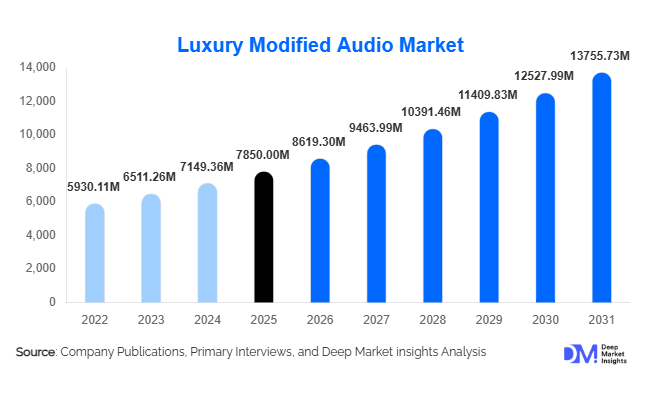
According to Deep Market Insights, the global luxury modified audio market size was valued at USD 7,850 million in 2025 and is projected to grow from USD 8,619.30 million in 2026 to reach USD 13,755.73 million by 2031, expanding at a CAGR of 9.8% during the forecast period (2026–2031). The luxury modified audio market growth is primarily driven by rising demand for high-fidelity sound experiences, increasing customization in premium automotive and residential applications, and rapid technological advancements in digital signal processing (DSP) and AI-enabled audio optimization.
Key Market Insights
- Automotive applications dominate the market, accounting for nearly 40% of total demand, driven by luxury vehicle customization trends.
- DSP-based and digital audio systems are rapidly replacing analog systems, improving sound precision and personalization.
- North America leads the global market, supported by high consumer spending and the strong presence of premium audio brands.
- Asia-Pacific is the fastest-growing region, fueled by rising affluent populations in China and India.
- Ultra-luxury audio systems ($10,000–$50,000 range) represent the largest revenue share due to strong demand for premium experiences.
- Integration with smart homes and IoT ecosystems is transforming how consumers interact with audio systems.
What are the latest trends in the luxury modified audio market?
AI-Driven Audio Personalization Gaining Momentum
Artificial intelligence is increasingly being integrated into luxury audio systems to deliver personalized sound experiences. AI algorithms analyze room acoustics, listener preferences, and content type to dynamically adjust sound output. This trend is particularly strong in high-end residential and automotive applications, where users demand seamless, adaptive sound quality. AI-driven tuning not only enhances listening experiences but also reduces manual calibration efforts, making advanced audio systems more user-friendly. Manufacturers are investing heavily in proprietary AI technologies to differentiate their offerings, while consumers are responding positively to systems that offer real-time optimization and immersive audio environments.
Seamless Integration with Smart Ecosystems
Luxury audio systems are increasingly becoming part of broader smart home and connected vehicle ecosystems. Integration with voice assistants, home automation platforms, and mobile applications is enabling centralized control of audio environments. Consumers are now expecting audio systems to sync with lighting, entertainment, and climate systems to create holistic experiences. This trend is accelerating demand for wireless, app-controlled, and cloud-enabled audio solutions. In addition, interoperability with streaming platforms and multi-room synchronization capabilities are becoming standard features, further enhancing user convenience and engagement.
What are the key drivers in the luxury modified audio market?
Rising Demand for Premium and Personalized Experiences
Affluent consumers are increasingly prioritizing personalized luxury experiences, and audio systems are becoming a key component of this trend. Customized sound profiles, bespoke installations, and aesthetic integration into interiors are driving significant demand. This is especially evident in luxury vehicles and high-end homes, where audio systems are no longer functional add-ons but central to the overall experience.
Growth in High-Resolution Audio Content
The expansion of high-resolution audio streaming platforms has heightened consumer awareness of sound quality. As more users access lossless and high-definition audio content, demand for systems capable of delivering superior sound fidelity has increased. This trend is pushing consumers toward premium upgrades and customized audio solutions.
Technological Advancements in DSP and Wireless Audio
Innovations in DSP, wireless connectivity, and acoustic engineering are significantly improving audio performance. Advanced technologies enable precise sound tuning, reduced distortion, and enhanced spatial audio experiences. These advancements are making luxury audio systems more appealing and accessible to a broader segment of affluent consumers.
What are the restraints for the global market?
High Cost of Customization
Luxury modified audio systems involve high costs due to bespoke design, premium components, and specialized installation services. This limits adoption primarily to high-net-worth individuals and restricts broader market penetration.
Complex Installation and Integration Challenges
Customized audio systems often require complex installation processes, particularly in retrofitting scenarios. The need for skilled professionals and potential compatibility issues with existing infrastructure can act as barriers to adoption.
What are the key opportunities in the luxury modified audio industry?
Expansion in Emerging Luxury Markets
Rapid economic growth and increasing disposable incomes in regions such as the Asia-Pacific and the Middle East are creating new opportunities for market expansion. Rising numbers of affluent consumers in countries like China, India, and the UAE are driving demand for premium lifestyle products, including luxury audio systems. Companies that localize their offerings and establish strong distribution networks in these regions can unlock significant growth potential.
OEM Partnerships with Automotive and Real Estate Developers
Collaborations with luxury automotive manufacturers and high-end real estate developers are emerging as a key growth strategy. Integrating customized audio systems during the design phase ensures seamless installation and enhances value propositions. These partnerships also provide companies with long-term revenue streams and brand visibility.
Report Scope
| Report Metric | Details |
|---|---|
| Market Size in 2025 | USD 7850 Million |
| Market Size in 2026 | USD 8619.30 Million |
| Market Size in 2031 | USD 13755.73 Million |
| CAGR | 9.8% (2026-2031) |
| Base Year for Estimation | 2025 |
| Historical Data | 2022-2024 |
| Forecast Period | 2026-2031 |
| Report Coverage | Revenue Forecast, Competitive Landscape, Supply Chain Disruption, Growth Factors, Environment & Regulatory Landscape and Trends |
| Geographies Covered | North America, Europe, APAC, Middle East and Africa, LATAM |
| Countries Covered | U.S., Canada, U.K., Germany, France, Spain, Italy, Russia, Nordic, Benelux, Rest of Europe, China, Korea, Japan, India, Australia, Singapore, Taiwan, South East Asia, Rest of Asia-Pacific, UAE, Turky, Saudi Arabia, South Africa, Egypt, Nigeria, Rest of MEA, Brazil, Mexico, Argentina, Chile, Colombia, Rest of LATAM |
Explore more data points, trends and opportunities Download Free Sample Report
Product Type Insights
High-end car audio systems dominate the luxury modified audio market, accounting for approximately 38% of the global share in 2025. This leadership position is primarily driven by the rapid growth of the luxury and supercar segments, where audio performance has become a critical differentiator in vehicle design. Increasing collaborations between premium automakers and high-end audio brands are further accelerating adoption, with consumers demanding immersive in-cabin experiences comparable to concert-level acoustics. Additionally, the rise in aftermarket customization among affluent car owners continues to support segment growth. Luxury home audio systems represent the second-largest segment, fueled by the expansion of smart homes and high-end residential real estate projects integrating multi-room and theater-grade sound systems. Personal audio devices, including customized headphones and audiophile-grade earbuds, are gaining traction due to the growing popularity of high-resolution music streaming and portable luxury experiences. Meanwhile, marine and aviation audio systems, though niche, are witnessing steady growth driven by increasing ownership of luxury yachts and private jets, where bespoke audio installations are becoming standard features.
Component Insights
Speakers and subwoofers lead the component segment with around 32% market share, owing to their fundamental role in delivering sound quality and their frequent replacement or upgrade in customized systems. This segment’s dominance is supported by continuous innovations in materials, design, and acoustic engineering, enabling deeper bass, clearer highs, and enhanced overall performance. Amplifiers and DSP units are also critical, as they enable precise sound tuning and optimization tailored to specific environments such as car cabins or home theaters. The growing adoption of DSP technology, in particular, is transforming how audio systems are calibrated, allowing for real-time adjustments based on user preferences. Acoustic materials and soundproofing solutions are gaining increasing importance, especially in residential and studio applications, where noise isolation and sound clarity are essential. The demand for premium cabling and connectivity solutions is also rising, driven by the need to maintain signal integrity in high-performance audio setups.
Technology Insights
Digital and DSP-based systems dominate the technology segment with nearly 45% market share, reflecting a significant shift from traditional analog systems toward digitally optimized audio environments. The primary driver of this dominance is the growing demand for precision sound tuning and adaptability across different listening conditions. AI-enhanced audio technologies are emerging as a key growth driver, enabling real-time sound adjustments based on room acoustics, user behavior, and content type. This level of personalization is particularly appealing to high-end consumers seeking tailored experiences. Wireless and smart audio systems are also gaining traction due to their seamless integration with connected ecosystems, including smart homes and connected vehicles. The convenience of app-based controls, voice integration, and multi-device synchronization is further accelerating adoption, making advanced audio systems more accessible and user-friendly without compromising on performance.
Distribution Channel Insights
Direct custom integrators hold the largest share at approximately 48%, as luxury audio systems often require specialized expertise for design, calibration, and installation. The dominance of this channel is driven by the highly personalized nature of the market, where consumers prefer end-to-end solutions tailored to their specific needs. These integrators provide consultation, system design, and after-sales support, making them indispensable in high-value transactions. OEM partnerships are rapidly expanding, particularly in the automotive and real estate sectors, where audio systems are integrated during the design and manufacturing stages. This approach ensures seamless installation and enhances the overall value proposition for end-users. Specialty audio retailers continue to serve niche audiophile communities, offering curated product selections and expert guidance. Meanwhile, online platforms are emerging as a growing channel, providing configuration tools, virtual demonstrations, and direct-to-consumer sales models, which are increasingly appealing to tech-savvy buyers.
End-Use Industry Insights
The automotive sector remains the largest end-use segment, contributing around 40% of total market demand. This dominance is driven by the increasing importance of in-car entertainment and the integration of premium audio systems in luxury vehicles. Automakers are investing heavily in advanced audio technologies to enhance user experience and differentiate their offerings. Luxury residential real estate is the fastest-growing segment, supported by the rising adoption of smart home technologies and integrated entertainment systems. High-end homeowners are increasingly investing in multi-room audio and home theater setups as part of comprehensive lifestyle upgrades. The entertainment and media industry also plays a significant role, particularly in professional studio setups requiring high-precision audio systems. Emerging applications in marine, aviation, and hospitality sectors are further expanding the market scope, as luxury experiences become a key focus across these industries.
Explore more data points, trends and opportunities Download Free Sample Report
Luxury Modified Audio Market Segmentations
By Product Type
- High-End Car Audio Systems
- Luxury Home Audio Systems
- Professional Studio-Grade Audio Systems
- Luxury Personal Audio Devices
- Marine & Aviation Audio Systems
By Component
- Speakers & Subwoofers
- Amplifiers
- Digital Signal Processors (DSPs)
- Acoustic Materials & Soundproofing
- Cabling & Connectivity Systems
By Technology
- Analog High-Fidelity Systems
- Digital & DSP-Based Systems
- AI-Enhanced Audio Systems
- Wireless & Smart Audio Systems
By Distribution Channel
- Direct Custom Integrators
- OEM Partnerships
- Specialty Audio Retailers
- Online Platforms
By End-Use Industry
- Automotive
- Residential Real Estate
- Entertainment & Media
- Marine & Aviation
- Hospitality
Regional Insights
North America
North America holds approximately 35% of the global market share, led by the United States. The region’s dominance is driven by high disposable incomes, a well-established luxury automotive market, and widespread adoption of smart home technologies. Additionally, the presence of leading audio manufacturers and strong R&D capabilities supports continuous innovation. Consumer preference for premium and customized experiences, coupled with high awareness of audio quality, further accelerates demand. The region also benefits from a mature aftermarket ecosystem, enabling extensive customization opportunities in both automotive and residential sectors.
Europe
Europe accounts for around 28% of the market, with Germany, the UK, and France leading demand. The region’s strong automotive manufacturing base, particularly in luxury vehicles, acts as a key growth driver. Europe’s deep-rooted audiophile culture and preference for high-fidelity sound systems further support market expansion. Increasing investments in premium residential developments and smart home technologies are also contributing to demand. Additionally, stringent quality standards and emphasis on engineering excellence drive innovation in audio technologies across the region.
Asia-Pacific
Asia-Pacific is the fastest-growing region, with a CAGR of approximately 12%. China holds about 18% of the global market share, driven by rapid urbanization, rising disposable incomes, and expanding luxury consumption. India and Southeast Asia are emerging as key growth markets due to increasing numbers of high-net-worth individuals and growing demand for premium lifestyle products. Government initiatives supporting manufacturing and technology adoption, along with expanding luxury real estate and automotive markets, are further fueling growth. The influence of digital platforms and social media is also playing a significant role in shaping consumer preferences toward premium audio experiences.
Middle East & Africa
The Middle East, particularly the UAE and Saudi Arabia, shows strong demand for luxury audio systems, supported by high-income populations, luxury lifestyle preferences, and a growing number of high-end real estate and automotive projects. The region’s focus on premium experiences and smart city developments is driving the adoption of advanced audio systems. In Africa, although the market remains relatively small, increasing urbanization and gradual growth in affluent consumer segments present long-term expansion opportunities.
Latin America
Latin America is an emerging market, with Brazil and Mexico leading demand. Growth in this region is driven by increasing adoption of premium consumer electronics, rising disposable incomes among upper-middle-class consumers, and expanding luxury automotive sales. The region is also witnessing growing interest in customized audio solutions, particularly in urban centers. While economic volatility may pose challenges, improving digital infrastructure and increasing exposure to global luxury trends are expected to support steady market growth over the forecast period.
Key Players in the Luxury Modified Audio Market
- Harman International
- Bose Corporation
- Bang & Olufsen
- Bowers & Wilkins
- Focal-JMlab
- JL Audio
- McIntosh Group
- Sonus Faber
- Burmester Audiosysteme
- Alpine Electronics
- Pioneer Corporation
- Sony Corporation
- Yamaha Corporation
- KEF Audio
- Devialet