Luxury Chocolate Market Size
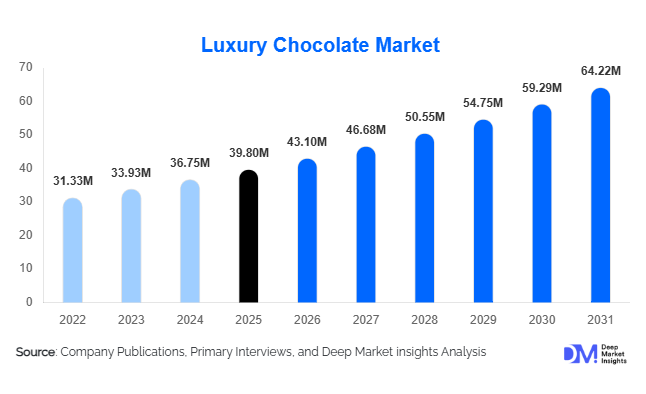
According to Deep Market Insights, the global luxury chocolate market size was valued at USD 39.8 billion in 2025 and is projected to grow from USD 43.10 billion in 2026 to reach USD 64.22 billion by 2031, expanding at a CAGR of 8.3% during the forecast period (2026–2031). The luxury chocolate market growth is primarily driven by increasing premiumization in confectionery consumption, rising demand for artisanal and ethically sourced chocolates, and the expanding culture of premium gifting across developed and emerging economies.
Key Market Insights
- Dark luxury chocolate continues to dominate globally, driven by rising health-conscious consumption and demand for high-cocoa-content premium products.
- Artisanal and bean-to-bar chocolates are witnessing strong growth, supported by consumer preference for handcrafted, traceable, and single-origin cocoa products.
- Europe dominates the global luxury chocolate market, led by Switzerland, Belgium, Germany, France, and Italy due to strong heritage manufacturing and export leadership.
- Asia-Pacific is the fastest-growing regional market, fueled by rising disposable incomes, urbanization, and premium gifting trends in China, India, Japan, and Southeast Asia.
- Sustainable and ethical sourcing practices are becoming critical purchasing factors, with growing demand for organic, fair-trade, vegan, and environmentally friendly chocolates.
- Digital retail and direct-to-consumer platforms are reshaping premium chocolate sales, enabling personalized gifting, subscription services, and wider global accessibility.
What are the latest trends in the luxury chocolate market?
Premium Artisanal and Bean-to-Bar Chocolates Gaining Popularity
The luxury chocolate market is witnessing a strong shift toward artisanal and bean-to-bar products as consumers increasingly prioritize authenticity, craftsmanship, and cocoa origin transparency. Premium consumers are actively seeking chocolates produced from single-origin cocoa beans sourced from regions such as Ecuador, Madagascar, Ghana, and Peru. Manufacturers are emphasizing handcrafted production techniques, small-batch processing, and exotic flavor combinations to differentiate products in a competitive premium confectionery environment. Bean-to-bar producers are also highlighting ethical sourcing and farmer partnerships to strengthen brand positioning among sustainability-focused consumers. The trend is especially prominent in North America and Europe, where affluent consumers increasingly associate artisanal chocolates with superior quality, exclusivity, and health-oriented indulgence.
Sustainable Packaging and Ethical Cocoa Sourcing
Sustainability has become a defining trend in the luxury chocolate industry. Consumers are increasingly demanding products that combine premium taste with environmentally responsible sourcing and packaging practices. Manufacturers are adopting recyclable packaging materials, biodegradable wrappers, and carbon-neutral production methods to align with evolving consumer preferences and regulatory requirements. Ethical cocoa sourcing programs focused on fair-trade certifications, child labor reduction, and farmer welfare are also gaining prominence globally. Luxury brands are integrating sustainability messaging into premium packaging and marketing campaigns, strengthening customer loyalty among younger demographics. Companies are further investing in regenerative agriculture and traceable supply chains to enhance long-term cocoa supply stability and brand credibility.
What are the key drivers in the luxury chocolate market?
Growing Premiumization in Food Consumption
One of the primary growth drivers for the luxury chocolate market is the increasing global trend toward premium food consumption. Consumers are increasingly willing to spend on indulgent, high-quality confectionery products that offer superior ingredients, unique flavor experiences, and elevated packaging aesthetics. Rising disposable incomes, urban lifestyles, and aspirational purchasing behavior among millennials and Generation Z are significantly contributing to demand for luxury chocolates. Premium dark chocolate products with high cocoa content are particularly benefiting from growing consumer awareness regarding antioxidants and perceived wellness benefits. The growing presence of luxury food boutiques, gourmet retail chains, and premium cafés is also strengthening product visibility and consumer accessibility globally.
Expansion of Premium Gifting Culture
The expansion of premium gifting culture across developed and emerging economies continues to accelerate demand for luxury chocolates. Premium chocolate assortments are increasingly used for corporate gifting, weddings, festive celebrations, and personal occasions such as Valentine’s Day, Easter, Christmas, Diwali, and Lunar New Year. Luxury brands are introducing limited-edition packaging, personalized gifting collections, and seasonal assortments to capitalize on this trend. In regions such as Asia-Pacific and the Middle East, luxury chocolate gifting is increasingly associated with social status and premium hospitality traditions. Corporate gifting programs are also driving higher bulk purchases, particularly in financial services, hospitality, and luxury retail industries.
What are the restraints for the global market?
Volatility in Cocoa Prices and Supply Chain Risks
The luxury chocolate industry remains highly vulnerable to fluctuations in cocoa prices and disruptions in global cocoa supply chains. Major cocoa-producing countries such as Côte d’Ivoire and Ghana frequently experience climate-related challenges, crop diseases, and geopolitical uncertainties that impact cocoa production volumes and pricing stability. Luxury chocolate manufacturers depend heavily on premium-quality cocoa beans, making raw material volatility a significant challenge for maintaining profitability and pricing consistency. Rising transportation and packaging costs further add to operational pressures, especially for artisanal and smaller premium brands.
High Product Pricing Limits Mass Adoption
Luxury chocolates are priced significantly higher than conventional confectionery products due to premium ingredients, artisanal production techniques, and sophisticated packaging requirements. While affluent consumers continue driving demand, premium pricing restricts broader adoption in price-sensitive markets and developing economies. Economic slowdowns, inflationary pressures, and reduced discretionary spending can also negatively impact premium confectionery consumption. In addition, increasing sugar regulations, food labeling compliance requirements, and sustainability mandates create added operational complexity for manufacturers operating across multiple international markets.
What are the key opportunities in the luxury chocolate industry?
Functional and Wellness-Oriented Premium Chocolates
The growing health and wellness movement presents significant opportunities for innovation within the luxury chocolate market. Consumers are increasingly seeking indulgent products that also offer functional benefits such as reduced sugar content, plant-based ingredients, probiotics, adaptogens, collagen, and protein enrichment. Premium dark chocolate products with organic and vegan positioning are witnessing particularly strong demand among younger urban consumers. Functional luxury chocolates are creating new premium pricing opportunities while enabling brands to target health-conscious demographics that traditionally avoided confectionery products. Manufacturers are also experimenting with superfood infusions, botanical ingredients, and low-glycemic sweeteners to expand the category further.
Expansion of Digital Luxury Chocolate Retail
The rapid growth of e-commerce and direct-to-consumer premium food retail is opening new opportunities for luxury chocolate manufacturers globally. Online premium gifting platforms, subscription-based chocolate clubs, AI-driven personalization, and temperature-controlled logistics are improving product accessibility and customer engagement. Direct digital channels allow brands to strengthen customer loyalty through customized packaging, exclusive launches, and targeted marketing campaigns. The expansion of premium online retail is especially important in emerging markets where luxury chocolate penetration through traditional retail channels remains limited. Social media-driven gifting trends and influencer-led product marketing are also helping luxury chocolate brands reach younger affluent consumers more effectively.
Report Scope
| Report Metric | Details |
|---|---|
| Market Size in 2025 | USD 39.80 Million |
| Market Size in 2026 | USD 43.10 Million |
| Market Size in 2031 | USD 64.22 Million |
| CAGR | 8.3% (2026-2031) |
| Base Year for Estimation | 2025 |
| Historical Data | 2022-2024 |
| Forecast Period | 2026-2031 |
| Report Coverage | Revenue Forecast, Competitive Landscape, Supply Chain Disruption, Growth Factors, Environment & Regulatory Landscape and Trends |
| Geographies Covered | North America, Europe, APAC, Middle East and Africa, LATAM |
| Countries Covered | U.S., Canada, U.K., Germany, France, Spain, Italy, Russia, Nordic, Benelux, Rest of Europe, China, Korea, Japan, India, Australia, Singapore, Taiwan, South East Asia, Rest of Asia-Pacific, UAE, Turky, Saudi Arabia, South Africa, Egypt, Nigeria, Rest of MEA, Brazil, Mexico, Argentina, Chile, Colombia, Rest of LATAM |
Explore more data points, trends and opportunities Download Free Sample Report
Product Type Insights
The global luxury chocolate market is experiencing substantial transformation as consumers increasingly shift toward premium indulgence products that combine superior taste, artisanal craftsmanship, ethical sourcing, and wellness-oriented ingredients. Among all product categories, dark luxury chocolate continues to dominate the market, accounting for nearly 34% of total global revenues in 2025. The dominance of this segment is strongly supported by growing consumer awareness regarding the health benefits associated with high-cocoa-content chocolate products. Consumers are increasingly attracted to dark luxury chocolate due to its antioxidant properties, reduced sugar content, rich flavor complexity, and perceived wellness benefits. Premium manufacturers are responding to this demand by introducing single-origin cocoa formulations, organic cacao blends, and bean-to-bar production techniques that enhance authenticity and exclusivity. The growing popularity of vegan diets and plant-based lifestyles is also contributing significantly to the expansion of dark chocolate consumption globally, as many dark chocolate products naturally align with dairy-free and clean-label consumer preferences.Milk luxury chocolate remains one of the most commercially significant categories within the industry due to its widespread consumer appeal and smoother taste profile. The segment continues to attract mainstream premium consumers who prefer creamy textures and balanced sweetness. Premium milk chocolates infused with caramelized nuts, gourmet fillings, fruit extracts, and specialty dairy ingredients continue to gain traction across both developed and emerging markets. Luxury chocolate brands are also expanding their portfolios with lactose-free and organic milk chocolate variants to appeal to evolving dietary preferences. The strong gifting appeal of premium milk chocolate assortments further contributes to segment growth, especially during festive and seasonal occasions.Functional luxury chocolates are emerging as a rapidly expanding niche segment within the premium confectionery industry. Manufacturers are increasingly incorporating wellness-oriented ingredients such as probiotics, adaptogens, collagen, superfoods, botanical extracts, and plant-based proteins into premium chocolate formulations. Consumers seeking indulgence without compromising health goals are driving demand for low-sugar, keto-friendly, high-protein, and immunity-supportive luxury chocolate products. This convergence between wellness and indulgence is expected to create long-term growth opportunities for innovation-driven premium chocolate brands over the forecast period.
Application Insights
Personal consumption continues to represent the leading application segment within the global luxury chocolate market as consumers increasingly integrate premium confectionery into everyday lifestyle and self-indulgence habits. The growing culture of affordable luxury is encouraging consumers to purchase premium chocolates not only for special occasions but also for daily emotional satisfaction, stress relief, and personal enjoyment. Rising urbanization, changing dietary preferences, and increasing exposure to global premium brands are supporting the expansion of personal luxury chocolate consumption across both developed and emerging economies. The growing influence of social media food culture and premium lifestyle marketing is also strengthening consumer interest in luxury confectionery products.The hospitality and tourism sector represents another important application area for luxury chocolates. Premium hotels, airlines, cruise lines, resorts, cafés, and fine-dining establishments increasingly utilize luxury confectionery to elevate customer experiences and reinforce premium service positioning. High-end chocolates are frequently incorporated into welcome amenities, dessert menus, event catering, and VIP hospitality packages. As international tourism recovers and luxury travel expenditure rises globally, hospitality-driven demand for premium confectionery is expected to strengthen further.Wedding and event gifting applications are also witnessing substantial growth, particularly across Asia-Pacific and Middle Eastern markets where premium gifting traditions remain deeply integrated into celebration culture. Luxury chocolate products are increasingly used as elegant wedding favors, ceremonial gifts, and premium event souvenirs. The expansion of destination weddings, luxury celebrations, and customized event planning services is further supporting market growth within this application segment.
Distribution Channel Insights
Specialty chocolate boutiques continue to dominate global luxury chocolate sales by offering immersive premium shopping experiences, exclusive artisanal collections, and personalized customer engagement. Consumers purchasing luxury confectionery often seek elevated retail environments that reflect product sophistication and craftsmanship quality. Boutique stores allow premium brands to strengthen direct customer relationships while enhancing brand storytelling through tasting experiences, live demonstrations, and customized recommendations. The leading driver supporting this segment is the increasing consumer demand for experiential luxury retail environments that deliver exclusivity, authenticity, and personalized service.Social commerce and influencer-driven marketing strategies are further strengthening digital channel growth, particularly among younger consumers. Premium chocolate brands increasingly utilize social media platforms to showcase product aesthetics, seasonal launches, artisanal craftsmanship, and sustainability initiatives. Enhanced cold-chain logistics and premium packaging innovations are also improving product quality preservation during transportation, supporting the expansion of direct-to-consumer sales.Duty-free and travel retail channels continue to perform strongly due to rising international travel activity and impulse gifting purchases among travelers. Airports across Europe, Asia-Pacific, and the Middle East represent major sales hubs for luxury confectionery brands targeting affluent international consumers. Premium boxed chocolates, souvenir collections, and region-specific assortments remain highly popular within travel retail environments. The recovery of global tourism and increasing expansion of luxury airport retail infrastructure are expected to continue supporting long-term growth within this channel.
Consumer Group Insights
Millennials account for the largest share of global luxury chocolate consumption, representing approximately 36% of the market in 2025. This demographic strongly values premium experiences, sustainability, artisanal craftsmanship, and innovative flavor experimentation. Millennials are highly influenced by brand authenticity, ethical sourcing practices, and premium lifestyle positioning. The leading driver supporting millennial consumption is the increasing preference for experiential indulgence products that combine quality, wellness, and social responsibility. Premium chocolate brands are actively targeting millennial consumers through digital storytelling, influencer collaborations, personalized gifting campaigns, and environmentally responsible packaging initiatives.Corporate buyers are becoming increasingly important contributors to overall market revenues due to expanding business gifting expenditure globally. Companies across finance, technology, hospitality, and luxury retail sectors increasingly utilize premium confectionery products for relationship management and corporate branding purposes. Customized premium chocolate gifts help businesses reinforce premium brand image while supporting employee appreciation initiatives and customer loyalty programs.Health-conscious consumers continue to drive rapid adoption of dark chocolate, vegan chocolate, low-sugar formulations, and functional luxury confectionery products. Consumers increasingly seek premium indulgence options that align with wellness goals, clean-label preferences, and sustainable consumption habits. This growing intersection between health and indulgence is expected to remain one of the most important long-term growth drivers shaping the global luxury chocolate industry.
Explore more data points, trends and opportunities Download Free Sample Report
Luxury Chocolate Market Segmentations
By Product Type
- Dark Luxury Chocolate
- Milk Luxury Chocolate
- White Luxury Chocolate
- Assorted & Gift Chocolate Boxes
- Artisanal & Handmade Chocolates
- Functional & Wellness Luxury Chocolates
- Filled & Inclusion Chocolates
By Ingredient Category
- Organic
- Conventional Premium
- Fair-Trade Certified
- Non-GMO
- Vegan/Plant-Based
- Gluten-Free
- Sugar-Free/Keto-Friendly
By Distribution Channel
- Supermarkets & Hypermarkets
- Specialty Chocolate Boutiques
- Gourmet Stores
- Department Stores
- Duty-Free & Travel Retail
- Online Retail/E-Commerce
- Direct-to-Consumer (D2C)
- Luxury Hotels & Cafés
By Application
- Personal Consumption
- Corporate Gifting
- Festive & Seasonal Consumption
- Hospitality & Tourism
- Weddings & Events
- Luxury Retail Gifting
By Consumer Group
- Millennials
- Generation Z
- High-Net-Worth Individuals
- Corporate Buyers
- Health-Conscious Consumers
- Gifting Consumers
Regional Insights
North America
North America accounts for approximately 28% of the global luxury chocolate market, led primarily by the United States and Canada. The region benefits from high disposable incomes, mature premium retail infrastructure, and strong consumer willingness to spend on premium indulgence products. Rising consumer demand for organic, vegan, and high-cocoa dark chocolate products continues to support substantial regional growth. One of the major growth drivers in North America is the increasing preference for clean-label and ethically sourced confectionery products among health-conscious consumers. Consumers increasingly prioritize transparency regarding cocoa sourcing, sustainable farming practices, and ingredient quality.The United States remains the largest luxury chocolate market in the region due to strong premium gifting culture, growing artisanal chocolate consumption, and rapid expansion of direct-to-consumer premium confectionery brands. Bean-to-bar manufacturers continue to gain popularity across metropolitan markets as consumers seek handcrafted products with authentic origin stories and premium production methods. The rapid expansion of e-commerce platforms, gourmet retail chains, and luxury subscription gifting services further strengthens regional market growth. Canada is also witnessing rising demand for wellness-oriented and ethically certified premium chocolates, supported by increasing consumer awareness regarding sustainable consumption practices.
Europe
Europe remains the dominant regional luxury chocolate market, accounting for nearly 39% of global revenues in 2025. The region benefits from longstanding chocolate manufacturing heritage, globally recognized artisanal expertise, and strong premium confectionery traditions. Switzerland and Belgium continue to lead premium chocolate exports worldwide due to exceptional craftsmanship standards and international brand recognition. Germany, France, Italy, and the United Kingdom also represent major consumption hubs supported by mature luxury retail ecosystems and strong cultural gifting traditions.The leading growth driver within Europe is the strong consumer preference for sustainable, fair-trade, and organic premium chocolates. European consumers demonstrate exceptionally high awareness regarding ethical sourcing practices, environmental sustainability, and cocoa supply chain transparency. Regulatory emphasis on traceability and responsible sourcing further strengthens demand for ethically produced luxury confectionery products. Growing demand for artisanal small-batch chocolates, functional premium confectionery, and innovative flavor profiles continues to support market expansion across the region. Europe also benefits from strong tourism activity and premium hospitality sectors that contribute significantly to luxury chocolate consumption.
Asia-Pacific
Asia-Pacific is the fastest-growing regional market and is projected to register a CAGR exceeding 10% during the forecast period. Rising middle-class incomes, rapid urbanization, westernization of food preferences, and expanding luxury consumption culture are major factors driving regional market growth. China and India are witnessing rapid expansion in premium gifting expenditure and luxury food consumption as affluent urban consumers increasingly embrace premium international brands.The rapid growth of e-commerce platforms and digital payment ecosystems is further accelerating luxury chocolate sales across Asia-Pacific markets. Social media influence, luxury lifestyle marketing, and expansion of premium shopping malls are contributing significantly to consumer adoption of high-end confectionery products throughout the region.
Latin America
Latin America represents an emerging growth market led primarily by Brazil and Mexico. Rising disposable incomes, expanding premium retail infrastructure, and growing awareness regarding artisanal confectionery are supporting regional market development. Brazil benefits significantly from proximity to cocoa-producing regions and increasing domestic bean-to-bar manufacturing capabilities. The region is witnessing rising consumer interest in premium locally sourced chocolates featuring native cocoa varieties and artisanal production methods.The leading growth driver within Latin America is the gradual expansion of affluent middle-class consumer populations combined with increasing premiumization of food consumption habits. Imported European luxury chocolate brands continue to gain popularity among urban consumers seeking premium gifting products and sophisticated indulgence experiences. Expansion of gourmet retail stores, luxury shopping centers, and premium café culture is further strengthening regional luxury chocolate demand.
Middle East & Africa
The Middle East & Africa region is witnessing robust growth in luxury chocolate demand led primarily by the UAE and Saudi Arabia. Premium gifting traditions, expanding luxury hospitality sectors, and recovering tourism activity continue to support regional market expansion. Consumers across Gulf countries increasingly prefer imported premium chocolate brands, personalized assortments, and luxury packaging formats associated with prestige and celebration culture.South Africa remains one of the key premium confectionery markets within Africa due to rising urbanization, growing middle-class consumption, and expanding gourmet retail development. Increasing investment in premium food retail infrastructure and rising exposure to international luxury brands are expected to further support regional luxury chocolate market growth over the coming years.
Key Players in the Luxury Chocolate Market
- Ferrero Group
- Lindt & Sprüngli
- Mondelēz International
- Nestlé
- Mars Incorporated
- Godiva Chocolatier
- Ghirardelli Chocolate Company
- Guylian
- Hotel Chocolat
- Leonidas Chocolates
- Neuhaus Chocolates
- Patchi
- Valrhona
- Pierre Marcolini
- Vosges Haut-Chocolat