Lemon Juice Market Size
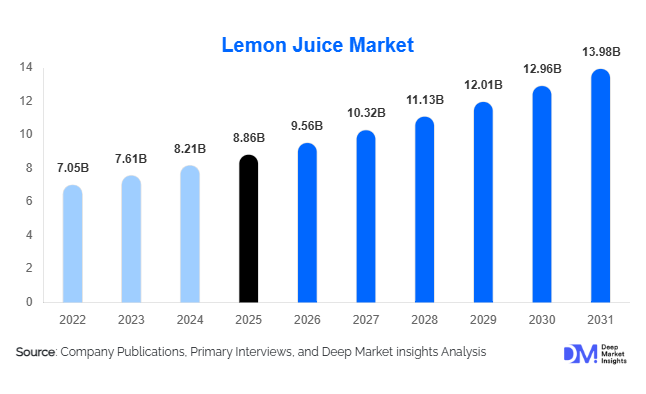
According to Deep Market Insights, the global lemon juice market size was valued at USD 8.86 billion in 2025 and is projected to grow from USD 9.56 billion in 2026 to reach USD 13.98 billion by 2031, expanding at a CAGR of 7.9% during the forecast period (2026–2031). The lemon juice market growth is primarily driven by rising consumer demand for natural and functional beverages, increasing applications in food processing and nutraceuticals, and growing preference for clean-label citrus ingredients across global markets.
Key Market Insights
- Functional and immunity-focused beverages are accelerating global lemon juice demand, particularly in health-conscious consumer segments seeking vitamin C-rich natural products.
- Organic and cold-pressed lemon juice products are witnessing strong adoption, driven by premiumization trends and increasing preference for minimally processed beverages.
- Asia-Pacific dominates the global market, supported by expanding beverage industries, rising urbanization, and increasing citrus processing capacity in China and India.
- North America remains a high-value market, led by strong demand for wellness beverages, flavored sparkling drinks, and clean-label juice formulations.
- Foodservice and HoReCa applications continue expanding globally, increasing industrial demand for concentrated and bulk lemon juice products.
- Technological advancements in aseptic packaging and high-pressure processing are improving product shelf life, quality retention, and export competitiveness.
What are the latest trends in the lemon juice market?
Premium and Clean-Label Lemon Juice Products Gaining Popularity
Consumers are increasingly shifting toward premium lemon juice products that emphasize natural sourcing, organic certification, and clean-label formulations. Cold-pressed and not-from-concentrate (NFC) lemon juice variants are becoming more popular among health-conscious consumers seeking minimally processed beverages with higher nutritional retention. Beverage manufacturers are introducing preservative-free, sugar-free, and functional lemon juice blends targeted at wellness-oriented demographics. Sustainable packaging solutions such as recyclable PET bottles, glass packaging, and aseptic cartons are also becoming important purchasing considerations. Retailers are expanding shelf space for premium citrus beverages as consumers increasingly associate lemon juice with detoxification, hydration, and immunity support.
Growing Integration of Lemon Juice in Functional Beverage Formulations
Lemon juice is increasingly being utilized in functional drinks, sports hydration products, herbal infusions, and vitamin-enhanced waters. Beverage companies are combining lemon juice with ingredients such as ginger, turmeric, honey, probiotics, and botanical extracts to create multifunctional wellness beverages. This trend is particularly strong across North America, Europe, and Asia-Pacific, where consumers are actively replacing carbonated soft drinks with natural alternatives. Manufacturers are also leveraging advanced processing technologies such as high-pressure processing (HPP) and aseptic filling to preserve freshness while extending shelf life. Functional beverage innovation is expected to remain one of the strongest long-term growth trends in the global lemon juice market.
What are the key drivers in the lemon juice market?
Rising Consumer Preference for Natural and Healthy Beverages
The increasing global shift toward healthier lifestyles is significantly driving demand for lemon juice products. Consumers are reducing consumption of artificial soft drinks and moving toward fruit-based beverages that offer natural nutrition and functional health benefits. Lemon juice is widely recognized for its vitamin C content, antioxidant properties, and digestive benefits, making it highly attractive in immunity-supporting diets. Millennials and younger consumers are especially contributing to this trend through increased consumption of detox beverages, infused waters, and wellness drinks. Rising awareness regarding clean-label nutrition is further supporting long-term market growth.
Expansion of Foodservice and Beverage Industries
The rapid growth of restaurants, cafes, hotels, and quick-service restaurant chains is increasing industrial demand for lemon juice globally. Lemon juice is extensively used in sauces, marinades, cocktails, flavored beverages, desserts, and culinary preparations across foodservice establishments. The recovery of tourism and hospitality industries has further strengthened demand from HoReCa channels. Beverage bottlers and food manufacturers are also incorporating lemon juice into flavored waters, energy drinks, and ready-to-drink beverages, expanding large-scale industrial consumption. Growing processed food production in emerging economies is creating additional opportunities for lemon juice suppliers and concentrate manufacturers.
What are the restraints for the global market?
Raw Material Price Volatility and Climate Dependency
The lemon juice industry is highly dependent on agricultural output, making it vulnerable to weather fluctuations, droughts, pest infestations, and climate-related disruptions. Major producing countries such as India, Spain, Mexico, Argentina, and Turkey frequently experience crop yield volatility that impacts lemon availability and pricing. Rising fertilizer, labor, and transportation costs are further increasing operational pressures for processors and beverage manufacturers. Sudden supply shortages can lead to sharp fluctuations in concentrate pricing, reducing profitability and creating challenges for long-term procurement planning.
Short Shelf Life and Storage Challenges
Natural lemon juice products are highly sensitive to oxidation and microbial degradation, creating challenges in storage, transportation, and retail distribution. Manufacturers must invest heavily in cold-chain logistics, aseptic packaging, and advanced preservation technologies to maintain product quality. Minimally processed and preservative-free lemon juice products face even greater shelf-life limitations compared to synthetic citrus alternatives. These factors increase operating costs and can limit market penetration in developing regions with underdeveloped refrigeration infrastructure and supply chain networks.
What are the key opportunities in the lemon juice industry?
Expansion of Organic and Functional Beverage Segments
The rapidly growing organic beverage industry presents significant opportunities for lemon juice manufacturers. Consumers increasingly prefer beverages free from artificial preservatives, additives, and synthetic flavors, driving demand for organic citrus ingredients. Beverage brands are launching premium lemon juice products with botanical infusions, immunity-enhancing properties, and reduced sugar content. Functional wellness beverages incorporating lemon juice are expanding rapidly across supermarkets, convenience stores, fitness chains, and e-commerce channels. Manufacturers investing in organic cultivation, traceability systems, and sustainable packaging are expected to benefit from higher profit margins and stronger brand positioning.
Emerging Market Expansion and Export Opportunities
Emerging economies including India, Brazil, Indonesia, Vietnam, and South Africa are creating substantial growth opportunities due to rising urbanization and increasing packaged beverage consumption. Governments are also investing in food processing infrastructure and agricultural export development, strengthening lemon juice production capabilities. Export-oriented demand for concentrated lemon juice continues rising across Europe and North America, where industrial beverage and food manufacturers require bulk citrus ingredients. Expanding middle-class populations and increasing adoption of Western-style beverages in developing economies are expected to support long-term market expansion for both domestic and export-focused producers.
Report Scope
| Report Metric | Details |
|---|---|
| Market Size in 2025 | USD 8.86 Billion |
| Market Size in 2026 | USD 9.56 Billion |
| Market Size in 2031 | USD 13.98 Billion |
| CAGR | 7.9% (2026-2031) |
| Base Year for Estimation | 2025 |
| Historical Data | 2022-2024 |
| Forecast Period | 2026-2031 |
| Report Coverage | Revenue Forecast, Competitive Landscape, Supply Chain Disruption, Growth Factors, Environment & Regulatory Landscape and Trends |
| Geographies Covered | North America, Europe, APAC, Middle East and Africa, LATAM |
| Countries Covered | U.S., Canada, U.K., Germany, France, Spain, Italy, Russia, Nordic, Benelux, Rest of Europe, China, Korea, Japan, India, Australia, Singapore, Taiwan, South East Asia, Rest of Asia-Pacific, UAE, Turky, Saudi Arabia, South Africa, Egypt, Nigeria, Rest of MEA, Brazil, Mexico, Argentina, Chile, Colombia, Rest of LATAM |
Explore more data points, trends and opportunities Download Free Sample Report
Product Type Insights
The global lemon juice market is segmented into concentrated lemon juice, fresh lemon juice, not-from-concentrate lemon juice, organic lemon juice, and cold-pressed lemon juice, with each category addressing distinct consumer preferences and industrial requirements. Among these, concentrated lemon juice continues to dominate the global market and accounts for the largest share of total consumption owing to its superior shelf stability, cost efficiency, and extensive utilization across large-scale food and beverage manufacturing operations. Concentrated lemon juice is widely preferred by beverage bottlers, industrial food processors, restaurant chains, and foodservice operators because it significantly reduces transportation and storage costs while enabling standardized flavor consistency across high-volume production environments. The growing demand for processed beverages, flavored drinks, sauces, dressings, marinades, and ready-to-use food ingredients continues to strengthen the position of concentrated lemon juice globally. In addition, expanding international trade of citrus concentrates and the increasing use of bulk industrial packaging formats are further supporting the long-term growth of this segment.Cold-pressed lemon juice products are additionally gaining momentum within premium retail channels and wellness beverage categories. Consumers increasingly prefer cold-pressed processing technologies because they are perceived to preserve natural nutrients, enzymes, and authentic flavor characteristics more effectively than conventional heat-processing methods. The rising popularity of immunity-support beverages, detox programs, and functional nutrition trends is encouraging beverage companies to launch innovative cold-pressed citrus products targeting urban health-focused consumers. This premiumization trend is expected to continue supporting market diversification and higher-value product innovation throughout the forecast period.
Application Insights
Based on application, the beverage segment remains the largest contributor to the global lemon juice market and continues to account for a dominant share of overall industry demand. The strong growth of beverage applications is primarily driven by rising global consumption of flavored water, lemonades, sports beverages, sparkling citrus drinks, ready-to-drink wellness products, cocktail mixers, and functional beverages. Lemon juice is extensively utilized within the beverage industry because of its refreshing taste profile, natural acidity, preservative properties, and compatibility with health-oriented formulations. Increasing consumer demand for low-calorie beverages and naturally flavored drinks is encouraging beverage manufacturers to expand their citrus-based product portfolios significantly.The cosmetics and personal care sector is also emerging as a promising application area for lemon juice and citrus-derived ingredients. Lemon extracts are increasingly incorporated into skincare, haircare, cleansing, and beauty formulations because of their antioxidant, antibacterial, exfoliating, and skin-brightening properties. Rising consumer preference for botanical and naturally derived cosmetic ingredients is encouraging manufacturers to utilize citrus-based compounds in premium personal care products. This trend is particularly strong among consumers seeking clean beauty and chemical-free skincare alternatives.Household cooking applications continue to maintain stable demand globally as lemon juice remains a widely utilized culinary ingredient across diverse cuisines. Consumers continue using lemon juice in home cooking, baking, salad preparation, marinades, and beverage preparation due to its versatility and flavor-enhancing qualities. Increasing home-based cooking trends and rising awareness regarding natural food ingredients continue supporting steady retail demand across global markets.
Distribution Channel Insights
Supermarkets and hypermarkets continue to dominate the global lemon juice distribution landscape due to their extensive retail penetration, large product assortments, and strong consumer accessibility. These retail formats provide consumers with convenient access to multiple lemon juice brands, packaging formats, and product variations under a single shopping environment. The leading growth driver for this segment is the continued expansion of organized retail infrastructure across both developed and developing economies. Consumers increasingly prefer supermarkets and hypermarkets because they offer competitive pricing, promotional discounts, and immediate product availability, thereby strengthening overall sales volumes.Large retail chains also play a critical role in enhancing brand visibility and supporting premium product positioning for organic, cold-pressed, and functional lemon juice products. Manufacturers increasingly collaborate with retail chains to introduce new product launches, seasonal promotional campaigns, and premium citrus beverage offerings targeting health-conscious consumers. The expansion of modern retail infrastructure in emerging economies, particularly across Asia-Pacific and Latin America, is expected to further strengthen the dominance of this distribution channel.Specialty food stores focusing on natural, organic, and premium beverages are also expanding steadily across developed markets. These stores cater to consumers seeking high-quality, minimally processed, and sustainably sourced lemon juice products. Increasing consumer awareness regarding ingredient transparency and product origin is supporting the growth of specialty retail formats globally.Foodservice distributors and wholesale bulk suppliers continue playing a crucial role in supplying industrial lemon juice products to restaurants, beverage bottlers, catering companies, hotels, and food manufacturers. The expansion of global hospitality industries and increasing foodservice consumption continue supporting strong industrial demand through wholesale distribution networks.
End-Use Industry Insights
The food and beverage industry remains the largest end-use sector for lemon juice globally and accounts for the majority of total industrial consumption. The primary growth driver for this segment is the rapidly expanding global beverage manufacturing industry, which increasingly incorporates lemon juice into flavored waters, wellness beverages, sparkling drinks, sports beverages, and ready-to-drink formulations. Consumers are increasingly seeking refreshing and health-oriented beverage alternatives, encouraging manufacturers to expand citrus-based product portfolios. Lemon juice also serves as an important flavoring and preservative ingredient across sauces, bakery products, confectionery items, dairy products, and processed foods.Nutraceutical companies are increasingly integrating lemon juice into detox beverages, digestive supplements, and immunity-support products due to rising consumer interest in preventive healthcare and natural wellness solutions. The expanding global functional food and dietary supplement industries are creating substantial opportunities for citrus ingredient manufacturers. Increasing consumer preference for naturally sourced vitamins and antioxidants is expected to further strengthen demand from nutraceutical companies during the forecast period.Pharmaceutical manufacturers are also utilizing lemon-derived extracts and citrus compounds in medicinal formulations, vitamin supplements, and therapeutic health products. Growing demand for plant-based pharmaceutical ingredients and natural health formulations is contributing to increasing utilization of citrus-based raw materials within the healthcare industry.The cosmetics and personal care industry is witnessing rising demand for lemon-based ingredients due to their cleansing, antioxidant, and antibacterial properties. Lemon extracts are increasingly incorporated into facial cleansers, skincare products, shampoos, soaps, and beauty formulations targeting consumers seeking natural and botanical personal care solutions. The continued expansion of the clean beauty movement is expected to generate long-term growth opportunities for lemon-derived ingredients across cosmetic applications.
Packaging Insights
PET bottles account for the largest share of the global lemon juice packaging market due to their affordability, lightweight structure, portability, and strong retail compatibility. The leading driver for this segment is the increasing global demand for convenient and portable beverage packaging solutions. PET packaging enables cost-effective transportation, improved shelf visibility, and efficient mass production, making it highly preferred among beverage manufacturers and retail distributors. Rising consumption of ready-to-drink citrus beverages and single-serve juice products is further strengthening demand for PET bottle packaging globally.Glass bottles continue to maintain strong demand within premium and organic lemon juice categories because they help preserve flavor quality and support premium brand positioning. Consumers increasingly associate glass packaging with product purity, sustainability, and high-quality beverage experiences. The growing consumer preference for environmentally sustainable packaging materials is also encouraging premium beverage brands to adopt recyclable glass packaging formats.Bulk industrial drums and bag-in-box packaging formats remain highly important for concentrated lemon juice supplied to food processors, beverage manufacturers, and foodservice operators. Industrial packaging demand continues growing due to expanding global food processing activities and increasing international trade of citrus concentrates.Single-serve sachets and portable packaging formats are also witnessing rising popularity among travel-oriented consumers and on-the-go beverage users. Manufacturers are increasingly focusing on portion-controlled and convenience-oriented packaging innovations to align with changing consumer lifestyles and modern retail trends.
Explore more data points, trends and opportunities Download Free Sample Report
Lemon Juice Market Segmentations
By Product Type
- Fresh Lemon Juice
- Concentrated Lemon Juice
- Reconstituted Lemon Juice
- Organic Lemon Juice
- Cold-Pressed Lemon Juice
- Clarified Lemon Juice
- Pasteurized Lemon Juice
By Application
- Beverages
- Food Processing
- Nutraceuticals & Dietary Supplements
- Pharmaceuticals
- Cosmetics & Personal Care
- Household Cooking
- HoReCa (Hotels, Restaurants & Cafes)
By Distribution Channel
- Supermarkets & Hypermarkets
- Convenience Stores
- Specialty Food Stores
- Online Retail/E-Commerce
- Foodservice Distributors
- Wholesale/Bulk Suppliers
By Packaging Type
- PET Bottles
- Glass Bottles
- Tetra Packs
- Pouches
- Cans
- Bag-in-Box
- Bulk Industrial Drums
By End User
- Household Consumers
- Food & Beverage Manufacturers
- Restaurants & Foodservice Chains
- Beverage Bottling Companies
- Nutraceutical Manufacturers
- Cosmetic Manufacturers
- Pharmaceutical Companies
Regional Insights
North America
North America represents one of the most mature and technologically advanced lemon juice markets globally and accounted for approximately 26% of the global market share in 2025. The United States dominates regional demand due to strong consumer preference for health-oriented beverages, flavored sparkling drinks, premium citrus products, and functional wellness formulations. One of the primary drivers supporting regional growth is the increasing consumer shift toward natural and clean-label beverages that contain fewer artificial ingredients and preservatives. Consumers across the region are increasingly prioritizing immunity-support beverages and vitamin-rich drinks, significantly boosting demand for lemon-based formulations.The rapid growth of functional beverages, detox drinks, and cold-pressed juice categories is further accelerating market expansion across North America. Organic lemon juice products are witnessing especially strong demand among wellness-focused consumers seeking sustainable and minimally processed beverages. Advanced retail infrastructure, highly developed cold-chain logistics networks, and strong penetration of premium beverage brands continue supporting consistent regional market growth. Additionally, rising investments in beverage innovation, growing e-commerce grocery adoption, and increasing demand for convenient ready-to-drink citrus beverages are expected to further strengthen the regional market outlook.
Europe
Europe remains a highly significant lemon juice market led by Germany, the United Kingdom, France, Spain, and Italy. The region benefits from strong consumer awareness regarding nutrition, sustainability, and clean-label food products. One of the major drivers for regional growth is the increasing consumer preference for organic, preservative-free, and sustainably packaged citrus beverages. European consumers increasingly seek premium-quality juice products with transparent ingredient sourcing and environmentally responsible packaging, encouraging manufacturers to expand organic and natural lemon juice portfolios.Spain continues to play a critical role within the regional citrus supply chain as one of the largest citrus processing and export hubs globally. Strong agricultural capabilities and advanced food processing infrastructure support stable regional supply availability. Germany and the United Kingdom are witnessing rising demand for functional beverages, immunity-focused drinks, and wellness-oriented citrus formulations. Strict food quality regulations and high clean-label awareness continue encouraging manufacturers to invest heavily in premium product development and sustainable packaging innovations throughout Europe.
Asia-Pacific
Asia-Pacific dominates the global lemon juice market with approximately 34% market share in 2025 and is expected to remain the fastest-growing regional market during the forecast period. China and India are major contributors due to their large populations, rapid urbanization, growing middle-class demographics, and expanding packaged beverage industries. One of the leading drivers for regional growth is the rapidly increasing consumption of convenience beverages and Western-style drinks among younger consumers across urban areas.India is also emerging as a major citrus processing and export hub supported by government-backed food processing initiatives, rising agricultural investments, and improving cold-chain infrastructure. Expanding retail modernization and increasing penetration of organized supermarkets are significantly improving product accessibility across the region. Japan and South Korea continue witnessing strong demand for premium citrus beverages, wellness products, and functional nutrition formulations driven by aging populations and increasing health consciousness. Rising disposable incomes, changing dietary habits, and growing popularity of ready-to-drink beverages across Southeast Asia are expected to further accelerate long-term regional market growth.
Latin America
Latin America represents an important production and export region for the global lemon juice industry, led by Brazil, Mexico, and Argentina. The region benefits from favorable climatic conditions for citrus cultivation and expanding agricultural investments. One of the key growth drivers for the regional market is the increasing expansion of export-oriented citrus processing industries, particularly in Mexico and Argentina. Mexico remains one of the largest exporters of concentrated lemon juice to North America, while Argentina continues strengthening its citrus processing capabilities and international trade presence.Domestic demand for packaged beverages, processed foods, and ready-to-drink citrus beverages is also increasing steadily throughout Latin America due to rising urbanization and changing consumer lifestyles. Growing investments in agricultural modernization, export infrastructure, and food processing technologies are expected to further strengthen the region’s strategic importance within the global lemon juice supply chain.
Middle East & Africa
The Middle East & Africa region is witnessing steadily rising demand for lemon juice due to increasing urbanization, tourism expansion, and the rapid growth of hospitality industries across major metropolitan markets. Gulf countries such as the UAE and Saudi Arabia remain major importers of packaged lemon juice products utilized across retail, hospitality, and foodservice sectors. One of the primary drivers supporting regional growth is the expanding tourism and restaurant industry, which continues generating significant demand for citrus beverages, cocktail mixers, and culinary ingredients.South Africa is emerging as a key regional citrus processing and export hub due to improving agricultural infrastructure, expanding citrus cultivation activities, and growing beverage manufacturing investments. Rising consumer awareness regarding natural beverages and healthier drink alternatives is also contributing to increasing demand for premium and imported lemon juice products across the region. Expanding supermarket infrastructure, rising disposable incomes, and increasing adoption of packaged convenience beverages are expected to support long-term market growth throughout the Middle East & Africa.
Key Players in the Lemon Juice Market
- Lemon Concentrate
- Citrosuco
- Döhler
- Kanegrade
- Tree Top
- Louis Dreyfus Company
- Ingredion
- SVZ International
- SunOpta
- Realemon
- Sicilia
- Diana Food
- Prinova
- Citromax Group
- B&G Foods