Lemon Extract Market Size
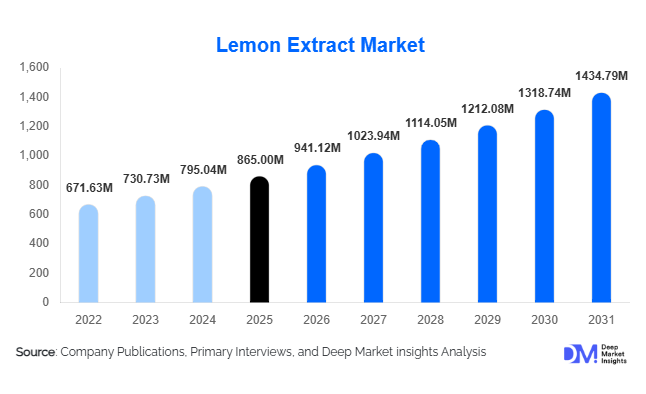
According to Deep Market Insights, the global lemon extract market size was valued at USD 865 million in 2025 and is projected to grow from USD 941.12 million in 2026 to reach USD 1,434.79 million by 2031, expanding at a CAGR of 8.8% during the forecast period (2026–2031). Market growth is primarily driven by rising demand for natural flavoring ingredients, increasing adoption of clean-label food formulations, and expanding applications of citrus-derived extracts across food & beverages, cosmetics, nutraceuticals, and pharmaceutical industries. Growing consumer preference for plant-based ingredients and functional formulations is encouraging manufacturers to replace synthetic flavor compounds with naturally derived lemon extracts, thereby accelerating global adoption across both developed and emerging markets.
Key Market Insights
- Natural and clean-label product demand is accelerating adoption of lemon extract across processed foods, beverages, and wellness products globally.
- Food & beverage applications dominate market consumption, accounting for more than 60% of global demand due to extensive use in bakery, beverages, and sauces.
- North America leads global consumption supported by mature food processing and premium ingredient markets.
- Asia-Pacific is the fastest-growing regional market, driven by rising urbanization and expanding packaged food industries in China and India.
- Organic lemon extract demand is rising rapidly as consumers increasingly prefer sustainably sourced ingredients.
- Technological advancements in cold-press extraction are improving flavor retention, shelf life, and product quality.
What are the latest trends in the lemon extract market?
Shift Toward Clean-Label and Natural Ingredients
Food manufacturers worldwide are reformulating products to eliminate artificial additives and synthetic flavors. Lemon extract has emerged as a preferred natural flavor enhancer due to its recognizable ingredient profile and functional properties. Clean-label positioning is increasingly influencing purchasing decisions, particularly in North America and Europe. Brands are highlighting natural citrus sourcing, minimal processing, and transparency in labeling to build consumer trust. This transition is especially evident in beverages, confectionery, and dairy alternatives, where citrus flavors support freshness perception and product differentiation.
Expansion of Functional and Wellness Applications
Lemon extract is gaining traction beyond flavoring applications, particularly in nutraceutical and personal care formulations. Its antioxidant and antimicrobial characteristics are driving adoption in immunity-focused supplements, herbal formulations, and skincare products. Cosmetic brands are incorporating lemon extract into brightening serums, cleansers, and haircare products aligned with botanical beauty trends. Functional beverages containing citrus extracts are also growing rapidly as consumers seek products associated with detoxification, digestive health, and vitamin-rich formulations.
What are the key drivers in the lemon extract market?
Growth of Processed Food and Beverage Industry
The expansion of global processed food consumption is a major growth driver for lemon extract demand. Urbanization, changing lifestyles, and rising disposable incomes are increasing consumption of ready-to-eat meals, flavored beverages, and packaged bakery products. Lemon extract enhances flavor stability and shelf life, making it a preferred ingredient among food manufacturers seeking consistency and scalability. Beverage innovation, including flavored water, energy drinks, and craft beverages, is further accelerating ingredient demand.
Rising Demand for Natural Cosmetics and Personal Care Products
The clean beauty movement is significantly boosting demand for plant-based ingredients. Lemon extract’s antimicrobial and antioxidant properties make it suitable for skincare and haircare applications. Consumers increasingly prefer botanical formulations over synthetic chemicals, encouraging cosmetic companies to integrate citrus-derived ingredients into premium product lines. This trend is particularly strong in Europe and Asia-Pacific, where natural beauty standards are shaping product innovation.
What are the restraints for the global market?
Raw Material Supply Volatility
Lemon extract production is directly dependent on citrus crop yields, which are vulnerable to climate variability, pests, and seasonal disruptions. Fluctuating lemon prices can significantly affect manufacturing costs and profit margins. Supply chain disruptions caused by adverse weather events or agricultural disease outbreaks remain a persistent challenge for industry participants.
Competition from Synthetic Flavor Alternatives
Artificial lemon flavoring remains cheaper and more stable compared to natural extracts. Cost-sensitive manufacturers, particularly in developing economies, may continue to rely on synthetic substitutes. This price differential creates competitive pressure for natural extract producers, especially in mass-market food applications where margins are limited.
What are the key opportunities in the lemon extract industry?
Organic and Premium Ingredient Expansion
Organic lemon extract represents a high-growth opportunity as consumers increasingly prioritize sustainability and health-conscious consumption. Certified organic sourcing allows manufacturers to command premium pricing while targeting specialty food and cosmetic brands. Investments in traceable supply chains and sustainable farming partnerships are expected to unlock long-term value creation.
Emerging Market Consumption Growth
Rapid expansion of packaged food industries in Asia-Pacific and Latin America presents strong opportunities for lemon extract producers. Rising middle-class populations and evolving dietary habits are driving demand for flavored beverages, bakery products, and convenience foods. Local manufacturing expansion and strategic partnerships with regional food processors are enabling companies to penetrate high-growth markets efficiently.
Report Scope
| Report Metric | Details |
|---|---|
| Market Size in 2025 | USD 865.00 Million |
| Market Size in 2026 | USD 941.12 Million |
| Market Size in 2031 | USD 1434.79 Million |
| CAGR | 8.8% (2026-2031) |
| Base Year for Estimation | 2025 |
| Historical Data | 2022-2024 |
| Forecast Period | 2026-2031 |
| Report Coverage | Revenue Forecast, Competitive Landscape, Supply Chain Disruption, Growth Factors, Environment & Regulatory Landscape and Trends |
| Geographies Covered | North America, Europe, APAC, Middle East and Africa, LATAM |
| Countries Covered | U.S., Canada, U.K., Germany, France, Spain, Italy, Russia, Nordic, Benelux, Rest of Europe, China, Korea, Japan, India, Australia, Singapore, Taiwan, South East Asia, Rest of Asia-Pacific, UAE, Turky, Saudi Arabia, South Africa, Egypt, Nigeria, Rest of MEA, Brazil, Mexico, Argentina, Chile, Colombia, Rest of LATAM |
Explore more data points, trends and opportunities Download Free Sample Report
Form Insights
Liquid lemon extract dominates the global market, accounting for nearly 52% of total market share in 2025, primarily driven by its superior solubility, uniform flavor distribution, and compatibility with high-volume food and beverage manufacturing processes. The leading position of liquid formulations is supported by increasing production of ready-to-drink beverages, flavored water, sauces, marinades, and dairy-based products where rapid blending and consistent sensory performance are essential. Industrial manufacturers prefer liquid extracts because they reduce processing time, enable precise dosing, and improve batch-to-batch consistency, thereby lowering operational complexity and production costs.Powdered lemon extracts are witnessing steady adoption, particularly in nutraceuticals, instant beverages, bakery premixes, and seasoning blends. The leading growth driver for powdered formats is their extended shelf stability and reduced logistics cost, which makes them suitable for global exports and e-commerce distribution. Advancements in spray-drying and encapsulation technologies are improving flavor retention and oxidation resistance, further strengthening demand. Concentrated paste formats, although smaller in share, are gaining traction in industrial-scale applications requiring high flavor intensity and reduced water content, especially in confectionery fillings, sauces, and flavor bases used by large food processors.
Nature Insights
Conventional lemon extract continues to lead the market with approximately 68% share, primarily due to its cost efficiency, scalable production processes, and widespread availability of conventionally cultivated lemons. The leading segment driver remains the strong demand from mass food processing industries where price competitiveness and stable supply volumes are critical purchasing factors. Large-scale beverage and packaged food manufacturers rely on conventional extracts to maintain affordability while meeting consistent flavor standards.Organic lemon extract, however, is expanding at a significantly faster pace as consumer preference shifts toward clean-label, sustainably sourced, and chemical-free ingredients. Premium food brands, natural cosmetics manufacturers, and wellness-focused nutraceutical companies are increasingly adopting certified organic extracts to strengthen product differentiation and brand credibility. Regulatory encouragement for organic farming practices, combined with rising consumer awareness regarding ingredient transparency, is accelerating adoption across North America and Europe. Additionally, organic certification enhances export opportunities, encouraging suppliers to expand organic processing capabilities.
Extraction Method Insights
Cold-press extraction leads the market with around 46% of global share, supported by its ability to preserve natural aroma compounds, essential oils, and bioactive nutrients. The leading driver behind this segment is the growing demand for premium-quality extracts that maintain authentic citrus flavor profiles without excessive heat exposure. Food, cosmetic, and aromatherapy manufacturers increasingly prefer cold-pressed extracts for clean-label formulations and high-end product positioning.Steam distillation remains widely utilized for large-scale commercial production due to its operational efficiency and suitability for essential oil recovery. This method supports high production volumes required by global flavor and fragrance manufacturers. Solvent extraction, although more specialized, continues to serve industrial applications requiring concentrated flavor compounds and standardized chemical compositions. Technological improvements in extraction efficiency and sustainability practices are further enhancing yield optimization while minimizing environmental impact.
Application Insights
The food & beverages segment dominates the market with nearly 61% share of global demand, primarily driven by rising consumption of flavored beverages, bakery products, confectionery, dairy desserts, and savory sauces. The leading driver for this segment is lemon extract’s multifunctional role as both a flavor enhancer and natural acidity regulator, enabling manufacturers to improve taste profiles while reducing reliance on artificial additives. Increasing innovation in functional drinks, low-sugar beverages, and plant-based foods continues to expand application scope.Cosmetics and personal care applications are emerging as high-growth areas as brands increasingly incorporate citrus-derived ingredients into skincare, haircare, and aromatherapy formulations. Lemon extract’s antioxidant and refreshing sensory properties support its inclusion in natural beauty products. Nutraceutical applications are also expanding rapidly, supported by growing consumer interest in immunity-supporting and wellness-oriented supplements that utilize botanical ingredients.
Distribution Channel Insights
B2B industrial sales dominate distribution channels, accounting for approximately 72% of total market revenue. The leading driver for this segment is the long-term procurement agreements between extract manufacturers and large food processors, beverage companies, and cosmetic formulators requiring bulk quantities and standardized ingredient quality. Industrial buyers prioritize reliability, scalability, and regulatory compliance, reinforcing the dominance of direct supply contracts and ingredient partnerships.Retail and direct-to-consumer channels are expanding steadily, supported by rapid growth in digital commerce platforms. E-commerce enables specialty brands and small-scale producers to access niche consumer segments seeking organic, premium, and artisanal lemon extract products. Online marketplaces are improving global accessibility, particularly in emerging markets where traditional retail penetration remains limited. Subscription-based ingredient supply models and specialty culinary platforms are further contributing to retail channel expansion.
End-Use Industry Insights
The food processing industry remains the largest end-use sector, contributing nearly 48% of total market demand. The leading driver is the increasing global production of processed and convenience foods requiring standardized natural flavoring agents. Lemon extract enhances shelf appeal, freshness perception, and flavor balance across packaged food categories, reinforcing its widespread industrial adoption.Beverage manufacturers represent one of the fastest-growing end users as companies introduce flavored water, functional beverages, energy drinks, and craft beverage innovations. Lemon extract provides a recognizable and refreshing flavor profile aligned with health-conscious consumer preferences. The cosmetics industry is experiencing rapid expansion due to rising demand for botanical skincare solutions emphasizing natural ingredients and sensory experiences. Meanwhile, pharmaceutical and nutraceutical sectors are incorporating lemon extract into herbal formulations and immunity-support products, supported by growing preventive healthcare awareness. Export-oriented ingredient manufacturing is also strengthening demand as suppliers cater to multinational food and beauty brands seeking globally standardized natural inputs.
Explore more data points, trends and opportunities Download Free Sample Report
Lemon Extract Market Segmentations
By Form
- Liquid Lemon Extract
- Powder Lemon Extract
- Paste/Concentrated Lemon Extract
By Nature
- Conventional Lemon Extract
- Organic Lemon Extract
By Extraction Method
- Cold-Press Extraction
- Steam Distillation
- Solvent Extraction
By Application
- Food Beverages
- Cosmetics Personal Care
- Pharmaceuticals Nutraceuticals
- Household Industrial Applications
By Distribution Channel
- B2B Industrial Sales
- Retail Offline
- Online/E-commerce Platforms
Regional Insights
North America
North America accounts for approximately 32% of global market share in 2025, led by the United States, where advanced food processing infrastructure and strong clean-label trends drive sustained demand. A major regional growth driver is the rapid expansion of functional beverages and premium natural food products that prioritize recognizable ingredients. High consumer purchasing power enables adoption of organic and premium extracts, while well-established cold-chain logistics and ingredient standardization frameworks support efficient distribution. Canada contributes significantly through increasing organic food consumption, private-label product innovation, and growing natural cosmetics demand, reinforcing regional market maturity.
Europe
Europe holds nearly 27% market share, supported by stringent regulatory frameworks limiting artificial additives and encouraging natural flavor alternatives. The leading regional driver is regulatory pressure combined with strong consumer preference for sustainable and traceable ingredients. Germany, France, Italy, and the United Kingdom act as key demand centers due to robust bakery, confectionery, and premium beverage industries. Additionally, Europe’s well-developed organic certification ecosystem accelerates adoption of organic lemon extracts. Growth in botanical cosmetics and fragrance innovation further strengthens regional consumption, particularly within clean beauty product segments.
Asia-Pacific
Asia-Pacific represents the fastest-growing region, expanding at over 10% CAGR, driven by rapid urbanization, rising disposable incomes, and expansion of packaged food industries. China and India serve as primary growth engines due to increasing consumption of convenience foods and flavored beverages among urban populations. The leading regional growth driver is the modernization of food manufacturing and increasing penetration of international food brands introducing citrus-based flavors. Japan and South Korea contribute through strong demand for premium, functional, and health-oriented products. Growing e-commerce penetration and evolving dietary habits influenced by Western cuisine trends are accelerating ingredient adoption across the region.
Latin America
Latin America is emerging as a promising market, with Brazil and Mexico leading regional demand. A key growth driver is the expansion of beverage production and food export industries requiring natural flavoring ingredients aligned with international quality standards. Rising domestic consumption of processed foods, coupled with increasing investment in food manufacturing infrastructure, is strengthening regional adoption. Favorable agricultural conditions also support regional citrus production, improving supply chain integration and reducing raw material costs for extract manufacturers.
Middle East & Africa
The Middle East and Africa region is witnessing steady growth supported by expanding food processing activities and increasing reliance on imported natural ingredients. The primary regional driver is the rapid growth of the hospitality, tourism, and premium food service sectors in countries such as the UAE and Saudi Arabia, which demand high-quality flavor ingredients. South Africa contributes through developing packaged food markets and growing cosmetic manufacturing activities. Rising urban populations, improving retail infrastructure, and increasing awareness of natural and health-focused products are gradually strengthening long-term market potential across the region.
Key Players in the Lemon Extract Market
- Kerry Group plc
- Givaudan SA
- Symrise AG
- International Flavors & Fragrances Inc.
- Sensient Technologies Corporation
- Firmenich SA
- Döhler Group
- Takasago International Corporation
- Mane SA
- Citromax Group
- Lemon Concentrate S.L.
- Citrosuco S.A.
- Bontoux S.A.S.
- Lionel Hitchen Ltd.
- Treatt Plc