Lead Generation Software Market Size
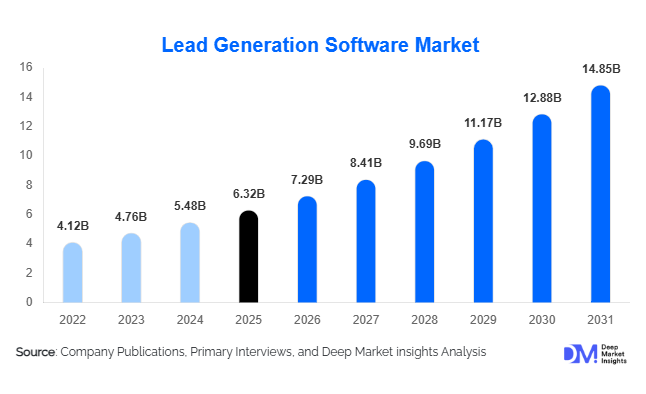
According to Deep Market Insights, the global lead generation software market size was valued at USD 6.32 billion in 2025 and is projected to grow from USD 7.29 billion in 2026 to reach USD 14.85 billion by 2031, expanding at a CAGR of 15.3% during the forecast period (2026–2031). The lead generation software market growth is primarily driven by increasing enterprise investments in digital customer acquisition, rapid adoption of AI-powered sales automation tools, and growing demand for omnichannel customer engagement platforms across B2B and B2C industries.
Key Market Insights
- Artificial intelligence and predictive analytics are transforming lead generation workflows, enabling enterprises to improve lead scoring accuracy, customer targeting, and sales conversion efficiency.
- Cloud-based lead generation platforms dominate the market, supported by lower implementation costs, scalability, and increasing demand for remote-access SaaS solutions.
- North America dominates the global market, driven by strong SaaS adoption, mature CRM ecosystems, and aggressive investments in digital marketing technologies.
- Asia-Pacific is the fastest-growing regional market, fueled by expanding startup ecosystems, rising SME digitization, and rapid growth of digital commerce platforms in India and China.
- B2B lead generation applications account for the largest market share, particularly across IT services, SaaS, financial services, and professional consulting industries.
- Integration of conversational AI, chatbots, and intent-based marketing tools is reshaping customer acquisition strategies and accelerating enterprise software adoption.
What are the latest trends in the lead generation software market?
AI-Powered Predictive Lead Intelligence Gaining Momentum
Artificial intelligence and machine learning technologies are becoming central to modern lead generation platforms. Enterprises are increasingly deploying predictive analytics systems capable of identifying high-intent customers, automating outreach personalization, and forecasting conversion probability with greater precision. AI-powered lead scoring tools are reducing manual qualification efforts while improving sales productivity and marketing ROI. Vendors are integrating natural language processing, behavioral analytics, and real-time customer engagement tracking into their platforms to create highly intelligent customer acquisition ecosystems. Conversational AI chatbots are also gaining traction for automated customer interaction and instant lead qualification across websites, social media channels, and messaging platforms. These technologies are enabling businesses to shorten sales cycles and improve customer retention efficiency.
Omnichannel Customer Acquisition Platforms Expanding Rapidly
Organizations are increasingly adopting omnichannel lead generation solutions capable of managing customer engagement across email, websites, social media, webinars, digital advertisements, and mobile applications simultaneously. Businesses are shifting away from isolated marketing tools toward unified customer acquisition ecosystems integrated with CRM, marketing automation, and analytics platforms. This trend is particularly strong among enterprises seeking seamless customer journey management and real-time campaign optimization. Software vendors are enhancing API connectivity, workflow automation, and customer data synchronization capabilities to support integrated omnichannel engagement strategies. Mobile-first customer acquisition campaigns, account-based marketing platforms, and intent-data-driven prospecting tools are also becoming mainstream across B2B industries, further strengthening demand for integrated lead generation software solutions.
What are the key drivers in the lead generation software market?
Rising Enterprise Digital Marketing Investments
Global enterprises are significantly increasing investments in digital marketing and automated customer acquisition strategies to improve sales efficiency and customer engagement. Businesses across industries are shifting toward performance-driven marketing models supported by analytics, automation, and real-time personalization capabilities. Lead generation software enables organizations to optimize customer targeting, reduce acquisition costs, and increase conversion rates through automated campaign management and data-driven prospecting. The rapid expansion of e-commerce, SaaS subscriptions, and remote selling ecosystems is further accelerating enterprise demand for advanced lead generation technologies. Companies are increasingly integrating lead generation tools with CRM systems, analytics platforms, and social media channels to create scalable customer acquisition infrastructures.
Growing Adoption of Cloud-Based SaaS Platforms
The widespread adoption of cloud computing and SaaS deployment models is significantly contributing to market growth. Cloud-based lead generation software offers scalability, flexibility, lower upfront costs, and faster deployment compared to traditional on-premises systems. SMEs and startups are increasingly adopting subscription-based lead generation platforms due to affordable pricing structures and minimal infrastructure requirements. SaaS vendors are continuously expanding AI capabilities, workflow automation, and integration ecosystems to attract enterprise customers. Remote work trends and distributed sales teams have also increased the need for cloud-accessible customer acquisition tools capable of supporting real-time collaboration and campaign management across geographies.
What are the restraints for the global market?
Data Privacy and Regulatory Compliance Challenges
Increasing global data privacy regulations remain a major challenge for lead generation software providers and enterprise users. Compliance requirements under GDPR, CCPA, and other regional data governance laws have increased operational complexity related to customer consent management, data storage security, and marketing communication practices. Businesses must invest heavily in cybersecurity infrastructure and compliance management systems to ensure secure customer data handling. Regulatory restrictions on third-party cookies and tracking technologies are also forcing companies to redesign customer acquisition strategies around first-party data ecosystems.
Intense Market Competition and Pricing Pressure
The lead generation software market is highly competitive, with numerous SaaS providers offering overlapping functionalities across customer acquisition, automation, analytics, and CRM integration segments. Aggressive subscription pricing strategies and freemium models are creating margin pressure, particularly for smaller vendors competing against established enterprise software providers. Customer retention challenges, high marketing expenditure, and integration complexities with legacy enterprise systems continue to impact profitability and operational scalability across the industry.
What are the key opportunities in the lead generation software industry?
Expansion of SME Digitalization Across Emerging Economies
Rapid digitization of SMEs across emerging economies presents substantial growth opportunities for lead generation software vendors. Countries such as India, Brazil, Indonesia, Vietnam, and the UAE are witnessing increasing adoption of cloud-based business applications and digital marketing technologies among small businesses. Affordable SaaS pricing models and scalable cloud deployment structures are enabling SMEs to implement enterprise-grade customer acquisition systems without significant capital expenditure. Vendors that offer localized language support, mobile-friendly platforms, and region-specific integrations are expected to gain strong competitive advantages within high-growth developing markets.
First-Party Data and Intent-Based Marketing Solutions
The gradual elimination of third-party cookies is accelerating enterprise investments in first-party customer data acquisition and intent-based marketing technologies. Businesses are increasingly prioritizing customer-owned data ecosystems capable of supporting compliant, personalized marketing campaigns. Lead generation platforms that integrate behavioral analytics, website engagement tracking, predictive customer modeling, and consent-based communication capabilities are expected to experience strong adoption growth. AI-powered intent analysis tools are also creating new opportunities for vendors focused on real-time customer engagement and account-based marketing strategies.
Report Scope
| Report Metric | Details |
|---|---|
| Market Size in 2025 | USD 6.32 Billion |
| Market Size in 2026 | USD 7.29 Billion |
| Market Size in 2031 | USD 14.85 Billion |
| CAGR | 15.3% (2026-2031) |
| Base Year for Estimation | 2025 |
| Historical Data | 2022-2024 |
| Forecast Period | 2026-2031 |
| Report Coverage | Revenue Forecast, Competitive Landscape, Supply Chain Disruption, Growth Factors, Environment & Regulatory Landscape and Trends |
| Geographies Covered | North America, Europe, APAC, Middle East and Africa, LATAM |
| Countries Covered | U.S., Canada, U.K., Germany, France, Spain, Italy, Russia, Nordic, Benelux, Rest of Europe, China, Korea, Japan, India, Australia, Singapore, Taiwan, South East Asia, Rest of Asia-Pacific, UAE, Turky, Saudi Arabia, South Africa, Egypt, Nigeria, Rest of MEA, Brazil, Mexico, Argentina, Chile, Colombia, Rest of LATAM |
Explore more data points, trends and opportunities Download Free Sample Report
Component Insights
The software segment continues to dominate the global lead generation software market and accounts for the majority of total industry revenues, primarily due to the growing enterprise focus on automation, customer intelligence, predictive analytics, and AI-powered sales optimization. Organizations across industries are increasingly adopting advanced lead generation platforms to streamline prospect identification, improve customer targeting accuracy, and accelerate revenue conversion cycles. Modern lead generation software has evolved beyond basic contact acquisition and now incorporates sophisticated capabilities such as predictive lead scoring, automated campaign orchestration, behavioral analytics, conversational AI, real-time engagement tracking, and omnichannel customer journey management. The growing demand for data-driven sales and marketing strategies is significantly increasing enterprise dependence on integrated lead management ecosystems capable of generating measurable return on investment and improving customer acquisition efficiency.The services segment is also experiencing steady expansion as organizations increasingly require consulting, integration, deployment, training, and managed support services to optimize lead generation software implementation. Enterprises often seek customized deployment strategies tailored to their industry-specific operational requirements, regulatory environments, and customer engagement objectives. Demand for integration services is rising substantially as companies attempt to connect lead generation systems with existing CRM platforms, marketing automation suites, and enterprise data management infrastructure. Managed services are becoming increasingly important for organizations seeking continuous platform optimization, cybersecurity management, compliance monitoring, and performance analytics. As software ecosystems become more sophisticated and AI-driven functionalities become standard industry requirements, the importance of ongoing technical support and customization services is expected to increase significantly throughout the forecast period.
Application Insights
B2B applications account for the largest share of the global lead generation software market, driven by growing enterprise dependence on data-driven prospecting, account-based marketing strategies, and intelligent customer acquisition technologies. Organizations operating in highly competitive industries are increasingly utilizing AI-powered lead generation platforms to identify high-value business prospects, optimize sales outreach campaigns, and improve conversion efficiency. The growing complexity of enterprise purchasing processes and the rising importance of personalized engagement strategies are encouraging businesses to invest in advanced lead intelligence systems capable of tracking buyer behavior, analyzing decision-making patterns, and automating customer communication workflows.Demand generation and customer acquisition remain the primary application areas within the market; however, customer retention, loyalty management, upselling, and cross-selling functionalities are becoming increasingly integrated into comprehensive lead management ecosystems. Organizations are recognizing the importance of maintaining long-term customer relationships in addition to acquiring new prospects. As a result, software vendors are developing more advanced platforms capable of combining lead acquisition, customer engagement, marketing automation, and post-sales analytics within unified digital ecosystems. The increasing emphasis on personalized marketing, customer lifetime value optimization, and omnichannel communication is expected to continue driving strong adoption across both B2B and B2C application segments over the forecast period.
Deployment Mode Insights
Cloud-based deployment remains the dominant segment within the global lead generation software market, accounting for approximately 72% of total market demand in 2025. The widespread adoption of cloud-native deployment models is primarily driven by increasing enterprise demand for scalable, cost-efficient, and highly accessible software infrastructure capable of supporting dynamic customer acquisition operations. Cloud-based lead generation platforms enable businesses to access real-time customer insights, automate marketing campaigns, and manage sales pipelines from geographically distributed environments without requiring extensive on-premises infrastructure investments. This deployment model has become especially attractive for enterprises pursuing digital transformation initiatives and remote workforce strategies.Hybrid deployment models are gradually gaining traction among large enterprises seeking greater control over sensitive customer information while still benefiting from the flexibility of cloud infrastructure. Hybrid environments allow organizations to maintain critical customer databases and compliance-sensitive operations within private infrastructure while leveraging cloud capabilities for analytics, automation, and customer engagement activities. This deployment model is becoming increasingly important in industries with strict regulatory and cybersecurity requirements.On-premises deployment continues to retain relevance within sectors such as BFSI, government, healthcare, and defense where organizations maintain stringent control over customer data management, privacy protection, and cybersecurity infrastructure. Enterprises operating in highly regulated industries often prioritize on-premises solutions to ensure compliance with regional data governance regulations and internal security standards. Although cloud adoption continues to accelerate globally, on-premises deployment remains important for organizations requiring customized infrastructure configurations and greater operational control over mission-critical customer acquisition systems.
Organization Size Insights
Large enterprises account for the largest share of the global lead generation software market due to their extensive customer acquisition operations, large-scale marketing budgets, and increasing investments in AI-powered automation technologies. Multinational corporations and enterprise-scale organizations manage complex sales pipelines involving large customer databases, multichannel engagement campaigns, and geographically diversified operations. As a result, these organizations require highly advanced lead generation ecosystems capable of integrating predictive analytics, customer intelligence, CRM functionality, and automated engagement tools within centralized digital platforms.SMEs represent the fastest-growing organization size segment within the market as digital transformation initiatives continue accelerating across emerging economies. Affordable SaaS pricing models, low-code integration capabilities, and user-friendly lead management interfaces are encouraging broader software adoption among small and medium-sized businesses seeking cost-effective customer acquisition solutions. SMEs are increasingly recognizing the importance of digital marketing, customer analytics, and automated engagement strategies in improving competitiveness and expanding customer reach.The rapid growth of startup ecosystems across Asia-Pacific, Latin America, and the Middle East is further contributing to rising demand for scalable lead generation software among SMEs. Small businesses are increasingly leveraging cloud-based marketing technologies to expand online visibility, automate customer outreach, and improve sales efficiency without requiring extensive IT infrastructure investments. Mobile-friendly platforms and AI-powered automation tools are becoming particularly attractive for SMEs seeking flexible and scalable growth solutions in highly competitive digital marketplaces.
Industry Vertical Insights
IT and telecommunications remain the largest industry vertical within the global lead generation software market, driven by intense competition for enterprise customers and increasing dependence on recurring subscription-based revenue models. Technology companies operate within highly dynamic business environments where customer acquisition speed, sales conversion efficiency, and personalized engagement strategies play a critical role in sustaining long-term growth. As a result, SaaS providers, cloud infrastructure companies, telecommunications operators, and digital service firms are aggressively investing in predictive lead scoring systems, AI-powered prospecting technologies, and customer intelligence platforms.BFSI organizations are increasingly implementing compliant lead generation systems to support digital customer onboarding, financial product marketing, and omnichannel customer engagement initiatives. Financial institutions require highly secure and regulatory-compliant platforms capable of managing sensitive customer data while improving lead conversion efficiency. Healthcare and education technology sectors are also expanding software adoption due to growing digital service delivery models and increasing online customer engagement requirements.Professional services firms, manufacturing companies, and logistics providers are increasingly adopting account-based marketing tools and customer intelligence systems to strengthen B2B sales operations. Manufacturing enterprises are leveraging predictive analytics and CRM-integrated lead management solutions to improve distributor engagement and global sales coordination. Logistics companies are increasingly implementing automated prospecting technologies to support digital supply chain services and international business expansion initiatives.
Explore more data points, trends and opportunities Download Free Sample Report
Lead Generation Software Market Segmentations
By Component
- Software
- Services
By Deployment Mode
- Cloud-Based
- On-Premises
- Hybrid Deployment
By Organization Size
- Small Enterprises
- Medium Enterprises
- Large Enterprises
By Application
- B2B Lead Generation
- B2C Lead Generation
- Account-Based Marketing
- Sales Intelligence
- Customer Acquisition
- Demand Generation
- Customer Retention & Upselling
- Digital Campaign Management
By Lead Source
- Email Marketing
- Search Engine Marketing
- Social Media Marketing
- Website & Landing Pages
- Referral Programs
- Webinars & Virtual Events
- Content Marketing
- Affiliate Marketing
- Cold Outreach & Prospecting
- Mobile Marketing
Regional Insights
North America
North America remains the dominant regional market for lead generation software, accounting for nearly 38% of global demand in 2025. The region benefits from highly developed digital infrastructure, mature SaaS ecosystems, widespread enterprise cloud adoption, and strong technological innovation capabilities. The United States contributes the majority of regional revenues due to extensive implementation of AI-powered customer acquisition technologies across industries including IT services, financial services, telecommunications, healthcare, retail, and professional consulting. Enterprises across the region continue investing heavily in predictive analytics, conversational AI, customer intelligence systems, and integrated CRM platforms to improve marketing efficiency and revenue generation performance.Canada is also experiencing steady market expansion supported by growing SME digitization, increasing cloud adoption, and rising digital advertising expenditure. Government support for technology innovation, startup development, and AI research initiatives is contributing to stronger enterprise software adoption throughout the region. Additionally, the increasing focus on customer experience optimization and omnichannel engagement strategies continues to create substantial growth opportunities for software vendors operating across North America.
Europe
Europe represents approximately 27% of the global lead generation software market and remains one of the most technologically advanced regional markets worldwide. The United Kingdom, Germany, and France are the leading contributors to regional demand due to strong enterprise digitalization, expanding fintech ecosystems, and increasing implementation of account-based marketing strategies. European enterprises are rapidly investing in customer intelligence systems, marketing automation technologies, and predictive analytics platforms to improve sales efficiency and customer engagement performance.European enterprises are increasingly integrating artificial intelligence, automation, and predictive customer analytics into marketing operations to improve campaign efficiency and optimize customer retention. The growing importance of cross-border digital commerce and omnichannel engagement strategies is expected to continue supporting strong market expansion across the region during the forecast period.
Asia-Pacific
Asia-Pacific is the fastest-growing regional market for lead generation software and is projected to register a CAGR exceeding 18% throughout the forecast period. China, India, Japan, Singapore, South Korea, and Australia represent the major regional growth centers supported by rapid internet penetration, accelerating cloud adoption, expanding startup ecosystems, and rising digital commerce activity. Businesses across the region are increasingly investing in automated customer acquisition technologies to strengthen online engagement, improve sales conversion efficiency, and expand digital market presence.Chinese enterprises continue investing heavily in AI-enabled business software, predictive analytics platforms, and digital commerce technologies to strengthen competitive positioning within highly dynamic online markets. Southeast Asian economies including Indonesia, Vietnam, Thailand, and the Philippines are also witnessing accelerating software demand due to the rapid growth of digital-first SMEs, fintech platforms, and online retail ecosystems. Japan and Australia remain technologically advanced markets characterized by strong enterprise cloud adoption and increasing investments in customer experience optimization technologies.
Latin America
Latin America is gradually expanding its share of the global lead generation software market, supported by increasing cloud adoption, rising internet accessibility, and growing enterprise investment in digital marketing infrastructure. Brazil, Mexico, Argentina, and Colombia represent the primary regional markets due to expanding e-commerce ecosystems, fintech sector growth, and increasing digital transformation initiatives among SMEs and large enterprises.Government initiatives supporting digital infrastructure modernization and startup ecosystem development are also contributing to rising enterprise software adoption across Latin America. As digital commerce penetration continues increasing throughout the region, demand for scalable lead generation and customer intelligence solutions is expected to strengthen steadily over the forecast period.
Middle East & Africa
The Middle East & Africa region is witnessing steady expansion within the global lead generation software market due to accelerating enterprise digital transformation initiatives, rising cloud infrastructure investments, and increasing adoption of AI-powered business technologies. The United Arab Emirates and Saudi Arabia remain the dominant regional markets supported by strong government-backed technology modernization programs, expanding startup ecosystems, and growing enterprise demand for advanced customer acquisition solutions.South Africa is emerging as an important regional technology hub due to increasing enterprise SaaS adoption, growing startup activity, and expanding digital commerce infrastructure. African SMEs are gradually embracing cloud-based lead generation platforms to improve business visibility, automate customer outreach, and support digital business expansion. As internet penetration, smartphone adoption, and enterprise cloud investments continue rising across the region, the Middle East & Africa market is expected to witness sustained long-term growth.
Key Players in the Lead Generation Software Market
- HubSpot
- Salesforce
- ZoomInfo Technologies
- LinkedIn Corporation
- Adobe
- Oracle
- SAP
- ActiveCampaign
- Zoho Corporation
- Apollo.io
- LeadSquared
- Pipedrive
- Marketo Engage
- Insider