Kiwi Fruit Market Size
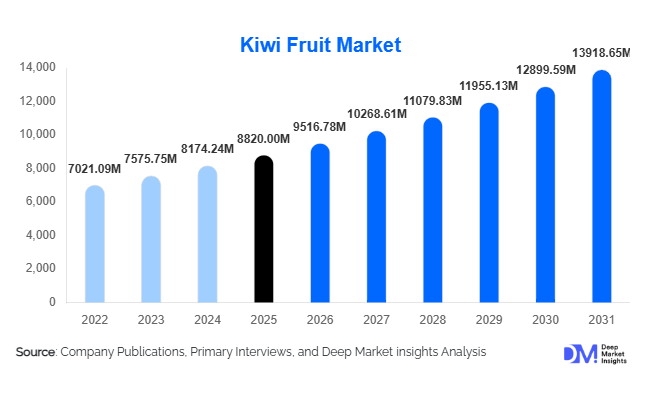
According to Deep Market Insights, the global kiwi fruit market size was valued at USD 8,820 million in 2025 and is projected to grow from USD 9,516.78 million in 2026 to reach USD 13,918.65 million by 2031, expanding at a CAGR of 7.9% during the forecast period (2026–2031). The kiwi fruit market growth is primarily driven by increasing global demand for nutrient-dense fruits, expansion of premium kiwi varieties, and rising international trade supported by improved cold-chain logistics and controlled atmosphere storage technologies.
Key Market Insights
- Premium kiwi varieties such as gold and red kiwi are gaining strong consumer traction, enabling higher price realization and brand-led fruit positioning.
- Asia-Pacific dominates global production and consumption, led by China and New Zealand’s export-oriented cultivation systems.
- Fresh fruit consumption accounts for the majority of market revenue, supported by rising healthy snacking trends worldwide.
- Modern retail and supermarket chains remain the primary distribution channels, ensuring quality consistency and global accessibility.
- Functional food and beverage industries are emerging as high-growth demand segments, integrating kiwi pulp and extracts into health-oriented products.
- Technological advancements in post-harvest handling and storage are enabling year-round supply and reducing spoilage losses.
What are the latest trends in the kiwi fruit market?
Premiumization Through New Kiwi Varieties
The kiwi fruit industry is witnessing a strong shift toward premium cultivars, particularly gold and red kiwi varieties. These fruits offer sweeter flavor profiles, smoother textures, and higher consumer appeal compared to traditional green kiwi. Producers are increasingly investing in licensed cultivars protected by intellectual property rights, enabling controlled supply chains and improved pricing stability. Premium branding strategies are transforming kiwi fruit from a commodity agricultural product into a differentiated horticultural category. Retailers are positioning premium kiwis as functional superfruits, enhancing shelf visibility and driving higher margins for growers and exporters.
Expansion of Processed and Functional Applications
Kiwi fruit is increasingly being utilized beyond fresh consumption. Food manufacturers are incorporating kiwi pulp, concentrates, and extracts into smoothies, juices, dairy products, and immunity-focused beverages. The presence of natural enzymes and antioxidants makes kiwi attractive for digestive-health formulations and functional nutrition products. Ready-to-eat fruit cups and frozen fruit blends are also expanding market applications, particularly in urban markets where convenience foods are gaining popularity. These developments are helping stabilize demand across seasons and reducing dependence on fresh fruit price cycles.
What are the key drivers in the kiwi fruit market?
Rising Global Health Awareness
Consumers worldwide are increasingly prioritizing foods that support immunity and overall wellness. Kiwi fruit’s high vitamin C content, fiber composition, and antioxidant benefits position it as a preferred fruit among health-conscious consumers. Dietary shifts toward plant-based nutrition and natural food sources are significantly boosting per capita fruit consumption, particularly in developed economies and emerging urban markets.
Advancements in Cold Chain Infrastructure
Improved refrigeration, controlled atmosphere storage, and efficient maritime logistics have transformed kiwi fruit trade. Exporters can now maintain freshness for extended periods, allowing year-round availability across continents. This technological evolution has enabled producers in New Zealand, Italy, and Chile to supply distant markets efficiently, expanding global consumption and reducing seasonal volatility.
What are the restraints for the global market?
Climate Sensitivity and Crop Vulnerability
Kiwi cultivation is highly sensitive to frost, excessive rainfall, and bacterial infections such as PSA disease. Climate variability increases production risks and can lead to yield fluctuations, impacting global supply stability and pricing consistency.
High Orchard Establishment Costs
Kiwi farming requires significant upfront investment in trellis systems, irrigation infrastructure, and multi-year cultivation cycles before commercial yields are achieved. These capital requirements limit entry for small growers and slow expansion in new producing regions.
What are the key opportunities in the kiwi fruit industry?
Emerging Market Consumption Growth
Rapid urbanization and rising disposable incomes across India, Southeast Asia, and the Middle East are expanding demand for imported premium fruits. Growing awareness of nutritional benefits and expansion of modern retail networks are accelerating kiwi adoption among middle-class consumers, creating significant opportunities for exporters.
Integration into Functional Food Ecosystems
The rapid growth of functional beverages, probiotic foods, and plant-based nutrition products presents substantial opportunities for kiwi processors. Kiwi-derived ingredients are increasingly used in digestive health formulations and immunity drinks, opening new industrial demand channels beyond traditional fresh fruit consumption.
Report Scope
| Report Metric | Details |
|---|---|
| Market Size in 2025 | USD 8820 Million |
| Market Size in 2026 | USD 9516.78 Million |
| Market Size in 2031 | USD 13918.65 Million |
| CAGR | 7.9% (2026-2031) |
| Base Year for Estimation | 2025 |
| Historical Data | 2022-2024 |
| Forecast Period | 2026-2031 |
| Report Coverage | Revenue Forecast, Competitive Landscape, Supply Chain Disruption, Growth Factors, Environment & Regulatory Landscape and Trends |
| Geographies Covered | North America, Europe, APAC, Middle East and Africa, LATAM |
| Countries Covered | U.S., Canada, U.K., Germany, France, Spain, Italy, Russia, Nordic, Benelux, Rest of Europe, China, Korea, Japan, India, Australia, Singapore, Taiwan, South East Asia, Rest of Asia-Pacific, UAE, Turky, Saudi Arabia, South Africa, Egypt, Nigeria, Rest of MEA, Brazil, Mexico, Argentina, Chile, Colombia, Rest of LATAM |
Explore more data points, trends and opportunities Download Free Sample Report
Product Type Insights
The global kiwi fruit market demonstrates strong product diversification, with green kiwi fruit maintaining its position as the dominant segment, accounting for approximately 58% of total market revenue. The leadership of green kiwi is primarily attributed to its extensive global cultivation footprint, high yield efficiency, and relatively affordable pricing, which makes it accessible across both developed and emerging economies. Its established consumer familiarity, balanced sweet-tart flavor profile, and strong shelf stability further support widespread retail penetration. The leading segment growth is driven by increasing consumer preference for nutrient-dense fruits rich in vitamin C, dietary fiber, and antioxidants, positioning green kiwi as a staple in daily nutrition and preventive health diets.Gold kiwi varieties represent the fastest-growing product category within the market, supported by rising premiumization trends in fresh fruit consumption. Consumers increasingly favor gold kiwi due to its smoother texture, sweeter taste, and lower acidity compared to traditional varieties, making it attractive to younger consumers and first-time buyers in emerging markets. Premium branding strategies, controlled cultivation programs, and improved post-harvest handling technologies have strengthened price realization and expanded international trade opportunities. Retailers also prioritize gold kiwi as a value-added product capable of generating higher margins and enhancing category differentiation.Red kiwi remains a niche yet rapidly expanding segment, driven primarily by agricultural innovation and limited commercial supply. The rarity of production, vibrant coloration, and unique flavor characteristics support strong consumer curiosity and premium positioning in specialty fruit markets. Producers are investing in varietal research and controlled orchard expansion to commercialize red kiwi at scale, enabling diversification across consumer price tiers while improving overall market value realization. Collectively, product innovation across kiwi varieties is enabling growers and distributors to target mass, premium, and specialty consumer segments simultaneously, strengthening long-term market resilience.
Application Insights
Household consumption continues to represent the largest application segment, contributing nearly 63% of global demand. The segment’s leadership is driven by growing consumer awareness regarding immunity support, digestive health benefits, and natural vitamin intake derived from fresh fruits. Kiwi fruit’s versatility as a breakfast ingredient, snack option, and smoothie component supports frequent consumption patterns across age groups. Rising urbanization, improved cold-chain availability, and increasing availability through organized retail formats further reinforce household adoption globally.Food processing applications are expanding steadily as manufacturers incorporate kiwi into fruit beverages, confectionery fillings, desserts, bakery toppings, and ready-to-eat packaged foods. The leading growth driver within this segment is the increasing demand for natural fruit ingredients that enhance flavor authenticity while supporting clean-label product positioning. Kiwi pulp and puree are gaining popularity among beverage manufacturers seeking differentiation through exotic fruit blends and functional refreshment products.Dairy applications are witnessing accelerated adoption, particularly in yogurts, probiotic drinks, frozen desserts, and flavored milk products. Kiwi’s natural acidity and vibrant flavor profile allow dairy producers to create premium offerings aligned with evolving consumer expectations for innovative taste experiences. Additionally, kiwi enzymes contribute to digestive positioning, enabling manufacturers to market products within the gut-health and wellness category.Nutraceutical applications are emerging as a significant long-term growth frontier. Increasing scientific recognition of kiwi’s digestive enzymes, antioxidant compounds, and immune-supporting properties is encouraging its use in dietary supplements, powdered extracts, and functional nutrition formulations. As consumers shift toward preventive healthcare and functional foods, kiwi-based nutraceutical formulations are expected to witness strong adoption through 2031.
Distribution Channel Insights
Supermarkets and hypermarkets account for the largest share of global kiwi fruit sales, supported by advanced cold storage infrastructure, standardized grading systems, and efficient global sourcing networks. The leading driver for this segment is consumer preference for one-stop shopping environments offering consistent fruit quality, transparent pricing, and year-round availability. Organized retail chains also play a crucial role in promoting premium kiwi varieties through in-store marketing, sampling campaigns, and branded packaging initiatives.Online grocery platforms are rapidly transforming fruit distribution dynamics, particularly in densely populated urban markets. Digital retail adoption accelerated due to changing consumer lifestyles and growing demand for convenience-driven purchasing behavior. Direct-to-consumer delivery models allow suppliers to reduce intermediaries while maintaining product freshness through optimized logistics and last-mile cold-chain solutions. Subscription-based fruit delivery services are further strengthening repeat purchasing patterns.Wholesale distribution channels remain essential for foodservice operators, hospitality industries, and large-scale food processors. Bulk purchasing requirements and price sensitivity within commercial buyers ensure continued reliance on wholesale markets. Meanwhile, specialty fruit retailers serve premium and organic kiwi segments, catering to health-conscious consumers seeking traceable sourcing, pesticide-free cultivation, and superior fruit quality.
End-Use Industry Insights
The retail household sector continues to dominate kiwi fruit demand globally, supported by rising awareness of balanced nutrition and increasing inclusion of fresh fruits in daily diets. The leading growth driver for this segment is the global shift toward healthier eating habits, particularly among urban consumers seeking natural alternatives to processed snacks. Educational health campaigns and social media-driven wellness trends are further accelerating consumption frequency.The beverage and functional food industries represent the fastest-growing end-use segment, fueled by increasing consumption of smoothies, cold-pressed juices, immunity beverages, and plant-based nutrition products. Kiwi’s refreshing flavor profile and high micronutrient density make it an attractive ingredient for functional formulations targeting energy, digestion, and immune health benefits.Export-driven demand plays a critical role in shaping global market dynamics, with more than half of global kiwi production entering international trade networks. Strong cross-border trade allows seasonal supply balancing between hemispheres, ensuring year-round availability in major consumer markets. Expanding food processing industries are also expected to significantly increase demand for kiwi pulp, concentrates, and frozen formats, enabling manufacturers to extend shelf life while maintaining nutritional value through 2031.
Explore more data points, trends and opportunities Download Free Sample Report
Kiwi Fruit Market Segmentations
By Product Type
- Green Kiwi Fruit
- Gold Kiwi Fruit
- Red Kiwi Fruit
- Organic Kiwi Fruit
By Application
- Fresh Consumption
- Beverages & Juice Processing
- Dairy & Frozen Desserts
- Bakery & Confectionery
- Nutraceutical & Functional Foods
By Distribution Channel
- Supermarkets & Hypermarkets
- Online Grocery Platforms
- Wholesale & Traditional Markets
- Specialty Fruit Stores
- Foodservice & Institutional Supply
By End Use
- Household Retail Consumption
- Food Processing Industry
- Beverage Industry
- HoReCa
- Nutraceutical Manufacturers
Regional Insights
Asia-Pacific
Asia-Pacific holds the largest share of the global kiwi fruit market, accounting for approximately 46% in 2025, driven by a combination of large-scale production capacity and rapidly expanding consumer demand. China leads global production and consumption due to favorable climatic conditions, government-supported agricultural modernization, and increasing domestic demand for nutrient-rich fruits. Rising middle-class income levels and heightened awareness of functional nutrition continue to accelerate per capita fruit consumption across urban centers.New Zealand remains a global leader in premium kiwi exports through well-established branded marketing programs and strict quality control systems that enhance international consumer trust. India represents the fastest-growing consumption market within the region, supported by expanding organized retail infrastructure, improved cold-chain logistics, and increasing awareness of immunity-boosting foods following heightened public health consciousness. Japan and South Korea serve as high-value import markets where consumers prioritize premium fruit quality, traceability, and consistent grading standards. Regional growth is further driven by expanding e-commerce grocery ecosystems, investment in post-harvest technology, and government initiatives encouraging fruit diversification in agricultural production.
Europe
Europe accounts for nearly 24% of global kiwi fruit demand, supported by strong regional production bases in Southern Europe and stable consumption patterns across Western European economies. Italy and Greece play a central role in regional supply due to advanced orchard management practices and favorable Mediterranean growing conditions. Consumer purchasing behavior increasingly emphasizes sustainability, organic certification, and environmentally responsible sourcing, which continues to shape product positioning within European retail markets.Growth across Germany, France, and the United Kingdom is driven by rising demand for fresh, minimally processed foods aligned with health-conscious lifestyles. Retailers are expanding private-label fruit programs and organic offerings to meet evolving consumer expectations. Additionally, stringent food safety regulations and traceability standards enhance consumer confidence, while increasing vegan and plant-based dietary adoption contributes to sustained kiwi consumption growth across the region.
North America
North America represents approximately 14% of the global kiwi fruit market, with the United States serving as one of the largest importers worldwide due to limited domestic production relative to consumption demand. Regional growth is strongly supported by health-focused dietary trends emphasizing vitamin-rich fruits, digestive wellness, and functional nutrition. Consumers increasingly incorporate kiwi into smoothies, salads, and wellness-focused meal plans.Highly developed retail distribution networks, advanced cold storage systems, and strong import logistics ensure consistent year-round supply availability. Rising popularity of convenient packaged fruit portions and ready-to-eat healthy snacks further supports market expansion. Additionally, increasing multicultural food consumption trends encourage experimentation with tropical and exotic fruits, strengthening kiwi’s position within mainstream dietary habits.
Latin America
Latin America contributes roughly 9% of global demand, with Chile emerging as a major export-oriented producer benefiting from favorable climatic conditions and strategic counter-seasonal supply advantages for Northern Hemisphere markets. Export competitiveness is supported by trade agreements, efficient port infrastructure, and growing investment in modern orchard technologies.Domestic consumption is gradually expanding in Brazil and Mexico as urbanization, rising disposable incomes, and improving retail penetration increase consumer access to imported and locally distributed kiwi fruit. Regional growth is further supported by expanding foodservice industries and increasing awareness of healthy eating habits among younger demographics, encouraging diversification beyond traditional fruit consumption patterns.
Middle East & Africa
The Middle East & Africa region accounts for approximately 7% of global kiwi fruit demand and represents a steadily expanding import-driven market. The United Arab Emirates and Saudi Arabia are emerging as key regional hubs due to premium food retail expansion, strong purchasing power, and increasing demand for imported fresh produce. Modern supermarket chains and luxury retail environments play a significant role in promoting premium fruit varieties.Population growth, rising tourism activity, and expanding hospitality sectors are strengthening foodservice demand for high-quality fruits used in beverages, desserts, and hotel dining experiences. Improvements in cold-chain logistics and regional distribution networks are enhancing product availability across urban centers. In Africa, gradual improvements in retail infrastructure and growing awareness of nutrition and wellness are expected to create long-term consumption opportunities, supporting sustained regional market development.
Key Players in the Kiwi Fruit Market
- Zespri Group Limited
- Jingold S.p.A.
- Seeka Limited
- Dole Food Company
- KiwiKoop Cooperative
- Apofruit Italia
- Rivoira Group
- Freshmax Group
- Golden Bay Fruit
- EastPack Limited
- TopFruit
- Sutherland Produce
- Agrilepidio S.r.l.
- Oppy (The Oppenheimer Group)
- Mr Apple New Zealand