King Oyster Mushroom Market Size
According to Deep Market Insights, the global king oyster mushroom market size was valued at USD 5,420 million in 2025 and is projected to grow from USD 5,962 million in 2026 to reach USD 9,601.86 million by 2031, expanding at a CAGR of 10.0% during the forecast period (2026–2031). The growth of the king oyster mushroom market is primarily driven by increasing consumer adoption of plant-based diets, rising demand for functional and nutrient-dense foods, and expanding commercial cultivation supported by controlled-environment agriculture technologies. King oyster mushrooms are gaining global popularity due to their meat-like texture, high protein and fiber content, and versatility across culinary applications, making them a preferred ingredient in vegan meat alternatives and premium gastronomy.
Key Market Insights
- Plant-based protein consumption is accelerating globally, positioning king oyster mushrooms as a key alternative protein ingredient.
- Asia-Pacific dominates production and consumption, supported by advanced mushroom cultivation infrastructure in China, South Korea, and Japan.
- Foodservice and processed food manufacturers are increasingly integrating king oyster mushrooms into ready meals and meat substitutes.
- Controlled-environment farming technologies are improving yield consistency and scalability.
- Export-oriented cultivation hubs are expanding across Eastern Europe and Southeast Asia.
- Retail penetration through supermarkets and e-commerce is increasing accessibility in Western markets.
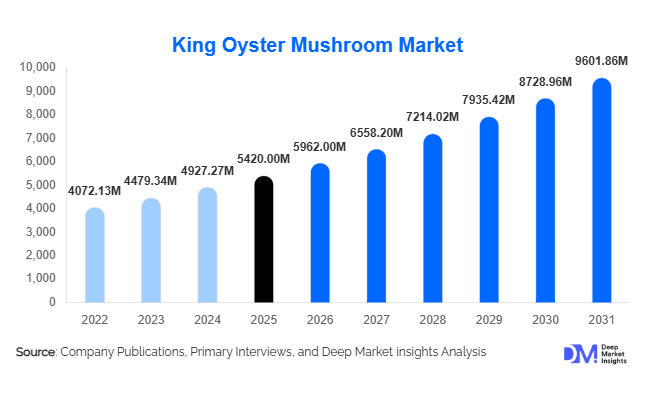
What are the latest trends in the king oyster mushroom market?
Rise of Plant-Based Culinary Innovation
King oyster mushrooms are becoming a cornerstone ingredient within plant-based cuisine due to their dense texture and umami flavor profile, which closely resembles seafood and meat. Food innovators are using sliced stems as scallop substitutes and shredded mushrooms as pulled meat alternatives. Restaurants and packaged food brands are introducing mushroom-based protein offerings targeting flexitarian consumers. This trend is accelerating adoption beyond traditional Asian markets into North America and Europe, where demand for sustainable protein sources continues to rise.
Expansion of Controlled Indoor Farming
Commercial mushroom growers are increasingly adopting climate-controlled vertical farming systems to ensure year-round production and standardized quality. Automation, humidity monitoring, AI-driven crop analytics, and substrate optimization are improving productivity and reducing contamination risks. These technological advancements enable producers to scale output while maintaining premium-grade consistency, making king oyster mushrooms commercially viable for export markets and large retail supply chains.
What are the key drivers in the king oyster mushroom market?
Growing Demand for Functional and Nutritional Foods
Consumers are increasingly prioritizing foods offering immune-supporting and health-promoting benefits. King oyster mushrooms contain antioxidants, beta-glucans, and essential amino acids, aligning strongly with functional food trends. Rising awareness regarding gut health and low-calorie nutrition is boosting adoption across health-conscious populations globally.
Expansion of Vegan and Flexitarian Diets
The rapid expansion of plant-based diets is a major growth driver. Flexitarian consumers seeking sustainable protein options are driving demand across supermarkets and restaurants. Food manufacturers are incorporating king oyster mushrooms into frozen meals, meat substitutes, and gourmet ready-to-cook kits, significantly expanding market penetration.
Growth of Premium Foodservice and Gourmet Cuisine
High-end restaurants and hospitality sectors increasingly use king oyster mushrooms due to their visual appeal and culinary versatility. Premium dining trends emphasizing sustainability and locally sourced ingredients further strengthen demand in developed markets.
What are the restraints for the global market?
Short Shelf Life and Cold Chain Dependence
Fresh king oyster mushrooms require controlled storage and logistics, increasing operational costs. Inadequate cold-chain infrastructure in emerging markets limits large-scale distribution and export efficiency.
High Initial Cultivation Investment
Commercial production requires specialized growing chambers, sterilization equipment, and climate control systems. These capital requirements create entry barriers for small-scale farmers transitioning from conventional crops.
What are the key opportunities in the king oyster mushroom industry?
Expansion into Meat Alternative Manufacturing
The global alternative protein industry presents significant opportunities for king oyster mushroom producers. Their fibrous texture allows processing into plant-based seafood and meat analogues without extensive modification. Partnerships between mushroom growers and food-tech companies are expected to drive new product development and higher-margin applications.
Export Growth from Emerging Agricultural Economies
Countries in Southeast Asia, Eastern Europe, and Latin America are investing in export-oriented mushroom farming supported by government agricultural modernization programs. Increasing global demand for specialty mushrooms enables producers to access premium international markets.
Integration into Functional Food and Nutraceutical Products
Extracts derived from king oyster mushrooms are increasingly used in supplements, immune-support products, and fortified foods. Growing demand for natural bioactive ingredients opens new revenue streams beyond fresh produce markets.
Report Scope
| Report Metric | Details |
|---|---|
| Market Size in 2025 | USD 5420 Million |
| Market Size in 2026 | USD 5962 Million |
| Market Size in 2031 | USD 9601.86 Million |
| CAGR | 10% (2026-2031) |
| Base Year for Estimation | 2025 |
| Historical Data | 2022-2024 |
| Forecast Period | 2026-2031 |
| Report Coverage | Revenue Forecast, Competitive Landscape, Supply Chain Disruption, Growth Factors, Environment & Regulatory Landscape and Trends |
| Geographies Covered | North America, Europe, APAC, Middle East and Africa, LATAM |
| Countries Covered | U.S., Canada, U.K., Germany, France, Spain, Italy, Russia, Nordic, Benelux, Rest of Europe, China, Korea, Japan, India, Australia, Singapore, Taiwan, South East Asia, Rest of Asia-Pacific, UAE, Turky, Saudi Arabia, South Africa, Egypt, Nigeria, Rest of MEA, Brazil, Mexico, Argentina, Chile, Colombia, Rest of LATAM |
Explore more data points, trends and opportunities Download Free Sample Report
Product Type Insights
Fresh king oyster mushrooms continue to dominate the global market landscape, accounting for approximately 61% of the global market share in 2025. The leadership of fresh products is primarily attributed to their superior texture, flavor profile, and visual appeal, which make them highly desirable across both commercial kitchens and retail households. Fresh king oyster mushrooms are widely recognized for their meaty consistency and ability to absorb flavors effectively, positioning them as a preferred ingredient in gourmet cuisine, plant-based recipes, and premium restaurant offerings. Increasing consumer preference for minimally processed foods and clean-label ingredients further strengthens demand for fresh varieties, particularly among health-conscious urban populations.The growth of fresh king oyster mushrooms is also supported by expanding cold-chain infrastructure and improved logistics networks, which enable producers to maintain product quality over longer distribution distances. Retail modernization across emerging economies has allowed supermarkets and specialty food stores to stock fresh mushrooms consistently, encouraging repeat consumer purchases. In addition, chefs and foodservice operators increasingly emphasize ingredient authenticity and freshness, reinforcing steady procurement of fresh mushrooms for culinary applications. The leading segment driver remains the rising global adoption of plant-forward diets, where fresh king oyster mushrooms serve as a natural meat substitute due to their fibrous structure and umami flavor.Frozen king oyster mushrooms are witnessing strong adoption, particularly in international trade and export-oriented markets. Freezing technology significantly extends shelf life, reduces spoilage risk, and allows producers to reach geographically distant markets without compromising product quality. This format is especially important for regions with limited domestic cultivation capacity but growing consumer demand. Food manufacturers favor frozen mushrooms because they provide standardized portioning, reduced preparation time, and stable pricing compared to fresh produce. As global trade networks expand and cross-border food supply chains become more integrated, frozen products are expected to gain increasing relevance.Dried and powdered king oyster mushrooms represent a rapidly evolving product category driven by innovation in functional foods and nutraceutical formulations. Drying enhances concentration of bioactive compounds while allowing long-term storage without refrigeration. Powdered forms are increasingly incorporated into seasoning blends, instant soups, dietary supplements, and protein-enriched snack formulations. The rise of functional nutrition trends, particularly those emphasizing immune health, gut wellness, and natural ingredients, is accelerating the commercialization of mushroom-based powders. Manufacturers are also leveraging dried mushroom extracts in plant-based flavor enhancers as consumers seek natural alternatives to synthetic additives.Overall, diversification across product formats reflects the maturation of the king oyster mushroom industry, where producers strategically balance freshness-driven premium demand with shelf-stable innovations that expand market accessibility and application versatility.
Application Insights
The food and beverage sector represents the largest application segment, contributing nearly 72% of total market revenue in 2025. The dominance of this segment is strongly linked to evolving dietary preferences and the increasing integration of specialty mushrooms into mainstream cuisine. King oyster mushrooms have gained significant traction due to their culinary flexibility, enabling use in grilling, roasting, stir-frying, and meat replacement applications. Restaurants and packaged food manufacturers increasingly incorporate these mushrooms into menus and ready-to-cook offerings, appealing to consumers seeking nutritious yet indulgent food experiences.The primary growth driver for the leading food and beverage segment is the accelerating global shift toward plant-based eating patterns. Consumers seeking alternatives to animal protein are turning toward natural whole-food substitutes rather than highly processed plant proteins. King oyster mushrooms provide a unique advantage because their dense texture closely resembles seafood and meat, allowing chefs and food manufacturers to create vegan scallops, shredded mushroom barbecue dishes, and plant-based steaks. This versatility significantly expands their culinary relevance across diverse cuisines and cultural markets.Within the food category, plant-based meat alternatives represent the fastest-growing sub-segment. Food innovation companies are investing heavily in mushroom-based formulations to improve texture realism and nutritional profiles. Unlike soy or pea protein isolates, mushrooms offer inherent umami flavor, reducing reliance on artificial flavoring agents. This trend aligns with consumer demand for recognizable ingredients and transparent labeling practices.Nutraceutical applications are expanding steadily as scientific research highlights the health-supporting properties of mushrooms, including antioxidants, polysaccharides, and immune-modulating compounds. Dietary supplement manufacturers increasingly utilize mushroom extracts in capsules, powders, and functional beverages marketed for wellness support. Growing consumer awareness regarding preventive healthcare and natural supplementation continues to expand this segment’s commercial potential.Pharmaceutical applications remain relatively niche but demonstrate promising long-term opportunities. Research institutions and biotechnology firms are exploring bioactive compounds derived from king oyster mushrooms for potential anti-inflammatory, cholesterol-lowering, and metabolic health applications. Although commercialization remains at an early stage, ongoing clinical research may unlock future high-value pharmaceutical use cases.
Distribution Channel Insights
Supermarkets and hypermarkets maintain the leading position in global distribution, accounting for approximately 46% market share in 2025. The dominance of this channel is supported by increasing consumer reliance on organized retail formats offering consistent product availability, quality assurance, and competitive pricing. Large retail chains invest heavily in refrigerated storage systems and supply chain optimization, enabling reliable stocking of perishable specialty mushrooms. Enhanced in-store merchandising and growing consumer familiarity with exotic produce categories further strengthen retail sales performance.The leading driver for supermarkets and hypermarkets is the expansion of modern retail infrastructure in both developed and emerging economies. Urbanization and rising disposable incomes encourage consumers to shop at organized outlets that provide a wide variety of fresh and premium food products. Retailers also collaborate directly with mushroom cultivators to ensure traceability and freshness, enhancing consumer trust and repeat purchasing behavior.Online grocery platforms represent the fastest-growing distribution channel as digital commerce reshapes food purchasing habits. Increasing smartphone penetration, improved last-mile delivery logistics, and consumer preference for convenience have accelerated online fresh produce sales. Subscription-based grocery models and quick-commerce platforms enable consumers to access specialty mushrooms without visiting physical stores. The pandemic-era shift toward digital grocery purchasing has created lasting behavioral changes that continue to benefit online distribution channels.Foodservice distributors remain essential intermediaries, supplying bulk quantities to restaurants, hotels, catering companies, and institutional kitchens. Growth in this channel is closely tied to the recovery and expansion of global hospitality industries. As dining-out culture strengthens and international cuisines gain popularity, foodservice distributors play a critical role in maintaining consistent supply to professional kitchens that rely heavily on specialty ingredients.
Cultivation Method Insights
Indoor controlled cultivation dominates global production with nearly 68% share, reflecting the industry’s transition toward technologically advanced farming systems. Controlled-environment agriculture enables producers to regulate temperature, humidity, and light conditions, ensuring consistent yields and uniform product quality. This method minimizes dependence on seasonal weather patterns and reduces vulnerability to climate variability, making it particularly attractive for commercial-scale producers and exporters.The leading segment driver for indoor cultivation is productivity optimization combined with supply reliability. Commercial buyers require stable year-round availability, which controlled cultivation systems can provide. Automation technologies, including climate monitoring sensors and substrate management systems, further enhance efficiency while reducing labor costs. These advancements enable scalable production capable of meeting rising global demand.Organic cultivation methods are expanding rapidly as consumers increasingly prioritize chemical-free and environmentally sustainable food products. Organic mushrooms command premium pricing due to perceived health benefits and environmentally responsible production practices. Retailers and foodservice operators are expanding organic product offerings to cater to eco-conscious consumers. Certification programs and regulatory support for organic agriculture further encourage growers to transition toward sustainable cultivation systems.Hybrid cultivation approaches combining indoor technology with sustainable substrate sourcing are also gaining traction. Producers are exploring agricultural waste recycling, including straw and sawdust substrates, to reduce environmental impact while improving resource efficiency. These sustainability-driven innovations align with broader global goals related to circular agriculture and carbon footprint reduction.
End-Use Insights
The commercial foodservice sector accounts for the largest demand share, representing approximately 52% of global consumption. Restaurants, hotels, and catering services increasingly incorporate king oyster mushrooms into menus as consumers seek gourmet dining experiences and innovative plant-based dishes. The mushroom’s ability to replicate meat textures allows chefs to develop creative vegan and flexitarian menu options without sacrificing flavor or presentation quality.The primary driver of the leading foodservice segment is the rapid expansion of experiential dining and global cuisine adoption. Fine dining establishments and casual restaurants alike are integrating specialty mushrooms into appetizers, main courses, and fusion dishes. Culinary trends emphasizing sustainability and ingredient storytelling further boost demand within professional kitchens.Household consumption is expanding rapidly as retail accessibility improves and consumers experiment with new ingredients at home. Cooking shows, social media recipes, and growing awareness of mushroom nutrition encourage home cooks to incorporate king oyster mushrooms into everyday meals. Increased availability in supermarkets and online grocery platforms has reduced barriers to adoption among first-time consumers.Processed food manufacturers represent the fastest-growing end-use segment. Ready-to-eat meals, frozen foods, and plant-based packaged products increasingly utilize king oyster mushrooms to enhance texture and nutritional value. Food companies are investing in mushroom-based innovation pipelines to address consumer demand for convenient yet healthy meal solutions. This shift reflects broader industry movement toward functional convenience foods combining nutrition, sustainability, and taste.
Explore more data points, trends and opportunities Download Free Sample Report
King Oyster Mushroom Market Segmentations
By Product Form
- Fresh King Oyster Mushrooms
- Frozen King Oyster Mushrooms
- Dried King Oyster Mushrooms
- Powder & Extract Forms
- Value-Added Processed Products
By Cultivation Method
- Indoor Controlled Environment Cultivation
- Greenhouse Cultivation
- Outdoor/Seasonal Cultivation
By Distribution Channel
- Modern Retail
- Traditional Retail & Wet Markets
- Foodservice & HoReCa Supply
- Online Retail & Direct-to-Consumer
- Industrial/B2B Bulk Supply
By End Use
- Household Consumption
- Food Processing Industry
- Restaurants & Foodservice
- Nutraceutical & Functional Foods
- Plant-Based Meat Alternative Manufacturing
Regional Insights
Asia-Pacific
Asia-Pacific dominates the global king oyster mushroom market, accounting for nearly 58% of total market share in 2025. The region’s leadership is supported by deeply rooted culinary traditions, advanced cultivation expertise, and large-scale production capacity. China serves as both the largest producer and consumer, benefiting from established mushroom farming infrastructure, technological innovation, and strong domestic consumption patterns. Government support for agricultural modernization and rural income diversification further strengthens production capabilities.Japan and South Korea drive premium demand through sophisticated food cultures that emphasize quality ingredients and functional nutrition. Consumers in these markets value mushrooms not only for taste but also for perceived health benefits, supporting higher price points and specialized product development. Rapid urbanization across Southeast Asia, rising disposable incomes, and expanding retail networks contribute to growing consumption across Thailand, Vietnam, and Indonesia.Regional growth is further driven by export expansion, technological innovation in controlled cultivation, and increasing investment in vertical farming systems. Asia-Pacific producers benefit from economies of scale, enabling competitive pricing in international markets while maintaining product diversity across fresh, frozen, and processed formats.
North America
North America accounts for approximately 17% of the global market, led by the United States and Canada. Regional growth is primarily fueled by rising adoption of plant-based diets and growing consumer awareness regarding specialty mushrooms. Increasing vegan and flexitarian populations are encouraging retailers and restaurants to diversify plant-based offerings, positioning king oyster mushrooms as a premium meat alternative.The United States represents the fastest-growing national market due to strong innovation within the plant-based food industry. Food startups and established manufacturers are incorporating mushrooms into alternative protein products to enhance texture authenticity and nutritional appeal. Expansion of indoor farming facilities and controlled-environment agriculture also supports domestic production growth, reducing dependence on imports.Health-conscious consumer behavior, demand for organic produce, and expansion of gourmet cooking culture further contribute to sustained regional market expansion. Retailers increasingly promote specialty mushrooms through educational marketing campaigns that highlight culinary versatility and health benefits.
Europe
Europe holds around 15% market share, driven by Germany, the Netherlands, France, and the United Kingdom. The region’s growth is closely linked to sustainability-focused consumption patterns and strong regulatory support for environmentally responsible agriculture. Consumers increasingly prefer locally produced and organic foods, encouraging expansion of controlled mushroom cultivation across Western Europe.The Netherlands plays a significant role as a technological hub for mushroom farming innovation, exporting cultivation expertise and equipment globally. Germany and the United Kingdom demonstrate strong retail demand fueled by vegan lifestyle adoption and expansion of plant-based product categories. France contributes through gourmet culinary applications where specialty mushrooms are widely utilized in fine dining.Eastern Europe is emerging as an important cultivation base due to lower production costs and favorable agricultural conditions. Countries such as Poland and Hungary are expanding exports across the European Union, strengthening regional supply chains and supporting long-term market growth.
Middle East & Africa
The Middle East and Africa region is experiencing steady growth supported by increasing urbanization and rising demand for premium food products. Countries such as the United Arab Emirates and Saudi Arabia are investing in indoor farming technologies to enhance food security and reduce reliance on imports. Controlled-environment agriculture is particularly attractive in arid climates where traditional farming faces limitations.Growth drivers include expanding hospitality sectors, rising expatriate populations, and increasing consumer exposure to international cuisines. Luxury hotels and fine dining establishments are key demand generators, incorporating specialty mushrooms into diverse culinary offerings. South Africa serves as a regional production hub, benefiting from agricultural expertise and growing domestic consumption.Government initiatives promoting agricultural innovation and sustainable food production are expected to accelerate adoption of mushroom cultivation technologies across the region over the forecast period.
Latin America
Latin America represents a smaller yet steadily expanding market led by Brazil and Mexico. Regional growth is supported by increasing consumer interest in healthy eating, diversification of agricultural production, and rising popularity of specialty foods within urban populations. Expansion of modern retail channels has improved availability of premium produce, encouraging trial consumption among middle-income consumers.Brazil’s agricultural innovation ecosystem supports experimentation with mushroom cultivation as farmers seek higher-value crops beyond traditional commodities. Mexico benefits from proximity to North American markets, enabling export opportunities alongside growing domestic demand. Culinary globalization and rising awareness of plant-based diets continue to create new growth pathways for king oyster mushrooms across the region.Overall, regional expansion across Latin America is driven by improving distribution infrastructure, investment in controlled cultivation, and gradual consumer education regarding the nutritional and culinary benefits of specialty mushrooms, positioning the region for sustained long-term growth.
Key Players in the King Oyster Mushroom Market
- Monaghan Mushrooms
- Hokto Kinoko Company
- Greenyard NV
- Shanghai Finc Bio-Tech Inc.
- Mycelia NV
- Okechamp Group
- Bonduelle Group
- Scelta Mushrooms
- CMP Mushrooms
- South Mill Champs
- Drinkwater Mushrooms Ltd.
- Costa Group Holdings
- The Mushroom Company
- Highline Mushrooms
- Walsh Mushrooms Group