Japanese Whisky Market Size
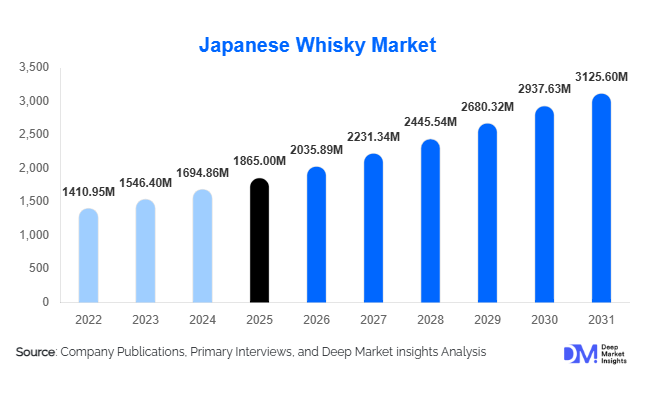
According to Deep Market Insights, the global Japanese whisky market size was valued at USD 1,865 million in 2025 and is projected to grow from USD 2,035.89 million in 2026 to reach USD 3,215.6 million by 2031, expanding at a CAGR of 9.6% during the forecast period (2026–2031). Market expansion is driven by premiumization trends in global spirits consumption, rising appreciation for craft and aged whiskies, and increasing export demand from North America, Europe, and emerging Asian luxury markets. Japanese whisky has transitioned from a niche collectible category into a globally recognized premium spirits segment supported by limited production, heritage distillation practices, and international awards recognition.
Key Market Insights
- Premium and ultra-premium Japanese whiskies dominate global demand, supported by collectors and luxury spirits consumers.
- Exports account for a growing share of total sales, particularly across the U.S., U.K., China, and Singapore.
- Single malt whisky remains the leading product category due to craftsmanship perception and aging complexity.
- Asia-Pacific represents the fastest-growing consumption region, driven by expanding affluent populations.
- Limited aging inventories continue to influence pricing trends, sustaining high margins across producers.
- Premium cocktail culture and high-end hospitality expansion are accelerating on-premise consumption globally.
What are the latest trends in the Japanese whisky market?
Premiumization and Collectible Whisky Culture
Japanese whisky has increasingly evolved into a luxury collectible category, with aged expressions and limited editions achieving strong auction performance and retail premiums. Consumers are shifting toward authenticity, heritage production, and scarcity-driven purchasing behavior. Distilleries are strategically releasing age-statement expressions in smaller batches to maintain exclusivity while protecting aging inventories. Secondary markets and whisky investment platforms are also influencing demand dynamics, positioning Japanese whisky as both a consumption and asset class product.
Expansion of Craft and New Distilleries
Following global success stories of legacy producers, Japan has witnessed growth in independent craft distilleries emphasizing regional terroir, innovative cask finishes, and experimental fermentation techniques. Smaller producers are targeting export markets earlier in their lifecycle, supported by digital marketing and whisky tourism. This diversification is broadening product offerings beyond traditional blends while strengthening long-term supply capacity.
What are the key drivers in the Japanese whisky market?
Rising Global Demand for Premium Spirits
Consumers worldwide are increasingly trading up from standard spirits toward premium and super-premium offerings. Japanese whisky benefits from strong brand storytelling, meticulous craftsmanship, and international awards recognition. High-income consumers in North America and Asia are driving sustained demand growth, especially within luxury hospitality and collector communities.
Growth of Whisky Tourism and Cultural Branding
Distillery tourism across Japan has significantly enhanced brand engagement. Visitors experience production processes, tasting sessions, and heritage storytelling, strengthening global brand equity. Tourism recovery post-pandemic has reinforced direct-to-consumer sales and international brand exposure.
Expansion of Premium Cocktail Culture
Japanese highball cocktails and mixology trends have gained popularity across upscale bars and restaurants. Bartenders increasingly use Japanese whisky for premium cocktail menus, expanding consumption occasions beyond neat drinking and collectors.
What are the restraints for the global market?
Limited Aging Inventory Supply
Whisky production requires long maturation periods, creating supply constraints. Many distilleries underestimated global demand growth in earlier decades, leading to shortages of aged stock today. This restricts volume expansion despite rising demand.
High Pricing and Accessibility Barriers
Premium positioning results in higher retail prices compared to Scotch or American whisky alternatives. This limits penetration into mass-market segments and creates dependency on affluent consumer bases.
What are the key opportunities in the Japanese whisky industry?
Expansion into Emerging Asian Luxury Markets
Rapid wealth growth in Southeast Asia, India, and South Korea presents significant opportunities. Rising luxury consumption and premium gifting culture are increasing demand for imported spirits. Strategic partnerships with luxury retailers and duty-free operators can accelerate adoption.
Innovation in Cask Finishing and Limited Editions
Distilleries are experimenting with Mizunara oak, wine casks, and specialty finishes to differentiate offerings. Limited-edition releases command higher margins while attracting collectors and enthusiasts seeking uniqueness.
Digital Direct-to-Consumer and Whisky Investment Platforms
E-commerce and blockchain-backed whisky authentication platforms are improving transparency and global accessibility. Producers leveraging digital channels can expand margins while reaching younger premium consumers.
Report Scope
| Report Metric | Details |
|---|---|
| Market Size in 2025 | USD 1865 Million |
| Market Size in 2026 | USD 2035.89 Million |
| Market Size in 2031 | USD 3125.6 Million |
| CAGR | 9.6% (2026-2031) |
| Base Year for Estimation | 2025 |
| Historical Data | 2022-2024 |
| Forecast Period | 2026-2031 |
| Report Coverage | Revenue Forecast, Competitive Landscape, Supply Chain Disruption, Growth Factors, Environment & Regulatory Landscape and Trends |
| Geographies Covered | North America, Europe, APAC, Middle East and Africa, LATAM |
| Countries Covered | U.S., Canada, U.K., Germany, France, Spain, Italy, Russia, Nordic, Benelux, Rest of Europe, China, Korea, Japan, India, Australia, Singapore, Taiwan, South East Asia, Rest of Asia-Pacific, UAE, Turky, Saudi Arabia, South Africa, Egypt, Nigeria, Rest of MEA, Brazil, Mexico, Argentina, Chile, Colombia, Rest of LATAM |
Explore more data points, trends and opportunities Download Free Sample Report
Product Type Insights
The global Japanese whisky market demonstrates strong product differentiation driven by heritage positioning, aging expertise, and premium craftsmanship narratives. Single malt Japanese whisky leads the market, accounting for approximately 38% of global revenue in 2025, primarily supported by its strong association with authenticity, limited production volumes, and distillery-specific flavor identity. Consumers increasingly perceive single malt expressions as luxury collectibles rather than standard spirits, reinforcing higher average selling prices and sustained demand among enthusiasts and investors. The leading position of this segment is further strengthened by auction market activity, age-statement scarcity, and the global prestige attached to Japanese distillation techniques influenced by precision craftsmanship and terroir-driven production philosophies.Blended whisky follows closely, holding around 34% market share, supported by its broader accessibility and versatility across consumption occasions. Blended expressions appeal to both entry-level premium consumers and mixology professionals, enabling wider adoption across retail and hospitality environments. Their balanced flavor profiles make them highly suitable for premium cocktails, contributing significantly to on-premise sales growth. Grain whisky represents nearly 18% of the market, largely supported by its essential role in blending operations and increasing experimentation by distillers seeking lighter, contemporary flavor profiles aligned with younger consumer preferences. Meanwhile, blended malt variants account for approximately 10%, benefiting from growing consumer curiosity toward innovative expressions that combine complexity with affordability.Overall, the dominance of single malt whisky reflects a broader premiumization shift within global spirits markets, where consumers increasingly prioritize provenance, aging transparency, and craftsmanship storytelling. Limited releases, cask experimentation, and brand heritage narratives continue to elevate perceived value, reinforcing the segment’s leadership while encouraging diversification across adjacent whisky categories.
Application Insights
Premium retail consumption represents the largest application segment, contributing nearly 46% of total market demand. Growth in this segment is primarily driven by collectors, connoisseurs, and affluent consumers purchasing Japanese whisky for personal enjoyment, gifting, and long-term investment purposes. The rising perception of whisky as an alternative asset class has significantly influenced purchasing behavior, particularly for rare and aged bottles whose resale values appreciate over time. Luxury packaging, limited-edition releases, and brand storytelling further stimulate retail-driven demand, positioning Japanese whisky as both a lifestyle product and a financial collectible.On-premise consumption accounts for approximately 32% of the market, supported by the global expansion of premium cocktail culture and experiential drinking environments. High-end bars, luxury restaurants, and curated whisky lounges increasingly showcase Japanese whisky as a premium offering, introducing new consumers through guided tastings and signature cocktails. Bartenders and mixologists play a crucial role in market expansion by promoting Japanese whisky’s versatility and refined flavor balance, which enhances its appeal across diverse consumer demographics.Duty-free and travel retail channels contribute around 22%, benefiting from the steady recovery of international tourism and strong gifting culture across Asia-Pacific and Middle Eastern travel hubs. Airports serve as key discovery platforms where travelers encounter exclusive editions unavailable in domestic markets, encouraging impulse purchases and brand trial. As global travel volumes normalize, travel retail is expected to remain an important growth engine for premium whisky exposure and cross-border brand expansion.
Distribution Channel Insights
Specialty liquor retail stores dominate distribution channels with nearly 41% market share, reflecting consumer preference for expert guidance and curated product selections when purchasing premium spirits. These outlets play an essential educational role by offering tasting experiences, personalized recommendations, and access to limited releases, which enhances consumer confidence and encourages premium spending. The leading position of specialty retailers is primarily driven by the need for authenticity assurance and product expertise within the high-value whisky category.Online retail channels account for approximately 27% share and represent one of the fastest-evolving distribution formats. Digital platforms enable broader geographic accessibility, transparent pricing comparisons, and access to rare bottles previously restricted to local markets. The integration of e-commerce with virtual tasting events, subscription models, and collector communities has strengthened consumer engagement while expanding global reach for distillers.Duty-free retail contributes roughly 19%, supported by strong international traveler traffic and premium gifting demand. Exclusive airport editions enhance brand visibility while reinforcing luxury positioning. Direct distillery sales represent about 13%, benefiting from whisky tourism experiences in Japan, where visitors purchase products directly from production sites, strengthening brand loyalty and enhancing experiential value connected to heritage and craftsmanship.
End-Use Insights
The hospitality sector represents the fastest-growing end-use segment, expanding in parallel with the global rise of luxury hotels, premium bars, and fine-dining establishments. High-end hospitality revenues exceeded USD 1 trillion globally in 2025, creating substantial demand for premium spirits that enhance guest experiences and reinforce luxury positioning. Japanese whisky’s refined flavor profile and prestige reputation make it particularly attractive for curated beverage menus and high-margin premium offerings within upscale venues.Export-driven demand continues to accelerate overall market expansion, with more than 55% of Japanese whisky production now directed toward overseas markets. International recognition through awards, critic reviews, and global whisky competitions has elevated brand visibility, encouraging distributors to expand presence across emerging premium spirits markets. Corporate gifting programs, especially in Asia and North America, have also emerged as significant demand drivers, reflecting whisky’s growing role as a luxury status symbol.New consumption occasions are further broadening market scope, including whisky investment portfolios, experiential tasting events, private collector clubs, and educational masterclasses. These experiences transform whisky consumption into a cultural and social activity, increasing engagement depth while strengthening long-term brand loyalty among younger affluent consumers entering the premium spirits category.
Explore more data points, trends and opportunities Download Free Sample Report
Japanese Whisky Market Segmentations
By Product Type
- Single Malt Japanese Whisky
- Blended Japanese Whisky
- Grain Whisky
- Blended Malt Whisky
- Limited Edition & Aged Expressions
By Application
- Premium Retail Consumption
- On-Premise Consumption
- Duty-Free & Travel Retail
- Collectible & Investment Purchases
By Distribution Channel
- Specialty Liquor Stores
- Online Retail & E-commerce Platforms
- Duty-Free Retail Stores
- Direct Distillery Sales
- Supermarkets & Premium Retail Chains
Regional Insights
Asia-Pacific
Asia-Pacific dominates the Japanese whisky market, accounting for approximately 42% market share in 2025, supported by geographic proximity, cultural familiarity, and strong luxury consumption ecosystems. Japan remains the primary consumption and production hub, where domestic appreciation for craftsmanship and premium beverages sustains stable demand. Regional growth is further driven by expanding affluent populations, rising disposable incomes, and strong gifting traditions across China, Singapore, and South Korea. China’s luxury consumption rebound and preference for prestige imported goods significantly accelerate premium whisky adoption, while Singapore functions as a regional distribution and investment trading hub for rare bottles.India is emerging as one of the fastest-growing markets, supported by rapid urbanization, expanding high-net-worth populations, and evolving premium drinking culture among younger professionals. Increasing exposure to global spirits trends through international travel and luxury hospitality expansion is accelerating demand. Additionally, growth in upscale retail formats and premium bars across major metropolitan cities is enhancing accessibility and consumer education, positioning Asia-Pacific as the long-term growth engine of the global Japanese whisky industry.
North America
North America accounts for nearly 28% market share, led predominantly by the United States, where consumers demonstrate strong appreciation for imported premium spirits and collectible whisky categories. Growth is supported by high disposable income levels, a mature whisky enthusiast community, and expanding interest in global whisky diversity beyond traditional Scotch and Bourbon offerings. Japanese whisky benefits from strong positioning within cocktail innovation and luxury bar programs, particularly in metropolitan markets such as New York, Los Angeles, and Chicago.The region’s developed e-commerce infrastructure and active secondary resale markets further strengthen demand by enabling collectors to access rare releases. Educational whisky events, tasting festivals, and influencer-driven spirits culture continue to introduce new consumers to Japanese whisky, supporting sustained long-term growth.
Europe
Europe represents approximately 20% of global market share, with the United Kingdom, Germany, and France serving as key consumption centers. European consumers display strong interest in artisanal spirits, heritage production methods, and aged expressions, aligning closely with Japanese whisky’s craftsmanship-driven identity. Growth is supported by well-established specialty retail networks, whisky festivals, and enthusiast communities that encourage experimentation with international whisky styles.Premiumization trends across Western Europe, combined with increasing demand for limited-edition releases and collector-oriented products, continue to drive market expansion. The region’s strong tourism sector also contributes to duty-free purchases and cross-border whisky discovery, reinforcing steady demand growth.
Middle East & Africa
The Middle East & Africa region demonstrates steady expansion despite regulatory constraints on alcohol consumption in certain markets. The United Arab Emirates and Saudi Arabia act as primary growth centers due to rapid luxury hospitality development, high tourist inflows, and strong premium dining culture. International hotel chains and luxury resorts increasingly feature premium whisky portfolios to cater to affluent global travelers.Duty-free retail hubs such as Dubai play a critical role in regional sales, enabling access to premium imported spirits. Rising expatriate populations, expanding luxury tourism infrastructure, and growing demand for high-end gifting products collectively support long-term market development across the region.
Latin America
Latin America holds a smaller but steadily expanding share of approximately 10%, led by Brazil and Mexico. Market growth is supported by rising urban middle-class populations, improving economic stability in key metropolitan areas, and increasing exposure to global premium spirits trends. Younger consumers are demonstrating growing interest in premium and imported alcoholic beverages, particularly within upscale nightlife and hospitality environments.Premiumization within the spirits sector, expansion of modern retail channels, and increasing participation in international whisky culture through events and tastings are gradually accelerating adoption. Although price sensitivity remains a moderating factor, expanding affluent consumer segments and evolving lifestyle aspirations position Latin America as an emerging opportunity market for Japanese whisky brands over the forecast period.
Key Players in the Japanese Whisky Market
- Suntory Holdings Limited
- Nikka Whisky Distilling Co.
- Kirin Holdings Company (Fuji Whisky)
- Venture Whisky Ltd. (Ichiro’s Malt)
- Chichibu Distillery
- Mars Whisky (Hombo Shuzo Co.)
- Asaka Distillery (Sasanokawa Shuzo)
- White Oak Distillery (Eigashima Shuzo)
- Kanosuke Distillery
- Saburomaru Distillery
- Akkeshi Distillery
- Shizuoka Distillery
- Nagasaki Distillery
- Kujira Whisky (Helios Distillery)
- Sakurao Distillery