Interactive Streaming Market Size
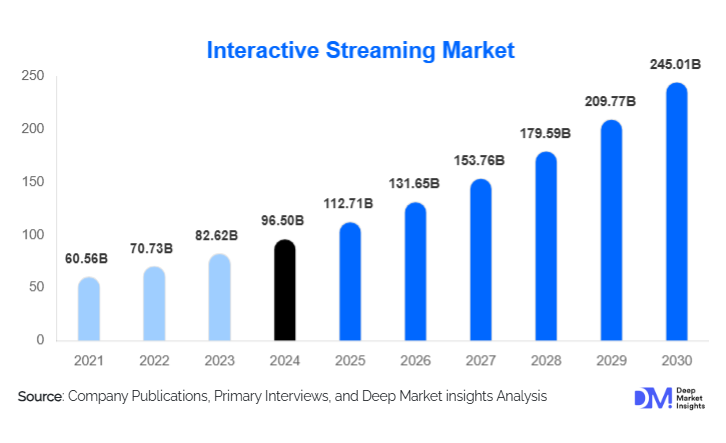
According to Deep Market Insights, the global interactive streaming market size was valued at USD 96.5 billion in 2025 and is projected to grow from USD 112.71 billion in 2026 to reach approximately USD 245.01 billion by 2031, expanding at a robust CAGR of 16.8% during the forecast period (2026–2031). The interactive streaming market growth is driven by the rapid shift from passive content consumption to real-time, participatory digital experiences, rising adoption of live commerce and gaming streams, and increasing monetization opportunities within the global creator economy.
Key Market Insights
- Live interactive streaming dominates the market, accounting for nearly half of global revenue due to strong demand from gaming, social media, and live events.
- Mobile-first platforms lead consumption, supported by smartphone penetration and 5G rollout across Asia-Pacific and emerging markets.
- Asia-Pacific is the largest regional market, driven by large-scale adoption of live commerce and social streaming ecosystems in China and Southeast Asia.
- North America remains a technology and monetization hub, with strong advertising revenues and creator-led platforms.
- Hybrid monetization models are gaining traction, combining advertising, subscriptions, and transaction-based revenue streams.
- AI-driven personalization and immersive technologies are reshaping user engagement and platform differentiation.
Interactive Streaming Market Trends
Rapid Expansion of Live Commerce Streaming
Live commerce has emerged as one of the most influential trends within the interactive streaming market. Real-time product demonstrations combined with instant purchasing capabilities are significantly improving conversion rates compared to traditional e-commerce formats. Influencer-led shopping streams, limited-time offers, and interactive Q&A sessions are driving strong engagement, particularly in Asia-Pacific. Retailers are increasingly integrating interactive streaming into omnichannel strategies, using live formats to bridge online and offline commerce. As payment infrastructure and logistics improve globally, live commerce streaming is expanding into North America, Europe, and the Middle East, creating a new high-growth revenue vertical.
Technology-Driven Personalization and Immersion
Advanced technologies such as artificial intelligence, augmented reality, and cloud-based streaming are transforming interactive experiences. AI-powered recommendation engines personalize content in real time, while AR features enable virtual try-ons and immersive overlays during live streams. Low-latency cloud infrastructure and edge computing are improving stream quality and interaction speed, enhancing user satisfaction. These innovations are particularly attractive to younger, digitally native audiences who prioritize immersive, customizable experiences over static video consumption.
Interactive Streaming Market Drivers
Rising Demand for Real-Time Engagement
Consumers increasingly favor real-time interaction over passive viewing, driving demand for features such as live chat, polls, reactions, and gamification. These capabilities significantly increase user retention, session duration, and monetization potential for platforms. Brands and creators are leveraging interactive formats to build communities and foster deeper audience relationships.
Growth of the Global Creator Economy
The expansion of the creator economy is a major growth driver for interactive streaming. Independent creators, gamers, and influencers rely on live interaction to monetize content through subscriptions, tipping, sponsorships, and live commerce commissions. Platforms that provide robust creator tools and analytics are experiencing accelerated adoption and revenue growth.
Advancements in Network Infrastructure
The global rollout of 5G networks and improvements in broadband connectivity are enabling seamless, low-latency interactive streaming. Enhanced infrastructure supports higher-quality video, real-time interactivity, and scalability across regions, particularly in emerging markets.
Interactive Streaming Market Restraints
High Infrastructure and Operating Costs
Interactive streaming platforms require significant investment in cloud infrastructure, content delivery networks, and moderation technologies. These costs can pressure margins, especially for smaller or emerging players, and may slow market entry in cost-sensitive regions.
Regulatory and Data Privacy Challenges
Increasing regulations related to data protection, content moderation, and digital payments vary across regions and create compliance complexity for global platforms. Navigating these regulatory frameworks remains a key challenge for sustained expansion.
Interactive Streaming Market Opportunities
Enterprise and Institutional Adoption
Enterprises and institutions are increasingly adopting interactive streaming for virtual events, employee training, education, and customer engagement. These applications offer stable, subscription-based revenue opportunities and reduce dependence on advertising-driven models.
Integration of Immersive Technologies
The integration of AR, VR, and AI presents significant opportunities for differentiation and premium monetization. Immersive interactive streaming is expanding beyond gaming into retail, education, and corporate training, enabling new use cases and revenue streams.
Report Scope
| Report Metric | Details |
|---|---|
| Market Size in 2025 | USD 96.5 Billion |
| Market Size in 2026 | USD 112.71 Billion |
| Market Size in 2031 | USD 245.01 Billion |
| CAGR | 16.8% (2026-2031) |
| Base Year for Estimation | 2025 |
| Historical Data | 2022-2024 |
| Forecast Period | 2026-2031 |
| Report Coverage | Revenue Forecast, Competitive Landscape, Supply Chain Disruption, Growth Factors, Environment & Regulatory Landscape and Trends |
| Geographies Covered | North America, Europe, APAC, Middle East and Africa, LATAM |
| Countries Covered | U.S., Canada, U.K., Germany, France, Spain, Italy, Russia, Nordic, Benelux, Rest of Europe, China, Korea, Japan, India, Australia, Singapore, Taiwan, South East Asia, Rest of Asia-Pacific, UAE, Turky, Saudi Arabia, South Africa, Egypt, Nigeria, Rest of MEA, Brazil, Mexico, Argentina, Chile, Colombia, Rest of LATAM |
Explore more data points, trends and opportunities Download Free Sample Report
Content Format Insights
Live interactive streaming leads the market, accounting for approximately 46% of global revenue in 2025, driven by gaming, live events, and influencer engagement. On-demand interactive streaming holds a significant share by offering flexible consumption combined with interactive elements. Hybrid formats that blend live and on-demand content are gaining popularity as platforms seek to maximize engagement and content reuse.
Interaction Type Insights
Real-time audience interaction dominates the market with nearly 38% share, supported by live chats, polls, and reactions. Gamified interactions are growing rapidly, particularly in gaming and education, while transactional interactions such as tipping and live shopping are emerging as high-revenue segments.
Monetization Model Insights
Advertising-supported interactive streaming remains the largest monetization model, accounting for around 41% of market revenue in 2025. Subscription-based models provide recurring income, while transaction-based monetization is expanding rapidly due to live commerce and virtual gifting. Hybrid models are increasingly adopted to diversify revenue streams.
End-Use Industry Insights
Media and entertainment represent the largest end-use segment with approximately 34% market share. Gaming and esports are the fastest-growing segments, expanding at over 18% CAGR. Retail and e-commerce live streaming is emerging as a major growth engine, while education and enterprise applications are gaining traction due to recurring demand.
Explore more data points, trends and opportunities Download Free Sample Report
Interactive Streaming Market Segmentations
By Content Format
- Live Interactive Streaming
- On-Demand Interactive Streaming
- Hybrid
By Interaction Type
- Real-Time Audience Interaction
- Gamified Interaction
- Transactional Interaction
- Co-Creation & Collaborative Interaction
By Platform Type
- Mobile-First Streaming Platforms
- Web-Based Streaming Platforms
- Smart TV & Connected Device Platforms
- AR/VR-Based Interactive Streaming Platforms
By Monetization Model
- Advertising-Supported Interactive Streaming
- Subscription-Based Interactive Streaming
- Transaction-Based Monetization
- Hybrid Monetization Models
By End-Use Industry
- Media & Entertainment
- Gaming & Esports
- Retail & E-commerce (Live Commerce)
- Education & E-learning
- Corporate & Enterprise Communication
- Social Media & Creator Economy
Regional Insights
Asia-Pacific
Asia-Pacific accounts for approximately 42% of the global interactive streaming market in 2025, led by China, India, Japan, and South Korea. The region benefits from large mobile-first user bases, strong live commerce adoption, and integrated digital payment ecosystems.
North America
North America holds around 27% market share, driven by the U.S. creator economy, advanced advertising markets, and high ARPU levels. The region is a leader in platform innovation and AI adoption.
Europe
Europe represents about 18% of global demand, supported by strong digital infrastructure and growing adoption of interactive formats in media, education, and enterprise communication.
Latin America
Latin America is an emerging growth region, led by Brazil and Mexico, with increasing mobile streaming adoption and social commerce penetration.
Middle East & Africa
The Middle East & Africa region is witnessing steady growth, driven by rising smartphone penetration, youth demographics, and government-led digital transformation initiatives.
Top Players in the Interactive Streaming Market
- Amazon
- Meta Platforms
- Tencent
- ByteDance
- Microsoft
- Sony Interactive Entertainment
- Alibaba Group
- Bilibili
- Huya
- Kuaishou
- Netflix
- Discord
- Zoom Video Communications
- Sea Limited