Insect-Based Pet Food Market Size
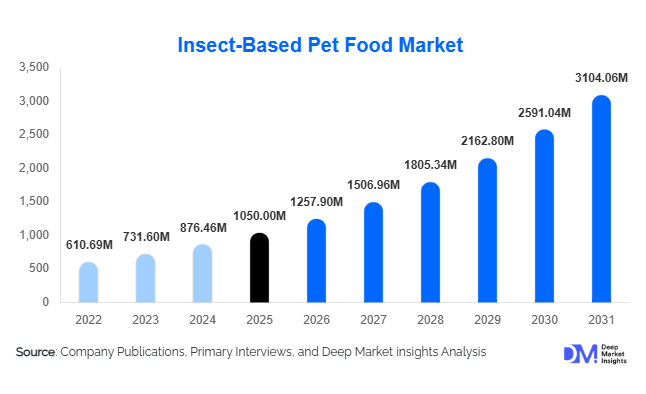
According to Deep Market Insights, the global insect-based pet food market size was valued at USD 1,050 million in 2025 and is projected to grow from USD 1,257.90 million in 2026 to reach USD 3,104.06 million by 2031, expanding at a CAGR of 19.8% during the forecast period (2026–2031). The insect-based pet food market growth is primarily driven by rising demand for sustainable protein alternatives, increasing pet humanization trends, and the growing adoption of hypoallergenic and functional pet diets. The market is transitioning from a niche segment to a mainstream category as consumers increasingly prioritize environmentally responsible and nutritionally superior pet food solutions.
Key Market Insights
- Insect-based pet food is gaining traction as a sustainable alternative, offering lower carbon footprint and efficient resource utilization compared to traditional meat-based products.
- Black soldier fly protein dominates raw material usage, owing to its high protein yield and cost-effective farming processes.
- Europe leads the global market, supported by strong regulatory approvals and high consumer awareness regarding sustainability.
- Asia-Pacific is the fastest-growing region, driven by rising pet ownership and increasing disposable income.
- Premium and therapeutic pet food segments are expanding rapidly, especially for allergy management and digestive health.
- Technological advancements in insect farming and processing are improving scalability, reducing costs, and enhancing product quality.
What are the latest trends in the insect-based pet food market?
Shift Toward Sustainable and Ethical Pet Nutrition
The global pet food industry is undergoing a structural transformation toward sustainability, with insect protein emerging as a viable solution to environmental challenges associated with livestock farming. Consumers are increasingly aware of the ecological impact of traditional protein sources, including greenhouse gas emissions, water consumption, and land use. Insect farming, by contrast, requires significantly fewer resources and produces minimal waste, making it highly attractive for eco-conscious pet owners. Brands are leveraging sustainability claims, eco-labeling, and carbon footprint disclosures to differentiate their offerings and appeal to environmentally responsible consumers. This trend is particularly strong in Europe and North America, where sustainability-driven purchasing decisions are influencing product innovation and marketing strategies.
Premiumization and Functional Nutrition Integration
Another prominent trend is the integration of functional benefits into insect-based pet food products. Manufacturers are developing specialized formulations targeting specific health concerns such as allergies, digestive issues, skin health, and weight management. Insect protein is naturally hypoallergenic and easily digestible, making it ideal for pets with dietary sensitivities. This has led to increased adoption in premium and veterinary-recommended diets. Additionally, the rise of pet humanization has encouraged consumers to seek high-quality, nutritionally balanced products that mirror human food standards. As a result, insect-based pet food is increasingly positioned as a premium offering, with higher price points supported by enhanced nutritional profiles and sustainability credentials.
What are the key drivers in the insect-based pet food market?
Rising Demand for Sustainable Protein Sources
One of the primary drivers of the insect-based pet food market is the growing need for sustainable protein alternatives. Traditional meat production is resource-intensive and contributes significantly to environmental degradation. Insect farming offers a more sustainable solution, requiring less land, water, and feed while producing high-quality protein. This aligns with global sustainability goals and is driving adoption among environmentally conscious consumers. Governments and regulatory bodies are also supporting alternative protein development, further accelerating market growth.
Increasing Pet Humanization and Premium Pet Food Demand
The trend of pet humanization is significantly influencing purchasing behavior, with pet owners increasingly treating pets as family members. This has led to a surge in demand for premium, high-quality, and functional pet food products. Insect-based pet food fits well within this trend, offering superior nutritional benefits, including high protein content, essential amino acids, and improved digestibility. Consumers are willing to pay a premium for products that enhance pet health and well-being, thereby driving market expansion.
What are the restraints for the global market?
Consumer Perception and Acceptance Barriers
Despite its benefits, insect-based pet food faces challenges related to consumer perception. Many pet owners are hesitant to adopt insect-based products due to psychological barriers and lack of familiarity. Overcoming this requires extensive consumer education, marketing efforts, and transparency regarding product safety and nutritional value. Brands need to emphasize the scientific and environmental advantages of insect protein to build trust and acceptance among consumers.
High Production Costs and Limited Scalability
Another significant restraint is the relatively high cost of insect farming and processing. While technological advancements are gradually reducing costs, the initial investment required for infrastructure, automation, and quality control remains high. This results in higher product prices compared to traditional pet food, limiting adoption in price-sensitive markets. Scaling production efficiently while maintaining quality standards is a key challenge for industry participants.
What are the key opportunities in the insect-based pet food industry?
Expansion into Emerging Markets
Emerging markets in Asia-Pacific and Latin America present significant growth opportunities for insect-based pet food manufacturers. Rising urbanization, increasing disposable incomes, and growing pet ownership are creating favorable conditions for market expansion. Companies can tap into these markets by offering affordable product variants and investing in localized marketing strategies to build awareness and acceptance.
Technological Advancements in Insect Farming
Advancements in insect farming technologies, including automation, AI-driven monitoring, and improved breeding techniques, are enhancing production efficiency and scalability. These innovations are expected to reduce costs, improve product consistency, and enable mass production. Companies investing in research and development can gain a competitive advantage by offering high-quality, cost-effective products.
Report Scope
| Report Metric | Details |
|---|---|
| Market Size in 2025 | USD 1050.00 Million |
| Market Size in 2026 | USD 1257.90 Million |
| Market Size in 2031 | USD 3104.06 Million |
| CAGR | 19.8% (2026-2031) |
| Base Year for Estimation | 2025 |
| Historical Data | 2022-2024 |
| Forecast Period | 2026-2031 |
| Report Coverage | Revenue Forecast, Competitive Landscape, Supply Chain Disruption, Growth Factors, Environment & Regulatory Landscape and Trends |
| Geographies Covered | North America, Europe, APAC, Middle East and Africa, LATAM |
| Countries Covered | U.S., Canada, U.K., Germany, France, Spain, Italy, Russia, Nordic, Benelux, Rest of Europe, China, Korea, Japan, India, Australia, Singapore, Taiwan, South East Asia, Rest of Asia-Pacific, UAE, Turky, Saudi Arabia, South Africa, Egypt, Nigeria, Rest of MEA, Brazil, Mexico, Argentina, Chile, Colombia, Rest of LATAM |
Explore more data points, trends and opportunities Download Free Sample Report
Product Type Insights
The insect-based pet food market is witnessing a clear consolidation around dry pet food, commonly known as kibble, which accounts for approximately 46% of the global market share in 2025. This dominance is rooted in a combination of structural advantages that align with both manufacturer capabilities and consumer behavior. Dry insect-based formulations offer superior shelf stability, reduced transportation costs, and ease of bulk production, which makes them particularly attractive for large-scale commercial pet food manufacturers seeking to integrate alternative protein sources without disrupting existing production infrastructure. The leading driver of this segment is the increasing consumer demand for affordable yet sustainable pet nutrition solutions. As sustainability becomes a mainstream purchasing criterion, kibble products infused with insect protein are increasingly perceived as a practical entry point for environmentally conscious pet owners who are not yet ready to shift toward more radical dietary changes such as raw or wet alternative protein diets.Within this segment, the growth trajectory is further reinforced by the rising acceptance of insect protein as a nutritionally complete and digestible ingredient. Advances in processing technology have improved taste masking and texture consistency, making dry formulations more palatable to both dogs and cats. Additionally, the expansion of mass retail distribution channels has strengthened availability, allowing kibble products to penetrate both urban and semi-urban markets. The segment also benefits from strong private-label adoption by retailers seeking to capitalize on sustainability trends while maintaining competitive pricing strategies. Treats and snacks represent a secondary yet rapidly expanding sub-segment, often functioning as an introductory product category for consumers exploring insect-based nutrition for the first time. These products are strategically positioned as trial items, enabling brands to reduce consumer hesitation and build familiarity with insect protein. Wet food, although currently smaller in market share, is gaining momentum in premium pet nutrition circles, where palatability, moisture content, and functional health benefits such as hydration and digestive support are increasingly valued. The leading growth driver in wet food is the premiumization trend, particularly among urban pet owners willing to pay higher prices for perceived health benefits and novelty ingredients.
Application (Pet Type) Insights
Dogs continue to dominate the application landscape, accounting for nearly 52% of the global insect-based pet food market share in 2025. This dominance is largely attributed to higher consumption volumes, greater nutritional diversity requirements, and a stronger emotional bond between owners and pets, which collectively drive increased spending on premium and alternative protein diets. The primary driver for this segment is the growing prevalence of pet humanization, where dog owners increasingly seek functional, clean-label, and environmentally responsible food options that mirror human dietary preferences. Insect protein, with its high digestibility, hypoallergenic properties, and rich amino acid profile, is particularly well-suited for dogs suffering from food sensitivities or protein allergies, further accelerating adoption.Beyond dogs and cats, smaller but strategically important segments such as fish, birds, and small mammals are emerging as high-potential niches. In aquaculture applications, insect protein aligns closely with natural feeding behaviors, making it a sustainable substitute for fishmeal, which has historically faced supply constraints and environmental scrutiny. The leading driver in these niche applications is the global push toward sustainable aquafeed alternatives, supported by regulatory encouragement and industry-level commitments to reduce marine resource dependency. Exotic pet ownership is also expanding in urban households, particularly in developed economies, contributing to incremental demand for insect-based formulations that closely replicate natural diets.
Distribution Channel Insights
Offline retail channels continue to dominate the distribution landscape, contributing approximately 57% of total market sales in 2025. This dominance is anchored in the critical role played by pet specialty stores, veterinary clinics, and independent pet retailers in educating consumers about insect-based nutrition. The leading driver of offline channel strength is the trust-based purchasing behavior observed in pet food consumption, where pet owners often rely on expert recommendations before transitioning to novel protein sources. Veterinary clinics, in particular, serve as influential touchpoints for product endorsement, especially for pets with dietary sensitivities or chronic health conditions.At the same time, online retail is emerging as the fastest-growing distribution channel, driven by rapid digitalization, increasing smartphone penetration, and the expansion of direct-to-consumer (DTC) business models. The primary driver of online growth is convenience combined with product transparency, as digital platforms allow consumers to access detailed nutritional information, sustainability certifications, and customer reviews. Subscription-based purchasing models are also gaining traction, enabling recurring revenue streams for brands while enhancing customer retention. Social media marketing and influencer-led pet care communities are further accelerating awareness and acceptance of insect-based pet food products, particularly among younger demographics.
End-Use Insights
Household pet ownership remains the dominant end-use segment, supported by a global increase in pet adoption rates and a significant shift toward premiumization in pet care spending. The leading driver in this segment is the humanization of pets, where animals are increasingly considered family members, resulting in higher expenditure on nutrition, health, and wellness-oriented products. Insect-based pet food fits well within this trend due to its sustainability narrative, high protein content, and alignment with clean-label consumer preferences.Beyond household consumption, industrial applications such as aquaculture and exotic animal nutrition are gaining strategic importance. Insect protein is increasingly being integrated into fish feed formulations due to its superior feed conversion efficiency and lower environmental footprint compared to conventional fishmeal. The leading driver here is sustainability compliance pressure within the aquaculture industry, which is undergoing structural transformation to meet global environmental standards. Exotic pet nutrition is also contributing incremental demand, particularly in regions with high urban affluence and diversified pet ownership trends.
Explore more data points, trends and opportunities Download Free Sample Report
Insect-Based Pet Food Market Segmentations
By Insect Type
- Black Soldier Fly
- Mealworms
- Crickets
- Grasshoppers & Locusts
- Silkworms
- Others
By Product Type
- Dry Pet Food
- Wet Pet Food
- Treats & Snacks
- Supplements & Additives
By Pet Type
- Dogs
- Cats
- Fish
- Birds
- Small Mammals
- Exotic Pets
By Protein Form
- Whole Insect Protein
- Insect Protein Meal
- Insect Oil & Lipids
- Hydrolyzed Insect Protein
By Nature
- Organic
- Conventional
Regional Insights
Europe
Europe remains the most mature and dominant regional market, accounting for approximately 34% of global demand in 2025. The region’s leadership is underpinned by strong regulatory frameworks that actively support insect farming and the use of insect protein in animal feed and pet food applications. Countries such as Germany, France, the Netherlands, and Belgium are at the forefront of industrial-scale insect production, benefiting from well-established infrastructure and favorable policy environments. The leading driver of growth in Europe is the region’s aggressive sustainability agenda, which prioritizes circular economy models and reduced carbon emissions across the food and agriculture value chain.Consumer awareness regarding environmental impact is exceptionally high in Europe, which has significantly accelerated the adoption of alternative protein sources. Pet owners in this region are more likely to prioritize eco-friendly purchasing decisions, making insect-based pet food a natural fit within existing consumption patterns. Additionally, strong collaboration between research institutions and private sector companies has led to continuous innovation in product formulation, improving palatability and nutritional completeness. Export demand from Europe is also expanding as European brands are widely perceived as sustainability leaders in global pet food markets.
North America
North America accounts for approximately 29% of the global market, with the United States serving as the primary growth engine. The region’s expansion is driven by high pet ownership rates, strong disposable income levels, and a well-established premium pet food industry. The leading driver in North America is the rapid premiumization of pet diets, where consumers are increasingly willing to invest in high-quality, functional, and ethically sourced nutrition products.Canada is also witnessing steady adoption, supported by rising awareness of climate-friendly consumption patterns and increasing availability of insect-based formulations in mainstream retail channels. The growth of e-commerce platforms in the region has significantly enhanced product accessibility, allowing niche brands to reach wider audiences without relying solely on traditional retail networks. Additionally, veterinary endorsement of alternative protein diets for allergy-prone pets is contributing to broader market acceptance. Sustainability messaging and carbon footprint reduction claims are particularly influential in shaping purchasing decisions among younger consumers in urban areas.
Asia-Pacific
Asia-Pacific represents the fastest-growing regional market, with a projected CAGR exceeding 22%. Rapid urbanization, rising disposable incomes, and increasing pet ownership across China, Japan, India, and Southeast Asia are collectively driving market expansion. The leading driver in this region is the structural shift in consumer lifestyle patterns, where pets are increasingly viewed as companions rather than utility animals, resulting in higher spending on premium nutrition products.China and Japan are leading early adoption due to their advanced pet care industries and openness to functional food innovations. In India, the market is still in its nascent stage but is growing rapidly due to expanding middle-class income levels and increasing exposure to global pet nutrition trends. The region also benefits from strong aquaculture demand, where insect protein is being actively explored as a sustainable feed alternative. Limited traditional protein supply constraints and rising environmental awareness are further accelerating adoption across industrial applications.
Latin America
Latin America accounts for approximately 8% of the global market, with Brazil and Mexico serving as key growth hubs. The region is experiencing gradual but steady adoption of insect-based pet food, primarily driven by expanding urban pet ownership and increasing awareness of alternative protein benefits. The leading driver of growth in Latin America is the modernization of the pet care industry, supported by rising retail penetration and the expansion of international pet food brands into emerging markets.Economic constraints in certain parts of the region have also encouraged interest in cost-effective and sustainable protein alternatives, making insect-based formulations a viable long-term solution. While adoption is still in early stages compared to North America and Europe, increasing investment in distribution infrastructure and growing e-commerce penetration are expected to significantly enhance market accessibility in the coming years.
Middle East & Africa
The Middle East and Africa region represents an emerging market with substantial long-term potential, driven by urbanization, increasing disposable incomes, and a growing culture of pet ownership in metropolitan areas. Although current adoption levels remain relatively low, the leading driver of future growth is the gradual shift toward premium pet care products among affluent consumers in urban centers such as the UAE and South Africa.The insect-based pet food market is moderately fragmented, with the top five players accounting for approximately 42% of the global market share. These companies are focusing on innovation, capacity expansion, and strategic partnerships to strengthen their market positions.
Key Players in the Insect-Based Pet Food Market
- Innovafeed
- Protix
- Ynsect
- Entomo Farms
- Aspire Food Group
- AgriProtein
- Beta Hatch
- NextProtein
- Hexafly
- Jiminy’s
- Chippin
- Bug Bakes
- Benevo
- PetMedicus
- EnviroFlight