Inline Skates Market Size
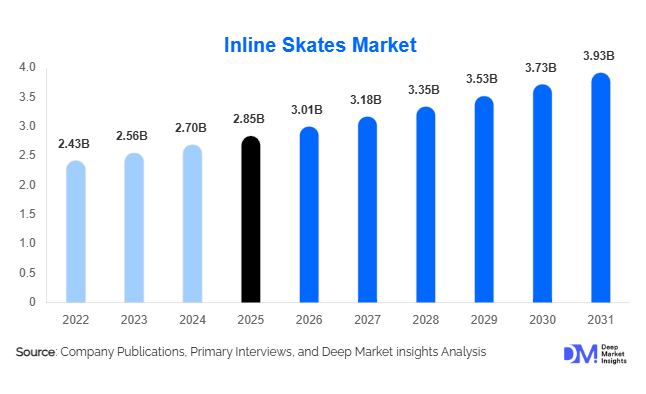
According to Deep Market Insights, the global inline skates market size was valued at USD 2.85 billion in 2025 and is projected to grow from USD 3.01 billion in 2026 to reach USD 3.93 billion by 2031, expanding at a CAGR of 5.5% during the forecast period (2026–2031). The inline skates market growth is primarily driven by rising participation in fitness and recreational sports, increasing consumer preference for outdoor physical activities, growing adoption of sustainable urban mobility solutions, and continuous technological advancements in skate design and performance. The market has evolved beyond traditional recreational skating and now encompasses fitness skating, speed skating, aggressive skating, urban commuting, and inline hockey applications. Growing awareness regarding cardiovascular health, weight management, and active lifestyles has significantly increased the adoption of inline skating among both adults and children. Additionally, manufacturers are introducing lightweight composite materials, advanced wheel technologies, carbon-fiber boots, and customizable performance features that continue to enhance the user experience and attract new consumers globally.
Key Market Insights
- Fitness-oriented inline skating is becoming one of the fastest-growing segments, supported by increasing demand for outdoor exercise alternatives and active lifestyle trends.
- Three-wheel skate configurations are witnessing rapid adoption, particularly among urban commuters and fitness enthusiasts seeking higher speeds and improved maneuverability.
- North America dominates the global inline skates market, supported by strong participation in recreational skating, inline hockey, and premium sports equipment purchases.
- Asia-Pacific is the fastest-growing regional market, driven by increasing sports participation, rising disposable incomes, and expanding youth recreational activities.
- E-commerce channels are reshaping global distribution, enabling consumers to access premium international brands and specialized performance products.
- Product innovation remains a key competitive factor, with manufacturers focusing on lightweight materials, advanced wheel compounds, enhanced safety features, and customizable skate systems.
Inline Skates Market Trends
Growing Adoption of Fitness and Wellness Skating
Inline skating is increasingly being recognized as a highly effective cardiovascular exercise that provides a low-impact alternative to running and other high-stress physical activities. Fitness-conscious consumers are adopting inline skating as part of broader wellness routines due to its ability to improve endurance, muscle strength, balance, and calorie expenditure. Fitness skates featuring enhanced ankle support, shock absorption systems, and larger wheels are gaining popularity among adult users. Social media fitness communities and outdoor recreation influencers are further promoting inline skating as an enjoyable and accessible form of exercise. This trend is particularly evident across North America and Europe, where consumers are actively seeking outdoor fitness activities that combine recreation with health benefits.
Rise of Urban Mobility and Commuter Skating
Urban mobility applications are emerging as an important growth driver within the inline skates market. Increasing traffic congestion, environmental concerns, and investments in bicycle-friendly infrastructure are encouraging consumers to consider alternative transportation methods for short-distance commuting. Modern urban skates are being designed with enhanced stability, braking systems, portability, and comfort to support daily commuting requirements. Cities across Europe and Asia are witnessing increased adoption of inline skating as part of broader micro-mobility ecosystems. Manufacturers are responding by developing specialized commuter-focused products that combine performance with practicality, creating new growth opportunities beyond traditional recreational applications.
Inline Skates Market Drivers
Increasing Participation in Recreational and Outdoor Sports
Growing consumer interest in outdoor recreational activities continues to support inline skates market expansion. Governments, municipalities, and sports organizations are investing in public recreational infrastructure such as skating tracks, parks, cycling lanes, and community sports facilities that indirectly encourage skating participation. Families increasingly view inline skating as an affordable recreational activity that can be enjoyed across age groups. Organized skating events, marathons, and community skating clubs are further contributing to participation growth, particularly in developed markets.
Rising Health Awareness and Active Lifestyle Adoption
The increasing global focus on preventive healthcare and active living has significantly boosted demand for fitness-oriented sports equipment. Inline skating offers a full-body workout while minimizing joint stress, making it attractive to consumers seeking sustainable long-term exercise solutions. Growing obesity concerns, sedentary lifestyles, and increasing healthcare awareness are encouraging consumers to adopt physical activities that combine enjoyment with measurable fitness benefits. This trend continues to support strong demand for fitness and performance inline skates worldwide.
Inline Skates Market Restraints
Seasonal Demand Fluctuations
Inline skating remains highly dependent on favorable weather conditions, particularly in North America and Europe. Rainfall, snow, and extreme temperatures significantly impact participation rates and product usage. As a result, sales often experience seasonal peaks during spring and summer months, creating inventory management and revenue planning challenges for manufacturers and retailers. Weather-related demand volatility remains a key restraint that can affect overall market growth.
Competition from Alternative Fitness and Mobility Solutions
The inline skates market faces increasing competition from bicycles, electric scooters, skateboards, fitness clubs, home workout equipment, and organized sports activities. Consumers have access to a broad range of recreational and fitness alternatives, requiring manufacturers to continuously innovate and differentiate their products. Maintaining consumer engagement while attracting new participants remains a significant challenge, particularly in mature markets where alternative fitness solutions are widely available.
Inline Skates Market Opportunities
Expansion of Urban Mobility Infrastructure
Governments worldwide are investing in sustainable transportation initiatives, including bicycle lanes, pedestrian corridors, and green mobility projects. These infrastructure developments create favorable conditions for inline skating as a practical short-distance transportation option. Manufacturers can capitalize on this trend by introducing commuter-focused skate models featuring enhanced portability, safety systems, and all-weather performance capabilities. Urban mobility applications are expected to create a new revenue stream beyond traditional recreational and fitness markets.
Growth of Youth Sports Development Programs
Many countries are increasing investments in youth sports participation programs, school athletics, and community recreational activities. Inline skating is being introduced into physical education curricula and youth sports initiatives due to its accessibility and relatively low participation costs. Emerging economies such as India, Indonesia, Vietnam, and Brazil present substantial opportunities for manufacturers to develop affordable product lines targeted at younger demographics. Partnerships with schools, sports associations, and community organizations are expected to support long-term market expansion.
Report Scope
| Report Metric | Details |
|---|---|
| Market Size in 2025 | USD 2.85 Billion |
| Market Size in 2026 | USD 3.01 Billion |
| Market Size in 2031 | USD 3.93 Billion |
| CAGR | 5.5% (2026-2031) |
| Base Year for Estimation | 2025 |
| Historical Data | 2022-2024 |
| Forecast Period | 2026-2031 |
| Report Coverage | Revenue Forecast, Competitive Landscape, Supply Chain Disruption, Growth Factors, Environment & Regulatory Landscape and Trends |
| Geographies Covered | North America, Europe, APAC, Middle East and Africa, LATAM |
| Countries Covered | U.S., Canada, U.K., Germany, France, Spain, Italy, Russia, Nordic, Benelux, Rest of Europe, China, Korea, Japan, India, Australia, Singapore, Taiwan, South East Asia, Rest of Asia-Pacific, UAE, Turky, Saudi Arabia, South Africa, Egypt, Nigeria, Rest of MEA, Brazil, Mexico, Argentina, Chile, Colombia, Rest of LATAM |
Explore more data points, trends and opportunities Download Free Sample Report
Product Type Insights
Recreational inline skates dominate the market, accounting for approximately 34% of global revenue in 2025. These products remain popular due to their affordability, ease of use, and broad appeal among casual users and families. Fitness inline skates represent the second-largest category, benefiting from increasing health awareness and outdoor exercise participation. Urban and freestyle skates are gaining traction among younger consumers seeking versatility for city environments and recreational tricks. Aggressive skates continue to attract niche enthusiasts participating in skate parks and extreme sports, while speed skates remain concentrated within competitive sports communities. Inline hockey skates maintain stable demand, particularly in North America and parts of Europe where organized hockey participation remains strong. Off-road and all-terrain skates are emerging as niche growth categories targeting adventure-oriented consumers seeking outdoor experiences beyond traditional paved surfaces.
Application Insights
Fitness and exercise applications account for the largest share of market demand, contributing approximately 31% of total revenue. Consumers increasingly view inline skating as a highly effective cardiovascular workout that combines recreation with measurable health benefits. Recreation and leisure remain core applications, supported by family-oriented activities and community participation. Competitive sports applications, including speed skating and inline hockey, continue generating demand for premium performance products. Urban mobility and commuting applications are growing rapidly as cities expand sustainable transportation infrastructure. Adventure and extreme sports applications, including aggressive skating and freestyle skating, continue attracting younger demographics seeking skill-based recreational activities and social engagement.
Distribution Channel Insights
Online channels dominate the inline skates market, accounting for approximately 41% of global sales in 2025. E-commerce platforms provide consumers with access to a wider range of brands, product comparisons, reviews, and competitive pricing. Direct-to-consumer sales channels have gained significant momentum as manufacturers strengthen their digital presence and improve customer engagement. Sporting goods retailers remain important distribution partners, particularly for entry-level and mid-range products where consumers prefer in-store fitting and product evaluation. Specialty skate shops continue serving enthusiasts and professional users seeking expert guidance, customization services, and premium equipment. Hypermarkets and department stores maintain relevance in value-oriented product categories, particularly in emerging markets.
User Category Insights
Adult men represent the largest user category, accounting for approximately 38% of global market demand due to strong participation in fitness skating, urban mobility, and inline hockey. Adult women are increasingly contributing to market growth as fitness-focused recreational activities gain popularity. Manufacturers are expanding product offerings specifically designed for female users, including lighter frames, enhanced comfort features, and aesthetic customization options. Children and youth remain a critical market segment supported by family recreational activities, youth sports programs, and educational institution participation. Growing investments in youth athletic development across Asia-Pacific and Latin America are expected to support future demand growth within this segment.
Explore more data points, trends and opportunities Download Free Sample Report
Inline Skates Market Segmentations
By Product Type
- Recreational Inline Skates
- Fitness Inline Skates
- Urban/Freestyle Inline Skates
- Aggressive Inline Skates
- Speed Inline Skates
- Inline Hockey Skates
- Off-Road/All-Terrain Inline Skates
- Cross-Training Inline Skates
By Application
- Recreation & Leisure
- Fitness & Exercise
- Competitive Sports
- Urban Mobility & Commuting
- Adventure & Extreme Sports
By Distribution Channel
- Online Marketplaces
- Direct-to-Consumer Brand Websites
- Sporting Goods Retail Stores
- Specialty Skate Shops
- Hypermarkets & Department Stores
By User Category
- Adult Men
- Adult Women
- Children & Youth
By Price Category
- Economy (Below USD 100)
- Mid-Range (USD 100–250)
- Premium (USD 250–500)
- Professional/Elite (Above USD 500)
Regional Insights
North America
North America accounted for approximately 31% of the global inline skates market in 2025, making it the largest regional market. The United States represents nearly 26% of global demand, supported by strong recreational skating participation, a well-established inline hockey culture, and high consumer spending on premium sports equipment. Canada also contributes significantly due to the popularity of hockey-related applications and outdoor recreational activities. The region benefits from advanced retail networks, strong brand presence, and widespread availability of skating infrastructure.
Europe
Europe accounted for approximately 29% of global revenue in 2025 and remains one of the most mature inline skating markets worldwide. Germany, France, Italy, Spain, and the Netherlands are major demand centers. Germany leads regional consumption due to high participation in fitness activities and well-developed cycling and skating infrastructure. The Netherlands benefits from a strong skating culture and increasing urban mobility adoption. European consumers are particularly receptive to premium products, sustainable manufacturing practices, and innovative performance technologies.
Asia-Pacific
Asia-Pacific accounted for approximately 27% of global demand and is projected to be the fastest-growing regional market through 2031. China remains the largest market within the region, benefiting from domestic manufacturing capabilities and growing consumer spending on sports equipment. India, Indonesia, Vietnam, Japan, and South Korea are experiencing increasing participation in recreational sports and youth athletic programs. Rising disposable incomes, expanding middle-class populations, and increasing awareness of fitness and wellness are supporting long-term market growth throughout the region.
Latin America
Latin America accounted for approximately 8% of global revenue in 2025, with Brazil and Mexico representing the largest markets. Growing youth participation in recreational sports, expanding urban populations, and increasing availability of affordable sporting goods are supporting regional demand. Local governments and community organizations are investing in recreational infrastructure, further encouraging skating participation among younger demographics.
Middle East & Africa
The Middle East and Africa represented approximately 5% of global demand in 2025. The United Arab Emirates and Saudi Arabia are emerging as important growth markets due to increasing investments in sports participation, recreational infrastructure, and active lifestyle initiatives. South Africa remains the largest market in Sub-Saharan Africa, supported by growing participation in outdoor recreational activities. Government efforts to promote physical fitness and sports tourism are expected to contribute to future market expansion across the region.
Key Players in the Inline Skates Market
- Rollerblade
- K2 Sports
- Powerslide
- Roces
- Bauer Hockey
- CCM Hockey
- Decathlon
- FR Skates
- Seba Skates
- Flying Eagle
- Micro Skate
- Riedell
- USD Skates
- Adapt Brand
- Edea