Infant Milk Powder Market Size
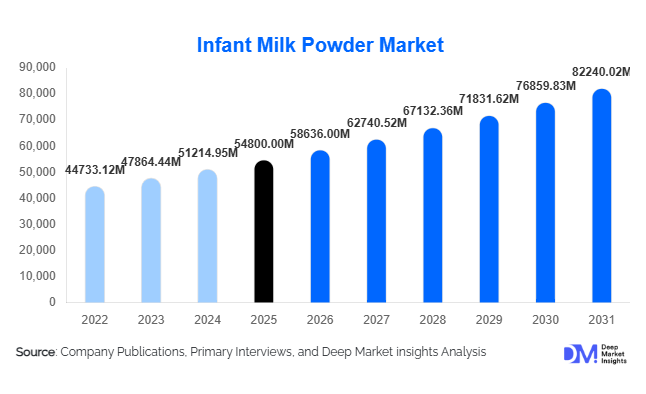
According to Deep Market Insights, the global infant milk powder market size was valued at USD 54,800 million in 2025 and is projected to grow from USD 58,636.00 million in 2026 to reach USD 82,240.02 million by 2031, expanding at a CAGR of 7.0% during the forecast period (2026–2031). The infant milk powder market growth is primarily driven by rising birth rates in emerging economies, increasing participation of women in the workforce, and growing awareness regarding scientifically formulated infant nutrition products. The market is further supported by advancements in product formulations that closely replicate breast milk composition, along with the expansion of organized retail and e-commerce distribution channels globally.
Key Market Insights
- Premium and organic infant milk powder products are gaining traction, driven by rising parental awareness regarding clean-label and chemical-free nutrition.
- Asia-Pacific dominates the global market, supported by large infant populations and strong demand in countries such as China and India.
- Online retail channels are rapidly expanding, offering convenience, subscription models, and direct-to-consumer engagement.
- Specialty formulas are witnessing strong growth, particularly hypoallergenic and lactose-free variants addressing infant health concerns.
- Technological advancements in formulation, including probiotics, prebiotics, and HMOs, are enhancing product differentiation.
- Stringent regulatory frameworks are improving product quality and safety, increasing consumer trust in global brands.
What are the latest trends in the infant milk powder market?
Rising Demand for Organic and Clean-Label Products
Consumers are increasingly prioritizing transparency and safety in infant nutrition, driving demand for organic and clean-label infant milk powder. Manufacturers are focusing on eliminating artificial additives, pesticides, and genetically modified ingredients from formulations. Certified organic infant formulas are gaining popularity in developed markets such as North America and Europe, where consumers are willing to pay premium prices for high-quality products. This trend is also expanding into emerging markets as awareness increases, prompting global players to invest in organic dairy supply chains and sustainable sourcing practices.
Digital Transformation and E-commerce Expansion
The rapid growth of e-commerce platforms is reshaping the distribution landscape of infant milk powder. Online channels provide convenience, product variety, and competitive pricing, making them increasingly popular among urban consumers. Subscription-based models and direct-to-consumer platforms are enhancing customer retention and brand loyalty. Additionally, digital marketing strategies, including influencer endorsements and personalized recommendations, are driving product awareness and adoption among tech-savvy parents.
What are the key drivers in the infant milk powder market?
Increasing Working Women Population
The growing number of working mothers globally is a major driver of infant milk powder demand. As women re-enter the workforce shortly after childbirth, the need for convenient and nutritionally balanced feeding solutions has increased significantly. Infant milk powder provides a reliable alternative to breastfeeding, supporting busy lifestyles while ensuring adequate infant nutrition.
Growing Awareness of Infant Nutrition
Rising awareness regarding the importance of early-life nutrition is encouraging parents to adopt scientifically formulated infant milk powder products. These formulations are enriched with essential nutrients such as DHA, iron, and vitamins, supporting cognitive and physical development. Educational campaigns by healthcare providers and governments are further reinforcing the importance of proper infant nutrition.
What are the restraints for the global market?
High Cost of Premium Products
The high price of premium and specialty infant milk powder products remains a significant barrier, particularly in developing economies. While demand for high-quality formulations is increasing, affordability constraints limit widespread adoption among price-sensitive consumers.
Stringent Regulatory Compliance
The infant milk powder market is subject to strict regulatory standards to ensure product safety and quality. Compliance with varying international regulations increases operational complexity and costs for manufacturers. Product recalls and regulatory scrutiny can also impact brand reputation and market growth.
What are the key opportunities in the infant milk powder industry?
Expansion in Emerging Markets
Emerging economies such as China, India, Indonesia, and Brazil present significant growth opportunities due to rising disposable incomes, urbanization, and improving healthcare infrastructure. Companies entering these markets with localized products and competitive pricing strategies can capture substantial market share.
Technological Innovation in Infant Nutrition
Advancements in nutritional science are enabling the development of advanced infant milk powder formulations incorporating probiotics, prebiotics, and human milk oligosaccharides (HMOs). These innovations enhance product differentiation and cater to evolving consumer preferences for functional nutrition.
Report Scope
| Report Metric | Details |
|---|---|
| Market Size in 2025 | USD 54800.00 Million |
| Market Size in 2026 | USD 58636.00 Million |
| Market Size in 2031 | USD 82240.02 Million |
| CAGR | 7% (2026-2031) |
| Base Year for Estimation | 2025 |
| Historical Data | 2022-2024 |
| Forecast Period | 2026-2031 |
| Report Coverage | Revenue Forecast, Competitive Landscape, Supply Chain Disruption, Growth Factors, Environment & Regulatory Landscape and Trends |
| Geographies Covered | North America, Europe, APAC, Middle East and Africa, LATAM |
| Countries Covered | U.S., Canada, U.K., Germany, France, Spain, Italy, Russia, Nordic, Benelux, Rest of Europe, China, Korea, Japan, India, Australia, Singapore, Taiwan, South East Asia, Rest of Asia-Pacific, UAE, Turky, Saudi Arabia, South Africa, Egypt, Nigeria, Rest of MEA, Brazil, Mexico, Argentina, Chile, Colombia, Rest of LATAM |
Explore more data points, trends and opportunities Download Free Sample Report
Product Type Insights
The global infant milk powder market is characterized by a diversified product landscape that caters to the evolving nutritional requirements of infants at different developmental stages. Among the various product types, standard infant formula designed for infants aged 0–6 months continues to dominate the market, accounting for approximately 42% of the overall share. This segment’s leadership is primarily attributed to its critical role as a primary substitute for breast milk in cases where breastfeeding is not possible due to medical, professional, or lifestyle constraints. The increasing number of working mothers, particularly in urban centers across developing economies, has significantly contributed to the demand for standard infant formula. Moreover, advancements in formulation technologies that closely mimic the nutritional composition of breast milk, including the addition of essential fatty acids such as DHA and ARA, have further strengthened consumer trust and adoption.Follow-on formulas (6–12 months) and growing-up milk (12 months and above) are also gaining substantial traction, driven by rising awareness among parents regarding the importance of stage-specific nutrition. These products are formulated to support the evolving dietary needs of infants and toddlers, including enhanced levels of vitamins, minerals, and proteins that align with their growth patterns. The growing emphasis on early childhood development and cognitive health has encouraged parents to adopt these products as part of a structured nutritional regimen. Additionally, aggressive marketing strategies and educational campaigns by manufacturers have played a pivotal role in promoting these product categories.Specialty infant formulas, including hypoallergenic, lactose-free, anti-reflux, and amino acid-based variants, represent a rapidly expanding segment within the market. The increasing prevalence of food allergies, lactose intolerance, and gastrointestinal disorders among infants has created a strong demand for these specialized solutions. Healthcare professionals often recommend such formulas, thereby reinforcing their credibility and uptake. This segment is particularly prominent in developed regions, where advanced diagnostic capabilities enable early detection of infant health conditions, and parents are more willing to invest in premium healthcare-oriented products. The continued innovation in this category, including the incorporation of probiotics, prebiotics, and immune-boosting ingredients, is expected to further accelerate its growth trajectory.
Ingredient Type Insights
Ingredient composition plays a crucial role in shaping consumer preferences and market dynamics within the infant milk powder industry. Cow milk-based formula remains the leading segment, capturing nearly 65% of the global market share. Its dominance can be attributed to its nutritional profile, which closely resembles that of human breast milk, making it a suitable and widely accepted alternative. Additionally, the abundant availability of cow milk and well-established dairy supply chains contribute to its cost-effectiveness and large-scale production. Continuous improvements in processing techniques, such as protein modification and fortification with essential nutrients, have further enhanced the digestibility and nutritional value of cow milk-based formulas.In contrast, soy-based formulas and hydrolyzed protein formulas are gaining increasing importance as they address specific dietary requirements and medical conditions. Soy-based formulas are particularly suitable for infants with lactose intolerance or those requiring plant-based nutrition, while hydrolyzed protein formulas are designed for infants with cow milk protein allergies. The growing awareness of food sensitivities and the rising incidence of allergic conditions among infants have driven the demand for these alternatives. Furthermore, pediatricians and healthcare providers are increasingly recommending these formulations, thereby supporting their market expansion.The emergence of organic and A2 milk-based formulas represents a significant shift toward premiumization within the market. These products cater to health-conscious consumers who prioritize natural, minimally processed, and easily digestible ingredients. Organic formulas are produced without synthetic pesticides, hormones, or genetically modified organisms, appealing to parents seeking cleaner and safer nutrition for their infants. Similarly, A2 milk-based formulas, derived from cows that produce only A2 beta-casein protein, are perceived to be easier to digest and less likely to cause discomfort. The strong growth potential of these segments is further supported by increasing disposable incomes, especially in urban areas, and a growing inclination toward premium and specialized nutrition products.
Formulation Insights
Formulation remains a key determinant of product accessibility, convenience, and affordability in the infant milk powder market. Powdered infant formula continues to dominate the segment, accounting for approximately 78% of the global share. Its widespread adoption is driven by several factors, including extended shelf life, ease of storage and transportation, and relatively lower cost compared to liquid alternatives. Powdered formulations are particularly well-suited for emerging markets, where infrastructure limitations and cost sensitivity influence purchasing decisions. Additionally, advancements in packaging technologies, such as resealable containers and moisture-resistant materials, have further enhanced product safety and usability.Liquid concentrate and ready-to-feed formulas, while representing a smaller share of the market, are experiencing steady growth, particularly in developed regions. These formulations offer unparalleled convenience, as they require minimal or no preparation, making them ideal for busy parents and caregivers. The rising participation of women in the workforce and the increasing demand for time-saving solutions have significantly contributed to the adoption of these products. However, their higher price point and shorter shelf life compared to powdered formulas limit their penetration in price-sensitive markets. Despite these challenges, ongoing innovations in packaging and distribution are expected to improve their accessibility and drive future growth.
Distribution Channel Insights
The distribution landscape of the infant milk powder market is evolving rapidly, influenced by changing consumer behavior and advancements in retail infrastructure. Supermarkets and hypermarkets remain the dominant distribution channels, accounting for approximately 38% of total sales. These retail formats offer a wide range of products under one roof, enabling consumers to compare brands, prices, and nutritional features conveniently. The trust associated with established retail chains, coupled with in-store promotions and discounts, further drives consumer preference for these outlets.Online retail has emerged as the fastest-growing distribution channel, fueled by increasing internet penetration, smartphone usage, and the growing popularity of e-commerce platforms. The convenience of home delivery, access to a broader product ассортимент, and the availability of detailed product information and customer reviews have significantly enhanced the appeal of online shopping. Subscription-based models and direct-to-consumer strategies adopted by manufacturers are also contributing to the rapid expansion of this channel. The COVID-19 pandemic further accelerated the shift toward online purchasing, a trend that is expected to persist in the long term.Pharmacies and specialty baby stores continue to play a vital role in the distribution ecosystem, particularly for premium and medically recommended products. These channels benefit from the trust of healthcare professionals and provide personalized guidance to consumers, influencing purchasing decisions. The presence of trained staff and the availability of specialized products make these outlets a preferred choice for parents seeking expert advice and high-quality nutrition solutions for their infants.
End-Use Insights
End-use patterns in the infant milk powder market highlight the dominance of household consumption, which accounts for over 85% of total demand. This segment’s growth is driven by the increasing reliance on infant formula as a convenient and reliable source of nutrition. Changing lifestyles, rising disposable incomes, and the growing awareness of infant health and development have significantly influenced purchasing behavior at the household level. Additionally, the increasing number of nuclear families and the lack of traditional caregiving support systems have further reinforced the demand for ready-to-use nutritional solutions.Hospitals and neonatal care units represent an emerging and increasingly important end-use segment, particularly for specialized infant formulas. These institutions play a critical role in the early stages of an infant’s life, especially for premature or medically vulnerable infants who require tailored nutritional support. The growing prevalence of preterm births and neonatal health conditions has led to increased demand for clinically approved formulas, thereby driving growth in this segment. Collaboration between manufacturers and healthcare providers is also enhancing product development and adoption.Childcare centers are witnessing rising demand for infant milk powder, supported by the expansion of organized daycare services in urban areas. As more parents return to work shortly after childbirth, the reliance on professional childcare services has increased, creating a steady demand for convenient and nutritionally balanced feeding options. This trend is particularly evident in developed economies and rapidly urbanizing regions, where dual-income households are becoming the norm.
Explore more data points, trends and opportunities Download Free Sample Report
Infant Milk Powder Market Segmentations
By Product Type
- Standard Infant Formula
- Follow-on Formula
- Growing-up Milk
- Specialty Formula
By Ingredient Type
- Cow Milk-based Formula
- Soy Protein-based Formula
- Hydrolyzed Protein Formula
- Organic Infant Milk Powder
- A2 Milk-based Formula
By Distribution Channel
- Supermarkets & Hypermarkets
- Pharmacies & Drug Stores
- Online Retail
- Specialty Baby Stores
- Convenience Stores
Regional Insights
Asia-Pacific
Asia-Pacific continues to dominate the global infant milk powder market, accounting for approximately 42% of the total share in 2025. The region’s leadership is driven by a combination of demographic, economic, and cultural factors. China remains the largest market within the region, supported by strong demand for premium and imported products. Consumer trust in international brands, reinforced by past food safety concerns, has significantly influenced purchasing behavior. Additionally, the relaxation of the one-child policy and subsequent population growth have contributed to increased demand for infant nutrition products.India represents one of the fastest-growing markets in the region, driven by high birth rates, rapid urbanization, and increasing awareness of infant nutrition. The expanding middle-class population and rising disposable incomes are enabling greater access to branded and premium products. Furthermore, government initiatives aimed at improving maternal and child health are indirectly supporting market growth. In Southeast Asia, countries such as Indonesia and Vietnam are experiencing robust growth due to improving economic conditions, rising female workforce participation, and the gradual shift toward modern retail channels. The increasing penetration of e-commerce platforms and the growing influence of digital marketing are also playing a significant role in shaping consumer preferences across the region.
North America
North America accounts for approximately 20% of the global infant milk powder market, with the United States serving as the primary growth engine. The region benefits from high disposable income levels, advanced healthcare infrastructure, and a strong emphasis on infant health and nutrition. One of the key drivers of growth in North America is the increasing demand for premium, organic, and specialty formulas, including non-GMO and clean-label products. Consumers in the region are highly informed and place significant importance on product quality, safety, and transparency.The presence of well-established distribution networks, including large retail chains and sophisticated e-commerce platforms, ensures widespread product availability. Additionally, stringent regulatory standards and quality control measures enhance consumer confidence in infant nutrition products. The growing trend of delayed parenthood and higher spending capacity among parents are further contributing to the demand for high-quality and specialized infant formulas.
Europe
Europe holds approximately 25% of the global market share and is characterized by a strong dairy industry and stringent regulatory framework. Countries such as Germany, France, and the Netherlands are not only major consumers but also key exporters of infant milk powder products. The region’s well-established infrastructure and advanced manufacturing capabilities support the production of high-quality formulas that meet strict safety and nutritional standards.One of the primary drivers of growth in Europe is the increasing demand for organic and specialty formulas. European consumers are highly conscious of product ingredients and environmental sustainability, leading to a strong preference for organic and ethically sourced products. Additionally, government regulations promoting breastfeeding while ensuring the availability of safe alternatives create a balanced market environment. The aging population and declining birth rates in certain countries pose challenges; however, the focus on premiumization and export opportunities continues to support market growth.
Middle East & Africa
The Middle East and Africa region is emerging as a promising market for infant milk powder, driven by improving economic conditions and expanding healthcare infrastructure. Countries such as Saudi Arabia, the United Arab Emirates, and South Africa are witnessing increasing demand for infant nutrition products, supported by rising disposable incomes and urbanization. The growing awareness of infant health and nutrition, coupled with the influence of Western lifestyles, is shaping consumer preferences in the region.Another key driver of growth is the increasing participation of women in the workforce, which has led to a higher reliance on convenient feeding solutions. The expansion of modern retail formats and the growing presence of international brands are further enhancing product accessibility. Additionally, government initiatives aimed at improving maternal and child health outcomes are contributing to the adoption of infant milk powder products across the region.
Latin America
Latin America accounts for approximately 8–10% of the global infant milk powder market, with Brazil and Mexico serving as the primary contributors. The region’s growth is driven by a combination of demographic trends, economic development, and increasing awareness of infant nutrition. The expanding middle-class population and rising disposable incomes are enabling greater access to packaged and branded infant nutrition products.The gradual expansion of organized retail channels, including supermarkets, hypermarkets, and e-commerce platforms, is improving product availability and consumer reach. Additionally, government initiatives aimed at promoting child health and nutrition are supporting market growth. Cultural shifts toward modern lifestyles and the increasing adoption of convenient feeding solutions are further driving demand for infant milk powder in the region. Despite economic volatility in certain countries, the long-term growth prospects remain positive, supported by favorable demographic trends and increasing consumer awareness.
Key Players in the Infant Milk Powder Market
- Nestlé S.A.
- Danone S.A.
- Abbott Laboratories
- Reckitt Benckiser Group plc
- FrieslandCampina
- Arla Foods
- Yili Group
- China Feihe Limited
- Fonterra Co-operative Group
- HiPP GmbH & Co. Vertrieb KG
- Bellamy’s Organic
- Perrigo Company plc
- Meiji Holdings Co., Ltd.
- Beingmate Baby & Child Food Co.
- Kraft Heinz Company