Industrial Enzymes Market Size
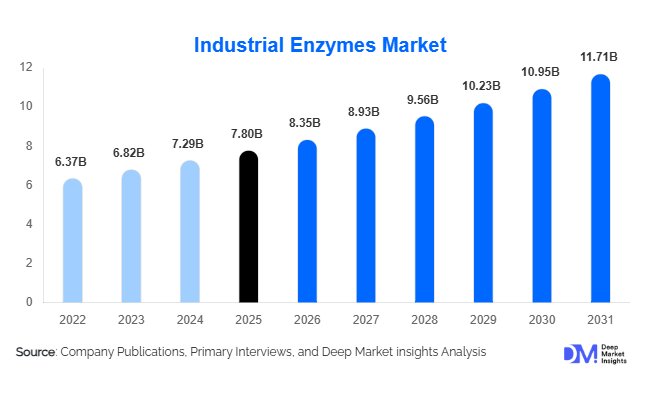
According to Deep Market Insights, the global industrial enzymes market size was valued at USD 7.8 billion in 2025 and is projected to grow from USD 8.35 billion in 2026 to reach USD 11.71 billion by 2031, expanding at a CAGR of 7% during the forecast period (2026–2031). The industrial enzymes market growth is primarily driven by the rising adoption of sustainable industrial processes, increasing demand from food & beverage and biofuel sectors, and technological advancements in enzyme engineering and recombinant technologies.
Key Market Insights
- Microorganism-derived enzymes dominate the market, accounting for 85% of global revenue, due to scalability, cost efficiency, and adaptability across multiple industrial processes.
- Carbohydrases are the leading enzyme type, representing 48% of the total market, owing to their extensive application in food processing, brewing, and biofuel production.
- Food & beverages remain the largest application segment, capturing 23% of the market share, driven by demand for enhanced product quality, shelf-life, and efficiency in processing.
- North America holds the largest regional share (36%), supported by advanced industrial adoption, high R&D investment, and stringent environmental regulations encouraging enzyme utilization.
- Asia Pacific is the fastest-growing region, propelled by industrial modernization, growing food processing and textile industries, and supportive biotechnology policies in China, India, and Southeast Asia.
- Technological innovations, including AI-assisted enzyme design, immobilized enzymes, and recombinant technologies, are reshaping enzyme development and performance across sectors.
What are the latest trends in the industrial enzymes market?
Green and Sustainable Industrial Processes
Industries are increasingly adopting enzymes to replace harsh chemical catalysts, reducing energy consumption, chemical waste, and environmental impact. This trend is particularly pronounced in the food & beverage, detergent, and biofuel sectors, where sustainable processing is now a regulatory and consumer-driven requirement. Enzyme use allows manufacturers to achieve cleaner operations while enhancing process efficiency, making green industrial applications a critical growth driver.
Technological Advancements in Enzyme Engineering
Recombinant DNA technology, protein engineering, and AI-driven enzyme design are enabling the creation of enzymes with enhanced stability, specificity, and operational efficiency. Tailored enzyme formulations now allow industrial processes to operate under extreme pH, temperature, or pressure conditions, opening new application areas. Immobilized enzymes and enzyme blends are increasingly adopted for continuous processes in biofuel, pharmaceutical, and textile manufacturing.
Expansion into Emerging Industrial Bioeconomies
Emerging markets in the Asia Pacific, Latin America, and Africa are experiencing rising demand for enzyme-based industrial solutions. Governments and private enterprises are investing in biotechnology infrastructure to support eco-friendly manufacturing. Regulatory incentives and industrial modernization programs are creating opportunities for enzyme manufacturers to establish local production hubs and supply customized solutions to meet diverse industrial needs.
What are the key drivers in the industrial enzymes market?
Growing Demand from End-Use Industries
Industrial enzymes are integral to food & beverage, detergents, biofuels, animal feed, and textiles. Their ability to improve yields, reduce energy consumption, and enhance product quality makes them indispensable. For example, carbohydrases are widely used in starch hydrolysis for bioethanol production, while proteases improve detergent performance, creating consistent demand across high-volume industries.
Regulatory and Environmental Compliance
Strict environmental regulations globally encourage industries to adopt enzyme-based processes that minimize chemical use and effluent toxicity. Enzyme adoption helps manufacturers comply with eco-label certifications, wastewater treatment standards, and carbon emission reduction targets, particularly in North America and Europe, driving long-term market growth.
Innovation in Enzyme Technologies
Advancements such as recombinant enzymes, immobilization, and custom enzyme cocktails are enhancing performance under extreme conditions and broadening application scope. These innovations reduce production costs, improve operational efficiency, and enable industrial processes previously constrained by enzyme limitations, facilitating rapid adoption across multiple sectors.
What are the restraints for the global market?
High Production and Operational Costs
Achieving high purity, activity, and stability in enzyme production requires substantial investment in fermentation, downstream processing, and quality control. These costs limit small-scale producers and affect pricing competitiveness in low-margin industries, constraining broader adoption in regions with price-sensitive end users.
Regulatory Uncertainty in Emerging Markets
Inconsistent or underdeveloped regulatory frameworks in developing countries create uncertainty for novel enzyme product approvals. This slows commercialization, limits market penetration, and deters investment, particularly in bio-processing and environmental applications.
What are the key opportunities in the industrial enzymes industry?
Expansion into Emerging Economies
Rising industrialization in the Asia Pacific, Latin America, and Africa presents significant growth potential. Enzyme manufacturers can leverage local demand by establishing regional production facilities, forming partnerships with industrial players, and customizing enzyme formulations for specific market needs.
AI and Synthetic Biology Integration
Technological integration in enzyme design and optimization enables faster development of highly efficient and stable enzymes. AI-driven modeling and synthetic biology allow manufacturers to create tailored solutions for complex industrial applications, opening avenues in pharmaceuticals, biofuels, and high-value chemical production.
Policy Support for Sustainable Manufacturing
Global initiatives promoting green manufacturing, circular economy models, and carbon reduction are driving enzyme adoption. Governments are providing incentives for sustainable production processes, giving early adopters a competitive advantage and encouraging long-term industry growth.
Report Scope
| Report Metric | Details |
|---|---|
| Market Size in 2025 | USD 7.8 Billion |
| Market Size in 2026 | USD 8.35 Billion |
| Market Size in 2031 | USD 11.71 Billion |
| CAGR | 7% (2026-2031) |
| Base Year for Estimation | 2025 |
| Historical Data | 2022-2024 |
| Forecast Period | 2026-2031 |
| Report Coverage | Revenue Forecast, Competitive Landscape, Supply Chain Disruption, Growth Factors, Environment & Regulatory Landscape and Trends |
| Geographies Covered | North America, Europe, APAC, Middle East and Africa, LATAM |
| Countries Covered | U.S., Canada, U.K., Germany, France, Spain, Italy, Russia, Nordic, Benelux, Rest of Europe, China, Korea, Japan, India, Australia, Singapore, Taiwan, South East Asia, Rest of Asia-Pacific, UAE, Turky, Saudi Arabia, South Africa, Egypt, Nigeria, Rest of MEA, Brazil, Mexico, Argentina, Chile, Colombia, Rest of LATAM |
Explore more data points, trends and opportunities Download Free Sample Report
Product Type Insights
Carbohydrases dominate the industrial enzymes market, accounting for nearly half of total global revenue, driven by their indispensable role in high-volume industries such as biofuel production, baking, brewing, starch processing, and sugar refinement. The primary driver for carbohydrase leadership is the global expansion of bioethanol production and processed food manufacturing. In biofuel production, amylases and cellulases enable efficient starch and biomass hydrolysis, improving fermentation yields and reducing energy consumption. In the food industry, carbohydrases enhance dough handling, improve texture, increase extraction efficiency, and extend shelf life, making them critical for large-scale commercial processing.
Proteases represent the second-largest enzyme category, widely used in detergents due to their superior protein stain removal capability at lower washing temperatures. The shift toward energy-efficient and eco-friendly laundry solutions has strengthened protease demand globally. Lipases are gaining importance across food processing, personal care, dairy modification, and biodiesel production, supported by the growth of specialty fats and renewable fuel markets. Additionally, recombinant and immobilized enzymes are the fastest-growing technology-driven subsegments. Their enhanced thermal stability, longer operational life, and ability to function in continuous processing environments make them increasingly attractive for pharmaceuticals, fine chemicals, and bioenergy applications. The driver behind this growth is the rising demand for high-performance, process-specific enzyme solutions that reduce downtime and improve cost efficiency in industrial manufacturing.
Application Insights
Food & beverages remain the largest application segment, contributing approximately 23% of the global market revenue. The leading driver for this dominance is the continuous global expansion of processed food consumption, particularly in Asia-Pacific and Latin America. Enzymes improve yield, texture, clarity, fermentation efficiency, and nutritional profiles, making them integral to modern food production. Clean-label product trends and demand for natural processing aids further reinforce enzyme adoption. Detergents represent the second-largest application, driven by increasing consumer preference for low-temperature washing and phosphate-free formulations. Enzymes such as proteases, amylases, and lipases enhance stain removal while reducing energy use, aligning with sustainability mandates and consumer energy-saving preferences.
Biofuels constitute one of the fastest-growing application segments, supported by global renewable energy targets and carbon reduction commitments. Enzymes are critical for converting lignocellulosic biomass into fermentable sugars, improving bioethanol and biodiesel yield efficiency. Emerging applications in wastewater treatment, textile processing, pharmaceuticals, and environmental remediation are expanding the addressable market. Textile manufacturers increasingly adopt enzymes for eco-friendly fabric processing, while wastewater facilities use enzymatic solutions to reduce sludge and chemical discharge. Specialty uses in cosmetics and biotech processing further diversify growth avenues.
Distribution Channel Insights
Direct sales to large industrial customers dominate the distribution landscape, as enzyme formulations often require technical customization, application-specific support, and long-term supply agreements. Major food processors, detergent manufacturers, and biofuel producers typically enter into strategic supply contracts with enzyme manufacturers to ensure quality consistency and regulatory compliance. B2B distribution partnerships complement direct sales by extending reach into mid-sized and regional industrial players. These distributors provide localized warehousing, technical service, and formulation assistance, particularly in emerging economies where industrial infrastructure is still developing.
Digital procurement platforms and online ordering systems are gradually expanding for standardized enzyme products, improving transparency and order efficiency. OEM collaborations and licensing agreements are also gaining traction, particularly in Asia-Pacific and Latin America, enabling multinational enzyme producers to penetrate regional markets through local manufacturing and technology transfer models.
End-Use Industry Insights
The food & beverage industry remains the largest end-use sector, supported by growing global demand for packaged foods, bakery products, dairy processing, and brewing. Urbanization, rising disposable incomes, and expanding retail infrastructure in emerging economies continue to drive volume growth. Biofuel production is the fastest-growing end-use industry, fueled by renewable energy mandates, decarbonization targets, and government subsidies in North America, Europe, and Brazil. The scaling of second-generation biofuels further strengthens enzyme demand, particularly for advanced cellulases.
The detergent and household care industry continues to expand steadily, supported by low-temperature washing trends, premium detergent formulations, and sustainability-driven consumer behavior. Emerging end-use applications include environmental remediation, wastewater management, cosmetic bio-processing, and pharmaceutical intermediate production. Increasing industrial wastewater regulations and clean manufacturing mandates are creating new demand pockets, particularly in developing economies, and upgrading environmental infrastructure.
Explore more data points, trends and opportunities Download Free Sample Report
Industrial Enzymes Market Segmentations
By Product Type
- Carbohydrases
- Proteases
- Lipases
- Polymerases & Nucleases
- Specialty Enzymes
By Source
- Microorganism-Based Enzymes
- Plant-Based Enzymes
- Animal-Based Enzymes
By Application
- Food & Beverages
- Detergents & Household Care
- Biofuels
- Animal Feed
- Textiles & Leather
- Pulp & Paper
- Wastewater Treatment
- Pharmaceuticals & Biotechnology
- Personal Care & Cosmetics
By End-Use Industry
- Food Processing Industry
- Bioenergy Industry
- Detergent & Household Products Industry
- Textile & Leather Manufacturing
- Feed & Livestock Industry
- Paper & Packaging Industry
- Environmental Services & Waste Management
- Biotechnology & Pharmaceutical Industry
Regional Insights
North America
North America remains the largest regional market, led by the United States. The primary driver of regional growth is the strong integration of enzymes into food processing, detergent manufacturing, and biofuel production. The U.S. bioethanol industry, supported by renewable fuel standards and carbon reduction policies, significantly boosts enzyme consumption. Additionally, stringent environmental regulations encourage the replacement of chemical catalysts with enzyme-based alternatives. High R&D investment, presence of global enzyme leaders, and advanced biotechnology infrastructure further strengthen the region’s dominance. Canada contributes through food processing and renewable energy initiatives, while Mexico supports growth through expanding beverage and processed food industries.
Europe
Europe’s market growth is driven primarily by sustainability-focused regulations and circular economy initiatives. Countries such as Germany, France, the U.K., and Denmark emphasize eco-friendly industrial processing, driving enzyme adoption in textiles, pulp & paper, detergents, and biofuels. The European Green Deal and carbon neutrality targets have accelerated enzyme integration into industrial value chains. Strong biotechnology research networks and established industrial enzyme manufacturers also reinforce regional innovation capacity. Eastern Europe is emerging as a secondary growth area due to expanding food processing infrastructure.
Asia-Pacific
Asia-Pacific is the fastest-growing regional market, driven by rapid industrialization, expanding processed food consumption, and textile manufacturing dominance. China leads demand due to large-scale food processing, biofuel initiatives, and domestic enzyme production capacity. India’s growth is fueled by expanding dairy processing, detergent production, and biotechnology sector development. Southeast Asian nations are witnessing increased enzyme usage in food exports and aquaculture feed production. Government biotechnology policies, lower manufacturing costs, and growing domestic demand position APAC as the key future growth engine of the industrial enzymes market.
Latin America
Latin America demonstrates steady growth, led by Brazil, Argentina, and Mexico. Brazil’s strong bioethanol industry serves as the principal regional driver, supported by renewable energy mandates and sugarcane processing. Expanding processed food exports and the modernization of agricultural value chains further increase enzyme demand. Government incentives for bio-based industries and foreign investment in industrial modernization contribute to long-term regional potential.
Middle East & Africa
The Middle East & Africa region shows emerging but promising growth. In Africa, enzyme demand is supported by expanding textile manufacturing, food processing, and wastewater treatment infrastructure. South Africa leads regional adoption due to its relatively advanced industrial base. In the Middle East, high-income economies such as the UAE and Saudi Arabia are driving demand through industrial diversification strategies and investments in food security and manufacturing. Increasing regulatory attention to water reuse and industrial sustainability is expected to further stimulate enzyme adoption in wastewater treatment and detergents.
Key Players in the Industrial Enzymes Market
- Novozymes A/S
- BASF SE
- DSM-Firmenich
- Associated British Foods plc (AB Enzymes)
- DuPont (Industrial Biosciences)
- IFF (International Flavors & Fragrances)
- Amano Enzyme Inc.
- Advanced Enzyme Technologies Ltd.
- Kemin Industries
- Lesaffre Group
- Novus International
- Adisseo
- Croda International plc
- Chr. Hansen Holding A/S
- Enzyme Development Corporation