Hydrolyzed Collagen Peptides Market Size
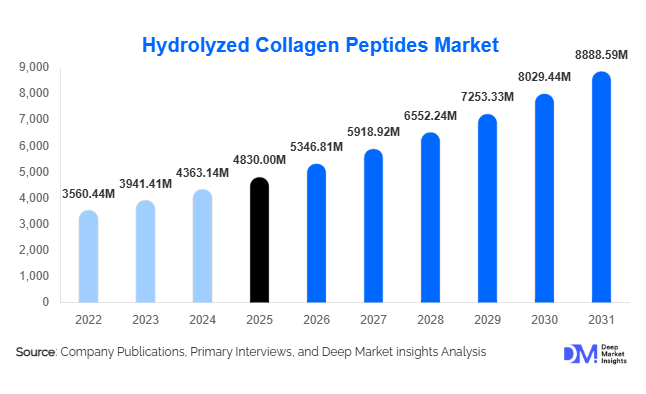
According to Deep Market Insights,the global hydrolyzed collagen peptides market size was valued at USD 4,830 million in 2025 and is projected to grow from USD 5,346.81 million in 2026 to reach USD 8,888.59 million by 2031, expanding at a CAGR of 10.7% during the forecast period (2026–2031). The hydrolyzed collagen peptides market growth is primarily driven by rising consumer demand for functional nutrition, increasing adoption of beauty-from-within supplements, and expanding applications across nutraceuticals, food & beverages, pharmaceuticals, and personal care formulations.
Key Market Insights
- Nutraceuticals and dietary supplements dominate global demand, accounting for nearly 46% of the 2025 market, driven by skin, joint, and bone health applications.
- Bovine collagen peptides remain the leading source, contributing approximately 42% of global market share due to cost efficiency and scalable supply chains.
- Powdered collagen peptides account for nearly 78% of total volume, supported by longer shelf life and ease of formulation in supplements and beverages.
- North America leads the global market with around 34% share in 2025, supported by strong sports nutrition and anti-aging product adoption.
- Asia-Pacific is the fastest-growing region, projected to expand at over 12% CAGR through 2031, led by China, Japan, and India.
- Top five manufacturers control approximately 48% of global supply, reflecting moderate consolidation and strong brand-driven B2B ingredient dominance.
What are the latest trends in the hydrolyzed collagen peptides market?
Rise of Beauty-from-Within and Functional Beverages
Consumers are increasingly turning toward ingestible beauty solutions, accelerating demand for collagen-enriched beverages, gummies, and flavored powders. Functional drinks such as collagen waters, protein coffees, and fortified dairy alternatives are rapidly expanding shelf space in North America and Asia-Pacific. Manufacturers are leveraging hydrolyzed collagen peptides’ high solubility, neutral taste, and bioavailability to incorporate them into ready-to-drink formats. Social media influence, dermatological endorsements, and rising aesthetic awareness are strengthening this trend, especially among consumers aged 25–45 years.
Shift Toward Marine and Sustainable Collagen Sources
Marine collagen peptides are gaining traction due to religious acceptability, improved absorption perception, and sustainability positioning. Brands are promoting traceable fish-skin sourcing and upcycled marine by-products to align with ESG expectations. Certifications such as halal, kosher, and sustainably sourced labeling are becoming competitive differentiators, particularly in the Middle East and Southeast Asia. Investment in enzymatic hydrolysis and filtration technologies is improving peptide purity while reducing environmental impact.
What are the key drivers in the hydrolyzed collagen peptides market?
Aging Global Population and Joint Health Demand
The expanding elderly population is a major driver of collagen supplementation, particularly for osteoarthritis and bone density management. Collagen peptides are widely marketed for improving cartilage strength and joint mobility. Growing healthcare expenditure and preventive health awareness are strengthening repeat consumption patterns in developed economies.
Sports Nutrition and Active Lifestyle Expansion
The global sports nutrition industry, valued above USD 45 billion, is integrating collagen peptides into performance and recovery supplements. Collagen supports connective tissue repair and muscle recovery, making it attractive for athletes and fitness enthusiasts. Rising gym memberships and wellness culture are directly fueling ingredient demand.
Clean Label and Natural Protein Preference
Hydrolyzed collagen peptides are perceived as natural, minimally processed proteins, aligning with clean-label trends. Food manufacturers increasingly use collagen to boost protein claims without altering taste or texture, especially in bars, dairy products, and snacks.
What are the restraints for the global market?
Raw Material Price Volatility
Collagen production relies on bovine hides and fish skins, by-products of the meat and seafood industries. Fluctuations in slaughter volumes, disease outbreaks, and export regulations impact supply consistency and pricing stability.
Regulatory and Claims Approval Challenges
Strict regulatory frameworks, particularly in Europe, require scientific substantiation of health claims. This increases R&D expenses and slows product commercialization, particularly for new functional formulations.
What are the key opportunities in the hydrolyzed collagen peptides industry?
Personalized Nutrition Platforms
AI-driven health assessments and nutrigenomic testing are creating opportunities for customized collagen blends targeting skin aging, joint risk, and athletic recovery. Subscription-based direct-to-consumer models allow higher margins and recurring revenue streams.
Emerging Market Expansion
Rising disposable incomes in India, Brazil, Indonesia, and Vietnam are creating untapped demand for mid-priced collagen supplements. Localization strategies and halal-certified offerings can significantly expand regional penetration.
Pharmaceutical and Regenerative Medicine Applications
Collagen peptides are being studied for wound care, tissue engineering, and orthopedic solutions. As regenerative medicine advances, pharmaceutical-grade collagen applications may unlock higher-value revenue streams.
Report Scope
| Report Metric | Details |
|---|---|
| Market Size in 2025 | USD 4830 Million |
| Market Size in 2026 | USD 5346.81 Million |
| Market Size in 2031 | USD 8888.59 Million |
| CAGR | 10.7% (2026-2031) |
| Base Year for Estimation | 2025 |
| Historical Data | 2022-2024 |
| Forecast Period | 2026-2031 |
| Report Coverage | Revenue Forecast, Competitive Landscape, Supply Chain Disruption, Growth Factors, Environment & Regulatory Landscape and Trends |
| Geographies Covered | North America, Europe, APAC, Middle East and Africa, LATAM |
| Countries Covered | U.S., Canada, U.K., Germany, France, Spain, Italy, Russia, Nordic, Benelux, Rest of Europe, China, Korea, Japan, India, Australia, Singapore, Taiwan, South East Asia, Rest of Asia-Pacific, UAE, Turky, Saudi Arabia, South Africa, Egypt, Nigeria, Rest of MEA, Brazil, Mexico, Argentina, Chile, Colombia, Rest of LATAM |
Explore more data points, trends and opportunities Download Free Sample Report
Source Insights
Bovine collagen peptides lead the global collagen peptides market, accounting for approximately 42% of total revenue share in 2025. The dominance of this segment is primarily driven by abundant availability of bovine raw materials, well-established rendering and hydrolysis infrastructure, and cost-efficient large-scale processing capabilities across major producing countries such as the United States, Brazil, and Germany. The presence of mature supply chains, strong quality standardization, and high protein yield efficiency further strengthens the segment’s leadership. Bovine collagen is widely preferred in nutraceutical, food, and pharmaceutical formulations due to its proven efficacy in joint health, skin elasticity improvement, and muscle recovery support, making it the leading source segment by both volume and value.
Marine collagen peptides represent the fastest-growing source segment, expanding at a CAGR of over 12% during the forecast period. Growth is supported by increasing consumer preference for sustainably sourced and pescatarian-friendly ingredients. Marine collagen’s superior bioavailability, smaller peptide size, and premium positioning in beauty-from-within products significantly contribute to its rising adoption. Growing environmental awareness, improved traceability in fisheries, and rising demand for clean-label ingredients further accelerate the shift toward marine-derived collagen, particularly across Asia-Pacific and Europe.
Application Insights
Nutraceuticals and dietary supplements account for nearly 46% of the global market value in 2025, making this the largest application segment. The segment’s leadership is driven by strong consumer demand for preventive healthcare solutions, growing awareness regarding skin aging, bone density management, and joint mobility, and increasing adoption of collagen powders, capsules, and ready-to-drink formulations. The global shift toward proactive wellness and functional nutrition significantly strengthens collagen’s integration into daily supplementation routines. Rising sports nutrition consumption and the popularity of ingestible beauty supplements further reinforce the segment’s dominance.
The food and beverage segment follows closely, supported by rapid expansion of collagen-fortified snacks, protein bars, dairy alternatives, and functional beverages. Manufacturers are increasingly incorporating collagen peptides into everyday food products to meet consumer demand for functional enrichment without altering taste or texture. The neutral sensory profile and high solubility of hydrolyzed collagen make it particularly suitable for beverage fortification, accelerating product innovation across global retail shelves.
Distribution Channel Insights
B2B bulk ingredient sales dominate the global collagen peptides market, contributing nearly 65% of overall revenue in 2025. This leadership position is driven by large-scale procurement by dietary supplement manufacturers, food processors, cosmetic brands, and pharmaceutical companies that require consistent supply volumes and standardized peptide specifications. Long-term supply agreements, vertically integrated processing facilities, and global export networks further reinforce the strength of this channel.
Online B2C retail represents the fastest-growing distribution channel, fueled by direct-to-consumer brand strategies, subscription-based collagen powder programs, influencer marketing, and increasing digital health awareness. E-commerce platforms allow brands to educate consumers about collagen benefits while offering personalized product bundles, thereby expanding global consumer reach and accelerating market penetration, particularly in emerging economies.
End-Use Industry Insights
Dietary supplement manufacturing leads end-use demand with approximately 44% share in 2025. The expansion of the global nutraceutical industry, valued at over USD 400 billion, provides a stable procurement base for collagen peptide suppliers. Collagen’s clinically supported role in improving skin hydration, reducing wrinkles, supporting cartilage regeneration, and enhancing post-exercise recovery continues to drive consistent integration into supplement portfolios.
Cosmetic manufacturers are increasingly incorporating ingestible collagen formats under the beauty-from-within category, bridging the gap between topical and nutritional skincare solutions. Meanwhile, pharmaceutical applications are gaining traction, particularly in wound healing formulations, orthopedic recovery products, tissue engineering scaffolds, and regenerative medicine research. The growing clinical validation of collagen-based biomaterials supports its gradual expansion into advanced therapeutic segments.
Explore more data points, trends and opportunities Download Free Sample Report
Hydrolyzed Collagen Peptides Market Segmentations
By Source
- Bovine Collagen Peptides
- Porcine Collagen Peptides
- Marine (Fish) Collagen Peptides
- Poultry Collagen Peptides
- Other Specialty Sources
By Product Form
- Powdered Collagen Peptides
- Liquid Collagen Peptides
By Application
- Nutraceuticals & Dietary Supplements
- Food & Beverages
- Pharmaceuticals
- Personal Care & Cosmetics
- Animal Nutrition
By Distribution Channel
- B2B Bulk Ingredient Supply
- Online Retail
- Pharmacies & Drug Stores
- Specialty Health Stores
- Supermarkets/Hypermarkets
By End-Use Industry
- Dietary Supplement Manufacturing
- Food Processing Industry
- Pharmaceutical Manufacturing
- Cosmetic & Personal Care Manufacturing
- Animal Feed Industry
Regional Insights
North America
North America accounts for approximately 34% of the global collagen peptides market share in 2025, with the United States representing over 80% of regional demand. Market growth is driven by high dietary supplement penetration, strong sports nutrition consumption, and widespread awareness of anti-aging and joint health products. The presence of leading nutraceutical brands, advanced protein processing facilities, and well-established regulatory frameworks further supports market stability. Increasing adoption of collagen-infused functional beverages and ready-to-mix powders across fitness-conscious consumers accelerates volume demand. Canada demonstrates steady growth supported by expanding wellness trends, clean-label preferences, and rising online supplement purchases.
Europe
Europe holds approximately 27% of the global market, with Germany, France, Italy, and the United Kingdom serving as key consumption hubs. Growth in the region is supported by strong nutraceutical infrastructure, stringent quality regulations that enhance consumer confidence, and rising demand for premium marine collagen products. Germany represents the largest European importer and processor, benefiting from advanced ingredient manufacturing capabilities and export-oriented production. Increasing aging populations across Western Europe and growing beauty supplement adoption further contribute to sustained regional expansion.
Asia-Pacific
Asia-Pacific is the fastest-growing regional market, expanding at a CAGR exceeding 12% during the forecast period. China and Japan lead regional consumption, particularly for marine collagen peptides widely used in beauty and functional beverage applications. Rising disposable incomes, urbanization, and strong cultural emphasis on skin health significantly support collagen adoption. India is emerging rapidly due to expanding middle-class spending, improving awareness of preventive healthcare, and accelerated e-commerce penetration that enhances direct-to-consumer supplement sales. Additionally, expanding aquaculture industries across the region strengthen marine collagen raw material availability.
Latin America
Brazil dominates the Latin American collagen peptides market, supported by abundant bovine raw material supply and a strong export-oriented meat processing industry that ensures cost-effective collagen extraction. Growing domestic supplement consumption, improving retail distribution, and increasing investment in functional food manufacturing drive market expansion. Argentina and Mexico are gradually increasing collagen supplement adoption due to rising health awareness and expanding pharmacy retail networks.
Middle East & Africa
The Middle East & Africa region demonstrates steady growth, with the United Arab Emirates and Saudi Arabia serving as major demand centers for halal-certified collagen supplements. Rising disposable incomes, expanding premium wellness retail, and increasing interest in anti-aging and beauty supplements support regional growth. South Africa contributes moderate expansion through the development of nutraceutical retail infrastructure and growing consumer awareness regarding joint and bone health solutions. Import-driven supply chains and rising regulatory standardization are expected to further strengthen market opportunities across the region.
Key Players in the Hydrolyzed Collagen Peptides Market
- Rousselot
- Gelita AG
- Nitta Gelatin Inc.
- PB Leiner
- Tessenderlo Group
- Weishardt Group
- PB Leiner
- Tessenderlo Group
- Weishardt Group
- Darling Ingredients Inc.
- Lapi Gelatine
- Gelnex
- Italgelatine
- Trobas Gelatine
- Holista Colltech
- Juncà Gelatines
- Nippi Inc.
- Baotou Dongbao Bio-Tech