Global Hotel And Resort Coffee Market Size
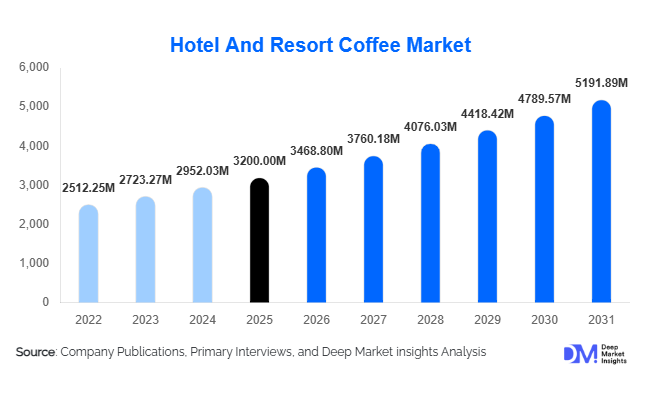
According to Deep Market Insights, the global hotel and resort coffee market size was valued at USD 3,200 million in 2026 and is projected to grow from USD 3,468.80 million in 2026 to reach USD 5,191.89 million by 2031, expanding at a CAGR of 8.4% during the forecast period (2026–2031). The market growth is primarily driven by the rising premiumization of hospitality services, increasing global tourism flows, and growing demand for café-quality specialty coffee experiences within hotels and resorts worldwide.
The market is undergoing a structural transformation where coffee is no longer a basic amenity but a core component of guest experience design. Luxury hotels, boutique resorts, and business chains are increasingly investing in high-end espresso systems, premium Arabica blends, and customized coffee menus to differentiate their brand positioning. The expansion of international tourism, especially across Asia-Pacific and the Middle East, is further strengthening demand for integrated coffee service ecosystems. In addition, technological innovations such as automated espresso machines and pod-based brewing systems are enabling hotels to deliver consistent quality at scale while optimizing operational efficiency. Sustainability trends, including ethically sourced beans and ESG-aligned procurement practices, are also reshaping sourcing strategies across global hospitality chains.
Key Market Insights
- Premiumization of hotel beverage offerings is driving adoption of specialty coffee, single-origin beans, and signature blends.
- Luxury and upscale hotels dominate consumption, as coffee becomes a key guest experience differentiator.
- Asia-Pacific leads global demand growth due to rapid hotel construction and tourism expansion in China, India, and Southeast Asia.
- Automation in coffee preparation systems is reducing labor dependency while improving beverage consistency.
- Sustainability and ethical sourcing are becoming standard procurement requirements across global hotel chains.
- Business and MICE tourism recovery is significantly boosting coffee consumption in commercial hospitality segments.
Hotel And Resort Coffee Market Latest Trends
Premiumization of Hospitality Coffee Experience
Hotels are increasingly transforming coffee service into a premium hospitality offering rather than a standard utility. High-end properties are introducing curated coffee menus featuring single-origin beans, cold brew systems, and barista-crafted beverages. Luxury chains are partnering directly with roasters to develop exclusive blends that align with their brand identity. This trend is particularly strong in 5-star hotels and boutique resorts, where coffee quality is directly linked to guest satisfaction scores and brand loyalty. The shift is also increasing average revenue per guest through upselling of premium beverage experiences.
Automation and Smart Brewing Systems
The adoption of fully automatic espresso machines and IoT-enabled brewing systems is rapidly increasing across hotels and resorts. These technologies ensure standardized coffee quality across multiple properties while reducing dependency on skilled baristas. Smart machines equipped with predictive maintenance and remote monitoring are improving operational efficiency and minimizing downtime. Mid-scale and large hotel chains are especially investing in pod-based systems and automated coffee kiosks to streamline service delivery while maintaining premium quality standards.
Hotel And Resort Coffee Market Drivers
Growth in Global Tourism and Hospitality Expansion
The recovery and expansion of global tourism is a major growth driver for the hotel coffee market. Increasing international arrivals and rising domestic travel are boosting hotel occupancy rates, directly increasing coffee consumption across in-room and F&B services. Emerging tourism hubs in Asia-Pacific and the Middle East are witnessing significant hotel construction activity, further expanding demand for integrated coffee solutions. Business travel and MICE tourism are also contributing to higher institutional coffee consumption in conference and banquet settings.
Rising Demand for Specialty Coffee Experiences
Modern travelers increasingly expect café-quality beverages within hotel environments. This shift has encouraged hotels to upgrade their coffee offerings with premium beans, artisan brewing methods, and customized beverage menus. Specialty coffee culture, driven by global café chains and urban consumption trends, is influencing guest expectations even in mid-scale hotels. As a result, hotels are investing in barista training, advanced equipment, and premium sourcing partnerships to enhance guest experience.
Technological Advancements in Coffee Equipment
Innovation in coffee preparation systems is significantly improving operational efficiency in hotels. Automated espresso machines, capsule-based systems, and smart brewing technologies are enabling consistent beverage quality across large-scale hospitality operations. These systems reduce labor costs, minimize training requirements, and ensure standardized output, making them highly attractive for global hotel chains managing multiple properties.
Global Market Restraints
High Capital Investment Requirements
The adoption of premium coffee systems requires significant upfront investment in machines, infrastructure, and training. This creates a barrier for budget and mid-scale hotels that operate under tight cost structures. Advanced espresso systems and specialty coffee programs often involve high maintenance costs, making adoption challenging in price-sensitive segments.
Volatility in Raw Coffee Bean Prices
The market is highly exposed to fluctuations in global coffee bean prices, driven by climate variability, supply chain disruptions, and geopolitical factors in key producing countries such as Brazil and Vietnam. This volatility impacts procurement costs for hotels and creates pricing instability in long-term supply contracts, affecting profitability and budgeting predictability.
Hotel And Resort Coffee Industry Key Opportunities
Expansion of Private Label Hotel Coffee Programs
Hotels are increasingly developing private-label coffee brands in collaboration with roasters. These exclusive blends enhance brand identity while offering higher margins and customer loyalty. Luxury chains in particular are using signature coffee programs as a differentiation strategy to enhance guest experience and increase in-room revenue streams.
Growth of Sustainable and Ethical Coffee Procurement
Sustainability is becoming a major procurement driver, with hotels prioritizing Fair Trade and Rainforest Alliance-certified coffee. This shift is creating opportunities for suppliers offering traceable, ethically sourced beans. Hotels are also integrating carbon-neutral coffee programs to align with ESG goals and appeal to environmentally conscious travelers.
Report Scope
| Report Metric | Details |
|---|---|
| Market Size in 2025 | USD 3200.00 Million |
| Market Size in 2026 | USD 3468.80 Million |
| Market Size in 2031 | USD 5191.89 Million |
| CAGR | 8.4% (2026-2031) |
| Base Year for Estimation | 2025 |
| Historical Data | 2022-2024 |
| Forecast Period | 2026-2031 |
| Report Coverage | Revenue Forecast, Competitive Landscape, Supply Chain Disruption, Growth Factors, Environment & Regulatory Landscape and Trends |
| Geographies Covered | North America, Europe, APAC, Middle East and Africa, LATAM |
| Countries Covered | U.S., Canada, U.K., Germany, France, Spain, Italy, Russia, Nordic, Benelux, Rest of Europe, China, Korea, Japan, India, Australia, Singapore, Taiwan, South East Asia, Rest of Asia-Pacific, UAE, Turky, Saudi Arabia, South Africa, Egypt, Nigeria, Rest of MEA, Brazil, Mexico, Argentina, Chile, Colombia, Rest of LATAM |
Explore more data points, trends and opportunities Download Free Sample Report
Product Type Insights
Espresso-based beverages account for the largest share of the global hotel coffee market as hotels continue to prioritize premium beverage experiences that align with evolving guest preferences for high-quality coffee. Strong consumer demand for cappuccinos, lattes, macchiatos, flat whites, and americanos across luxury, upscale, and business hotels continues to support the dominance of this segment. The leading growth driver for espresso-based beverages is the increasing adoption of premium café-style hospitality concepts within hotels, where guests expect barista-quality beverages comparable to specialty coffee chains. Hotels are investing in advanced espresso machines, automated brewing technologies, and customized coffee menus to enhance customer satisfaction and strengthen brand positioning. In-room coffee systems, particularly pod-based and capsule solutions, are witnessing rapid adoption due to rising demand for convenience, personalization, and contactless guest services. Hotels are increasingly introducing smart in-room coffee solutions that provide consistency, operational efficiency, and reduced preparation time while improving the overall guest experience.
Application Insights
All-day dining restaurants represent the largest application segment within the hotel coffee market due to continuous guest traffic, high beverage consumption frequency, and increasing integration of premium coffee programs into hotel dining operations. The primary driver supporting the dominance of this segment is the growing consumer preference for café-style dining experiences within hotels, where coffee has become an essential component of breakfast, brunch, business meetings, and casual social interactions. Hotels are enhancing beverage menus with specialty coffee offerings, premium brewing methods, and customized beverage options to improve guest retention and increase per-customer spending. The expansion of international tourism and business travel has further strengthened coffee demand across hotel restaurants, particularly in urban hospitality hubs and premium business hotels.Banquet and conference services continue to contribute substantially to bulk coffee demand, particularly in business hotels, convention centers, and event-focused hospitality properties. Increasing corporate events, trade exhibitions, weddings, and international conferences are supporting demand for high-capacity coffee dispensing systems and large-scale catering solutions. Resort poolside cafés, outdoor hospitality venues, and experiential beverage stations are also expanding rapidly as hotels focus on lifestyle-oriented hospitality concepts. Premium resorts are increasingly integrating specialty cold beverages, iced coffee products, and seasonal coffee menus into outdoor dining experiences to enhance customer engagement and strengthen ancillary revenue streams.
Explore more data points, trends and opportunities Download Free Sample Report
Hotel And Resort Coffee Market Segmentations
By Product Type
- Brewed Coffee
- Espresso-Based Beverages
- Specialty Coffee
- Coffee-Based Culinary Applications
By Service Location
- In-Room Guest Coffee Service
- All-Day Dining Restaurants
- Lobby Lounges & Café Spaces
- Banquet & Conference Services
- Poolside & Outdoor Resort Service Points
By Coffee Source
- Arabica-Dominant Premium Blends
- Robusta-Dominant Commercial Blends
- Single-Origin Specialty Beans
- Hotel Private-Label Signature Blends
By Preparation System
- Fully Automatic Espresso Machines
- Semi-Automatic Barista Machines
- Pod/Capsule-Based Systems
- Manual Brewing Systems
- Large-Scale Commercial Brewing Equipment
By Hotel Category
- Luxury & 5-Star Hotels
- Upscale & Business Hotels
- Mid-Scale Hotels
- Budget & Economy Hotels
- Resorts & Boutique Properties
Regional Insights
North America
North America maintains a substantial share of the global hotel coffee market, led primarily by the United States and supported by Canada’s mature hospitality sector. The region benefits from a highly developed hotel industry, strong consumer preference for premium coffee experiences, and widespread adoption of technologically advanced coffee systems across hospitality establishments. A major growth driver in North America is the strong recovery in business travel and corporate hospitality activities, which continues to increase coffee consumption across hotels, conference venues, and business accommodation facilities. The expansion of upscale hotel chains, growing demand for specialty coffee beverages, and increasing integration of automated and AI-enabled brewing systems are further supporting market growth. Sustainability initiatives are also influencing purchasing decisions, with hotels increasingly emphasizing recyclable coffee pods, ethically sourced beans, and energy-efficient brewing equipment to meet consumer expectations and environmental goals.
Europe
Europe demonstrates stable and mature demand within the hotel coffee market, with major contributions from the United Kingdom, Germany, France, Italy, and Spain. The region’s deeply rooted café culture strongly shapes hotel beverage offerings, encouraging hospitality operators to maintain high standards in coffee quality, preparation methods, and guest presentation. The primary driver supporting regional growth is the increasing demand for premium and sustainable coffee experiences among both domestic and international travelers. European hotels are increasingly adopting fair-trade, organic, and single-origin coffee products while collaborating with artisanal roasters to strengthen product differentiation. Luxury boutique hotels and heritage hospitality properties are also investing in specialty coffee concepts and experiential café environments to enhance guest engagement. In addition, strong tourism inflows across Southern Europe and rising urban hospitality investments continue to support long-term market expansion.
Asia-Pacific
Asia-Pacific is the fastest-growing region in the global hotel coffee market, driven by rapid urbanization, rising disposable income levels, expanding middle-class populations, and significant growth in international tourism. China, India, Japan, Australia, and Southeast Asian countries are major contributors to regional demand. The leading growth driver in Asia-Pacific is the rapid expansion of hotel infrastructure and luxury hospitality developments across emerging tourism destinations and metropolitan business centers. International hotel chains are aggressively expanding their regional footprint, increasing investment in premium coffee systems, specialty beverage programs, and café-inspired hospitality formats. Rising coffee consumption among younger consumers, increasing exposure to global café culture, and the growth of premium travel experiences are accelerating demand for high-quality hotel coffee offerings. Smart hotel technologies, automated beverage preparation systems, and customized in-room coffee solutions are also gaining strong traction across modern hospitality establishments in the region.
Middle East & Africa
The Middle East & Africa region is experiencing notable growth in the hotel coffee market, supported by expanding tourism infrastructure, luxury hospitality investments, and increasing international visitor arrivals. The United Arab Emirates and Saudi Arabia represent the largest growth markets due to extensive tourism mega-projects, international hospitality partnerships, and premium hotel developments. The key regional growth driver is the rapid expansion of luxury tourism and large-scale hospitality diversification initiatives under long-term economic transformation programs. Hotels across the Gulf region are increasingly investing in premium specialty coffee experiences, upscale café lounges, and technologically advanced beverage preparation systems to cater to affluent international travelers.
Latin America
Latin America represents an emerging growth market for hotel coffee, led by Brazil, Mexico, Colombia, and selected tourism-driven economies across the region. The market benefits from the region’s strong coffee production heritage and increasing expansion of urban hospitality infrastructure. The primary driver supporting market growth is the rising investment in tourism development and hotel construction across major urban centers, beach destinations, and business travel corridors. International hotel operators are expanding their presence in the region while integrating locally sourced coffee experiences into hospitality offerings to attract both domestic and international travelers.
Key global players include:
- Nestlé S.A.
- JDE Peet’s
- Starbucks Corporation
- Lavazza Group
- illycaffè S.p.A.
- Tchibo GmbH
- Costa Coffee
- Peet’s Coffee
- Keurig Dr Pepper
- Tata Consumer Products
- Melitta Group
- Segafredo Zanetti
- UCC Ueshima Coffee
- Strauss Group
- Paulig Group