Healthy Snack Chips Market Size
According to Deep Market Insights, the global healthy snack chips market size was valued at USD 28.9 billion in 2025 and is projected to grow from USD 31.62 billion in 2026 to reach USD 49.55 billion by 2031, expanding at a CAGR of 9.4% during the forecast period (2026–2031). The healthy snack chips market growth is primarily driven by increasing consumer preference for nutritious and convenient snacking alternatives, rising awareness regarding obesity and lifestyle diseases, and strong demand for plant-based, gluten-free, and low-fat snack products across global markets.
Key Market Insights
- Consumers are increasingly shifting toward clean-label and functional snacks, driving demand for vegetable chips, protein crisps, and baked snack formats.
- Plant-based snack chips dominate product innovation globally, supported by rising vegan and flexitarian dietary preferences.
- North America dominates the healthy snack chips market, led by strong retail penetration, premium snack adoption, and growing wellness-focused consumption patterns.
- Asia-Pacific is the fastest-growing regional market, driven by urbanization, increasing disposable income, and rapid expansion of online grocery platforms.
- Air-fried and vacuum-fried technologies are transforming product development, enabling lower oil content while preserving taste and texture.
- Sustainable packaging and ingredient transparency are becoming major competitive differentiators, particularly among millennials and Gen Z consumers.
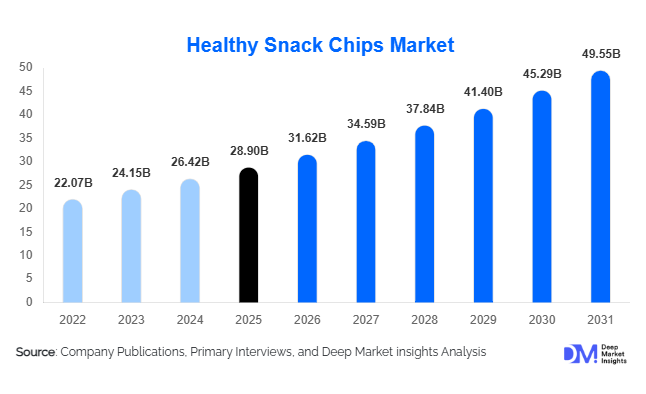
What are the latest trends in the healthy snack chips market?
Rise of Plant-Based and Functional Snacking
The healthy snack chips industry is increasingly evolving toward plant-based and nutrient-rich formulations. Consumers are actively seeking products that offer additional health benefits such as high protein, high fiber, low carbohydrates, and clean-label ingredients. Lentil chips, chickpea crisps, pea-protein snacks, and vegetable-based chips made from sweet potatoes, kale, beetroot, and cassava are witnessing strong demand globally. Functional ingredients such as probiotics, adaptogens, superfoods, and fortified vitamins are also being incorporated into snack chips to attract health-conscious consumers. This trend is particularly strong among younger consumers who associate plant-based foods with sustainability, wellness, and ethical food consumption. Manufacturers are responding with expanded product portfolios targeting vegan, keto, and gluten-free lifestyles while emphasizing minimally processed ingredients and natural seasoning blends.
Technological Advancements in Low-Oil Processing
Food processing innovations are significantly reshaping the healthy snack chips market. Air frying, vacuum frying, freeze drying, and dehydration technologies are allowing manufacturers to reduce fat content without compromising texture and flavor. Air-fried chips, in particular, are rapidly gaining traction as consumers increasingly avoid deep-fried snacks while still seeking crunchy snack experiences. Companies are investing heavily in advanced manufacturing systems to improve shelf stability, optimize flavor retention, and reduce preservative usage. Artificial intelligence and automation are also being integrated into production lines to improve consistency, quality control, and operational efficiency. Packaging technologies are simultaneously advancing, with resealable pouches, biodegradable materials, and moisture-control systems becoming increasingly common across premium healthy snack products.
What are the key drivers in the healthy snack chips market?
Growing Health Awareness and Lifestyle Changes
The increasing prevalence of obesity, diabetes, hypertension, and cardiovascular disorders is one of the most significant drivers supporting healthy snack chips market growth. Consumers are increasingly replacing traditional fried potato chips with healthier alternatives containing lower sodium, reduced oil content, and functional nutritional benefits. Urban consumers are prioritizing convenient snacking options that align with active lifestyles, fitness goals, and wellness-focused dietary habits. Governments and healthcare organizations globally are also promoting healthier eating through awareness campaigns and nutritional labeling initiatives, encouraging consumers to shift toward better-for-you snack products.
Expansion of E-Commerce and Organized Retail
The rapid expansion of online grocery platforms and modern retail infrastructure is accelerating healthy snack chips market penetration globally. E-commerce channels allow consumers to access a broader range of niche and premium healthy snack brands that may not be available in traditional retail stores. Subscription snack services, direct-to-consumer models, and influencer-driven digital marketing campaigns are helping emerging healthy snack companies scale rapidly. Supermarkets and hypermarkets are also dedicating larger shelf spaces to functional and organic snack categories due to rising consumer demand and higher premium margins. Improved product accessibility and targeted online marketing are significantly strengthening global market expansion.
What are the restraints for the global market?
Premium Pricing and Consumer Affordability Challenges
Healthy snack chips are generally priced significantly higher than conventional snack products because of premium raw materials, specialized manufacturing technologies, and certification requirements such as organic, non-GMO, and gluten-free labeling. This pricing gap can restrict adoption among price-sensitive consumers, particularly in developing economies where conventional snack options remain substantially cheaper. Inflationary pressures and rising food costs further intensify affordability challenges across mass-market consumer segments.
Volatility in Raw Material Supply Chains
The healthy snack chips industry is highly dependent on agricultural commodities such as chickpeas, lentils, sweet potatoes, avocados, quinoa, and specialty vegetables. Seasonal production variability, climate-related disruptions, and fluctuations in transportation costs can significantly affect raw material availability and pricing stability. Supply chain disruptions and inconsistent agricultural yields can pressure manufacturer profit margins and create pricing volatility across retail markets. Maintaining consistent quality standards for natural and minimally processed ingredients also remains a major operational challenge for producers.
What are the key opportunities in the healthy snack chips industry?
Expansion into Emerging Markets
Emerging economies across Asia-Pacific, Latin America, and the Middle East present substantial growth opportunities for healthy snack chip manufacturers. Rising urbanization, expanding middle-class populations, and increasing disposable income are significantly improving consumer spending on premium packaged foods. Countries such as India, China, Indonesia, Brazil, and the UAE are witnessing rapid expansion of organized retail infrastructure and digital grocery platforms, making healthy snack products more accessible to mainstream consumers. Localization of flavors and region-specific product innovation are expected to further strengthen growth opportunities across these high-potential markets.
Growth of Sustainable and Clean-Label Products
Sustainability-focused snacking is emerging as a major opportunity area for manufacturers. Consumers increasingly prefer products made with ethically sourced ingredients, eco-friendly packaging, and transparent supply chains. Companies investing in biodegradable packaging, reduced plastic usage, and carbon-conscious manufacturing are strengthening brand loyalty among environmentally conscious consumers. Clean-label positioning with fewer artificial additives and preservatives is also becoming a critical purchasing factor globally. Brands capable of combining sustainability, transparency, and nutritional value are expected to gain long-term competitive advantages within premium healthy snack categories.
Report Scope
| Report Metric | Details |
|---|---|
| Market Size in 2025 | USD 28.90 Billion |
| Market Size in 2026 | USD 31.62 Billion |
| Market Size in 2031 | USD 49.55 Billion |
| CAGR | 9.4% (2026-2031) |
| Base Year for Estimation | 2025 |
| Historical Data | 2022-2024 |
| Forecast Period | 2026-2031 |
| Report Coverage | Revenue Forecast, Competitive Landscape, Supply Chain Disruption, Growth Factors, Environment & Regulatory Landscape and Trends |
| Geographies Covered | North America, Europe, APAC, Middle East and Africa, LATAM |
| Countries Covered | U.S., Canada, U.K., Germany, France, Spain, Italy, Russia, Nordic, Benelux, Rest of Europe, China, Korea, Japan, India, Australia, Singapore, Taiwan, South East Asia, Rest of Asia-Pacific, UAE, Turky, Saudi Arabia, South Africa, Egypt, Nigeria, Rest of MEA, Brazil, Mexico, Argentina, Chile, Colombia, Rest of LATAM |
Explore more data points, trends and opportunities Download Free Sample Report
Product Type Insights
The healthy snack chips market is experiencing substantial diversification across product categories as consumers increasingly prioritize nutritional value, clean-label ingredients, and functional health benefits when selecting convenient snack options. Among all product categories, vegetable chips continue to dominate the global market, accounting for nearly 28% of total market demand in 2025. The strong performance of vegetable chips is primarily driven by rising consumer perception that plant-based ingredients offer superior nutritional profiles compared to conventional potato chips. Sweet potato chips, beetroot chips, kale chips, cassava chips, carrot chips, and mixed vegetable variants are witnessing particularly strong demand due to their association with natural vitamins, fiber content, antioxidant properties, and reduced artificial ingredient usage. Consumers are increasingly attracted to products that provide both indulgence and health-oriented positioning, allowing vegetable chips to successfully bridge the gap between traditional snacking and wellness-focused eating habits.Air-fried and baked snack chips continue to witness strong market expansion as consumers actively reduce consumption of deep-fried and high-fat packaged foods. The growing public focus on obesity management, cardiovascular health, diabetes prevention, and calorie reduction is encouraging consumers to shift toward low-oil snack alternatives without sacrificing taste or convenience. Baked chips are increasingly positioned as healthier everyday snack options suitable for family consumption, workplace snacking, and school lunch inclusion. Advances in food processing technologies are also helping manufacturers improve crispiness, flavor retention, and shelf stability in baked and air-fried products, allowing healthier chips to compete more effectively with traditional fried snacks.Organic, non-GMO, vegan, and clean-label certified healthy snack chips are gaining exceptional traction in premium retail channels, particularly across North America and Europe where consumer scrutiny regarding ingredient transparency is extremely high. Shoppers increasingly prefer products free from artificial preservatives, synthetic flavors, trans fats, and excessive sodium levels. Certification labels related to organic farming, sustainable sourcing, and plant-based production are becoming important purchasing drivers, especially among younger demographic groups and affluent urban consumers. This trend is encouraging manufacturers to invest heavily in natural ingredient sourcing, transparent labeling strategies, and sustainable product development practices to maintain long-term consumer trust and brand loyalty.
Application Insights
Household consumption continues to represent the largest application segment within the healthy snack chips market as at-home snacking behavior remains deeply integrated into modern consumer lifestyles. Busy schedules, hybrid working environments, increased digital entertainment consumption, and growing preference for convenient ready-to-eat foods are significantly increasing household demand for healthier packaged snack alternatives. Consumers are increasingly replacing traditional high-fat snacks with healthier chip varieties that align with long-term wellness goals while still providing convenience and indulgence. Families are particularly attracted to snack products containing reduced sodium, lower oil content, natural ingredients, and improved nutritional value, supporting widespread adoption across multiple age groups.Educational institutions are gradually integrating healthier packaged food products into cafeterias, vending systems, and school meal programs as governments, parents, and policymakers become increasingly focused on child nutrition and obesity prevention. Schools and universities are progressively replacing traditional high-calorie snack products with healthier alternatives that contain fewer artificial ingredients and improved nutritional profiles. The growing emphasis on balanced student diets is creating long-term opportunities for healthy snack manufacturers capable of delivering affordable, nutritious, and child-friendly snack options.Foodservice applications across airlines, hotels, cafés, cinemas, quick-service restaurants, and travel retail environments are also contributing to steady market expansion. Hospitality providers are increasingly incorporating healthy snack offerings into menus to accommodate rising consumer demand for wellness-oriented food choices. Premium airlines and hotel chains, in particular, are introducing healthier packaged snack selections as part of broader customer experience enhancement strategies. The expansion of tourism, business travel, and urban foodservice infrastructure globally continues to create additional consumption opportunities for healthy snack chips across multiple commercial settings.
Distribution Channel Insights
Supermarkets and hypermarkets remain the dominant distribution channels within the healthy snack chips market, accounting for approximately 41% of global sales distribution in 2025. The leading position of large-format retail stores is supported by extensive shelf visibility, strong promotional capabilities, broad product assortments, and high consumer accessibility. Supermarkets allow consumers to directly compare nutritional information, ingredient transparency, packaging formats, and pricing across multiple healthy snack brands, significantly influencing purchasing behavior. Retail chains are also expanding dedicated health food sections and premium organic snack categories to accommodate rising consumer demand for wellness-oriented packaged foods.Specialty health food stores continue to attract premium consumers seeking organic, vegan, keto-certified, gluten-free, and clean-label snack products. These retail channels are particularly important for premium niche brands that differentiate themselves through ingredient quality, sustainability practices, and functional nutrition positioning. Consumers shopping within specialty health stores often demonstrate higher willingness to pay premium prices for products aligned with their wellness values and dietary preferences.Direct brand websites and digital marketplaces are increasingly enabling manufacturers to establish stronger consumer engagement, improve product customization capabilities, and collect valuable purchasing behavior data. Brands are leveraging direct online sales to launch limited-edition flavors, personalized snack bundles, and subscription programs that strengthen customer retention and long-term loyalty. The growing integration of artificial intelligence-driven recommendation systems and targeted digital advertising is expected to further accelerate healthy snack chip sales through online channels during the forecast period.
Consumer Group Insights
Millennials continue to represent the largest consumer group within the healthy snack chips market, accounting for nearly 35% of total global demand in 2025. This demographic strongly prioritizes convenience, functional nutrition, clean-label ingredients, and wellness-oriented lifestyles, making healthy snack chips highly compatible with their purchasing preferences. Millennials are particularly attracted to innovative flavors, plant-based ingredients, sustainable packaging, and products positioned around fitness, energy, and holistic health benefits. Their strong digital engagement also makes them highly responsive to influencer marketing, social media campaigns, and online health trends, significantly shaping product innovation across the industry.Fitness enthusiasts and health-conscious consumers are substantially driving growth in protein-rich, low-carb, keto-friendly, and functional snack chip categories. Rising participation in sports activities, gym memberships, and wellness programs globally is encouraging consumers to seek snacks that support active lifestyles without compromising nutritional goals. High-protein chips, vegetable-based products, and minimally processed snacks are increasingly preferred among consumers focused on weight management, muscle recovery, and long-term health optimization.Working professionals represent another major consumer category due to rising demand for convenient and portable snack products compatible with busy schedules and mobile lifestyles. Long working hours, hybrid office environments, and increasing commuting patterns are encouraging professionals to purchase portion-controlled healthy snacks that can be consumed easily throughout the day. Portable pouches, resealable packs, and single-serving formats are particularly popular among this consumer segment.Parents are also contributing significantly to healthy snack chip market expansion as awareness regarding childhood nutrition continues to increase globally. Families are actively seeking healthier snack alternatives for children that contain lower sodium levels, fewer artificial additives, natural ingredients, and improved nutritional content. Manufacturers are responding by developing child-friendly healthy snacks featuring simplified ingredient lists, attractive packaging designs, and balanced flavor profiles suitable for younger consumers.
Packaging Insights
Pouches remain the dominant packaging format within the healthy snack chips market, contributing nearly 46% of global packaging demand due to their convenience, lightweight structure, portability, and cost-efficient logistics characteristics. Flexible pouch packaging significantly reduces transportation costs while offering improved shelf presentation and product protection. Consumers increasingly prefer pouch-based packaging because it allows easy handling, convenient storage, and suitability for on-the-go snacking applications.Single-serve packaging formats are expanding rapidly due to growing urbanization, busy lifestyles, and increasing demand for portable snack solutions among office workers, students, travelers, and fitness consumers. Individually packaged healthy snacks are particularly popular within convenience stores, vending machines, airline catering, and workplace snack programs. Portion-controlled formats also align with consumer interest in calorie management and mindful eating practices.Sustainability is becoming one of the most influential packaging trends shaping the healthy snack chips industry globally. Environmental concerns regarding plastic waste, carbon emissions, and packaging disposal are encouraging manufacturers to invest heavily in recyclable films, compostable materials, biodegradable packaging technologies, and lightweight packaging systems. Consumers increasingly evaluate packaging sustainability alongside nutritional content when making purchasing decisions, particularly across developed markets.Government regulations targeting single-use plastics and increasing corporate sustainability commitments are further accelerating the transition toward environmentally responsible packaging solutions. Companies are actively redesigning packaging structures to improve recyclability, reduce material usage, and strengthen environmental credentials. Sustainable packaging innovation is expected to remain a major competitive differentiator within the healthy snack chips market throughout the forecast period.
Explore more data points, trends and opportunities Download Free Sample Report
Healthy Snack Chips Market Segmentations
By Product Type
- Vegetable Chips
- Protein Chips
- Grain-Based Healthy Chips
- Fruit Chips
- Keto & Low-Carb Chips
- Baked Chips
- Air-Fried Chips
- Organic & Gluten-Free Chips
By Ingredient Source
- Plant-Based Chips
- Dairy-Based Chips
- Mixed Ingredient Chips
By Flavor Type
- Salted
- Barbecue
- Cheese
- Spicy & Chili
- Herb & Garlic
- Sweet & Savory
- Regional & Exotic Flavors
By Processing Technology
- Baked
- Vacuum Fried
- Air-Fried
- Freeze-Dried
- Extruded
By Distribution Channel
- Supermarkets & Hypermarkets
- Convenience Stores
- Specialty Health Stores
- Online Retail & E-Commerce
- Direct-to-Consumer Platforms
- Foodservice & Institutional Sales
Regional Insights
North America
North America accounted for approximately 37% of the global healthy snack chips market in 2025, making it the largest regional market worldwide. The United States dominates regional consumption due to exceptionally high consumer awareness regarding obesity prevention, clean-label nutrition, calorie management, and functional snacking habits. The region benefits from a highly developed packaged food industry, advanced retail infrastructure, strong purchasing power, and extensive availability of premium healthy snack products across supermarkets, convenience stores, specialty retailers, and online platforms.The United States market is further supported by aggressive product innovation, celebrity-backed wellness branding, and strong investment in functional food development by leading snack manufacturers. Canada is also witnessing rising demand for organic and clean-label snacks due to expanding health-conscious consumer populations and increasing penetration of specialty health food retail channels. Growing e-commerce grocery adoption and subscription-based snack delivery services are further supporting regional market expansion.
Europe
Europe held nearly 28% of the global healthy snack chips market share in 2025, supported by strong regional demand for organic foods, clean-label packaged products, and environmentally sustainable packaging solutions. Germany, the United Kingdom, France, Italy, Spain, and the Netherlands represent some of the largest consumption markets within the region. European consumers increasingly prioritize minimally processed foods containing natural ingredients, lower sodium content, and reduced artificial additives.The rapid expansion of veganism, flexitarian diets, and plant-based eating patterns across Europe is also significantly supporting demand for vegetable-based and protein-rich healthy chips. Western European consumers are particularly responsive to products positioned around organic certification, local sourcing, and sustainable agriculture practices. Rising disposable income, premiumization trends, and increasing health consciousness among younger consumers continue to strengthen long-term regional market potential.
Asia-Pacific
Asia-Pacific represents the fastest-growing regional market within the healthy snack chips industry and is projected to expand at a CAGR exceeding 11% during the forecast period. China and India are emerging as major growth engines due to rapid urbanization, rising middle-class populations, increasing disposable income, and accelerating westernization of dietary habits. Consumers across the region are increasingly adopting convenient packaged foods while simultaneously becoming more aware of nutrition, wellness, and healthier eating behaviors.Japan and South Korea are experiencing strong demand for premium vegetable chips, low-calorie snacks, and functional nutrition products due to highly health-conscious consumer bases and advanced packaged food industries. Australia represents a relatively mature but steadily expanding market characterized by strong consumer demand for organic, clean-label, and sustainably packaged snack products. Additionally, increasing participation in fitness activities and growing awareness regarding obesity prevention are encouraging regional consumers to shift toward healthier snacking alternatives.
Latin America
Latin America is emerging as a promising market for healthy snack chips, led primarily by Brazil and Mexico. Rising middle-class populations, improving economic conditions, increasing retail modernization, and growing awareness regarding healthier dietary habits are supporting regional market expansion. Consumers are gradually transitioning away from heavily processed snack foods and showing greater interest in products perceived as natural, nutritious, and lower in unhealthy fats.Regional manufacturers are increasingly introducing localized flavors, culturally adapted ingredients, and affordable healthy snack products to strengthen consumer engagement and improve market penetration. While premium healthy snack categories remain concentrated primarily in major urban centers, rising health awareness campaigns and expanding middle-income populations are expected to gradually broaden demand across additional demographic groups during the forecast period.
Middle East & Africa
The Middle East & Africa healthy snack chips market is experiencing steady growth led by the UAE, Saudi Arabia, and South Africa. Increasing urbanization, rising disposable income, premium retail expansion, and growing awareness regarding healthier dietary practices are supporting healthy snack adoption across the region. Consumers are increasingly seeking convenient snack products aligned with fitness, wellness, and balanced nutrition trends.South Africa remains one of the largest packaged snack markets within Africa due to relatively advanced retail infrastructure, increasing supermarket penetration, and growing middle-class consumption. The expansion of international snack brands, rising youth populations, and increasing exposure to global food trends are also supporting market development across the broader region. As awareness regarding nutrition and preventive healthcare continues to improve, demand for healthier packaged snack products is expected to strengthen steadily throughout the Middle East & Africa market.
Key Players in the Healthy Snack Chips Market
- PepsiCo Inc.
- Kellanova
- Calbee Inc.
- The Hain Celestial Group Inc.
- General Mills Inc.
- Intersnack Group GmbH & Co. KG
- Kettle Foods Inc.
- Bare Snacks
- Popchips Inc.
- Rhythm Superfoods LLC
- Siete Foods
- Tyrrells Potato Crisps Ltd.
- HIPPEAS
- Beanfields Snacks
- Late July Snacks