Hard Seltzer Market Size
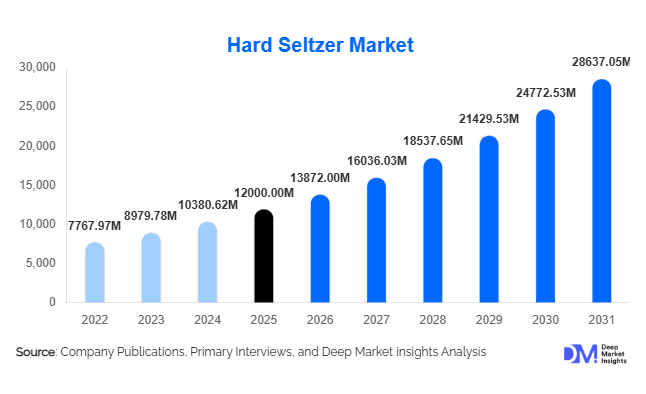
According to Deep Market Insights, the global hard seltzer market size was valued at USD 12,000 million in 2025 and is projected to grow from USD 13,872 million in 2026 to reach USD 28,637.05 million by 2031, expanding at a CAGR of 15.6% during the forecast period (2026–2031). The hard seltzer market growth is primarily driven by the increasing consumer shift toward low-calorie alcoholic beverages, rising health consciousness, and continuous product innovation in flavors and formulations. The category has rapidly transitioned from a niche segment into a mainstream alcoholic beverage, supported by premiumization trends, aggressive marketing strategies, and expanding retail penetration across both developed and emerging markets.
Key Market Insights
- Hard seltzers are gaining popularity as a “better-for-you” alcoholic beverage, with low calorie and low sugar content attracting health-conscious consumers globally.
- Flavor innovation and premiumization are key growth levers, with brands introducing exotic, botanical, and functional variants.
- North America dominates the global market, driven by strong consumer awareness and established distribution networks.
- Asia-Pacific is the fastest-growing region, fueled by urbanization, rising disposable incomes, and westernized consumption habits.
- Off-trade distribution channels lead the market, particularly supermarkets, liquor stores, and online retail platforms.
- Slim can packaging is the most preferred format, aligning with portability, sustainability, and premium branding trends.
What are the latest trends in the hard seltzer market?
Functional and Health-Oriented Hard Seltzers
One of the most prominent trends in the hard seltzer market is the emergence of functional and health-oriented variants. Manufacturers are incorporating ingredients such as vitamins, electrolytes, antioxidants, and adaptogens to differentiate their offerings and align with wellness-focused consumer preferences. These innovations are transforming hard seltzers from simple alcoholic beverages into lifestyle products that appeal to fitness-conscious individuals. Additionally, low-carb, organic, and gluten-free formulations are gaining traction, particularly among younger demographics. This trend is enabling brands to command premium pricing while expanding their consumer base beyond traditional alcohol consumers.
Expansion of Premium and Craft Segments
The premiumization trend is reshaping the competitive landscape of the hard seltzer market. Craft producers and established beverage companies are launching high-end variants with unique flavor combinations, natural ingredients, and sophisticated branding. Consumers are increasingly willing to pay a premium for quality, authenticity, and innovative experiences. Limited-edition releases, seasonal flavors, and collaborations with lifestyle brands are further driving engagement. This shift toward premium offerings is also contributing to higher profit margins and brand differentiation in an increasingly saturated market.
What are the key drivers in the hard seltzer market?
Rising Demand for Low-Calorie Alcoholic Beverages
The growing awareness of health and wellness is a major driver of the hard seltzer market. Consumers are actively seeking alternatives to traditional alcoholic beverages such as beer and cocktails, which are often high in calories and sugar. Hard seltzers, typically containing fewer calories and minimal carbohydrates, are positioned as a healthier choice. This trend is particularly strong among millennials and Gen Z consumers, who prioritize balanced lifestyles and mindful consumption.
Rapid Expansion of Distribution Channels
The increasing availability of hard seltzers across diverse distribution channels is significantly boosting market growth. Supermarkets, convenience stores, and liquor outlets are expanding shelf space for these products, while e-commerce platforms are enabling direct-to-consumer sales. Online retail, in particular, is gaining momentum, offering convenience, wider product selection, and targeted marketing strategies. This widespread accessibility is accelerating product adoption across urban and semi-urban markets.
What are the restraints for the global market?
Regulatory and Taxation Challenges
The hard seltzer market is subject to varying regulatory frameworks and alcohol taxation policies across different regions. Compliance with labeling standards, licensing requirements, and advertising restrictions can increase operational complexity and costs for manufacturers. These challenges are particularly pronounced in emerging markets, where regulatory environments are still evolving.
Market Saturation and Intense Competition
In mature markets such as North America, the rapid influx of new brands has led to market saturation and heightened competition. This has resulted in pricing pressures and reduced profit margins, making it increasingly difficult for new entrants to establish a strong foothold. Continuous innovation and effective branding are essential to remain competitive in this crowded landscape.
What are the key opportunities in the hard seltzer industry?
Expansion into Emerging Markets
Emerging economies in Asia-Pacific and Latin America present significant growth opportunities for hard seltzer manufacturers. Rising disposable incomes, urbanization, and changing consumer preferences are driving demand for premium alcoholic beverages in these regions. Localized flavor offerings and targeted marketing strategies can further enhance market penetration.
Digital and Direct-to-Consumer Channels
The growth of e-commerce and digital platforms is creating new opportunities for market expansion. Brands can leverage data analytics to personalize offerings, optimize pricing, and enhance customer engagement. Subscription models and online-exclusive product launches are also gaining popularity, enabling companies to build strong customer loyalty.
Report Scope
| Report Metric | Details |
|---|---|
| Market Size in 2025 | USD 12000 Million |
| Market Size in 2026 | USD 13872 Million |
| Market Size in 2031 | USD 28637.05 Million |
| CAGR | 15.6% (2026-2031) |
| Base Year for Estimation | 2025 |
| Historical Data | 2022-2024 |
| Forecast Period | 2026-2031 |
| Report Coverage | Revenue Forecast, Competitive Landscape, Supply Chain Disruption, Growth Factors, Environment & Regulatory Landscape and Trends |
| Geographies Covered | North America, Europe, APAC, Middle East and Africa, LATAM |
| Countries Covered | U.S., Canada, U.K., Germany, France, Spain, Italy, Russia, Nordic, Benelux, Rest of Europe, China, Korea, Japan, India, Australia, Singapore, Taiwan, South East Asia, Rest of Asia-Pacific, UAE, Turky, Saudi Arabia, South Africa, Egypt, Nigeria, Rest of MEA, Brazil, Mexico, Argentina, Chile, Colombia, Rest of LATAM |
Explore more data points, trends and opportunities Download Free Sample Report
Product Type Insights
Based on alcohol content segmentation, medium ABV hard seltzers (4.6%–6%) continue to dominate the global market, accounting for approximately 48% of the total share in 2025. This segment’s leadership is primarily driven by its ability to strike an optimal balance between flavor intensity and moderate alcohol consumption, making it highly appealing to a broad consumer base that seeks both refreshment and controlled intake. The growing preference for sessionable alcoholic beverages, particularly among millennials and Gen Z consumers, has significantly reinforced the demand for medium ABV variants. These products align well with evolving consumption habits that emphasize social drinking experiences without excessive intoxication, positioning them as an ideal choice for casual gatherings, outdoor events, and lifestyle-oriented consumption occasions.Low ABV hard seltzers are witnessing accelerated growth, fueled by increasing health consciousness and a shift toward mindful drinking behaviors. Consumers are actively seeking beverages with lower alcohol content, reduced calories, and minimal sugar, which has prompted manufacturers to expand their low ABV portfolios. Additionally, regulatory pressures and public health campaigns in several regions are encouraging reduced alcohol consumption, further supporting this segment’s expansion. On the other hand, high ABV variants cater to a niche but steadily growing segment of consumers who prefer stronger alternatives without compromising on convenience and portability. These products often appeal to experienced drinkers and those transitioning from traditional alcoholic beverages such as beer and spirits, thereby contributing to product diversification within the market.
Flavor Insights
Flavor innovation remains a cornerstone of the hard seltzer market, with citrus flavors leading the global landscape and accounting for approximately 32% of the market share in 2025. The dominance of citrus flavors can be attributed to their universally refreshing profile, clean taste, and compatibility with the light and crisp nature of hard seltzers. Lemon, lime, and grapefruit variants have particularly gained traction due to their ability to deliver a balanced sensory experience that appeals to both new and existing consumers. The leading driver for this segment is the strong consumer inclination toward familiar, refreshing, and low-sweetness flavor profiles that enhance drinkability across various occasions.Berry and tropical flavors are also experiencing robust growth, supported by continuous product innovation and seasonal launches that cater to evolving consumer preferences. Brands are increasingly experimenting with combinations such as mixed berries, mango, pineapple, and passion fruit to create differentiated offerings that stand out in a competitive marketplace. Furthermore, exotic and botanical blends, including ingredients like hibiscus, cucumber, and herbal infusions, are emerging as niche yet premium segments. These variants are particularly popular among urban consumers seeking sophisticated and unique taste experiences, thereby driving premiumization trends within the market. The expansion of flavor portfolios not only enhances consumer engagement but also encourages repeat purchases, making flavor diversity a critical growth driver.
Packaging Insights
Slim cans dominate the packaging segment, accounting for nearly 65% of the global market share, and their leadership is primarily driven by convenience, portability, and strong visual appeal. The leading driver for this segment is the increasing consumer preference for lightweight, easy-to-carry packaging that complements on-the-go lifestyles. Slim cans are particularly popular among younger demographics due to their modern aesthetic, ergonomic design, and association with premium branding. Additionally, their compatibility with outdoor activities such as picnics, beach outings, and festivals further strengthens their market position.From a sustainability perspective, aluminum cans offer high recyclability, which aligns with growing environmental awareness among consumers. This has prompted manufacturers to emphasize eco-friendly packaging solutions, thereby enhancing brand perception and customer loyalty. While bottles and kegs continue to play a role, particularly in on-trade environments such as bars, restaurants, and hospitality venues, their overall market share remains comparatively smaller. However, these formats are essential for enhancing brand visibility and enabling experiential consumption, especially in premium and craft segments. The ongoing innovation in packaging design, including resealable cans and multi-pack offerings, is expected to further drive growth and differentiation in this segment.
Distribution Channel Insights
Off-trade channels, including supermarkets, hypermarkets, convenience stores, and online retail platforms, dominate the distribution landscape, accounting for approximately 70% of the market share. The leading driver for this segment is the unparalleled convenience and accessibility offered by retail networks, enabling consumers to purchase hard seltzers for at-home consumption and social gatherings. The rapid expansion of e-commerce platforms has further amplified this trend, allowing consumers to explore a wide range of brands and flavors with ease. Digitalization, coupled with targeted marketing strategies and subscription-based delivery models, has significantly enhanced the reach and penetration of hard seltzers across diverse consumer segments.On-trade channels, while representing a smaller share, remain crucial for brand building and consumer engagement. Bars, restaurants, and clubs provide an experiential platform where consumers can discover new products and flavors, often influencing their future purchasing decisions in off-trade settings. The integration of hard seltzers into cocktail menus and curated beverage offerings has also contributed to their growing visibility in the on-trade sector. As consumer lifestyles continue to evolve, the synergy between online and offline distribution channels is expected to play a pivotal role in shaping market dynamics.
End-Use Insights
Casual drinking emerges as the dominant end-use segment, accounting for nearly 50% of global demand, driven primarily by the versatility and convenience of hard seltzers. The leading driver for this segment is the increasing preference for low-calorie, easy-to-consume alcoholic beverages that fit seamlessly into everyday lifestyles. Hard seltzers are particularly favored for their light and refreshing profile, making them suitable for a wide range of occasions, from relaxing at home to informal social gatherings.In addition to casual consumption, social events and outdoor activities are significantly contributing to market growth. The portability and ready-to-drink nature of hard seltzers make them an ideal choice for events such as parties, barbecues, and festivals. Furthermore, the rising popularity of fitness-oriented lifestyles has led to increased demand for beverages that align with health and wellness goals. Hard seltzers, often marketed as low-carb and low-sugar alternatives, resonate strongly with this consumer segment, thereby expanding their application across diverse usage scenarios. The convergence of lifestyle trends and product attributes continues to reinforce the dominance of casual drinking as the primary end-use segment.
Explore more data points, trends and opportunities Download Free Sample Report
Hard Seltzer Market Segmentations
Alcohol Content
- Low ABV
- Medium ABV
- High ABV
Flavor Type
- Citrus
- Berry
- Tropical
- Stone Fruit
- Mixed/Exotic Blends
- Unflavored/Classic
Packaging Type
- Slim Cans
- Standard Cans
- Bottles
- Draft/Kegs
Distribution Channel
- On-Trade
- Supermarkets & Hypermarkets
- Convenience Stores
- Liquor Stores
- Online Retail
Price Segment
- Economy
- Mid-Range
- Premium
- Super-Premium/Craft
End-Use Occasion
- Casual Drinking
- Social Events & Parties
- Fitness & Outdoor Activities
- Hospitality & Tourism
Regional Insights
North America
North America holds the largest share of the global hard seltzer market, accounting for approximately 52% in 2025, with the United States serving as the primary growth engine. The region’s dominance is underpinned by high consumer awareness, strong brand presence, and an advanced retail infrastructure that ensures widespread product availability. One of the key growth drivers in North America is the rapid shift toward healthier alcoholic beverage alternatives, as consumers increasingly prioritize low-calorie and low-sugar options. Additionally, aggressive marketing campaigns, celebrity endorsements, and innovative product launches have significantly boosted market penetration.The cultural emphasis on convenience and ready-to-drink beverages further supports the adoption of hard seltzers across various demographics. In Canada, similar consumption patterns, coupled with expanding distribution networks and favorable regulatory frameworks, are contributing to steady market growth. The region also benefits from a mature beverage industry that fosters continuous innovation, enabling manufacturers to introduce new flavors, packaging formats, and product variations that cater to evolving consumer preferences.
Europe
Europe accounts for approximately 22% of the global market, with countries such as the United Kingdom, Germany, and France leading regional demand. The growth of the hard seltzer market in Europe is primarily driven by increasing health consciousness and a gradual shift away from traditional alcoholic beverages toward lighter alternatives. Consumers in this region are becoming more receptive to low-calorie and low-alcohol options, particularly as awareness of wellness and balanced lifestyles continues to rise.Another significant driver is the expansion of craft and artisanal beverage producers, which are introducing premium and innovative hard seltzer variants tailored to local tastes. The region’s strong emphasis on quality and authenticity has encouraged the development of unique flavor profiles and high-end products, thereby supporting premiumization trends. Additionally, the growing popularity of social drinking and outdoor leisure activities, especially during summer months, is further fueling demand. Regulatory support for product innovation and the increasing presence of international brands are also contributing to market expansion across Europe.
Asia-Pacific
Asia-Pacific is the fastest-growing region in the global hard seltzer market, with a projected CAGR exceeding 18% during the forecast period. Countries such as China, Japan, Australia, and India are driving this growth, supported by rapid urbanization, rising disposable incomes, and changing consumer preferences. A key growth driver in this region is the increasing adoption of western lifestyle trends, including the consumption of ready-to-drink alcoholic beverages.The expanding middle-class population and growing exposure to global brands are further accelerating market penetration. In addition, the rising awareness of low-calorie and health-oriented beverages is encouraging consumers to explore alternatives to traditional alcoholic drinks. E-commerce platforms and digital marketing strategies are playing a crucial role in enhancing product accessibility and brand visibility, particularly in emerging markets. The region’s dynamic demographic profile, characterized by a large युवा population, continues to create significant growth opportunities for market players.
Latin America
Latin America accounts for approximately 10% of the global hard seltzer market, with Brazil and Mexico leading regional demand. The market in this region is driven by a young and increasingly urban population that is open to experimenting with new beverage categories. One of the primary growth drivers is the expansion of retail infrastructure, which has improved product availability across both urban and semi-urban areas.Additionally, the growing influence of global beverage trends and increasing exposure to international brands are contributing to rising consumer awareness. The region’s vibrant social culture, characterized by frequent gatherings and celebrations, further supports the consumption of convenient and ready-to-drink beverages such as hard seltzers. Economic development and rising disposable incomes are also enabling consumers to explore premium and imported products, thereby driving market growth.
Middle East & Africa
The Middle East and Africa region holds approximately 6% of the global market share, with growth driven by a combination of tourism, expatriate populations, and evolving consumption patterns. Key markets such as South Africa and the United Arab Emirates are witnessing increasing demand for hard seltzers, supported by a growing preference for modern and convenient beverage options.Tourism plays a significant role in driving demand, particularly in regions with a strong hospitality sector, where international visitors influence local consumption trends. The presence of expatriate communities further contributes to the adoption of western beverage preferences, including hard seltzers. Additionally, the gradual liberalization of alcohol regulations in certain markets is creating new opportunities for market expansion. As awareness of low-calorie and lifestyle-oriented beverages continues to grow, the region is expected to witness steady growth in the coming years.
Key Players in the Hard Seltzer Market
- Anheuser-Busch InBev
- Boston Beer Company
- Diageo Plc
- Molson Coors Beverage Company
- Constellation Brands Inc.
- Heineken N.V.
- Carlsberg Group
- Pernod Ricard
- Asahi Group Holdings
- Suntory Holdings
- Mark Anthony Brands
- Coca-Cola Company (Alcoholic RTD Segment)
- PepsiCo Inc. (Alcoholic RTD Ventures)
- Kirin Holdings
- Halewood Artisanal Spirits