Hamburger Market Size
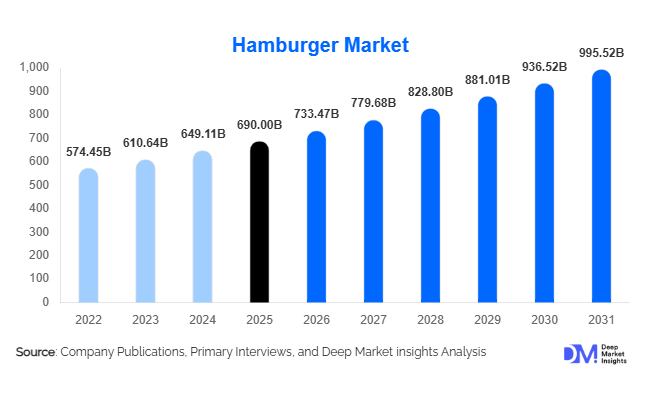
According to Deep Market Insights, the global hamburger market size was valued at USD 690.00 Billion in 2025 and is projected to grow from USD 733.47 Billion in 2026 to reach USD 995.52 Billion by 2031, expanding at a CAGR of 6.3% during the forecast period (2026–2031). The hamburger market growth is primarily driven by the rapid expansion of quick service restaurants (QSRs), increasing urbanization, and the growing demand for convenient, ready-to-eat food options. Additionally, the diversification of product offerings, including plant-based burgers and premium gourmet variants, is significantly reshaping consumer demand patterns globally.
Key Market Insights
- Quick service restaurants dominate global hamburger consumption, accounting for the majority of revenue due to affordability, scalability, and accessibility.
- Plant-based hamburgers are witnessing rapid adoption, driven by sustainability concerns and growing vegan and flexitarian populations.
- North America leads the global market, supported by high consumption frequency and strong presence of global fast-food chains.
- Asia-Pacific is the fastest-growing region, fueled by urbanization, rising disposable income, and Western food adoption.
- Digital ordering and food delivery platforms are transforming consumption patterns, enabling rapid market expansion across emerging economies.
- Premium and gourmet burger segments are gaining traction, particularly in urban centers where consumers seek quality and customization.
What are the latest trends in the hamburger market?
Rise of Plant-Based and Alternative Protein Burgers
The hamburger market is undergoing a significant transformation with the rapid growth of plant-based and alternative protein burgers. Consumers are increasingly opting for meat substitutes due to health, environmental, and ethical considerations. Food manufacturers and restaurant chains are investing heavily in plant-based innovations using pea protein, soy, and other sustainable ingredients. This trend is particularly strong in North America and Europe but is gradually gaining traction in Asia-Pacific markets as awareness grows. The introduction of lab-grown meat and hybrid protein burgers is expected to further disrupt the traditional hamburger segment, offering scalable and environmentally friendly alternatives.
Digitalization and Delivery-Led Consumption
The integration of digital platforms has revolutionized the hamburger market. Online food delivery services, mobile apps, and cloud kitchens are expanding accessibility and reshaping consumer purchasing behavior. Digital ordering allows brands to reach a wider audience without heavy investment in physical outlets, especially in emerging markets. Data analytics and AI-driven insights are enabling personalized menus, targeted promotions, and optimized pricing strategies. This trend is particularly appealing to younger consumers who prioritize convenience and speed, making digital channels a critical growth driver for the industry.
What are the key drivers in the hamburger market?
Expansion of Quick Service Restaurant Chains
The rapid global expansion of QSR chains is one of the primary drivers of the hamburger market. These chains leverage standardized processes, strong branding, and extensive supply chains to deliver consistent quality at competitive prices. Emerging markets in Asia-Pacific, Latin America, and the Middle East are witnessing aggressive expansion by both global and regional players, significantly boosting hamburger consumption.
Changing Consumer Lifestyles and Urbanization
Increasing urbanization and busy lifestyles are driving demand for convenient and ready-to-eat meals. Hamburgers, being quick, affordable, and widely available, have become a staple food choice for urban populations. Rising disposable incomes and exposure to Western food culture are further accelerating demand, particularly among younger demographics.
What are the restraints for the global market?
Health Concerns and Dietary Shifts
Growing awareness of health risks associated with processed meat consumption, including obesity and cardiovascular diseases, is a key restraint. Consumers are increasingly shifting toward healthier alternatives, including salads, wraps, and plant-based foods, which may limit the growth of traditional hamburger products.
Volatility in Raw Material Prices
Fluctuations in the prices of key raw materials such as beef, poultry, and grains can significantly impact production costs and profit margins. Supply chain disruptions and environmental factors further exacerbate price volatility, posing challenges for manufacturers and foodservice operators.
What are the key opportunities in the hamburger industry?
Premiumization and Gourmet Offerings
The growing demand for premium and gourmet hamburgers presents a significant opportunity for market players. Consumers are increasingly willing to pay higher prices for high-quality ingredients, artisanal preparation, and unique flavor combinations. This trend is particularly strong in urban areas and developed markets, where dining experiences are evolving beyond basic fast food.
Expansion in Emerging Markets
Emerging economies such as India, China, and Brazil offer substantial growth potential due to rising middle-class populations and increasing exposure to global cuisines. Localized menu offerings and strategic partnerships are enabling companies to penetrate these markets effectively, driving long-term growth.
Report Scope
| Report Metric | Details |
|---|---|
| Market Size in 2025 | USD 690.00 Billion |
| Market Size in 2026 | USD 733.47 Billion |
| Market Size in 2031 | USD 995.52 Billion |
| CAGR | 6.3% (2026-2031) |
| Base Year for Estimation | 2025 |
| Historical Data | 2022-2024 |
| Forecast Period | 2026-2031 |
| Report Coverage | Revenue Forecast, Competitive Landscape, Supply Chain Disruption, Growth Factors, Environment & Regulatory Landscape and Trends |
| Geographies Covered | North America, Europe, APAC, Middle East and Africa, LATAM |
| Countries Covered | U.S., Canada, U.K., Germany, France, Spain, Italy, Russia, Nordic, Benelux, Rest of Europe, China, Korea, Japan, India, Australia, Singapore, Taiwan, South East Asia, Rest of Asia-Pacific, UAE, Turky, Saudi Arabia, South Africa, Egypt, Nigeria, Rest of MEA, Brazil, Mexico, Argentina, Chile, Colombia, Rest of LATAM |
Explore more data points, trends and opportunities Download Free Sample Report
Product Type Insights
The global hamburger market continues to be strongly anchored by beef hamburgers, which account for approximately 48% of total market share in 2025. This dominance is underpinned by deeply ingrained consumer preferences, particularly in North America and parts of Europe, where beef-based burgers are widely regarded as the traditional standard. The robustness of established cattle supply chains, vertical integration among key producers, and widespread availability of processed beef products further reinforce the segment’s leadership. Additionally, continuous product innovation—such as premium grass-fed beef burgers, organic variants, and gourmet-style offerings—has helped sustain consumer interest and pricing power in this segment. The leading segment driver for beef hamburgers remains the strong brand association with taste authenticity, coupled with the operational efficiency of large-scale meat processing industries that ensure consistent supply and affordability.In contrast, plant-based hamburgers are rapidly emerging as the fastest-growing segment within the market, reflecting a significant shift in consumer behavior. This growth is being driven by increasing awareness of environmental sustainability, concerns over greenhouse gas emissions from livestock farming, and rising health consciousness among consumers. Technological advancements in food science have enabled manufacturers to closely replicate the taste, texture, and appearance of traditional meat burgers, thereby improving acceptance among mainstream consumers. The leading driver for this segment lies in the convergence of ethical consumption trends and innovation in alternative protein development, which is further supported by investments from major food corporations and venture capital firms. Regulatory support in several developed markets, along with expanding retail and foodservice availability, is accelerating the penetration of plant-based options.Hybrid burgers, which combine meat with plant-based proteins, are gaining traction as a transitional product category catering to flexitarian consumers. These products aim to reduce meat consumption without compromising on taste, offering a balanced approach that appeals to environmentally conscious yet taste-driven consumers. The growth of this segment is driven by its ability to bridge the gap between traditional and alternative protein markets, supported by innovation in formulation and increasing consumer openness to blended food products.
Application Insights
Quick service restaurants (QSRs) represent the largest application segment in the hamburger market, contributing nearly 55% of total market revenue. The dominance of this segment is primarily driven by the global expansion of fast-food chains, standardized menu offerings, and the ability to deliver consistent taste and quality across locations. The leading segment driver for QSRs is the increasing demand for convenience and affordability, particularly among urban populations with busy lifestyles. The integration of digital ordering platforms, delivery services, and loyalty programs has further strengthened the position of QSRs, enabling them to capture a larger share of consumer spending.Full-service restaurants are also playing a critical role in shaping market dynamics by introducing premium and gourmet burger offerings. These establishments cater to consumers seeking unique dining experiences, with an emphasis on high-quality ingredients, artisanal preparation methods, and innovative flavor combinations. The growth of this segment is driven by rising disposable incomes and a growing preference for experiential dining, particularly in developed markets. Food trucks and street food vendors are similarly contributing to market expansion by offering affordable yet creative burger options, often targeting younger demographics and urban consumers.Institutional catering, including airlines, corporate cafeterias, and educational institutions, is witnessing steady growth as organizations increasingly prioritize convenient and standardized meal solutions. The leading driver for this segment is the need for scalable, cost-effective food options that can be prepared and served efficiently in large quantities. The adoption of frozen and pre-cooked hamburger patties has further facilitated growth in this segment, enabling consistent quality and reduced preparation time.
Distribution Channel Insights
Foodservice channels dominate the hamburger market, accounting for approximately 65% of total revenue. This dominance is largely attributed to the extensive network of restaurants, QSR chains, and catering services that rely on hamburgers as a core menu item. The leading driver for this segment is the strong consumer preference for eating out and ordering in, supported by the rapid expansion of food delivery platforms and digital ecosystems. Strategic partnerships between foodservice operators and suppliers have also enhanced supply chain efficiency, ensuring timely delivery and consistent product quality.Retail channels are gaining traction as consumers increasingly seek convenient meal solutions for home consumption. Supermarkets, hypermarkets, and specialty stores offer a wide range of frozen and ready-to-cook hamburger products, catering to diverse preferences and price points. The leading driver for retail growth is the rising trend of home cooking, particularly in the wake of changing lifestyle patterns and increased health awareness. Consumers are also drawn to the ability to customize their meals and control ingredient quality, which has boosted demand for retail hamburger products.E-commerce is emerging as a fast-growing distribution channel, driven by increasing digital adoption and the proliferation of online grocery platforms. The convenience of home delivery, coupled with the availability of a wide product assortment, has made online channels an attractive option for consumers. The leading driver for this segment is the integration of technology into the food retail ecosystem, enabling seamless ordering, personalized recommendations, and efficient logistics.
End-Use Insights
The foodservice industry remains the primary end-use segment for hamburgers, with QSR chains leading global demand. This segment is projected to exceed USD 500 billion by 2031, driven by the rapid expansion of foodservice outlets in emerging markets and increasing consumption frequency among urban populations. The leading driver for this segment is the growing preference for convenient, ready-to-eat meals, supported by rising disposable incomes and changing lifestyle patterns. The ability of foodservice operators to innovate and adapt to consumer preferences—such as introducing healthier options and plant-based alternatives—has further strengthened their market position.Retail consumption is also experiencing significant growth, particularly for frozen hamburgers. Consumers are increasingly opting for home-cooked meals, driven by health considerations, cost savings, and the desire for greater control over ingredients. The leading driver for this segment is the expansion of cold chain infrastructure and the availability of high-quality frozen products that offer convenience without compromising on taste. Manufacturers are also introducing value-added products, such as pre-seasoned patties and ready-to-assemble burger kits, to enhance consumer appeal.Export-driven demand plays a crucial role in the global hamburger market, with countries such as the United States and Brazil serving as major exporters. These countries benefit from abundant livestock resources, advanced processing capabilities, and established trade networks. The leading driver for this segment is the increasing demand from regions with limited domestic production capacity, particularly in Asia-Pacific and the Middle East. Trade agreements and improvements in logistics infrastructure are further facilitating cross-border distribution of hamburger products.
Explore more data points, trends and opportunities Download Free Sample Report
Hamburger Market Segmentations
By Product Type
- Beef Hamburgers
- Chicken Hamburgers
- Pork Hamburgers
- Fish & Seafood Hamburgers
- Plant-Based/Vegan Hamburgers
- Hybrid (Blended) Hamburgers
By Application / Service Type
- Quick Service Restaurants (QSR)
- Full-Service Restaurants (FSR)
- Street Vendors & Food Trucks
- Institutional Catering
By Distribution Channel
- Foodservice Channels
- Supermarkets & Hypermarkets
- Convenience Stores
- Online Retail / E-commerce
- Specialty Stores
Regional Insights
North America
North America accounts for approximately 38% of the global hamburger market, with the United States serving as the largest contributor. The region’s dominance is supported by high per capita consumption, a well-established foodservice industry, and advanced supply chain infrastructure. The presence of major QSR chains and a strong culture of fast-food consumption further reinforce market growth. Additionally, North America is at the forefront of innovation, particularly in plant-based and premium burger segments, driven by significant investments in research and development.The key drivers of regional growth include the increasing demand for convenience foods, widespread adoption of digital ordering and delivery platforms, and a strong focus on product innovation. Health-conscious consumers are also driving demand for alternative protein options, while the premiumization trend is encouraging the introduction of high-quality, gourmet burgers. Furthermore, robust agricultural output and efficient processing capabilities ensure a stable supply of raw materials, supporting sustained market expansion.
Europe
Europe holds around 25% of the global market share, with key markets including the United Kingdom, Germany, and France. The region is characterized by a growing emphasis on sustainability and ethical consumption, which has significantly influenced market dynamics. Plant-based hamburgers are gaining strong traction, supported by regulatory initiatives aimed at reducing carbon emissions and promoting alternative proteins.Regional growth is driven by increasing consumer awareness of environmental issues, stringent food safety regulations, and the rising popularity of flexitarian diets. The expansion of premium and gourmet burger offerings, particularly in urban areas, is also contributing to market growth. Additionally, the presence of well-developed retail networks and the growing penetration of online grocery platforms are enhancing product accessibility across the region.
Asia-Pacific
Asia-Pacific is the fastest-growing region in the hamburger market, with a projected CAGR exceeding 8%. Major contributors include China, India, and Japan, where rapid urbanization and rising disposable incomes are driving changes in dietary habits. The adoption of Western food culture, particularly among younger consumers, is significantly boosting demand for hamburgers.The primary drivers of regional growth include the expansion of international QSR chains, increasing consumer exposure to global cuisines, and the growing middle-class population. Cultural and religious preferences are also shaping product demand, with strong growth in chicken and vegetarian burger segments. Additionally, improvements in cold chain logistics and retail infrastructure are facilitating the distribution of frozen and ready-to-cook products, further supporting market expansion.
Latin America
Latin America is witnessing steady growth in the hamburger market, led by countries such as Brazil and Mexico. The region benefits from a large and growing middle-class population, which is driving increased spending on dining out and convenience foods. The expansion of QSR chains and the introduction of localized menu offerings are further enhancing market penetration.Key drivers of regional growth include rising urbanization, increasing disposable incomes, and the growing influence of Western food culture. The availability of affordable beef products, particularly in Brazil, supports the dominance of traditional hamburgers. At the same time, the introduction of innovative and value-added products is helping to attract a broader consumer base. Improvements in supply chain infrastructure and the growth of modern retail channels are also contributing to market development.
Middle East & Africa
The Middle East & Africa region is emerging as a high-potential market for hamburgers, particularly in Gulf Cooperation Council (GCC) countries. The region’s growth is supported by strong tourism activity, a large expatriate population, and increasing disposable incomes. The presence of international QSR chains and premium dining establishments is driving demand for high-quality hamburger products.Regional growth is driven by changing consumer lifestyles, increasing urbanization, and the rising popularity of Western fast-food culture. In addition, favorable government initiatives aimed at diversifying economies and promoting the foodservice sector are supporting market expansion. The demand for halal-certified products is also shaping market dynamics, particularly in the Middle East. Furthermore, the growth of modern retail infrastructure and e-commerce platforms is enhancing product availability and accessibility across the region.
Key Players in the Hamburger Market
- McDonald’s Corporation
- Restaurant Brands International Inc.
- Yum! Brands Inc.
- Wendy’s Company
- Darden Restaurants Inc.
- Shake Shack Inc.
- Five Guys Enterprises LLC
- Jack in the Box Inc.
- Culver’s Franchising System LLC
- In-N-Out Burger Inc.
- Jollibee Foods Corporation
- Lotteria Co., Ltd.
- MOS Food Services Inc.
- A&W Restaurants Inc.
- Fatburger North America Inc.