Guar Gum Market Size
According to Deep Market Insights, the global guar gum market size was valued at USD 1,280 million in 2025 and is projected to grow from USD 1,379.84 million in 2026 to reach USD 2,008.73 million by 2031, expanding at a CAGR of 7.8% during the forecast period (2026–2031). The guar gum market growth is primarily driven by increasing demand from the oil & gas sector for hydraulic fracturing, rising adoption of natural food stabilizers, and expanding applications in pharmaceuticals and personal care industries.
Key Market Insights
- Industrial-grade guar gum dominates the market, driven by strong demand from hydraulic fracturing operations in the oil & gas sector.
- Food-grade guar gum is witnessing steady growth, supported by the global shift toward clean-label and plant-based ingredients.
- Asia-Pacific leads global production and supply, with India accounting for over 80% of global guar gum output.
- North America remains the largest consumption hub, driven by shale gas exploration and energy sector investments.
- Technological advancements in modified guar derivatives are expanding applications in cosmetics, pharmaceuticals, and high-performance industrial uses.
- Export-driven demand plays a crucial role, with major imports concentrated in the U.S., China, and Europe.
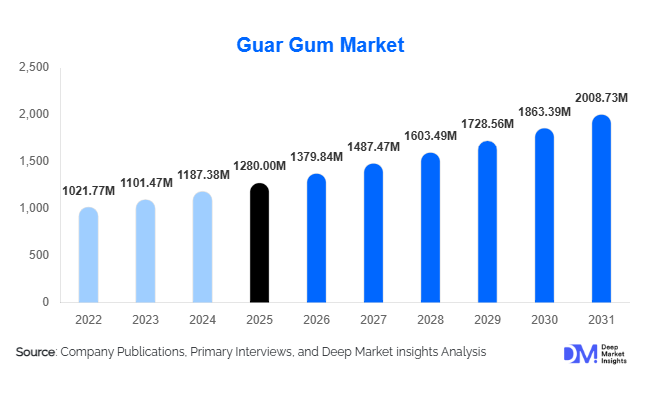
What are the latest trends in the guar gum market?
Rising Demand for Clean-Label Ingredients
The global food industry is undergoing a transformation toward natural and minimally processed ingredients, positioning guar gum as a preferred thickening and stabilizing agent. Food manufacturers are increasingly replacing synthetic additives with plant-based alternatives, particularly in dairy, bakery, and processed food applications. The surge in vegan, gluten-free, and organic food categories has significantly boosted guar gum demand. Regulatory frameworks in Europe and North America are further encouraging the use of natural hydrocolloids, reinforcing guar gum’s role in clean-label product formulations.
Expansion of Modified Guar Derivatives
Technological advancements have led to the development of modified guar derivatives such as hydroxypropyl guar and cationic guar, which offer enhanced functionality including improved solubility, thermal stability, and compatibility with other compounds. These derivatives are increasingly used in high-value applications such as cosmetics, pharmaceuticals, and specialty chemicals. The ability to customize guar gum properties for specific industrial needs is enabling manufacturers to capture premium pricing and expand into niche markets.
What are the key drivers in the guar gum market?
Growth in Oil & Gas Exploration Activities
The expansion of hydraulic fracturing activities, particularly in North America and emerging markets such as Argentina and China, is a major driver of guar gum demand. Guar gum plays a critical role in enhancing fluid viscosity in fracking operations, making it indispensable for efficient hydrocarbon extraction. Increasing global energy demand and investments in unconventional oil and gas reserves continue to support this segment’s growth.
Increasing Demand from Food Processing Industry
The rapid growth of the global food processing industry, driven by urbanization and changing dietary habits, is significantly boosting guar gum consumption. Its application as a stabilizer and thickener in processed foods aligns with consumer demand for texture, shelf-life enhancement, and natural ingredients. The rising popularity of convenience foods further accelerates this trend.
What are the restraints for the global market?
Supply Chain Dependency on Limited Regions
The global guar gum supply chain is highly concentrated in India, making it vulnerable to climatic conditions such as monsoon variability. Fluctuations in guar bean production directly impact pricing and availability, creating uncertainty for manufacturers and end-users.
Availability of Substitutes
Alternative hydrocolloids such as xanthan gum and locust bean gum pose competitive challenges, particularly in food and industrial applications. These substitutes can sometimes offer similar or improved performance, limiting guar gum’s market penetration in certain segments.
What are the key opportunities in the guar gum industry?
Expansion in Emerging Energy Markets
Countries such as Argentina, China, and regions in the Middle East are expanding shale gas exploration, creating significant opportunities for guar gum suppliers. As these markets develop their unconventional energy capabilities, demand for industrial-grade guar gum is expected to increase substantially.
Growth in Sustainable and Biodegradable Applications
Guar gum’s biodegradable and eco-friendly properties make it a strong candidate for emerging applications such as sustainable packaging, water treatment, and green industrial processes. Increasing environmental regulations and sustainability initiatives are likely to drive adoption in these areas.
Report Scope
| Report Metric | Details |
|---|---|
| Market Size in 2025 | USD 1280.00 Million |
| Market Size in 2026 | USD 1379.84 Million |
| Market Size in 2031 | USD 2008.73 Million |
| CAGR | 7.8% (2026-2031) |
| Base Year for Estimation | 2025 |
| Historical Data | 2022-2024 |
| Forecast Period | 2026-2031 |
| Report Coverage | Revenue Forecast, Competitive Landscape, Supply Chain Disruption, Growth Factors, Environment & Regulatory Landscape and Trends |
| Geographies Covered | North America, Europe, APAC, Middle East and Africa, LATAM |
| Countries Covered | U.S., Canada, U.K., Germany, France, Spain, Italy, Russia, Nordic, Benelux, Rest of Europe, China, Korea, Japan, India, Australia, Singapore, Taiwan, South East Asia, Rest of Asia-Pacific, UAE, Turky, Saudi Arabia, South Africa, Egypt, Nigeria, Rest of MEA, Brazil, Mexico, Argentina, Chile, Colombia, Rest of LATAM |
Explore more data points, trends and opportunities Download Free Sample Report
Product Type Insights
The guar gum market is segmented by product type into industrial-grade, food-grade, and pharmaceutical-grade variants, each catering to distinct end-use industries with varying functional requirements. Among these, industrial-grade guar gum continues to dominate the global market, accounting for approximately 48% of the total market share in 2025. The dominance of this segment is primarily driven by its extensive utilization in oilfield applications, particularly in hydraulic fracturing operations where guar gum is used as a thickening and stabilizing agent. Its ability to enhance viscosity, improve proppant transport, and optimize drilling efficiency makes it indispensable in oil and gas extraction processes. Additionally, the growing global energy demand and increasing investments in unconventional oil exploration activities are reinforcing the sustained demand for industrial-grade guar gum.Food-grade guar gum represents the second-largest segment, supported by the rising global demand for natural, plant-based, and clean-label food ingredients. As consumers increasingly shift toward healthier and minimally processed foods, manufacturers are incorporating guar gum as a natural thickener, stabilizer, and emulsifier in a wide range of food products, including dairy, bakery, sauces, and beverages. The segment is further benefiting from regulatory approvals across major markets, as guar gum is widely recognized as a safe food additive. The leading driver for this segment is the growing consumer preference for natural hydrocolloids over synthetic additives, which is encouraging food manufacturers to reformulate their products.Pharmaceutical-grade guar gum, although smaller in terms of volume, is emerging as a high-value segment due to its specialized applications in drug delivery systems, controlled-release formulations, and dietary fiber supplements. Its biocompatibility, non-toxicity, and ability to form gels make it highly suitable for pharmaceutical use. The segment is being driven by advancements in drug formulation technologies and the increasing focus on targeted drug delivery mechanisms. Furthermore, the rising prevalence of chronic diseases and the demand for innovative therapeutic solutions are expected to boost the adoption of pharmaceutical-grade guar gum over the forecast period.
Application Insights
Based on application, the guar gum market is broadly categorized into oil & gas, food & beverages, pharmaceuticals, cosmetics, textiles, paper manufacturing, and other industrial applications. The oil & gas segment dominates the market, contributing nearly 42% of the total market share. The leading driver for this segment is the widespread use of guar gum in hydraulic fracturing, where it plays a critical role in enhancing fluid viscosity and ensuring efficient extraction of hydrocarbons. The resurgence of shale gas exploration, particularly in North America and emerging regions, continues to drive significant demand for guar gum in this application.The food & beverages segment is the fastest-growing application area, fueled by the increasing adoption of clean-label and functional food ingredients. Guar gum is widely used to improve texture, extend shelf life, and enhance the sensory properties of food products. The leading driver for this segment is the growing global demand for processed and convenience foods, coupled with rising consumer awareness regarding natural and sustainable ingredients. The expansion of the food processing industry in developing economies is further accelerating segment growth.Other applications, including pharmaceuticals, cosmetics, textiles, and paper manufacturing, are witnessing steady growth due to the versatility of guar gum. In cosmetics, it is used as a conditioning and thickening agent in personal care products, while in textiles and paper manufacturing, it enhances binding and finishing properties. The pharmaceutical sector, in particular, is benefiting from increasing R&D activities focused on developing advanced drug delivery systems. The cumulative growth across these diverse applications underscores the multifunctional nature of guar gum and its expanding industrial relevance.
Distribution Channel Insights
The guar gum market is predominantly driven by B2B distribution channels, which account for around 80% of total sales. This dominance is attributed to the bulk nature of guar gum procurement, as it is primarily supplied to industrial users such as oilfield service providers, food manufacturers, and pharmaceutical companies. The leading driver for this segment is the strong demand for large-volume, consistent supply agreements between manufacturers and end-use industries, ensuring operational efficiency and cost optimization.Export trading companies play a crucial role in the global guar gum supply chain, particularly in connecting producers in India—the world’s largest producer—with international markets. These intermediaries facilitate logistics, quality assurance, and regulatory compliance, thereby enabling seamless cross-border trade. The importance of export trading channels is further amplified by the global nature of demand, as major consuming regions rely heavily on imports to meet their requirements.Online bulk suppliers are emerging as a niche but rapidly evolving distribution channel, catering to smaller buyers, specialty manufacturers, and research institutions. The growth of digital procurement platforms and e-commerce solutions is enabling greater transparency, price comparison, and accessibility for buyers. Although still a relatively small segment, the online channel is expected to gain traction in the coming years, driven by digital transformation across industries and the increasing preference for streamlined procurement processes.
End-Use Industry Insights
The oilfield services industry remains the largest end-use segment in the guar gum market, contributing approximately 40% of the global market. The leading driver for this dominance is the critical role of guar gum in hydraulic fracturing and drilling operations, where it enhances fluid performance and operational efficiency. The continued expansion of shale gas exploration and the increasing focus on energy security are expected to sustain demand from this sector.The food processing industry is the fastest-growing end-use segment, supported by the rising global consumption of processed and convenience foods. Guar gum is widely used in food formulations to improve texture, stability, and shelf life. The leading driver for this segment is the increasing consumer demand for natural and functional ingredients, which is prompting manufacturers to incorporate guar gum into a wide range of products. Additionally, the growth of organized retail and foodservice industries is further contributing to the expansion of this segment.Pharmaceutical and personal care industries are also gaining traction as key end-use segments. In pharmaceuticals, guar gum is used in controlled-release drug formulations and dietary supplements, while in personal care products, it serves as a thickening and conditioning agent. The growth of these segments is driven by increasing health awareness, rising disposable incomes, and the growing demand for high-quality personal care and healthcare products. The diversification of end-use industries highlights the broad applicability of guar gum and its potential for sustained market growth.
Explore more data points, trends and opportunities Download Free Sample Report
Guar Gum Market Segmentations
By Product Type
- Food Grade Guar Gum
- Industrial Grade Guar Gum
- Pharmaceutical Grade Guar Gum
By Application
- Food & Beverages
- Oil & Gas
- Pharmaceuticals
- Cosmetics & Personal Care
- Textile Processing
- Paper & Pulp Industry
- Mining & Explosives
By Form
- Powder
- Splits
By Distribution Channel
- B2B (Direct Industrial Supply)
- Export/Trading Companies
- Online Bulk Suppliers
By End-Use Industry
- Food Processing Industry
- Oilfield Services Industry
- Pharmaceutical Industry
- Personal Care Industry
- Industrial Manufacturing
Regional Insights
Asia-Pacific
Asia-Pacific dominates the global guar gum market, accounting for around 45% of the market share in 2025. The region’s leadership is primarily driven by India, which contributes over 80% of global guar production and exports. The abundance of raw materials, favorable climatic conditions for guar cultivation, and well-established processing infrastructure provide a strong foundation for market growth. China, on the other hand, represents a major consumption hub, with significant demand from food processing and oil industries.The leading drivers for regional growth include the strong agricultural base supporting guar cultivation, increasing industrialization, and rising demand from diverse end-use industries. Government initiatives promoting agricultural exports and value-added processing are further strengthening the market. Additionally, the rapid expansion of the food processing sector and growing investments in oil and gas exploration in countries such as China and India are contributing to sustained demand. The region’s cost competitiveness and supply chain efficiency make it a critical player in the global guar gum market.
North America
North America holds approximately 30% of the global market share, with the United States being the largest consumer of guar gum worldwide. The region’s dominance is largely attributed to its extensive shale gas exploration activities and high consumption of guar gum in hydraulic fracturing operations. The presence of advanced oilfield technologies and continuous investments in energy infrastructure further support market growth.The leading drivers for regional growth include the resurgence of shale gas production, increasing energy demand, and technological advancements in drilling techniques. Additionally, the region’s well-developed food and pharmaceutical industries contribute to steady demand for guar gum in non-oilfield applications. The growing emphasis on sustainable and natural ingredients in food products is also boosting demand in the food & beverages sector. Overall, North America’s strong industrial base and innovation-driven environment position it as a key market for guar gum.
Europe
Europe accounts for approximately 15% of the global guar gum market, with key demand originating from countries such as Germany, France, and the United Kingdom. The region is characterized by a strong focus on sustainability, clean-label products, and stringent regulatory standards, which favor the use of natural additives like guar gum.The leading drivers for regional growth include increasing consumer preference for plant-based and environmentally friendly ingredients, as well as stringent food safety regulations that encourage the use of approved natural hydrocolloids. The pharmaceutical industry in Europe is also contributing to demand, driven by ongoing research and development activities. Furthermore, the region’s advanced food processing sector and growing demand for functional foods are supporting market expansion. Europe’s emphasis on quality and sustainability continues to drive the adoption of guar gum across multiple applications.
Latin America
Latin America is an emerging market for guar gum, with countries such as Brazil and Argentina demonstrating strong growth potential. Argentina, in particular, is witnessing increased demand due to expanding shale gas exploration activities, positioning it as one of the fastest-growing markets in the region.The leading drivers for regional growth include rising investments in oil and gas exploration, increasing industrialization, and the gradual expansion of the food processing industry. The region is also benefiting from improving trade relations and growing awareness of guar gum’s functional properties. As energy exploration activities continue to expand, the demand for guar gum in oilfield applications is expected to rise significantly, driving overall market growth in Latin America.
Middle East & Africa
The Middle East & Africa region is gaining traction in the guar gum market, supported by increasing oilfield activities in countries such as Saudi Arabia and the United Arab Emirates. The region’s strategic focus on energy production and exploration is driving demand for guar gum in drilling and fracturing operations.The leading drivers for regional growth include the expansion of oil and gas projects, rising investments in energy infrastructure, and efforts to diversify economies. Additionally, some countries in the region are exploring local guar cultivation to reduce dependency on imports and ensure supply stability. The growing food processing industry and increasing adoption of natural additives are also contributing to demand. As the region continues to invest in industrial development and energy exploration, the guar gum market is expected to witness steady growth.
Key Players in the Guar Gum Market
- Vikas WSP Ltd.
- Hindustan Gum & Chemicals Ltd.
- Rama Gum Industries
- Jai Bharat Gum & Chemicals Ltd.
- Shree Ram Industries
- Lucid Colloids Ltd.
- Neelkanth Polymers
- Premcem Gums Pvt. Ltd.
- Ashwin Exports
- Raj Gum Industries
- Altrafine Gums
- India Glycols Ltd.
- Supreme Gums Pvt. Ltd.
- Agro Gums
- Shubham Starch Chem Pvt. Ltd.