Ground Beef Market Size
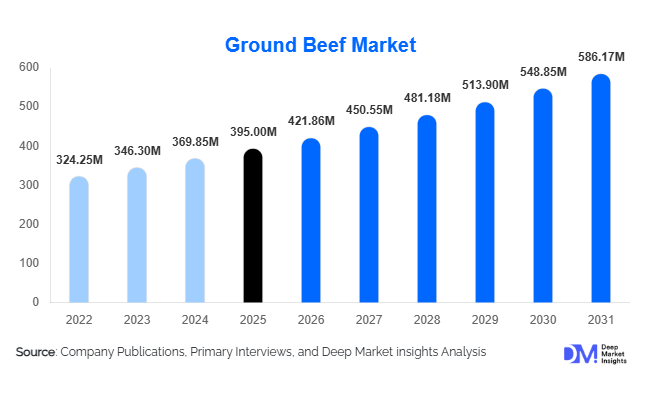
According to Deep Market Insights, the global ground beef market size was valued at USD 395.0 billion in 2025 and is projected to grow from USD 421.86 billion in 2026 to reach USD 586.17 billion by 2031, expanding at a CAGR of 6.8% during the forecast period (2026–2031).The ground beef market growth is primarily driven by rising global protein consumption, increasing demand from quick-service restaurants (QSRs), and expanding cold chain and retail infrastructure worldwide. Ground beef continues to be a staple meat product due to its affordability, versatility, and wide applicability across cuisines, ranging from burgers and meatballs to processed ready meals.
Key Market Insights
- Lean ground beef is gaining traction globally, driven by increasing consumer preference for healthier, lower-fat protein options.
- Foodservice channels dominate demand, particularly due to the rapid expansion of QSR chains and global burger consumption.
- North America leads the market, supported by high per capita beef consumption and a mature meat processing industry.
- Asia-Pacific is the fastest-growing region, fueled by urbanization, rising disposable incomes, and westernized dietary patterns.
- Premiumization trends, including organic, grass-fed, and antibiotic-free beef, are expanding high-margin product segments.
- Advancements in packaging technologies, such as modified atmosphere packaging (MAP), are improving shelf life and distribution efficiency.
What are the latest trends in the ground beef market?
Shift Toward Premium and Clean-Label Beef Products
The ground beef market is increasingly witnessing a shift toward premium and clean-label products. Consumers are actively seeking organic, grass-fed, and antibiotic-free beef variants, driven by rising awareness around health, sustainability, and ethical sourcing. This has led to the emergence of branded premium ground beef offerings that command significantly higher prices than conventional products. Retailers and processors are focusing on transparency, labeling, and traceability, enabling consumers to make informed purchasing decisions. This trend is particularly strong in North America and Europe, where consumers are willing to pay a premium for quality assurance and environmental responsibility.
Expansion of Processed and Convenience Food Applications
Ground beef is increasingly being integrated into processed and ready-to-eat food categories, including frozen meals, packaged snacks, and pre-seasoned products. The growth of urban lifestyles and demand for convenience foods has accelerated the adoption of value-added ground beef products such as pre-formed patties and marinated meat mixes. Food manufacturers are innovating with flavors and packaging formats to cater to evolving consumer preferences. This trend is especially prominent in emerging economies, where convenience foods are gaining popularity among younger demographics and working professionals.
What are the key drivers in the ground beef market?
Rising Global Protein Consumption
The increasing demand for animal-based protein is a major driver of the ground beef market. As disposable incomes rise in developing countries, dietary patterns are shifting toward higher meat consumption. Ground beef, being relatively affordable compared to premium cuts, is benefiting significantly from this trend. It serves as a key protein source in both developed and emerging markets, contributing to consistent demand growth.
Growth of Quick-Service Restaurants (QSRs)
The rapid expansion of QSR chains globally has created strong and sustained demand for ground beef. Burgers remain one of the most consumed fast-food items worldwide, and ground beef is a core ingredient. The proliferation of international and regional fast-food brands, along with the rise of cloud kitchens and food delivery platforms, is further accelerating demand. This driver is particularly impactful in Asia-Pacific and Latin America, where QSR penetration is increasing rapidly.
What are the restraints for the global market?
Volatility in Raw Material Prices
Fluctuations in cattle prices and feed costs significantly impact the production cost of ground beef. External factors such as climate change, supply chain disruptions, and feed availability contribute to price volatility, affecting profit margins for producers and processors. This creates uncertainty in pricing and supply, posing a challenge for market participants.
Health and Environmental Concerns
Growing awareness about the health risks associated with red meat consumption, including cardiovascular diseases, is influencing consumer behavior. Additionally, environmental concerns related to greenhouse gas emissions from cattle farming are leading to increased scrutiny and regulatory pressures. These factors are encouraging some consumers to reduce beef consumption or shift toward alternative protein sources, acting as a restraint on market growth.
What are the key opportunities in the ground beef industry?
Expansion in Emerging Markets
Emerging economies in Asia-Pacific, the Middle East, and Latin America present significant growth opportunities for the ground beef market. Rapid urbanization, increasing disposable incomes, and changing dietary habits are driving demand for meat-based products. The expansion of retail infrastructure and foodservice chains in these regions is creating new consumption avenues for ground beef.
Technological Advancements in Processing and Traceability
Technological innovations such as automation in meat processing, blockchain-based traceability systems, and advanced cold chain logistics are transforming the ground beef industry. These technologies enhance operational efficiency, ensure product safety, and build consumer trust. Companies investing in digital supply chains and traceability solutions can gain a competitive advantage, particularly in markets with stringent food safety regulations.
Report Scope
| Report Metric | Details |
|---|---|
| Market Size in 2025 | USD 395 Million |
| Market Size in 2026 | USD 421.86 Million |
| Market Size in 2031 | USD 586.17 Million |
| CAGR | 6.8% (2026-2031) |
| Base Year for Estimation | 2025 |
| Historical Data | 2022-2024 |
| Forecast Period | 2026-2031 |
| Report Coverage | Revenue Forecast, Competitive Landscape, Supply Chain Disruption, Growth Factors, Environment & Regulatory Landscape and Trends |
| Geographies Covered | North America, Europe, APAC, Middle East and Africa, LATAM |
| Countries Covered | U.S., Canada, U.K., Germany, France, Spain, Italy, Russia, Nordic, Benelux, Rest of Europe, China, Korea, Japan, India, Australia, Singapore, Taiwan, South East Asia, Rest of Asia-Pacific, UAE, Turky, Saudi Arabia, South Africa, Egypt, Nigeria, Rest of MEA, Brazil, Mexico, Argentina, Chile, Colombia, Rest of LATAM |
Explore more data points, trends and opportunities Download Free Sample Report
Product Type Insights
The global ground beef market is strongly led by the lean ground beef segment (80–89% lean), which accounts for approximately 34% of the total market share in 2025. This dominance is primarily driven by a structural shift in consumer behavior toward healthier eating patterns, where protein intake is maintained while fat consumption is moderated. Lean ground beef offers an optimal balance between flavor retention and reduced fat content, making it highly appealing to health-conscious consumers who are not willing to compromise on taste. Increasing awareness around obesity, cardiovascular diseases, and dietary management has significantly influenced purchasing decisions, particularly in developed markets where nutritional labeling and transparency are prioritized.Regular ground beef continues to maintain a significant presence in the global market, particularly in price-sensitive regions where affordability remains a key purchasing determinant. This segment is widely consumed in emerging economies and among lower- to middle-income households, where cost considerations often outweigh nutritional preferences. Its higher fat content enhances flavor and juiciness, making it a preferred choice for traditional recipes and street food applications. The consistent demand for regular ground beef is also supported by its extensive use in mass-market foodservice establishments, where cost efficiency is critical.Premium ground beef, including organic, grass-fed, and hormone-free variants, represents the fastest-growing segment within the product type category. The growth of this segment is driven by increasing consumer awareness regarding food safety, animal welfare, and environmental sustainability. Consumers are increasingly willing to pay a premium for products that align with their values, particularly in developed markets such as North America and Europe. The rising influence of clean-label trends and the demand for minimally processed foods are also contributing to the expansion of this segment. Furthermore, premium products are gaining traction in high-end restaurants and specialty retail stores, where differentiation and quality are key competitive factors.The leading driver for the product type segment overall is the growing consumer preference for healthier and higher-quality protein sources, which is reshaping demand patterns across both developed and emerging markets. This shift is encouraging producers to diversify their offerings and invest in premiumization strategies to capture evolving consumer demand.
Application Insights
The foodservice industry remains the largest application segment in the global ground beef market, accounting for nearly 48% of the market share in 2025. This dominance is primarily attributed to the widespread popularity of beef-based fast food products, particularly burgers, which are a staple offering across quick-service restaurants (QSRs), casual dining establishments, and food trucks. The rapid expansion of global QSR chains, coupled with increasing urbanization and changing lifestyles, has significantly boosted the consumption of ground beef in the foodservice sector. Consumers are increasingly opting for convenient dining options, leading to higher footfall in restaurants and increased demand for ground beef as a key ingredient.Household consumption represents another significant application segment, particularly in developed regions where home cooking remains prevalent. The COVID-19 pandemic reinforced cooking-at-home habits, many of which have persisted, leading to sustained demand for ground beef in retail channels. Consumers appreciate the convenience, affordability, and versatility of ground beef, which can be used in a wide range of recipes. Additionally, the availability of pre-packaged and portion-controlled products has made it easier for households to incorporate ground beef into their daily meals.The food processing industry is emerging as a high-growth segment within the application category. This growth is driven by the increasing demand for ready-to-eat (RTE) and ready-to-cook (RTC) meals, which often include ground beef as a primary ingredient. Frozen foods, packaged meals, and convenience products are gaining popularity due to busy lifestyles and the need for quick meal solutions. Food manufacturers are leveraging ground beef to develop innovative products that cater to evolving consumer preferences, including healthier and premium options.The leading driver for the application segment is the rapid expansion of the global foodservice industry, supported by urbanization, rising disposable incomes, and changing consumer lifestyles that favor convenience and dining out.
Distribution Channel Insights
Supermarkets and hypermarkets dominate the distribution channel landscape, accounting for approximately 42% of the global market share. These retail formats offer a comprehensive range of ground beef products, including regular, lean, and premium variants, enabling consumers to choose based on their preferences and budgets. The dominance of this channel is driven by factors such as strong supply chain infrastructure, competitive pricing, and high consumer trust. Supermarkets and hypermarkets also provide an enhanced shopping experience, with clear product labeling, freshness assurance, and promotional offers that attract a wide customer base.Foodservice distribution channels also play a crucial role in the market, driven by bulk demand from restaurants, hotels, and catering services. These channels ensure consistent supply and quality, which are critical for foodservice operators. Suppliers often establish long-term contracts with foodservice providers to secure stable demand and streamline operations. The growth of the hospitality industry and large-scale events has further strengthened this distribution segment.Online meat delivery platforms are rapidly gaining traction, particularly in urban areas where digital adoption is high. The growth of e-commerce and changing consumer preferences toward convenience have led to increased demand for online grocery and meat delivery services. These platforms offer benefits such as doorstep delivery, product customization, and access to premium and specialty products that may not be available in traditional retail outlets. Technological advancements in cold chain logistics and packaging have also improved the reliability and safety of online meat delivery, boosting consumer confidence.The leading driver for the distribution channel segment is the expansion of organized retail and e-commerce platforms, which are enhancing product accessibility and convenience for consumers worldwide.
End-Use Insights
The foodservice sector is the largest end-use segment in the global ground beef market, with a market size exceeding USD 180,000 million in 2026 and growing at a CAGR of over 7.5%. This growth is primarily driven by the rapid expansion of QSR chains, increasing consumer preference for dining out, and the rising popularity of beef-based menu items. The foodservice sector benefits from economies of scale, allowing operators to source ground beef in bulk at competitive prices. Additionally, menu standardization and brand consistency across global chains ensure sustained demand for ground beef.Household consumption remains a stable and significant end-use segment, supported by consistent demand for home-cooked meals. Consumers value ground beef for its versatility, affordability, and ease of preparation. The segment is further supported by the availability of diverse product formats, including frozen, chilled, and ready-to-cook options. Marketing campaigns emphasizing health benefits and quality assurance are also influencing consumer purchasing decisions.The food processing industry is experiencing rapid growth as an end-use segment, driven by the increasing demand for convenience foods. Manufacturers are incorporating ground beef into a wide range of products, including frozen meals, canned foods, and snack items. The growth of this segment is closely linked to changing lifestyles, where consumers seek quick and easy meal solutions without compromising on taste and nutrition.Export-driven demand is another important factor shaping the end-use landscape. Major beef-producing countries are increasingly supplying ground beef to high-consumption regions, leveraging trade agreements and efficient supply chains. This trend is particularly evident in regions with limited domestic production capacity but high demand for beef products.The leading driver for the end-use segment is the expansion of the global foodservice sector, which continues to drive large-scale consumption of ground beef across various formats and cuisines.
Explore more data points, trends and opportunities Download Free Sample Report
Ground Beef Market Segmentations
By Product Type
- Regular Ground Beef
- Lean Ground Beef
- Extra Lean Ground Beef
- Premium/Branded Ground Beef
By Application
- Household Consumption
- Foodservice Industry
- Food Processing Industry
By Distribution Channel
- Supermarkets/Hypermarkets
- Convenience Stores
- Butcher Shops
- Foodservice Distribution
- Online/E-commerce Platforms
Regional Insights
North America
North America holds the largest share of the global ground beef market, accounting for approximately 38% of the market in 2025. The region’s dominance is primarily driven by high per capita beef consumption, particularly in the United States, where ground beef is a staple ingredient in everyday diets. The well-established foodservice industry, characterized by a strong presence of QSR chains and casual dining restaurants, significantly contributes to market growth. Canada also plays a vital role, supported by robust domestic consumption and strong export capabilities.Key growth drivers in North America include advanced meat processing infrastructure, high consumer awareness regarding product quality, and strong demand for premium and organic beef products. The region also benefits from efficient supply chains and stringent food safety regulations, which enhance consumer trust. Additionally, the increasing popularity of high-protein diets and keto-friendly meal plans is further boosting demand for ground beef.
Europe
Europe accounts for around 25% of the global market share, with major contributions from countries such as Germany, the United Kingdom, and France. The region is characterized by a strong preference for premium and sustainably sourced beef products. Stringent regulatory frameworks governing food safety, animal welfare, and environmental sustainability play a crucial role in shaping market dynamics.The primary drivers of regional growth include rising consumer demand for organic and grass-fed beef, increasing awareness of ethical sourcing, and the expansion of specialty retail channels. Additionally, the growing trend of flexitarian diets has led to a shift toward higher-quality meat consumption, even as overall meat intake stabilizes. Innovation in product offerings, including ready-to-cook and gourmet options, is also contributing to market expansion.
Asia-Pacific
Asia-Pacific is the fastest-growing region in the global ground beef market, with a projected CAGR of over 8.5%. Key markets such as China, India, and Japan are driving this growth, supported by rapid urbanization, rising disposable incomes, and changing dietary preferences. The increasing influence of Western food culture, particularly the popularity of burgers and fast food, is significantly boosting demand for ground beef.Regional growth is further driven by the expansion of modern retail infrastructure, including supermarkets, hypermarkets, and online platforms. The proliferation of international and domestic QSR chains is also contributing to increased consumption. Additionally, improvements in cold chain logistics and supply chain efficiency are enhancing product availability and quality across the region.
Latin America
Latin America holds approximately 12% of the global market share, with Brazil and Argentina being major contributors. The region is a key producer and exporter of beef, supported by abundant livestock resources and favorable climatic conditions. Strong cultural preferences for meat-based diets further drive domestic consumption.The main drivers of growth in Latin America include increasing export demand, rising urbanization, and the expansion of the foodservice sector. Government support for the livestock industry and investments in processing infrastructure are also contributing to market development. Additionally, the growing middle class is driving demand for higher-quality beef products.
Middle East & Africa
The Middle East & Africa region is witnessing steady growth in the ground beef market, driven by increasing imports and rising urbanization. Countries such as Saudi Arabia and the UAE serve as key demand centers, supported by growing populations and expanding foodservice industries.Key growth drivers in this region include rising disposable incomes, increasing tourism, and the proliferation of international restaurant chains. The demand for halal-certified beef products is also a significant factor shaping market dynamics. Additionally, improvements in retail infrastructure and cold chain logistics are enhancing product accessibility and quality, further supporting market growth.
Key Players in the Ground Beef Market
- Tyson Foods
- JBS S.A.
- Cargill Inc.
- Marfrig Global Foods
- Hormel Foods
- BRF S.A.
- Minerva Foods
- Perdue Farms
- Sanderson Farms
- OSI Group
- Danish Crown
- NH Foods Ltd.
- Maple Leaf Foods
- Smithfield Foods
- Vion Food Group