Grape Seed Oil Market Size
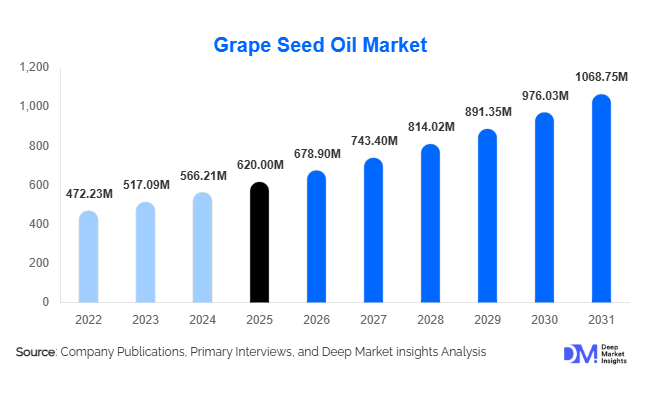
According to Deep Market Insights, the global grape seed oil market size was valued at USD 580 million in 2025 and is projected to grow from USD 678.90 million in 2026 to reach USD 1,068.75 million by 2031, expanding at a CAGR of 9.5% during the forecast period (2026–2031). The grape seed oil market growth is primarily driven by increasing consumer preference for healthy edible oils, rising demand for natural ingredients in cosmetics and personal care products, and expanding utilization of wine industry by-products in sustainable production processes.
Key Market Insights
- Grape seed oil is gaining traction as a premium healthy oil, supported by its high antioxidant content and favorable fatty acid profile.
- The cosmetics and personal care industry is emerging as a major demand driver, leveraging grape seed oil in clean-label skincare and haircare formulations.
- Europe dominates the global market, benefiting from strong wine production and established processing infrastructure.
- Asia-Pacific is the fastest-growing region, driven by rising disposable incomes and increasing awareness of natural products.
- Organic and cold-pressed variants are witnessing accelerated demand, supported by premiumization and clean-label trends.
- Sustainability and circular economy practices, including the use of winery waste, are strengthening the market’s long-term outlook.
What are the latest trends in the grape seed oil market?
Rising Demand for Clean-Label and Organic Oils
Consumers are increasingly shifting toward organic and minimally processed oils, driving demand for cold-pressed and certified organic grape seed oil. This trend is particularly strong in North America and Europe, where regulatory frameworks and consumer awareness around clean-label products are well established. Manufacturers are responding by investing in organic certification, transparent sourcing, and eco-friendly packaging solutions. The premium positioning of organic grape seed oil is enabling higher margins while attracting health-conscious consumers seeking chemical-free and sustainable alternatives.
Expansion in Cosmetic and Personal Care Applications
The integration of grape seed oil in cosmetics and personal care products is rapidly expanding. Its lightweight texture, non-comedogenic properties, and high vitamin E content make it an ideal ingredient for skincare, haircare, and massage oils. The global shift toward vegan and cruelty-free beauty products is further accelerating adoption. Cosmetic manufacturers are increasingly incorporating grape seed oil into anti-aging formulations, serums, and dermatological products, positioning it as a key ingredient in the clean beauty movement.
What are the key drivers in the grape seed oil market?
Growing Demand for Healthy Edible Oils
The increasing focus on health and wellness is driving consumers to shift away from traditional cooking oils toward healthier alternatives. Grape seed oil, rich in polyunsaturated fats and antioxidants, is gaining popularity among health-conscious consumers. Its high smoke point and neutral flavor make it suitable for a wide range of culinary applications, further boosting its adoption in both household and commercial kitchens.
Growth of Natural Cosmetics Industry
The global cosmetics industry is undergoing a transformation toward natural and plant-based ingredients. Grape seed oil’s anti-inflammatory and antioxidant properties make it a preferred ingredient in skincare and haircare formulations. This trend is particularly strong in developed markets, where consumers are willing to pay a premium for clean and sustainable beauty products.
Utilization of Wine Industry By-Products
The availability of grape seeds as a by-product of wine production is supporting cost-effective raw material sourcing. This not only reduces waste but also aligns with sustainability initiatives, making grape seed oil an environmentally friendly product. Increasing wine production globally is indirectly contributing to the growth of the grape seed oil market.
What are the restraints for the global market?
Price Volatility and Raw Material Dependency
The grape seed oil market is highly dependent on grape production, which is influenced by climatic conditions and agricultural cycles. Fluctuations in grape harvests can lead to inconsistent supply and price volatility, impacting production costs and profitability for manufacturers.
Limited Awareness in Emerging Markets
Despite its health benefits, grape seed oil remains relatively unknown in many developing regions. High pricing compared to conventional oils such as sunflower or soybean oil further limits its adoption among price-sensitive consumers, restricting market penetration in emerging economies.
What are the key opportunities in the grape seed oil industry?
Growth in Nutraceutical and Functional Food Applications
The increasing demand for functional foods and dietary supplements presents significant opportunities for grape seed oil manufacturers. Its antioxidant properties make it suitable for cardiovascular health products, capsules, and fortified foods. Expanding nutraceutical markets in Asia-Pacific are expected to drive substantial growth.
Expansion in Emerging Markets
Rising disposable incomes and urbanization in regions such as Asia-Pacific, Latin America, and the Middle East are creating new demand for premium edible oils and natural cosmetics. Strategic market entry, partnerships, and localized production can help companies capitalize on these emerging opportunities.
Report Scope
| Report Metric | Details |
|---|---|
| Market Size in 2025 | USD 620.00 Million |
| Market Size in 2026 | USD 678.90 Million |
| Market Size in 2031 | USD 1068.75 Million |
| CAGR | 9.5% (2026-2031) |
| Base Year for Estimation | 2025 |
| Historical Data | 2022-2024 |
| Forecast Period | 2026-2031 |
| Report Coverage | Revenue Forecast, Competitive Landscape, Supply Chain Disruption, Growth Factors, Environment & Regulatory Landscape and Trends |
| Geographies Covered | North America, Europe, APAC, Middle East and Africa, LATAM |
| Countries Covered | U.S., Canada, U.K., Germany, France, Spain, Italy, Russia, Nordic, Benelux, Rest of Europe, China, Korea, Japan, India, Australia, Singapore, Taiwan, South East Asia, Rest of Asia-Pacific, UAE, Turky, Saudi Arabia, South Africa, Egypt, Nigeria, Rest of MEA, Brazil, Mexico, Argentina, Chile, Colombia, Rest of LATAM |
Explore more data points, trends and opportunities Download Free Sample Report
Product Type Insights
Refined grape seed oil continues to dominate the global grape seed oil market, accounting for approximately 62% of the total market share in 2025. This dominance is primarily attributed to its superior versatility, neutral taste profile, high oxidative stability, and extended shelf life, all of which make it highly suitable for a wide range of culinary and industrial applications. Unlike unrefined variants, refined grape seed oil undergoes processing that removes impurities, color, and strong flavor compounds, thereby making it more adaptable for large-scale food manufacturing and consistent product formulation. Its high smoke point further strengthens its position, as it is widely preferred for frying, sautéing, roasting, and other high-temperature cooking methods without compromising nutritional integrity or flavor consistency. The leading driver of growth in this segment is the expanding global demand for health-oriented cooking oils that combine functionality with perceived wellness benefits. As consumers increasingly shift away from saturated fats and trans fats, refined grape seed oil has emerged as a desirable alternative due to its high content of polyunsaturated fatty acids, particularly linoleic acid, and its association with heart health benefits. Additionally, its widespread adoption in the food processing industry, where consistency, scalability, and cost efficiency are critical, further reinforces its dominance. Industrial food manufacturers prefer refined grape seed oil due to its long shelf stability, ease of blending with other ingredients, and compatibility with packaged food products such as snacks, baked goods, and ready-to-eat meals. The growth of the processed food sector globally continues to act as a structural driver supporting long-term expansion of this segment.
Application Insights
The food and beverages application segment leads the global grape seed oil market with nearly 45% share, making it the largest application area in terms of consumption volume. Grape seed oil is increasingly incorporated into a wide range of culinary applications, including cooking oils, salad dressings, marinades, bakery products, and processed foods. Its mild flavor profile allows it to blend seamlessly into food formulations without altering taste, while its nutritional profile adds functional value, particularly in health-conscious product categories. Its high smoke point and oxidative stability also make it a preferred ingredient for frying and food preparation in both household and commercial kitchens. The key growth driver for this segment is the global shift toward healthier eating habits and clean-label food products. Consumers are becoming more aware of the negative health impacts of heavily processed fats and are actively seeking oils with better lipid profiles and natural origins. This trend is particularly strong in urban populations, where lifestyle-related diseases have increased demand for heart-friendly dietary alternatives. Additionally, the rising popularity of Mediterranean and plant-based diets has further elevated the use of grape seed oil in gourmet cooking and premium food products. Food manufacturers are also leveraging grape seed oil to position their offerings as premium, health-focused products, thereby enhancing brand value and consumer appeal.
Distribution Channel Insights
Business-to-business (B2B) channels dominate the grape seed oil market, accounting for approximately 65% of total distribution. This dominance is primarily driven by large-scale procurement from food processing companies, cosmetic manufacturers, pharmaceutical firms, and industrial users. These buyers require consistent bulk supply, standardized quality, and long-term contractual sourcing agreements, all of which are efficiently facilitated through B2B distribution networks. The B2B ecosystem ensures streamlined logistics, cost efficiency, and supply chain stability, making it the preferred channel for industrial consumption. The primary driver of this segment is the rapid expansion of industrial applications across food processing and personal care manufacturing sectors. As these industries scale globally, particularly in emerging economies, the demand for raw ingredients such as grape seed oil has increased significantly. Additionally, the growing trend of contract manufacturing and private label production in cosmetics and packaged foods has strengthened the role of B2B procurement channels. However, while B2B remains dominant, the online retail segment is experiencing notable growth due to increasing consumer preference for direct-to-consumer purchasing models, especially for organic, cold-pressed, and premium-grade oils. Digital marketplaces and e-commerce platforms are making specialty oils more accessible to individual consumers, thereby gradually diversifying the distribution landscape.
End-Use Industry Insights
The cosmetics and personal care industry accounts for nearly 35% of the global grape seed oil market, positioning it as one of the most influential end-use sectors. Grape seed oil is highly valued in this industry due to its lightweight texture, non-comedogenic properties, and rich antioxidant content, particularly vitamin E and phenolic compounds. It is widely used in skincare formulations, moisturizers, anti-aging creams, serums, hair oils, and massage oils. Its ability to penetrate the skin easily without leaving a greasy residue makes it especially popular in premium cosmetic formulations. The key driver for growth in this segment is the accelerating global demand for natural, plant-based, and clean-label beauty products. Consumers are increasingly rejecting synthetic chemicals in favor of botanical and sustainably sourced ingredients, pushing cosmetic manufacturers to reformulate products with natural oils like grape seed oil. The clean beauty movement, coupled with rising awareness of skin health and long-term dermatological safety, has significantly expanded the application of grape seed oil in personal care. Additionally, the rapid expansion of the wellness and self-care industry, especially in urban markets, continues to fuel demand for multifunctional natural oils that offer both cosmetic and therapeutic benefits. This has positioned grape seed oil as a core ingredient in premium and dermatologically sensitive product lines.
Explore more data points, trends and opportunities Download Free Sample Report
Grape Seed Oil Market Segmentations
By Extraction Method
- Cold-Pressed Extraction
- Expeller-Pressed Extraction
- Solvent Extraction
- Supercritical CO₂ Extraction
By Product Type
- Refined Grape Seed Oil
- Unrefined (Virgin) Grape Seed Oil
By Nature
- Conventional
- Organic
By Application
- Food & Beverages
- Cosmetics & Personal Care
- Pharmaceuticals & Nutraceuticals
- Industrial Applications
By Distribution Channel
- B2B
- B2C
By End-Use Industry
- Food Processing Industry
- Cosmetic & Personal Care Industry
- Pharmaceutical Industry
- Hospitality & Foodservice
- Retail Consumers
Regional Insights
Europe
Europe holds the largest share of approximately 35% of the global grape seed oil market in 2025, making it the most mature and established regional market. The region benefits significantly from its strong wine production industry, particularly in countries such as France, Italy, Spain, and Germany, which ensures a steady and abundant supply of grape seeds as a by-product of winemaking. This availability of raw material provides a structural advantage in production cost and supply chain integration. Europe also has a highly developed food processing and cosmetics industry, both of which are major consumers of grape seed oil. The primary drivers of regional growth include strong consumer awareness regarding health and wellness, stringent regulations promoting natural and sustainable ingredients, and the deep-rooted tradition of using plant-based oils in culinary and cosmetic applications. Additionally, the European clean beauty movement is one of the most advanced globally, with consumers actively preferring organic, cold-pressed, and sustainably sourced ingredients. This has significantly boosted demand for grape seed oil in skincare and personal care formulations. The presence of established cosmetic brands and premium food manufacturers further strengthens Europe’s dominance in the global market.
North America
North America accounts for around 28% of the global market share, with the United States being the dominant contributor. The region exhibits strong demand across both food and cosmetic applications, supported by high consumer purchasing power and advanced retail infrastructure. The United States, in particular, has seen increasing adoption of healthy cooking oils as part of broader dietary shifts toward organic and non-GMO food products. Grape seed oil is widely used in salad dressings, gourmet cooking, and packaged health foods. The key growth drivers in North America include rising health consciousness, strong penetration of organic food culture, and rapid expansion of the premium cosmetics sector. The region also benefits from a highly developed e-commerce ecosystem, which has made specialty oils more accessible to consumers. Furthermore, increasing preference for plant-based diets and functional foods has significantly contributed to demand growth. Cosmetic manufacturers in North America are also incorporating grape seed oil into anti-aging and dermatology-focused formulations, further expanding its industrial footprint.
Asia-Pacific
Asia-Pacific is the fastest-growing regional market, with a CAGR exceeding 11%, driven by rapid urbanization, rising disposable incomes, and growing awareness of health and wellness trends. Countries such as China, India, Japan, and South Korea are emerging as key growth hubs. While the region is still largely import-dependent for grape seed oil, demand is expanding rapidly due to increasing consumption of premium cooking oils and natural cosmetic products. The major drivers of growth in Asia-Pacific include a rapidly expanding middle-class population, increasing influence of Western dietary and beauty trends, and growing penetration of e-commerce platforms that facilitate access to imported specialty oils. The cosmetics industry in countries like South Korea and Japan is particularly influential, driving strong demand for grape seed oil in skincare and beauty formulations. Additionally, rising incidences of lifestyle-related health conditions are encouraging consumers to adopt healthier cooking alternatives, further boosting market penetration.
Latin America
Latin America represents a moderate but steadily growing market, with key contributions from countries such as Brazil, Argentina, and Chile. The region benefits from a growing food processing industry and increasing export-oriented agricultural production. Grape seed oil demand is primarily driven by its use in processed foods and emerging cosmetic applications. The key growth drivers include expanding urban populations, gradual increase in disposable income, and growing awareness of health-conscious dietary habits. Additionally, Latin America’s strong agricultural base, including wine production in certain regions, supports local availability of raw materials. The expansion of retail and supermarket chains has also improved product accessibility, contributing to market growth.
Middle East & Africa
The Middle East & Africa region is witnessing gradual but consistent growth, with notable demand emerging from countries such as the United Arab Emirates, Saudi Arabia, and South Africa. The market is primarily driven by increasing demand for premium food products, expanding hospitality and tourism sectors, and rising interest in imported health and wellness products. Key growth drivers include a growing affluent population with preference for high-quality imported oils, expansion of luxury hospitality and food service industries, and increasing adoption of natural cosmetic ingredients in personal care products. The region’s warm climate also encourages demand for lightweight, non-greasy oils such as grape seed oil in skincare applications. Additionally, the growing influence of Western lifestyle trends is further accelerating market penetration in both food and cosmetic sectors.
Key Players in the Grape Seed Oil Market
- Borges International Group
- Olitalia S.r.l.
- Tampieri Group
- Gustav Heess GmbH
- Mediaco Vrac
- Aromex Industry
- Salute Santé
- Oilseeds International Ltd.
- Mazola (ACH Food Companies)
- Jedwards International
- Nature’s Way Products LLC
- NOW Foods
- Aura Cacia
- Kanta Enterprises Pvt. Ltd.
- Borges Agricultural & Industrial Nuts