Grape Seed Extract Market Size
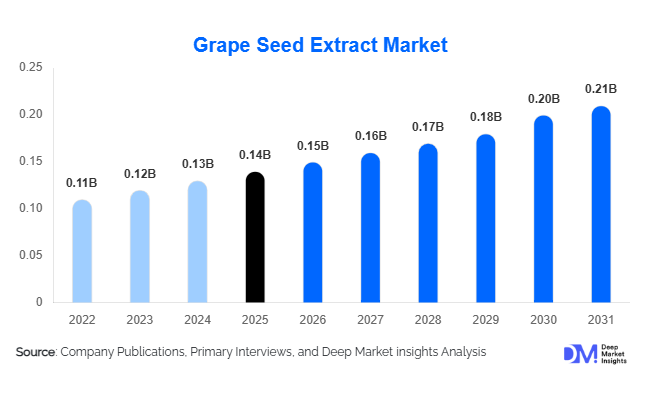
According to Deep Market Insights, the global grape seed extract market size was valued at USD 0.14 billion in 2025 and is projected to grow from USD 0.15 billion in 2026 to reach USD 0.21 billion by 2031, expanding at a CAGR of 6.98% during the forecast period (2026–2031). The grape seed extract market growth is primarily driven by rising global demand for natural antioxidants, expanding nutraceutical consumption, and increasing adoption of plant-derived bioactive ingredients across cosmetics, functional foods, and pharmaceutical applications. Growing consumer preference for clean-label formulations and sustainable sourcing from winery by-products is further accelerating industry expansion worldwide.
Key Market Insights
- Nutraceutical applications dominate global demand, accounting for the largest share due to increasing preventive healthcare adoption and antioxidant supplementation trends.
- Standardized high-OPC grape seed extracts are gaining premium positioning, supported by clinical validation and higher efficacy claims.
- North America leads global consumption, driven by mature dietary supplement markets and strong consumer awareness of botanical ingredients.
- Asia-Pacific is the fastest-growing region, fueled by rising disposable income, herbal supplement adoption, and expanding e-commerce health retail.
- Cosmetics and nutricosmetics applications are rapidly expanding, particularly in anti-aging and skin protection formulations.
- Sustainable extraction and circular economy initiatives utilizing winery waste streams are reshaping sourcing strategies and improving profitability.
What are the latest trends in the grape seed extract market?
Expansion of Nutricosmetics and Beauty-from-Within Products
One of the most prominent trends shaping the grape seed extract market is the rapid rise of nutricosmetics. Consumers increasingly seek ingestible solutions that support skin health, collagen protection, and anti-aging benefits. Grape seed extract, rich in oligomeric proanthocyanidins (OPCs), is widely incorporated into beauty supplements targeting skin elasticity and UV protection. Cosmetic brands are integrating grape seed antioxidants into both topical and ingestible product portfolios, creating cross-industry convergence between wellness and personal care. Premium skincare manufacturers are marketing botanical antioxidant blends emphasizing clean-label and plant-based positioning, strengthening long-term demand growth.
Technological Advancements in Extraction Processes
Manufacturers are increasingly adopting advanced extraction technologies such as supercritical CO₂ and enzyme-assisted extraction to enhance purity and yield while minimizing solvent residues. These technologies improve bioavailability and enable production of standardized extracts with higher OPC concentrations, which command premium pricing. Automation and traceability technologies are also being implemented to meet strict regulatory requirements across Europe and North America. Sustainable processing techniques reduce environmental impact and align with ESG-driven procurement strategies among global ingredient buyers.
What are the key drivers in the grape seed extract market?
Growing Demand for Natural Antioxidants
Consumers worldwide are shifting away from synthetic additives toward plant-based functional ingredients. Grape seed extract’s strong antioxidant capacity supports cardiovascular health, immune function, and anti-inflammatory benefits, making it highly attractive across supplements and fortified foods. Increasing awareness of oxidative stress and lifestyle-related diseases continues to drive adoption globally.
Rapid Expansion of the Nutraceutical Industry
The global nutraceutical industry’s sustained growth is significantly boosting ingredient demand. Aging populations, preventive healthcare awareness, and rising health expenditure are encouraging daily supplement consumption. Grape seed extract is increasingly incorporated into heart health, cognitive wellness, and immunity formulations, expanding its addressable market across developed and emerging economies.
What are the restraints for the global market?
Raw Material Supply Variability
The availability of grape seeds depends largely on wine production volumes, which fluctuate due to climate conditions and agricultural cycles. Variations in harvest quality and regional grape output can create pricing volatility and supply chain uncertainty for extract manufacturers.
Regulatory and Health Claim Limitations
Regulatory frameworks differ significantly across regions regarding botanical ingredient approvals and permissible health claims. Compliance costs, certification requirements, and labeling restrictions may slow product launches and increase operational complexity for market participants.
What are the key opportunities in the grape seed extract industry?
Preventive Healthcare Integration
Healthcare systems globally are encouraging preventive nutrition to reduce chronic disease burden. Grape seed extract’s scientifically supported cardiovascular and anti-inflammatory benefits create strong opportunities for pharmaceutical-grade nutraceutical development. Companies investing in clinically validated formulations can capture premium healthcare segments.
Sustainable Bioeconomy and Winery Waste Utilization
The conversion of grape pomace into high-value extracts represents a major sustainability opportunity. Governments and wine-producing regions are promoting circular economy initiatives that reduce agricultural waste while generating additional revenue streams. Vertically integrated extraction facilities located near vineyards benefit from lower raw material costs and improved sustainability certifications.
Report Scope
| Report Metric | Details |
|---|---|
| Market Size in 2025 | USD 0.14 Billion |
| Market Size in 2026 | USD 0.15 Billion |
| Market Size in 2031 | USD 0.21 Billion |
| CAGR | 6.98% (2026-2031) |
| Base Year for Estimation | 2025 |
| Historical Data | 2022-2024 |
| Forecast Period | 2026-2031 |
| Report Coverage | Revenue Forecast, Competitive Landscape, Supply Chain Disruption, Growth Factors, Environment & Regulatory Landscape and Trends |
| Geographies Covered | North America, Europe, APAC, Middle East and Africa, LATAM |
| Countries Covered | U.S., Canada, U.K., Germany, France, Spain, Italy, Russia, Nordic, Benelux, Rest of Europe, China, Korea, Japan, India, Australia, Singapore, Taiwan, South East Asia, Rest of Asia-Pacific, UAE, Turky, Saudi Arabia, South Africa, Egypt, Nigeria, Rest of MEA, Brazil, Mexico, Argentina, Chile, Colombia, Rest of LATAM |
Explore more data points, trends and opportunities Download Free Sample Report
Product Type Insights
The grape seed extract market is primarily led by powdered grape seed extract, which accounts for nearly 46% of global demand owing to its superior shelf stability, ease of transportation, and compatibility with large-scale nutraceutical and functional food manufacturing processes. Powdered formats allow manufacturers to achieve precise dosage standardization, particularly for oligomeric proanthocyanidins (OPCs), which are widely recognized for their antioxidant efficacy. The growing consumer preference for scientifically standardized botanical ingredients has significantly strengthened demand for powder-based extracts, especially among dietary supplement manufacturers seeking consistent bioactive concentration and extended product shelf life.Liquid grape seed extracts continue to maintain strong adoption across beverage formulations, liquid supplements, and cosmetic serums due to their rapid solubility and formulation flexibility. As functional beverages and wellness drinks gain global popularity, liquid extracts are increasingly incorporated into ready-to-drink health products targeting immunity, cardiovascular support, and anti-aging benefits. Encapsulated grape seed extract formats are also expanding rapidly, supported by private-label nutraceutical brands and direct-to-consumer supplement companies that prioritize convenience, dosage accuracy, and consumer compliance. Additionally, oil-soluble concentrates are gaining traction within skincare and dermaceutical applications, where lipid compatibility enhances antioxidant stability and skin absorption. The ongoing shift toward premium-grade standardized extracts with verified potency and traceability continues to elevate product innovation and differentiation across all product categories.
Application Insights
Dietary supplements remain the dominant application segment, contributing approximately 48% of global market demand. Growth in this segment is primarily driven by rising consumer awareness of preventive healthcare, increasing adoption of plant-based nutraceuticals, and expanding research supporting grape seed extract’s antioxidant, cardiovascular, and anti-inflammatory properties. Consumers are increasingly seeking natural alternatives to synthetic health products, positioning grape seed extract as a key ingredient in immunity, skin health, and metabolic wellness formulations. The expansion of personalized nutrition trends and subscription-based supplement models further strengthens long-term demand within this application.Functional food and beverage applications are emerging as a major growth avenue as manufacturers incorporate grape seed extract into nutrition bars, fortified beverages, dairy alternatives, and wellness snacks to enhance nutritional value and clean-label positioning. Cosmetic and personal care applications are experiencing steady expansion, particularly in anti-aging, UV-protection, and skin-repair formulations where antioxidant protection plays a critical role. Pharmaceutical research is progressively exploring therapeutic applications linked to vascular health, inflammation management, and chronic disease prevention, opening new opportunities for clinical-grade extracts. Meanwhile, animal nutrition applications, although currently niche, are gaining attention as livestock and pet nutrition industries increasingly adopt antioxidant supplementation to improve animal health and productivity.
Distribution Channel Insights
Direct business-to-business (B2B) ingredient supply dominates market distribution, accounting for more than half of global revenue as dietary supplement, food, and cosmetic manufacturers procure bulk standardized extracts directly from producers. This dominance is driven by the need for consistent quality assurance, long-term supply agreements, and customized formulations tailored to industrial-scale production requirements. Ingredient manufacturers are increasingly forming strategic partnerships with nutraceutical brands to support co-development and product innovation initiatives.Online retail channels are witnessing rapid growth, fueled by the rise of digital-first supplement brands and expanding consumer reliance on e-commerce platforms for health and wellness purchases. Direct-to-consumer models enable brands to educate consumers, build loyalty, and introduce premium formulations with higher margins. Specialty health stores and pharmacies continue to play a crucial role in reinforcing product credibility and premium positioning, particularly for clinically supported supplements. In parallel, contract manufacturing and private-label production are expanding significantly as nutraceutical startups and wellness entrepreneurs enter the market, leveraging outsourced production capabilities to accelerate product launches while minimizing capital investment.
End-Use Industry Insights
The nutraceutical industry represents the largest end-use sector, accounting for approximately 44% of global consumption. The segment’s leadership is supported by increasing global focus on preventive healthcare, aging population demographics, and rising consumer adoption of botanical supplements as part of daily wellness routines. Nutraceutical manufacturers increasingly incorporate grape seed extract into multi-functional formulations targeting cardiovascular health, cognitive support, and skin vitality, strengthening its role as a core antioxidant ingredient.The cosmetic and personal care industry is among the fastest-growing end-use sectors, driven by growing demand for plant-derived anti-aging solutions and clean beauty formulations. Grape seed extract’s strong antioxidant profile and collagen-protective properties make it highly attractive for premium skincare applications. Functional food manufacturers are also accelerating adoption to enhance product differentiation through natural health claims and nutritional enrichment. Pharmaceutical applications are gradually expanding as clinical studies validate therapeutic potential, encouraging investment in standardized, high-purity extracts. Additionally, veterinary and animal feed industries are emerging as promising growth avenues, with antioxidant supplementation increasingly used to support immune health and improve overall animal performance.
Explore more data points, trends and opportunities Download Free Sample Report
Grape Seed Extract Market Segmentations
By Type
- Powder
- Liquid
- Gel
By Application
- Food Industry
- Pharmaceutical Industry
- Personal Care Industry
- Others
Regional Insights
North America
North America holds the largest share of the global grape seed extract market, accounting for approximately 34% of total revenue in 2025, with the United States serving as the primary demand center. Regional growth is strongly supported by high dietary supplement penetration, advanced nutraceutical infrastructure, and strong consumer awareness regarding natural antioxidants and preventive health solutions. The rapid expansion of e-commerce supplement brands, influencer-driven wellness marketing, and personalized nutrition platforms continues to stimulate product adoption. Regulatory clarity surrounding dietary supplements and the presence of leading nutraceutical manufacturers further support innovation and product commercialization. Additionally, growing demand for clean-label cosmetic formulations and functional beverages enhances cross-industry consumption of grape seed extract throughout the region.
Europe
Europe accounts for nearly 29% of global demand, led by France, Italy, Germany, and Spain. Regional growth is closely linked to the well-established wine industry, which ensures stable availability of grape-derived raw materials and supports sustainable production practices through by-product valorization. European consumers demonstrate strong preference for scientifically validated botanical ingredients, organic certifications, and environmentally responsible sourcing, encouraging manufacturers to invest in traceability and premium-quality extracts. Increasing demand for natural cosmetics, functional nutrition, and plant-based wellness products further strengthens market expansion. Supportive regulatory frameworks promoting quality standards and product safety also contribute to long-term market stability across the region.
Asia-Pacific
Asia-Pacific represents the fastest-growing regional market, driven by rising health consciousness, expanding middle-class populations, and rapid urbanization across China, India, Japan, and South Korea. China plays a central role as a global manufacturing hub due to large-scale extraction capabilities and cost-efficient production, while Japan and South Korea lead innovation in premium cosmetic and dermaceutical applications. Increasing disposable income levels, growing adoption of preventive healthcare practices, and widespread digital commerce penetration are accelerating supplement consumption. The popularity of beauty-from-within products and functional beverages further drives demand, positioning Asia-Pacific as a major future growth engine for the grape seed extract industry.
Latin America
Latin America is emerging as both a supply and consumption hub within the global grape seed extract market. Countries such as Chile and Argentina benefit from strong integration with the regional wine industry, enabling efficient raw material utilization and export-oriented production models. Brazil is witnessing increasing demand for functional nutrition and natural health supplements as consumer awareness of wellness products expands. Regional manufacturers are increasingly investing in value-added processing to reduce reliance on raw material exports and capture higher margins through ingredient production. Improving retail infrastructure and growing interest in natural cosmetics are further supporting market development across the region.
Middle East & Africa
The Middle East and Africa market is experiencing gradual but steady growth, driven primarily by rising imports of premium wellness and cosmetic products in countries such as the United Arab Emirates and South Africa. Increasing urbanization, expanding middle-income populations, and growing awareness of preventive health practices are encouraging adoption of nutraceutical supplements containing natural antioxidants. The expansion of organized retail channels, specialty wellness stores, and luxury skincare markets is supporting demand growth. Additionally, increasing tourism-driven retail consumption and the rising popularity of premium beauty products across metropolitan areas contribute to long-term market potential in the region.
Key Players in the Grape Seed Extract Market
- Givaudan (Naturex)
- Indena S.p.A.
- Nexira
- Polyphenolics Inc.
- Botanic Innovations LLC
- Hunan Nutramax Inc.
- Xi’an Greena Biotech
- Chengdu Wagott Bio-Tech
- Eevia Health Plc
- Ambe NS Agro Products
- Martin Bauer Group
- Döhler Group
- FutureCeuticals Inc.
- Herbal Creations
- Shaanxi Undersun Biomedtech