Granola Bars Market Size
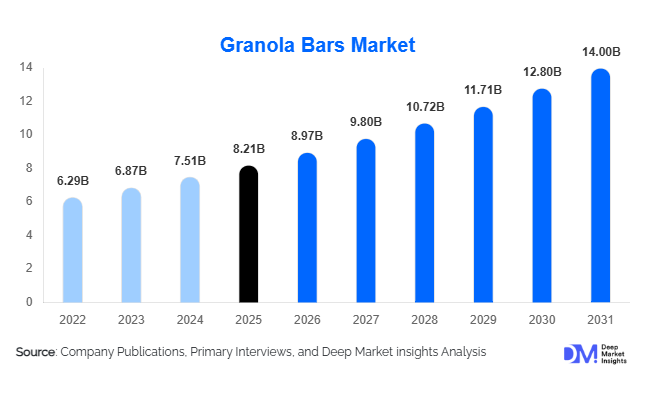
According to Deep Market Insights, the global granola bars market size was valued at USD 8.21 billion in 2025 and is projected to grow from USD 8.97 billion in 2026 to reach USD 14.00 billion by 2031, expanding at a CAGR of 9.3% during the forecast period (2026–2031). The granola bars market growth is primarily driven by rising consumer preference for healthy snacking products, increasing demand for convenient on-the-go nutrition, and rapid expansion of functional and protein-enriched snack categories across global retail channels.
Key Market Insights
- Protein and functional granola bars are witnessing strong demand globally, supported by rising fitness participation and consumer focus on nutritional snacking.
- Clean-label and organic formulations are reshaping product innovation, with consumers increasingly preferring non-GMO, gluten-free, and low-sugar products.
- North America dominates the global granola bars market, driven by strong healthy snack penetration and mature sports nutrition consumption.
- Asia-Pacific is the fastest-growing regional market, fueled by rising disposable incomes, urbanization, and increasing adoption of Western-style breakfast habits.
- E-commerce and direct-to-consumer sales channels are rapidly expanding, enabling premium and niche brands to scale internationally.
- Sustainable packaging and plant-based ingredients are becoming major competitive differentiators, especially among millennials and Gen Z consumers.
What are the latest trends in the granola bars market?
Functional Nutrition and High-Protein Innovation
Manufacturers are increasingly launching granola bars fortified with proteins, probiotics, vitamins, collagen, and adaptogenic ingredients to align with the growing functional nutrition trend. Consumers are seeking snacks that deliver benefits such as digestive health, energy enhancement, immunity support, and satiety management. High-protein granola bars are particularly popular among fitness enthusiasts, athletes, and working professionals looking for convenient meal replacements or post-workout snacks. Plant-based protein formulations using pea protein, soy protein, and nut blends are also gaining momentum due to rising vegan and flexitarian dietary preferences. Functional positioning allows brands to command premium pricing while differentiating themselves in a crowded healthy snack market.
Clean-Label and Sustainable Product Development
Clean-label product positioning has emerged as a major trend across the global granola bars market. Consumers increasingly scrutinize ingredient lists and prefer products made with recognizable, minimally processed ingredients. This has accelerated demand for organic oats, natural sweeteners, non-GMO ingredients, and preservative-free formulations. Sustainability initiatives are also influencing purchasing decisions, encouraging manufacturers to adopt recyclable packaging, responsibly sourced ingredients, and environmentally friendly production practices. Several companies are introducing biodegradable wrappers and carbon-neutral production models to appeal to environmentally conscious consumers. Transparency in sourcing and ethical ingredient procurement are becoming critical brand differentiators across developed markets.
What are the key drivers in the granola bars market?
Rising Demand for Healthy and Convenient Snacking
Changing consumer lifestyles and increasing urbanization are driving global demand for convenient yet nutritious food products. Granola bars are increasingly being consumed as breakfast replacements, between-meal snacks, and portable nutrition options by busy consumers. Working professionals, students, and travelers prefer ready-to-eat products that offer both convenience and nutritional value. Rising awareness regarding balanced diets, calorie management, and fiber intake has further accelerated the shift away from traditional sugary snacks toward granola bars and similar healthy alternatives. The growing popularity of portion-controlled snacks is also supporting category expansion.
Expansion of Sports Nutrition and Fitness Culture
The rapid growth of fitness culture globally has significantly strengthened demand for protein-rich granola bars and energy snacks. Rising gym memberships, participation in endurance sports, and growing awareness regarding protein consumption are contributing to increased adoption of performance-oriented snack products. Sports nutrition consumption is no longer limited to professional athletes, with mainstream consumers increasingly incorporating protein bars and fortified granola bars into their daily wellness routines. Manufacturers are capitalizing on this trend by launching high-protein, keto-friendly, and low-carb variants tailored to active lifestyles.
What are the restraints for the global market?
Volatility in Raw Material Prices
The granola bars market remains highly vulnerable to fluctuations in raw material costs, particularly oats, nuts, dried fruits, cocoa, and honey. Agricultural supply disruptions caused by adverse weather conditions, geopolitical tensions, and global trade uncertainties can significantly impact manufacturing costs and profitability. Since premium ingredients constitute a substantial portion of production expenses, sustained cost inflation can pressure manufacturer margins and lead to higher retail pricing, especially in price-sensitive emerging markets.
Concerns Regarding Sugar Content and Processed Ingredients
Despite their healthy positioning, several granola bars contain relatively high sugar levels, artificial preservatives, and processed additives. Health-conscious consumers and regulatory authorities are increasingly scrutinizing nutritional labels and demanding reduced sugar formulations. Governments in several regions are implementing stricter food labeling standards and nutritional transparency regulations, compelling manufacturers to reformulate products. Failure to address these concerns may reduce consumer trust and limit long-term growth potential in mature markets.
What are the key opportunities in the granola bars industry?
Expansion Across Emerging Markets
Emerging economies such as India, China, Indonesia, Brazil, and the UAE present strong growth opportunities for granola bar manufacturers. Rising disposable incomes, increasing urban populations, and expanding modern retail infrastructure are driving demand for packaged healthy snacks. Western eating habits are gaining popularity among younger consumers, particularly in urban centers where convenience foods are increasingly integrated into daily lifestyles. Manufacturers can unlock substantial growth by introducing localized flavors, affordable pricing strategies, and smaller packaging formats suited to regional consumption preferences.
Personalized Nutrition and Direct-to-Consumer Models
The rise of personalized nutrition represents a major opportunity for granola bar brands. Consumers increasingly seek products tailored to specific dietary needs such as keto, vegan, gluten-free, diabetic-friendly, or high-protein diets. Direct-to-consumer business models enable companies to gather real-time customer insights and develop customized formulations based on consumer preferences. Subscription snack services and online wellness platforms are further accelerating adoption of personalized nutrition products. Digital engagement and AI-driven recommendation systems are expected to strengthen customer retention and support premium product positioning over the long term.
Report Scope
| Report Metric | Details |
|---|---|
| Market Size in 2025 | USD 8.21 Billion |
| Market Size in 2026 | USD 8.97 Billion |
| Market Size in 2031 | USD 14.00 Billion |
| CAGR | 9.3% (2026-2031) |
| Base Year for Estimation | 2025 |
| Historical Data | 2022-2024 |
| Forecast Period | 2026-2031 |
| Report Coverage | Revenue Forecast, Competitive Landscape, Supply Chain Disruption, Growth Factors, Environment & Regulatory Landscape and Trends |
| Geographies Covered | North America, Europe, APAC, Middle East and Africa, LATAM |
| Countries Covered | U.S., Canada, U.K., Germany, France, Spain, Italy, Russia, Nordic, Benelux, Rest of Europe, China, Korea, Japan, India, Australia, Singapore, Taiwan, South East Asia, Rest of Asia-Pacific, UAE, Turky, Saudi Arabia, South Africa, Egypt, Nigeria, Rest of MEA, Brazil, Mexico, Argentina, Chile, Colombia, Rest of LATAM |
Explore more data points, trends and opportunities Download Free Sample Report
Product Type Insights
The global granola bars market is experiencing substantial expansion across multiple product categories as consumers increasingly prioritize convenient, nutritious, and functional snack options that align with modern lifestyles. Among all product types, protein granola bars continue to dominate the market and account for the largest revenue share globally. The strong performance of this segment is primarily driven by rising health consciousness, increasing gym participation, and the growing popularity of sports nutrition products among consumers across both developed and emerging economies. Protein-enriched granola bars are increasingly being consumed as meal replacements, pre-workout energy boosters, and post-workout recovery snacks due to their ability to provide sustained energy and muscle support. Manufacturers are continuously introducing high-protein formulations containing whey protein, pea protein, soy protein, and nut-based protein blends to meet the rising demand from athletes, fitness enthusiasts, and working professionals seeking healthier snack alternatives.Organic granola bars represent one of the fastest-growing product segments globally due to rising awareness regarding sustainable agriculture, pesticide-free ingredients, and clean eating habits. Consumers are becoming increasingly selective regarding ingredient sourcing and food transparency, prompting manufacturers to emphasize organic certifications and non-GMO labeling across product packaging. Demand for organic products is particularly strong in Europe and North America, where consumers demonstrate higher willingness to pay premium prices for environmentally sustainable and ethically sourced food products. Organic granola bars are also benefiting from increasing distribution through specialty health stores, premium supermarkets, and online wellness platforms that target affluent and health-focused consumers.Vegan and plant-based granola bars are additionally witnessing robust growth momentum due to the rising adoption of vegan, vegetarian, and flexitarian diets worldwide. Consumers are increasingly reducing animal-based product consumption due to environmental concerns, ethical considerations, and perceived health benefits associated with plant-based nutrition. Manufacturers are responding by introducing dairy-free, soy-free, gluten-free, and allergen-friendly formulations that appeal to a broader customer base. Plant-derived ingredients such as oats, quinoa, chia seeds, flaxseeds, almonds, and pea protein are increasingly incorporated into product innovation strategies. This segment is expected to witness sustained long-term growth as plant-based lifestyles continue to gain mainstream acceptance across global markets.
Application Insights
On-the-go snacking remains the leading application segment within the global granola bars market and continues to account for a significant share of overall product consumption. The increasing pace of urban lifestyles, longer working hours, and growing consumer preference for convenient food solutions are major factors supporting the dominance of this application segment. Consumers increasingly seek portable snack products that can be consumed during commuting, travel, office breaks, and outdoor activities without requiring preparation or refrigeration. Granola bars effectively fulfill these requirements by offering convenience, portability, and nutritional value in compact packaging formats. The expansion of busy lifestyles among working professionals, students, and urban consumers continues to drive strong market demand for convenient snack alternatives.Workplace snacking has emerged as another significant application area within the global granola bars market. Employers are increasingly implementing corporate wellness initiatives that encourage healthier dietary habits among employees. As a result, healthier packaged snacks are replacing traditional high-sugar vending machine products across offices and commercial workplaces. Granola bars are increasingly favored due to their balanced nutritional profile, convenience, and suitability for consumption during busy work schedules. The growing adoption of hybrid work environments and flexible office cultures is further supporting demand for individually packaged snack products suitable for workplace consumption.The school snack segment is additionally gaining traction due to increasing parental preference for healthier packaged food products for children and teenagers. Parents are becoming increasingly aware of the negative health impacts associated with excessive sugar consumption and highly processed snack foods. Consequently, granola bars containing whole grains, fruits, nuts, and reduced sugar formulations are increasingly preferred as healthier lunchbox alternatives. Manufacturers are introducing child-friendly packaging, smaller serving sizes, and appealing flavors specifically designed to attract younger consumers while meeting nutritional expectations from parents and educational institutions.
Distribution Channel Insights
Supermarkets and hypermarkets continue to dominate global granola bar sales due to their extensive retail presence, broad product assortment, and strong consumer accessibility. These organized retail channels provide consumers with convenient access to a wide variety of brands, flavors, nutritional formulations, and pricing options under a single shopping environment. Promotional campaigns, in-store visibility, product sampling, and discount strategies implemented by large retail chains significantly contribute to product sales and consumer awareness. The strong dominance of supermarkets is particularly evident across North America and Europe, where organized retail infrastructure remains highly developed and consumer dependence on modern retail channels is substantial.Online retail channels are witnessing the fastest growth rates within the global granola bars market due to expanding e-commerce penetration and changing consumer purchasing behavior. Digital grocery platforms, health-focused online marketplaces, and direct-to-consumer brand websites are significantly reshaping retail dynamics across the packaged snack industry. Consumers increasingly prefer online shopping due to convenience, subscription models, broader product selection, and access to niche premium brands not widely available through physical retail channels. The growing use of smartphones, digital payment systems, and personalized online marketing strategies is further accelerating e-commerce adoption globally.Subscription-based snack delivery models are additionally gaining popularity among health-conscious consumers seeking curated nutrition products and recurring deliveries. Direct-to-consumer strategies enable manufacturers to strengthen customer engagement, collect consumer preference data, and improve brand loyalty through personalized offerings and targeted promotions. Social media advertising, influencer marketing, and digital wellness campaigns are further supporting online sales growth, particularly among millennials and Gen Z consumers who demonstrate strong digital purchasing behavior.
Consumer Group Insights
Millennials continue to represent the largest consumer group within the global granola bars market due to their strong preference for convenient, health-oriented, and functional food products. This demographic group demonstrates significant interest in wellness trends, fitness culture, sustainable consumption, and clean-label nutrition, all of which strongly align with granola bar product positioning. Millennials frequently seek portable meal replacements and healthy snacks that fit busy lifestyles while supporting fitness and dietary goals. Their growing purchasing power and willingness to experiment with innovative flavors and premium formulations continue to drive product innovation across the industry.Fitness enthusiasts remain a high-value consumer segment for protein-enriched and functional granola bars. This consumer group prioritizes products containing high protein content, low sugar formulations, fiber enrichment, and performance-oriented nutritional benefits. The continued expansion of global fitness culture, sports participation, and wellness awareness is positively influencing demand for premium functional snack products targeted toward active lifestyles.Teenagers and children are emerging as important consumer groups due to increasing parental focus on healthier snacking alternatives. Rising concerns regarding childhood obesity and unhealthy eating habits are encouraging parents to choose granola bars containing natural ingredients, whole grains, and reduced sugar content. Product innovation targeted toward younger demographics continues to increase through appealing flavors, creative packaging designs, and nutritional fortification strategies.Elderly consumers are also increasingly adopting granola bars designed to support digestive health, heart health, and nutritional supplementation. High-fiber formulations, low-sodium products, and functional ingredients targeting healthy aging are becoming more prominent within product development initiatives aimed at senior consumers.
Ingredient Type Insights
Oats-based granola bars account for the largest market share globally due to the widespread recognition of oats as a healthy and versatile ingredient. Oats are strongly associated with heart health, cholesterol reduction, digestive wellness, and sustained energy release, making them highly attractive among health-conscious consumers. Manufacturers prefer oats because they provide formulation stability, affordability, and compatibility with diverse flavor profiles and nutritional ingredients. Oats additionally support clean-label product positioning due to strong consumer familiarity and positive health perceptions.Mixed grain and ancient grain formulations are increasingly gaining traction as consumers seek more diverse nutritional profiles and functional health benefits. Ingredients such as quinoa, millet, amaranth, and brown rice are being incorporated into premium products targeting wellness-oriented consumers seeking high-protein, fiber-rich, and nutrient-dense snack alternatives. The growing popularity of ancient grains is further supported by consumer interest in natural and minimally processed food ingredients.Chia seeds, flaxseeds, and quinoa-based ingredients are increasingly incorporated into granola bars due to their association with omega-3 fatty acids, protein content, digestive health, and superfood positioning. Manufacturers are leveraging these ingredients to strengthen premium product differentiation and appeal to consumers seeking advanced nutritional functionality. Nut and seed inclusions additionally continue to play a major role in improving texture, protein content, satiety, and flavor enhancement across multiple product categories.
Explore more data points, trends and opportunities Download Free Sample Report
Granola Bars Market Segmentations
By Product Type
- Protein Granola Bars
- Nut-Based Granola Bars
- Fruit-Based Granola Bars
- Organic Granola Bars
- Gluten-Free Granola Bars
- Low-Sugar & Sugar-Free Granola Bars
- Kids’ Granola Bars
- Vegan & Plant-Based Granola Bars
- Keto & Low-Carb Granola Bars
- Functional & Fortified Granola Bars
By Ingredient Type
- Oats-Based
- Rice-Based
- Quinoa-Based
- Mixed Grain-Based
- Chia & Flaxseed-Based
- Ancient Grain-Based
By Application
- Breakfast Replacement
- On-the-Go Snacking
- Sports Nutrition
- Weight Management
- School Snacks
- Workplace Snacking
By Distribution Channel
- Supermarkets & Hypermarkets
- Convenience Stores
- Specialty Health Stores
- Online Retail & E-Commerce
- Direct-to-Consumer Channels
- Pharmacies & Wellness Stores
By Consumer Group
- Children
- Teenagers
- Millennials
- Working Professionals
- Fitness Enthusiasts
- Elderly Consumers
Regional Insights
North America
North America accounted for nearly 39% of the global granola bars market in 2025, making it the largest regional market worldwide. The United States dominates regional consumption due to strong healthy snacking culture, widespread sports nutrition adoption, and high consumer awareness regarding wellness-focused dietary habits. The region benefits significantly from advanced retail infrastructure, strong brand presence, and continuous product innovation across premium and functional snack categories. Rising consumer preference for low-sugar, organic, gluten-free, and protein-rich snack products continues to support market expansion throughout the region.One of the major growth drivers in North America is the increasing emphasis on preventive healthcare and weight management among consumers. Rising obesity concerns and growing awareness regarding nutrition are encouraging consumers to replace traditional high-calorie snacks with healthier alternatives such as granola bars. Additionally, the rapid expansion of fitness culture, gym memberships, and sports nutrition consumption continues to fuel demand for protein-based and functional granola bars. The strong penetration of e-commerce platforms and subscription snack services further accelerates product accessibility and market growth. Canada also demonstrates substantial growth potential due to rising demand for plant-based and allergen-free snack products supported by growing vegan and flexitarian populations.
Europe
Europe represents the second-largest regional market, accounting for approximately 28% of global demand in 2025. Countries including the United Kingdom, Germany, and France are major contributors to regional market growth due to increasing health awareness and rising preference for sustainable food consumption. European consumers increasingly prioritize clean-label ingredients, environmentally friendly packaging, and ethically sourced products, creating strong demand for premium granola bar formulations.A major growth driver within Europe is the strong consumer preference for organic and natural food products. Germany remains a leading market for organic granola bars due to widespread organic food adoption and stringent quality standards across the food industry. The United Kingdom is witnessing strong growth in vegan, low-sugar, and plant-based snack variants driven by rising health consciousness and changing dietary preferences. Additionally, increasing government focus on reducing sugar consumption and promoting healthier eating habits is encouraging manufacturers to reformulate products with improved nutritional profiles. Sustainability initiatives, recyclable packaging adoption, and growing environmental awareness are also significantly supporting premium product demand across European markets.
Asia-Pacific
Asia-Pacific is the fastest-growing regional market and is projected to expand at a CAGR exceeding 11% during the forecast period. China remains the leading regional market due to rapid urbanization, expanding middle-class populations, changing dietary patterns, and increasing adoption of Western-style convenience foods. Consumers across urban centers are increasingly seeking healthier packaged snacks that align with busy lifestyles and rising wellness awareness.One of the primary growth drivers in Asia-Pacific is the rapid expansion of organized retail and e-commerce infrastructure across emerging economies. Increasing disposable incomes, digital shopping adoption, and greater product accessibility are significantly accelerating granola bar consumption across the region. India is emerging as a major high-growth market driven by growing health awareness, rising fitness participation, and increasing demand for convenient nutrition products among younger populations. Japan and South Korea continue to witness strong demand for premium and functional snack bars targeted at busy professionals and wellness-oriented consumers. Additionally, social media influence, rising nutrition awareness campaigns, and expanding urban populations are further supporting market penetration throughout Asia-Pacific.
Latin America
Latin America is witnessing gradual yet steady growth in granola bar consumption, particularly across Brazil and Mexico. Increasing urbanization, changing dietary habits, and rising awareness regarding healthy eating are positively influencing regional demand for nutritious packaged snack products. International manufacturers are strengthening regional expansion strategies through affordable product offerings, localized flavor innovation, and wider retail distribution partnerships.A key growth driver in Latin America is the increasing expansion of middle-class populations and improving consumer purchasing power. Consumers are becoming more willing to spend on healthier packaged foods that offer convenience and nutritional benefits. The rapid growth of fitness participation, sports activities, and wellness awareness campaigns is additionally supporting demand for protein-rich and functional snack products. Expansion of modern retail infrastructure and increasing penetration of supermarkets and convenience stores are also improving product accessibility across urban and semi-urban areas.
Middle East & Africa
The Middle East & Africa region is emerging as a promising growth market for premium granola bars due to increasing health awareness, rising disposable incomes, and expanding urban populations. Countries such as the UAE and Saudi Arabia are witnessing growing demand for healthy snack products driven by strong expatriate populations, increasing fitness culture, and premium retail development. Consumers are increasingly seeking convenient nutrition products aligned with modern lifestyles and wellness-focused dietary trends.One of the major regional growth drivers is the rapid expansion of modern retail infrastructure, including supermarkets, premium grocery chains, and international food retail brands. South Africa remains one of the leading regional markets due to rising adoption of packaged health foods and growing consumer awareness regarding balanced nutrition. Additionally, increasing penetration of international snack brands, rising youth populations, and expanding digital commerce platforms are further contributing to regional market development. The growing popularity of fitness centers, sports activities, and preventive healthcare initiatives is expected to continue supporting long-term demand for granola bars across the Middle East & Africa region.
Key Players in the Granola Bars Market
- Kellogg Company
- General Mills
- PepsiCo
- Mars Incorporated
- Clif Bar & Company
- Nature’s Bakery
- KIND LLC
- Bob’s Red Mill Natural Foods
- The Hain Celestial Group
- Post Holdings
- Lotus Bakeries
- Freedom Foods Group
- Simply Good Foods
- Nestlé
- McKee Foods Corporation