Goat Milk Market Size
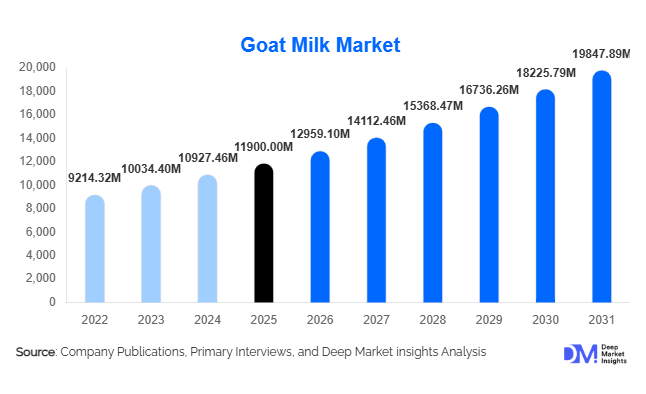
According to Deep Market Insights, the global goat milk market size was valued at USD 11,900 million in 2025 and is projected to grow from USD 12,959.10 million in 2026 to reach USD 19,847.89 million by 2031, expanding at a CAGR of 8.9% during the forecast period (2026–2031). The goat milk market growth is primarily driven by rising demand for easily digestible dairy alternatives, increasing adoption of goat milk-based infant nutrition products, and growing consumer preference for clean-label and functional dairy offerings. Expanding applications across food, nutraceutical, and personal care industries are further strengthening market penetration globally.
Key Market Insights
- Goat milk is increasingly positioned as a premium and functional dairy alternative, driven by its superior digestibility and hypoallergenic properties.
- Infant nutrition applications are rapidly expanding, particularly in Asia-Pacific, due to rising awareness of cow milk protein allergies.
- Europe dominates the global market, supported by established dairy infrastructure and strong cheese consumption.
- Asia-Pacific is the fastest-growing region, led by China and India with rising middle-class demand and urbanization.
- Organic and clean-label goat milk products are gaining traction, commanding premium pricing in developed markets.
- Technological advancements in processing and spray drying are improving shelf life, export potential, and product innovation.
What are the latest trends in the goat milk market?
Rising Demand for Goat Milk-Based Infant Formula
The infant nutrition segment is emerging as a key trend in the goat milk market. Increasing incidence of lactose intolerance and cow milk protein allergies among infants has driven demand for goat milk-based formulas. Regulatory approvals across major markets and growing clinical validation are further strengthening consumer trust. Manufacturers are investing in high-quality formulations enriched with essential nutrients, positioning goat milk formula as a premium alternative. This trend is particularly prominent in China and Southeast Asia, where premiumization of infant nutrition products is accelerating.
Growth of Organic and Clean-Label Dairy Products
Consumers are increasingly prioritizing organic, hormone-free, and minimally processed dairy products. Organic goat milk is gaining popularity due to its perceived health benefits and sustainable production practices. Producers are focusing on obtaining organic certifications and improving traceability across the supply chain. Clean-label trends are also influencing product innovation, with reduced additives and transparent ingredient sourcing becoming key differentiators. This shift is especially evident in North America and Europe, where consumers are willing to pay premium prices for high-quality dairy alternatives.
What are the key drivers in the goat milk market?
Increasing Lactose Intolerance and Digestive Health Awareness
The growing prevalence of lactose intolerance worldwide is a major driver of goat milk consumption. Goat milk contains lower lactose levels and smaller fat globules, making it easier to digest compared to cow milk. As awareness of digestive health increases, consumers are shifting toward alternatives that offer better tolerance and nutritional benefits. This trend is particularly strong in Asia and Africa, where lactose intolerance rates are higher.
Expansion of Premium Dairy and Specialty Products
The rising demand for premium and specialty dairy products is significantly boosting the goat milk market. Products such as goat cheese, yogurt, and flavored milk are gaining popularity among health-conscious consumers. Artisanal and gourmet dairy segments are also expanding, particularly in Europe and North America. Consumers are increasingly willing to pay higher prices for unique taste profiles and perceived health benefits, supporting market growth.
What are the restraints for the global market?
High Production Costs and Limited Supply
Goat milk production is relatively limited compared to cow milk, leading to higher production costs. Goat farming requires specialized management, and yields per animal are lower. This results in higher retail prices, restricting mass-market adoption and limiting accessibility in price-sensitive regions.
Low Consumer Awareness in Emerging Markets
Despite its benefits, goat milk remains underutilized in several regions due to limited awareness and cultural preferences for traditional dairy products. Marketing challenges and lack of large-scale distribution networks further restrict market expansion in Latin America and parts of Asia.
What are the key opportunities in the goat milk industry?
Expansion into Functional Foods and Nutraceuticals
The increasing demand for functional foods presents significant opportunities for goat milk producers. Goat milk’s bioactive compounds make it suitable for products targeting gut health, immunity, and metabolic wellness. Innovations in probiotic yogurts, fortified powders, and dietary supplements are opening new revenue streams for manufacturers.
Growth in Emerging Markets and Export Potential
Emerging markets in Asia, Africa, and the Middle East offer untapped growth potential. Rising disposable incomes, urbanization, and dietary diversification are driving demand for alternative dairy products. Export-oriented production, particularly from New Zealand and Europe to China, is further expanding global trade opportunities.
Report Scope
| Report Metric | Details |
|---|---|
| Market Size in 2025 | USD 11900.00 Million |
| Market Size in 2026 | USD 12959.10 Million |
| Market Size in 2031 | USD 19847.89 Million |
| CAGR | 8.9% (2026-2031) |
| Base Year for Estimation | 2025 |
| Historical Data | 2022-2024 |
| Forecast Period | 2026-2031 |
| Report Coverage | Revenue Forecast, Competitive Landscape, Supply Chain Disruption, Growth Factors, Environment & Regulatory Landscape and Trends |
| Geographies Covered | North America, Europe, APAC, Middle East and Africa, LATAM |
| Countries Covered | U.S., Canada, U.K., Germany, France, Spain, Italy, Russia, Nordic, Benelux, Rest of Europe, China, Korea, Japan, India, Australia, Singapore, Taiwan, South East Asia, Rest of Asia-Pacific, UAE, Turky, Saudi Arabia, South Africa, Egypt, Nigeria, Rest of MEA, Brazil, Mexico, Argentina, Chile, Colombia, Rest of LATAM |
Explore more data points, trends and opportunities Download Free Sample Report
Product Type Insights
The global goat milk market is characterized by a diverse product portfolio, with goat milk powder emerging as the dominant segment, accounting for approximately 28% of the total market share in 2025. This leadership position is primarily driven by the product’s superior shelf stability, reduced risk of spoilage, and logistical advantages in storage and transportation compared to liquid milk. Goat milk powder is extensively used in infant nutrition formulations, where consistency, safety, and long shelf life are critical. The growing global demand for infant formula, particularly in regions with rising birth rates and increasing disposable incomes, continues to strengthen the position of this segment. Additionally, advancements in spray-drying technology and improved processing techniques are enhancing the nutritional retention and solubility of goat milk powder, further supporting its adoption across multiple applications.Liquid goat milk is gradually gaining traction, especially in urban markets where improved cold chain infrastructure and modern retail networks are enhancing product accessibility. Increasing consumer awareness regarding the digestibility and hypoallergenic properties of goat milk compared to cow milk is driving its demand among health-conscious individuals and those with lactose intolerance. Additionally, the growing availability of pasteurized and flavored goat milk variants is attracting younger consumers and expanding its appeal beyond traditional markets.Fermented goat milk products, including yogurt and kefir, are experiencing steady growth due to their alignment with global health and wellness trends. These products are rich in probiotics, which support gut health and immune function, making them increasingly popular among consumers seeking functional foods. The rising demand for natural and minimally processed dairy products is further contributing to the growth of this segment. Manufacturers are also introducing innovative product formulations, such as low-fat and fortified variants, to cater to specific dietary needs and preferences, thereby expanding the overall market scope.
Application Insights
The application landscape of the goat milk market is evolving rapidly, with the infant nutrition segment emerging as the fastest-growing category, contributing approximately 26% of the total market share. The leading driver for this segment is the superior digestibility and nutritional composition of goat milk, which closely resembles human breast milk in terms of protein structure and fat globule size. This makes it an ideal alternative for infants with sensitivities to cow milk-based formulas. Increasing parental awareness regarding infant health and nutrition, coupled with rising disposable incomes, is driving the adoption of premium goat milk-based formulas, particularly in Asia-Pacific and Europe.Nutraceutical applications are gaining momentum as consumers increasingly prioritize preventive healthcare and functional nutrition. Goat milk is being incorporated into dietary supplements, protein powders, and fortified foods due to its high content of essential vitamins, minerals, and bioactive compounds. The leading driver for this segment is the rising awareness of the health benefits associated with goat milk, including improved digestion, enhanced immunity, and anti-inflammatory properties. This trend is particularly strong in developed markets, where consumers are willing to invest in premium health products.The personal care industry is also emerging as a promising application area for goat milk. Its natural moisturizing properties, along with the presence of vitamins such as A and E, make it an attractive ingredient in skincare and cosmetic products. Goat milk-based soaps, creams, and lotions are gaining popularity among consumers seeking natural and chemical-free alternatives. The growing demand for organic and sustainable personal care products is further driving the adoption of goat milk in this sector, creating new opportunities for market expansion.
Distribution Channel Insights
Distribution channels play a crucial role in shaping the accessibility and reach of goat milk products. Supermarkets and hypermarkets dominate the market, accounting for nearly 40% of global sales. The leading driver for this segment is the convenience and wide product assortment offered by these retail formats, which allow consumers to access a variety of goat milk products under one roof. The presence of dedicated dairy sections, promotional activities, and attractive packaging further enhance consumer engagement and drive sales through these channels. Additionally, the expansion of organized retail networks in emerging economies is contributing to the growth of this segment.Online retail is rapidly emerging as a significant distribution channel, driven by the increasing adoption of digital technologies and changing consumer shopping behaviors. The convenience of home delivery, availability of detailed product information, and access to a wider range of specialty products are key factors driving the growth of this channel. Online platforms are particularly लोकप्रिय for infant formula and premium goat milk products, where consumers prioritize quality and authenticity. The integration of advanced logistics and cold chain solutions is further enhancing the reliability of online distribution, making it a preferred choice for many consumers.Specialty stores and direct farm sales are also gaining traction, especially among consumers seeking organic, artisanal, and locally sourced products. These channels offer a personalized shopping experience and allow producers to establish direct relationships with consumers. The growing interest in farm-to-table concepts and sustainable agriculture is supporting the expansion of these distribution channels. Additionally, farmers and small-scale producers are leveraging direct sales to capture higher profit margins and differentiate their products in a competitive market.
End-Use Insights
The end-use landscape of the goat milk market is shaped by diverse industries, with the infant nutrition segment emerging as the fastest-growing category, registering a growth rate exceeding 10% CAGR. The leading driver for this segment is the increasing demand for alternative dairy sources that offer superior digestibility and nutritional benefits for infants. As parents become more aware of the potential allergens in cow milk, goat milk-based products are gaining acceptance as a safer and healthier option. This trend is particularly pronounced in regions with stringent food safety regulations and high consumer awareness.The food and beverage industry remains the largest end-use sector, driven by the extensive use of goat milk in cheese production, dairy beverages, and processed foods. The continuous innovation in product development, including flavored and fortified variants, is supporting the growth of this segment. Additionally, the rising demand for premium and specialty dairy products is encouraging manufacturers to invest in goat milk processing and product diversification.Emerging end-use applications in nutraceuticals and personal care are further expanding the market scope. The incorporation of goat milk into dietary supplements and skincare products is driven by its perceived health and wellness benefits. This diversification of end-use applications is not only enhancing market growth but also reducing dependence on traditional dairy segments. Furthermore, export-driven demand, particularly from Asia-Pacific countries, is encouraging global producers to increase production capacity and invest in advanced processing technologies, thereby strengthening the overall market ecosystem.
Explore more data points, trends and opportunities Download Free Sample Report
Goat Milk Market Segmentations
By Product Type
- Fluid (Liquid) Goat Milk
- Goat Milk Powder
- Goat Milk-Based Infant Formula
- Fermented Goat Milk Products
- Goat Butter & Cream
- Goat Milk-Based Desserts
By Application / End Use
- Household Consumption
- Food & Beverage Industry
- Infant Nutrition Industry
- Pharmaceutical & Nutraceutical Industry
- Personal Care & Cosmetics Industry
By Distribution Channel
- Supermarkets & Hypermarkets
- Convenience Stores
- Specialty Stores
- Online Retail
- Foodservice
- Direct Farm Sales
Regional Insights
North America
North America accounts for approximately 18% of the global goat milk market, with the United States serving as the primary contributor. The region’s growth is driven by increasing consumer awareness regarding the health benefits of goat milk, particularly its digestibility and suitability for individuals with lactose intolerance. The rising demand for organic and clean-label products is encouraging producers to expand their offerings in the goat milk segment. Additionally, the growing popularity of artisanal and specialty cheeses is supporting market growth. Investments in advanced dairy processing technologies and the presence of well-established retail networks further enhance the accessibility of goat milk products. The expansion of e-commerce platforms and the increasing adoption of online grocery shopping are also contributing to market growth in the region.
Europe
Europe dominates the global goat milk market with a share of approximately 34%, supported by a long-standing tradition of goat milk consumption and a well-developed dairy industry. Countries such as France, Spain, and the Netherlands are key contributors, with strong production capabilities and established export networks. The leading drivers for regional growth include high consumer preference for goat cheese, the presence of premium and artisanal dairy products, and supportive government policies promoting sustainable agriculture. Additionally, the region’s focus on quality standards and product innovation is encouraging the development of new goat milk-based products. The increasing demand for organic and locally sourced foods is further strengthening the market, as consumers prioritize sustainability and traceability in their purchasing decisions.
Asia-Pacific
Asia-Pacific holds approximately 29% of the global market and represents the fastest-growing region. China is the largest consumer, driven by strong demand for goat milk-based infant formula, particularly in the aftermath of food safety concerns associated with other dairy products. The leading driver for regional growth is the rising middle-class population, increasing disposable incomes, and growing awareness of the nutritional benefits of goat milk. India is emerging as a key producer due to its large goat population and supportive government initiatives aimed at promoting livestock farming and rural development. Additionally, the expansion of modern retail infrastructure and the increasing penetration of e-commerce platforms are enhancing product accessibility across the region. The growing focus on health and wellness, coupled with changing dietary preferences, is further fueling market growth.
Latin America
Latin America accounts for approximately 8% of the global goat milk market, with Brazil and Mexico leading demand. The region is experiencing moderate growth, primarily driven by increasing urbanization and rising consumer awareness of alternative dairy products. The leading drivers for regional growth include improving economic conditions, expanding retail networks, and growing interest in functional and health-oriented foods. Although awareness of goat milk benefits remains relatively limited compared to developed regions, ongoing marketing efforts and product innovations are expected to enhance consumer acceptance. Additionally, government initiatives aimed at supporting small-scale farmers and improving dairy infrastructure are contributing to the gradual expansion of the market.
Middle East & Africa
The Middle East & Africa region contributes around 11% of the global goat milk market, supported by strong cultural acceptance and traditional consumption patterns. Countries such as Sudan and Somalia have a long history of goat milk consumption, which continues to drive demand. The leading drivers for regional growth include increasing investments in dairy infrastructure, rising population, and growing awareness of the nutritional benefits of goat milk. In the Middle East, the demand for premium and imported dairy products is also contributing to market expansion. Additionally, the development of modern retail channels and improvements in supply chain logistics are enhancing product availability. The region’s focus on food security and self-sufficiency is encouraging investments in local dairy production, further supporting market growth.
Key Players in the Goat Milk Market
- Danone S.A.
- Nestlé S.A.
- Ausnutria Dairy Corporation Ltd.
- Fonterra Co-operative Group Ltd.
- Dairy Goat Co-operative (NZ) Ltd.
- Holle Baby Food GmbH
- Meyenberg Goat Milk Products LLC
- AVH Dairy Trade B.V.
- Emmi Group
- Saputo Inc.
- Delamere Dairy Ltd.
- Stickney Hill Dairy
- Redwood Hill Farm & Creamery
- St Helen’s Farm Ltd.
- Woolwich Dairy Inc.