Ginger Market Size
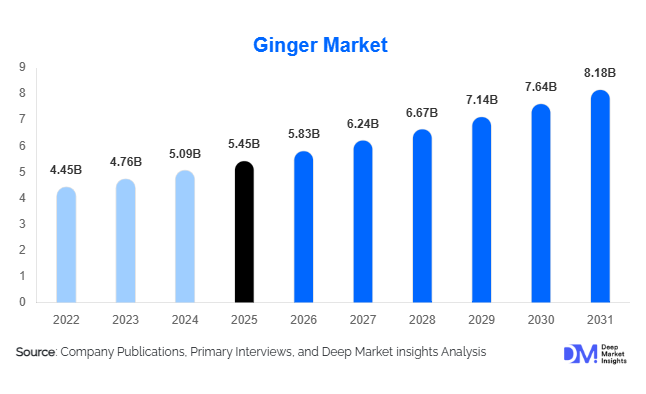
According to Deep Market Insights, the global ginger market size was valued at USD 5.08 billion in 2025 and is projected to grow from USD 5.83 billion in 2026 to reach USD 8.18 billion by 2031, expanding at a CAGR of 7.0% during the forecast period (2026–2031). The ginger market growth is primarily driven by rising consumer demand for natural immunity-boosting ingredients, increasing applications in functional foods and beverages, and expanding utilization of ginger extracts in nutraceutical, pharmaceutical, and personal care industries.
Key Market Insights
- Functional beverages and immunity-focused products are significantly boosting global ginger demand, particularly across North America and Europe.
- Organic ginger cultivation is rapidly expanding, supported by premium consumer demand for clean-label and pesticide-free agricultural products.
- Asia-Pacific dominates the global ginger market, led by India and China due to strong cultivation capacity and export-oriented production.
- North America remains one of the fastest-growing consumption markets, driven by rising health awareness and growing nutraceutical adoption.
- Pharmaceutical and nutraceutical industries are increasingly integrating ginger extracts into digestive health, anti-inflammatory, and wellness formulations.
- Advanced processing technologies, including freeze-drying and supercritical extraction, are improving product quality, shelf life, and export competitiveness.
ginger market latest trends
Growing Popularity of Functional and Wellness Beverages
Ginger is increasingly becoming a key ingredient in functional beverages, immunity shots, kombucha drinks, herbal teas, flavored waters, and wellness-focused juices. Consumers are shifting toward preventive healthcare and natural nutritional products, accelerating demand for ginger-infused beverages across developed and emerging economies. Beverage manufacturers are investing heavily in botanical formulations that combine ginger with turmeric, lemon, probiotics, and adaptogens to create premium health-oriented drinks. The trend is particularly strong among younger consumers and urban populations seeking digestive support, energy enhancement, and natural anti-inflammatory ingredients. Ready-to-drink wellness products containing ginger are rapidly expanding shelf presence in supermarkets, specialty health stores, and online retail platforms globally.
Expansion of Organic and Sustainable Ginger Farming
Organic ginger production is gaining momentum as consumers increasingly prefer sustainably sourced and chemical-free agricultural products. Export-oriented producers in India, Peru, Nigeria, and Thailand are expanding certified organic cultivation to meet growing demand from Europe, North America, Japan, and South Korea. Governments and agricultural boards are supporting farmers through subsidies, organic certification programs, and sustainable farming initiatives. Buyers are also emphasizing traceability, ethical sourcing, and regenerative agriculture practices within ginger supply chains. Blockchain-based traceability systems and sustainable packaging solutions are gradually being integrated into premium ginger exports, particularly for nutraceutical and wellness-focused applications.
ginger market drivers
Increasing Consumer Preference for Natural Health Ingredients
Consumers globally are increasingly favoring natural and plant-based ingredients over synthetic additives and chemical-based formulations. Ginger is widely recognized for its antioxidant, digestive, anti-inflammatory, and immunity-enhancing properties, making it highly attractive across food, beverage, pharmaceutical, and nutraceutical applications. Growing awareness regarding preventive healthcare and wellness nutrition is accelerating adoption of ginger supplements, herbal teas, immunity beverages, and botanical formulations. The expanding popularity of clean-label products and herbal remedies is expected to remain a major long-term growth driver for the ginger market.
Rising Demand from Food Processing and Beverage Industries
The processed food and beverage industries are major contributors to ginger market growth. Ginger is widely utilized in sauces, seasonings, bakery products, confectionery, ready meals, and flavored beverages. The globalization of Asian cuisine and growing popularity of ethnic food products are increasing ginger consumption worldwide. Beverage companies are aggressively launching ginger-based wellness drinks, detox beverages, and herbal formulations targeting health-conscious consumers. Rapid urbanization, changing dietary preferences, and rising convenience food consumption continue supporting industrial ginger demand globally.
global market restraints
Price Volatility and Supply Chain Instability
The ginger market is highly vulnerable to climatic disruptions, pest infestations, irregular rainfall, and transportation bottlenecks. Production fluctuations in key exporting countries such as India and China often create significant price volatility in global markets. Export restrictions, rising logistics costs, and inconsistent agricultural yields further impact supply stability. Such fluctuations create procurement challenges for food processors, exporters, and ingredient manufacturers operating under long-term pricing agreements.
Fragmented Farming Structure and Quality Inconsistency
A substantial portion of global ginger cultivation is managed by smallholder farmers with limited mechanization and inconsistent agricultural practices. Variations in moisture levels, contamination risks, pesticide residues, and post-harvest handling standards often create quality inconsistency across export shipments. International buyers, particularly in Europe and North America, require strict compliance with food safety regulations, traceability systems, and phytosanitary standards. Smaller producers often face challenges in meeting these requirements, limiting their participation in premium export markets.
ginger industry key opportunities
Expansion of Nutraceutical and Herbal Supplement Applications
The growing global nutraceutical industry presents substantial opportunities for ginger ingredient manufacturers. Ginger extracts, oils, and oleoresins are increasingly being incorporated into digestive health supplements, anti-inflammatory formulations, joint care products, and immunity-enhancing capsules. Aging populations, increasing healthcare awareness, and rising demand for botanical supplements are encouraging pharmaceutical and nutraceutical companies to expand ginger procurement. Manufacturers investing in standardized extraction technologies and high-purity active compounds are expected to gain significant competitive advantages within premium healthcare markets.
Export Growth in Emerging International Markets
Emerging economies across the Middle East, Eastern Europe, and Latin America are becoming increasingly important import destinations for ginger products. Rising urbanization, expanding foodservice industries, and growing consumer interest in herbal wellness products are driving import demand across these regions. Export-oriented producers are also benefiting from the diversification of global supply chains, as international buyers seek alternatives to concentrated sourcing from China. Improvements in cold-chain logistics, digital trade platforms, and cross-border e-commerce are creating additional export opportunities for ginger processors and agricultural cooperatives globally.
Report Scope
| Report Metric | Details |
|---|---|
| Market Size in 2025 | USD 5.45 Billion |
| Market Size in 2026 | USD 5.83 Billion |
| Market Size in 2031 | USD 8.18 Billion |
| CAGR | 7% (2026-2031) |
| Base Year for Estimation | 2025 |
| Historical Data | 2022-2024 |
| Forecast Period | 2026-2031 |
| Report Coverage | Revenue Forecast, Competitive Landscape, Supply Chain Disruption, Growth Factors, Environment & Regulatory Landscape and Trends |
| Geographies Covered | North America, Europe, APAC, Middle East and Africa, LATAM |
| Countries Covered | U.S., Canada, U.K., Germany, France, Spain, Italy, Russia, Nordic, Benelux, Rest of Europe, China, Korea, Japan, India, Australia, Singapore, Taiwan, South East Asia, Rest of Asia-Pacific, UAE, Turky, Saudi Arabia, South Africa, Egypt, Nigeria, Rest of MEA, Brazil, Mexico, Argentina, Chile, Colombia, Rest of LATAM |
Explore more data points, trends and opportunities Download Free Sample Report
Product Type Insights
Fresh ginger continues to dominate the global ginger market due to its extensive utilization across household cooking, foodservice operations, fresh produce retail, and traditional medicinal preparations. The segment maintains a leading position because consumers increasingly prefer natural and minimally processed ingredients in daily diets, while restaurants and food manufacturers rely heavily on fresh ginger for authentic flavor profiles and aroma enhancement. Strong consumption across Asia-Pacific, the Middle East, and African countries, where ginger remains deeply embedded in regional cuisines and traditional remedies, further supports segment growth. In addition, rising consumer interest in immunity-supporting foods and fresh botanical ingredients has strengthened retail demand for fresh ginger products worldwide.Ginger oils and oleoresins are witnessing substantial growth across pharmaceutical, nutraceutical, and cosmetic industries due to their concentrated bioactive compounds, anti-inflammatory properties, and extended stability compared to fresh variants. Rising investments in herbal healthcare formulations and clean-label cosmetic ingredients are encouraging manufacturers to expand ginger extract applications within skincare, aromatherapy, digestive wellness, and therapeutic products. Crystallized and preserved ginger products are also gaining popularity within confectionery, bakery, and specialty snack categories, particularly across North America and Europe, where consumers are increasingly seeking exotic flavor combinations and premium natural snacks.
Application Insights
Food and beverage applications account for the largest share of the global ginger market, primarily driven by rising consumer demand for functional foods, herbal beverages, sauces, marinades, confectionery products, and ready-to-eat meals. The leading position of this segment is supported by the growing incorporation of ginger into wellness-oriented diets due to its perceived digestive, anti-inflammatory, and immunity-enhancing benefits. Beverage manufacturers are increasingly launching ginger-based teas, kombucha products, detox beverages, energy drinks, and immunity shots to cater to health-conscious consumers seeking natural alternatives to synthetic ingredients.Pharmaceutical applications are expanding steadily as ginger gains wider acceptance within digestive health medicines, anti-nausea formulations, anti-inflammatory therapies, and traditional herbal remedies. Increasing clinical research highlighting ginger’s therapeutic potential for gastrointestinal health, pain management, and immune support continues to strengthen demand from pharmaceutical manufacturers globally. Nutraceutical applications are also accelerating rapidly due to rising awareness regarding preventive healthcare and the growing popularity of herbal supplements and botanical extracts.Within personal care and cosmetics, ginger extracts are increasingly integrated into skincare, haircare, aromatherapy, and wellness products because of their antioxidant, antimicrobial, and circulation-enhancing properties. Cosmetic companies are actively incorporating ginger into premium formulations targeting anti-aging, scalp stimulation, and skin revitalization applications, further contributing to market expansion.
Distribution Channel Insights
Supermarkets and hypermarkets dominate global ginger product distribution due to their extensive retail penetration, diversified product offerings, and strong consumer accessibility. The segment benefits from rising consumer preference for organized retail shopping environments where fresh produce, packaged spices, herbal beverages, and wellness products are conveniently available under one platform. Large retail chains are also expanding dedicated shelf space for organic and premium ginger products in response to growing health-conscious purchasing behavior.Traditional grocery retail continues to play a particularly important role in fresh ginger sales across Asia-Pacific, Latin America, and parts of Africa, where local markets remain essential for daily food purchases and regional culinary consumption patterns. Online retail channels are witnessing rapid expansion, especially for organic ginger powders, dietary supplements, herbal teas, immunity beverages, and specialty wellness products. The rapid growth of e-commerce platforms, direct-to-consumer health brands, and digital grocery services is enabling consumers to access premium and imported ginger products more efficiently.Specialty health stores and nutraceutical retailers are increasing shelf space dedicated to ginger-based supplements, botanical formulations, and herbal wellness products due to rising consumer interest in preventive healthcare and natural remedies. Meanwhile, wholesale and B2B distribution channels continue playing a critical role in supplying food processors, beverage manufacturers, pharmaceutical companies, and cosmetic producers with bulk ginger ingredients required for large-scale industrial applications.
End-Use Industry Insights
Food processing companies represent the largest end-use industry within the global ginger market, driven by widespread utilization of fresh and processed ginger in sauces, snacks, ready meals, beverages, bakery products, and seasoning formulations. The leading position of this segment is supported by increasing global demand for ethnic cuisines, convenience foods, and functional food ingredients that enhance flavor while offering perceived health benefits. Manufacturers are increasingly incorporating ginger into clean-label food formulations to meet evolving consumer preferences for natural additives and botanical ingredients.Beverage manufacturers are among the fastest-growing consumers of ginger due to expanding production of herbal teas, kombucha, flavored waters, detox beverages, immunity drinks, and wellness-focused functional beverages. Rising consumer interest in digestive wellness and immunity support continues to accelerate product innovation across the beverage industry.Pharmaceutical and nutraceutical companies are significantly increasing ginger procurement for digestive health products, herbal medicines, immunity supplements, and anti-inflammatory formulations. Growing acceptance of plant-based healthcare ingredients and traditional medicinal systems is further strengthening demand from these sectors. Cosmetic and personal care manufacturers are also expanding ginger utilization within premium skincare, haircare, aromatherapy, and spa products due to increasing consumer preference for naturally derived cosmetic ingredients. Restaurants and foodservice operators continue contributing substantially to fresh ginger demand, particularly within Asian cuisine, fusion dining, and gourmet food preparation segments globally.
Nature Insights
Conventional ginger accounts for the majority of global production and trade volumes due to large-scale cultivation practices, wider availability, established agricultural infrastructure, and comparatively lower production costs. The dominance of this segment is further supported by strong demand from mass-market food processing, foodservice, and retail industries that require stable supply volumes and cost-efficient sourcing. Developing countries continue to rely heavily on conventional farming methods to meet rising domestic and export demand.However, organic ginger is emerging as the fastest-growing segment within the global market. Rising consumer concerns regarding pesticide residues, food safety, environmental sustainability, and chemical-free farming practices are significantly increasing demand for certified organic ginger products across Europe and North America. Organic ginger commands premium pricing within export markets and is witnessing particularly strong demand across nutraceutical, herbal beverage, and specialty wellness categories.Governments, agricultural cooperatives, and export agencies are increasingly supporting organic farming initiatives through certification programs, sustainable cultivation training, and export promotion strategies aimed at improving international competitiveness. Growing retailer focus on traceability, sustainability compliance, and clean-label product positioning is expected to further strengthen long-term growth prospects for the organic ginger segment.
Explore more data points, trends and opportunities Download Free Sample Report
Ginger Market Segmentations
By Product Form
- Fresh Ginger
- Dried Ginger
- Ginger Powder
- Ginger Paste & Puree
- Ginger Oil
- Ginger Oleoresin
- Ginger Extracts
- Pickled & Preserved Ginger
- Frozen Ginger
By Nature
- Conventional Ginger
- Organic Ginger
By Application
- Food & Beverage
- Pharmaceuticals
- Nutraceuticals & Dietary Supplements
- Personal Care & Cosmetics
- Traditional Medicine
- Foodservice & Hospitality
By Distribution Channel
- Supermarkets & Hypermarkets
- Convenience Stores
- Specialty Stores
- Online Retail
- Wholesale & B2B Distribution
By End User
- Household Consumers
- Food Processing Companies
- Beverage Manufacturers
- Pharmaceutical Companies
- Nutraceutical Manufacturers
- Cosmetic & Personal Care Companies
- Restaurants & Catering Services
Regional Insights
Asia-Pacific
Asia-Pacific dominates the global ginger market with nearly 43% market share in 2025, led by India, China, Indonesia, Thailand, and Vietnam. The region maintains its leadership position due to favorable agro-climatic conditions, extensive cultivation acreage, abundant agricultural labor availability, and strong domestic consumption of ginger across culinary and medicinal applications. India remains the world’s largest producer of ginger, supported by diversified cultivation regions, increasing government support for spice exports, and rising investments in post-harvest infrastructure. China continues to lead global exports of fresh and processed ginger products owing to advanced processing capabilities, strong international trade networks, and large-scale agricultural commercialization.Regional growth is further driven by rising consumer demand for herbal beverages, traditional medicine, functional foods, and natural immunity-enhancing ingredients across densely populated Asian economies. Increasing urbanization, changing dietary habits, and expanding middle-class populations are accelerating consumption of processed ginger products including powders, teas, and supplements. Indonesia and Thailand are strengthening exports of dehydrated and organic ginger products to North America and Europe, while government initiatives promoting spice cultivation and agricultural exports continue supporting long-term regional market expansion.
North America
North America accounts for approximately 21% of the global ginger market, supported primarily by strong demand from the United States and Canada. Regional growth is being driven by rising consumer awareness regarding digestive health, immunity enhancement, preventive healthcare, and plant-based wellness products. Consumers across the region are increasingly incorporating ginger into beverages, supplements, packaged foods, functional snacks, and herbal remedies as part of broader health-conscious lifestyle trends.The United States remains one of the world’s largest importers of fresh and processed ginger products due to limited domestic production capacity and continuously expanding consumption across foodservice, retail, and nutraceutical sectors. Rapid expansion of functional beverage categories, including kombucha, wellness shots, herbal teas, and immunity drinks, is further stimulating regional demand. Additionally, growing preference for organic, clean-label, and sustainably sourced food ingredients among premium retail consumers continues to accelerate growth within specialty ginger product categories.
Europe
Europe represents nearly 19% of global ginger market demand, with Germany, the United Kingdom, France, and the Netherlands serving as major consumption and trade centers. Regional growth is strongly supported by increasing consumer preference for clean-label foods, herbal supplements, natural remedies, and sustainably sourced agricultural products. Germany remains a major importer due to the presence of large pharmaceutical, nutraceutical, and organic food industries, while the Netherlands functions as a key redistribution and logistics hub for imported spices across the European market.Rising adoption of preventive healthcare practices and growing popularity of botanical ingredients within beverages, dietary supplements, and personal care products are significantly increasing ginger consumption across the region. European consumers are also demonstrating stronger demand for certified organic and ethically sourced ginger products, encouraging retailers and manufacturers to expand premium product offerings. Regulatory emphasis on food traceability, sustainability compliance, and reduced chemical residues is further supporting growth within the organic ginger segment.
Latin America
Latin America is emerging as a rapidly growing production and export region for ginger, particularly led by Peru and Brazil. The region benefits from favorable agricultural conditions, expanding organic farming practices, and rising international demand for premium-quality ginger exports. Peru has established a strong competitive position within the organic ginger export market due to increasing compliance with international certification standards, improving export infrastructure, and growing cultivation investments.Regional market growth is further supported by rising trade partnerships with North American and European importers seeking diversified supply sources outside Asia. Increasing farmer participation in export-oriented spice cultivation, along with government initiatives promoting agricultural exports and sustainable farming practices, is enhancing the region’s competitiveness within the global ginger trade. Demand for organic and minimally processed ginger products continues creating new growth opportunities for Latin American producers.
Middle East & Africa
The Middle East and Africa region is witnessing increasing ginger demand due to rapid urbanization, expanding foodservice industries, population growth, and rising adoption of herbal wellness products. Ginger consumption remains deeply integrated within regional culinary traditions, herbal beverages, and natural medicinal practices, particularly across African and Middle Eastern households.Nigeria remains one of the leading ginger producers in Africa, supported by favorable climatic conditions and expanding export activities. The UAE and Saudi Arabia represent important import-driven markets due to strong demand from hospitality, food processing, and retail sectors. Regional growth is also being driven by increasing consumer awareness regarding immunity enhancement, digestive health, and natural healthcare solutions following rising interest in preventive wellness trends. Expanding retail modernization, growth of organized food distribution networks, and increasing investments in herbal and functional beverage categories are expected to support sustained market expansion across the region during the forecast period.
Key Players in the Ginger Market
- Olam Group
- Buderim Group
- The Ginger People
- Knitspice
- Sino-Nature International
- Canadian Ginger Company
- Capital Foods
- SA Rawther Spices
- Floracopeia
- Monterey Bay Spice Company
- Indian Organic Farmers Producer Company
- Huaguang Group
- ADM
- Yummy Food Industrial Group
- Ako GmbH