Gelatin Market Size
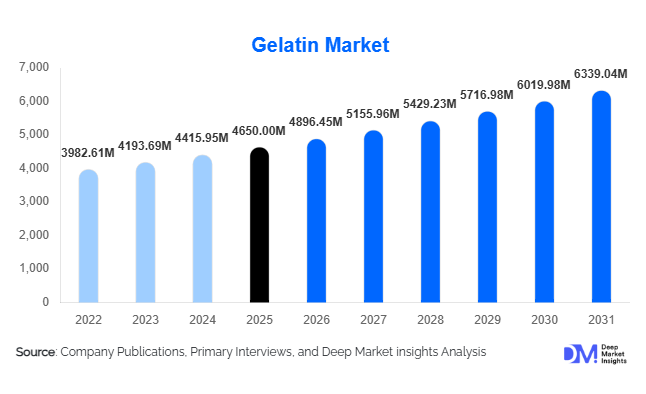
According to Deep Market Insights, the global gelatin market size was valued at USD 4,650 million in 2025 and is projected to grow from USD 4,896.45 million in 2026 to reach USD 6,339.04 million by 2031, expanding at a CAGR of 5.3% during the forecast period (2026–2031). The gelatin market growth is primarily driven by increasing demand in food and beverage applications, rising pharmaceutical softgel consumption, and the expansion of cosmetic and personal care uses. Additionally, innovations in marine and sustainable gelatin are boosting adoption across emerging and regulated markets worldwide.
Key Market Insights
- Food and beverage applications dominate the gelatin market, led by confectionery, dairy, and beverage products requiring gelling, stabilizing, and texturizing agents.
- Pharmaceutical softgel capsules are driving higher-value demand, as gelatin ensures high bioavailability and structural integrity in nutraceuticals and medications.
- Marine gelatin is gaining traction globally due to religious and dietary restrictions limiting bovine and porcine consumption.
- Asia-Pacific is the fastest-growing regional market, driven by rising disposable income, growing processed food industries, and expanding pharmaceutical manufacturing hubs in China and India.
- Technological integration in gelatin processing, including enzymatic extraction and specialty formulations, is improving functional properties and reducing production costs.
- Regulatory certifications such as halal, kosher, and clean-label are shaping market differentiation, creating opportunities for premium gelatin offerings globally.
What are the latest trends in the gelatin market?
Clean-Label and Sustainable Gelatin
Manufacturers are increasingly focusing on ethically sourced, halal, kosher, and environmentally sustainable gelatin. Marine gelatin is a key trend here, as it meets religious and dietary requirements while appealing to consumers demanding natural, traceable, and environmentally friendly products. Companies are adopting transparent supply chains and sustainability certifications to differentiate products in the food, pharmaceutical, and cosmetic segments. Consumer preference for clean-label products continues to influence innovation, leading to specialty gelatin variants such as low-calorie, low-moisture, and enhanced bioactive formulations.
Advanced Functional and Specialty Gelatin
Gelatin is being modified to improve solubility, gelling strength, and bioactive delivery, enabling novel applications in pharmaceuticals, nutraceuticals, and functional foods. Enzymatic extraction, micro-encapsulation, and low-temperature processing are being adopted to enhance performance and maintain nutritional integrity. This trend caters to high-margin markets such as softgel capsules, protein-enriched foods, and cosmetic formulations requiring controlled texture and stability.
What are the key drivers in the gelatin market?
Rising Demand in Confectionery and Processed Foods
Global consumption of gummies, marshmallows, desserts, and dairy products has significantly increased, particularly in North America, Europe, and APAC. Gelatin’s unique functional properties, gelling, emulsifying, and stabilizing, make it indispensable in these applications. As urbanization and disposable income rise, processed food consumption grows, directly boosting gelatin demand. This driver accounts for over 55% of the 2025 global market share.
Pharmaceutical Softgel Applications
Softgel capsules are a major contributor to gelatin market growth. Gelatin ensures high bioavailability, capsule integrity, and shelf stability. Rising global healthcare expenditure and growing nutraceutical adoption have increased the consumption of pharmaceutical-grade gelatin. The Asia-Pacific and North America regions are witnessing strong expansion due to local manufacturing and export-oriented production hubs.
Emergence of Marine Gelatin
Marine gelatin, sourced from fish skins and bones, is increasingly preferred in regions where bovine or porcine gelatin is restricted for religious or dietary reasons. Its adoption in pharmaceuticals, confectionery, and cosmetics opens new market segments, particularly in Muslim-majority countries, Japan, and Europe, providing a significant growth avenue for manufacturers.
What are the restraints for the global market?
Volatility in Raw Material Prices
The gelatin industry is highly dependent on animal-derived raw materials such as bovine and porcine hides and bones, which are subject to price volatility due to livestock supply fluctuations, disease outbreaks, and regulatory changes. Price swings can increase production costs, reduce profit margins, and affect the stability of supply chains globally.
Regulatory Compliance and Quality Standards
Gelatin manufacturers must comply with stringent food, pharmaceutical, and cosmetic regulations, including halal, kosher, and GMP standards. Meeting these requirements increases operational costs and can slow market entry for new players, acting as a restraint to rapid market expansion, especially in high-value applications like pharmaceuticals and nutraceuticals.
What are the key opportunities in the gelatin industry?
Expansion in Emerging Markets
Asia-Pacific and Latin America are witnessing rapid growth in processed foods, beverages, and pharmaceuticals. Rising disposable income, urbanization, and increased consumer health awareness are fueling demand for gelatin. Companies can leverage local manufacturing, strategic partnerships, and product adaptation to regional tastes to capture high-growth opportunities.
Technological Advancements in Gelatin Production
Innovations such as enzymatic extraction, micro-encapsulation, and functional gelatin formulations offer opportunities to enhance quality, reduce production costs, and create premium products. These advancements enable applications in specialized areas like nutraceuticals, functional foods, and high-end cosmetics, differentiating products and commanding higher margins.
Regulatory and Government Support
Initiatives such as “Make in India” and “Made in China 2026” encourage domestic manufacturing and export of gelatin and related products. Government incentives for the pharmaceutical, cosmetic, and food processing sectors indirectly support gelatin demand, allowing companies to expand production capacities, invest in R&D, and explore new international markets.
Report Scope
| Report Metric | Details |
|---|---|
| Market Size in 2025 | USD 4650 Million |
| Market Size in 2026 | USD 4896.45 Million |
| Market Size in 2031 | USD 6339.04 Million |
| CAGR | 5.3% (2026-2031) |
| Base Year for Estimation | 2025 |
| Historical Data | 2022-2024 |
| Forecast Period | 2026-2031 |
| Report Coverage | Revenue Forecast, Competitive Landscape, Supply Chain Disruption, Growth Factors, Environment & Regulatory Landscape and Trends |
| Geographies Covered | North America, Europe, APAC, Middle East and Africa, LATAM |
| Countries Covered | U.S., Canada, U.K., Germany, France, Spain, Italy, Russia, Nordic, Benelux, Rest of Europe, China, Korea, Japan, India, Australia, Singapore, Taiwan, South East Asia, Rest of Asia-Pacific, UAE, Turky, Saudi Arabia, South Africa, Egypt, Nigeria, Rest of MEA, Brazil, Mexico, Argentina, Chile, Colombia, Rest of LATAM |
Explore more data points, trends and opportunities Download Free Sample Report
Product Type Insights
Powder gelatin dominates the global gelatin market, accounting for over 52% of total revenue in 2025, primarily due to its superior solubility, longer shelf life, ease of transportation, and compatibility across multiple end-use industries. Powder gelatin is extensively used in confectionery (gummies, marshmallows, jellies), dairy desserts, beverages, and pharmaceutical capsules. Its ability to deliver consistent bloom strength, controlled viscosity, and stable gelling performance makes it the preferred format for large-scale industrial production. The growing global demand for processed foods and nutraceutical supplements continues to reinforce powder gelatin’s leadership position. Additionally, clean-label and high-protein product innovations are further accelerating its adoption in functional foods and fortified beverages.
Sheet gelatin, although smaller in volume share (approximately 25% of the market), holds strong relevance in premium confectionery and gourmet dessert applications. It offers precise texture control and superior clarity, making it highly preferred in artisanal and high-end culinary preparations, particularly in Europe and Japan. The rising popularity of premium desserts and patisserie products in developed markets is supporting steady growth in this segment. Granular gelatin accounts for nearly 23% of global demand and is increasingly used in pharmaceutical and industrial applications due to dosing convenience and controlled hydration properties. Pharmaceutical manufacturers favor granular formats for capsule production and specialty formulations. Growth in global softgel manufacturing, particularly in Asia-Pacific, is supporting this segment’s upward trajectory.
Application Insights
Confectionery remains the largest application segment, contributing approximately 38% of the global gelatin market revenue in 2025. The segment’s dominance is driven by rising global consumption of gummies, chewable candies, marshmallows, and gelatin-based desserts. Increasing product innovation in sugar-free, fortified, and functional confectionery products is further supporting demand. Emerging markets in Asia-Pacific and Latin America are witnessing strong volume growth due to expanding retail networks and westernized consumption patterns.
Pharmaceutical softgel capsules represent the fastest-growing application segment, expanding at a CAGR higher than the overall market average. This segment accounts for nearly 28% of global gelatin demand. The growth is fueled by rising global healthcare expenditure, increased consumption of dietary supplements, aging populations in developed economies, and expanding generic drug manufacturing in countries such as India and China. Gelatin’s superior film-forming and oxygen-barrier properties make it indispensable in capsule production.
Explore more data points, trends and opportunities Download Free Sample Report
Gelatin Market Segmentations
By Product Type
- Powder Gelatin
- Sheet Gelatin
- Granular Gelatin
By Application
- Confectionery
- Dairy & Processed Foods
- Pharmaceutical Softgel Capsules
- Cosmetics & Personal Care
- Technical & Industrial Applications
By Source
- Bovine Gelatin
- Porcine Gelatin
- Marine Gelatin
- Other Sources
By End-Use Industry
- Food & Beverage Industry
- Pharmaceutical & Nutraceutical Industry
- Cosmetics & Personal Care Industry
- Technical & Industrial Sector
Regional Insights
North America
North America accounted for approximately 30% of the global gelatin market revenue in 2025, with the United States representing the largest country-level contributor. Regional growth is driven by strong demand for functional confectionery, dietary supplements, and pharmaceutical softgel capsules. The U.S. nutraceutical industry—valued at over USD 60 billion—continues to expand, directly boosting pharmaceutical-grade gelatin consumption. High consumer preference for protein-enriched and clean-label products is further accelerating demand. Additionally, advanced pharmaceutical manufacturing infrastructure, strict quality standards, and well-established distribution networks strengthen regional dominance. Canada also contributes significantly by expanding natural health product markets and processed food exports.
Europe
Europe holds approximately 28% of the global gelatin market share, led by Germany, France, the U.K., Italy, and Spain. The region benefits from a mature confectionery industry and a strong pharmaceutical manufacturing base. Germany alone accounts for a substantial portion of European pharmaceutical gelatin consumption due to its advanced drug production capabilities. Strict EU regulations emphasizing traceability, halal and kosher certifications, and sustainability are shaping purchasing patterns. Additionally, Europe is a leader in marine gelatin adoption, driven by religious dietary considerations and environmental sustainability awareness. Rising demand for collagen-based beauty supplements is also supporting steady growth.
Asia-Pacific
Asia-Pacific is the fastest-growing region, accounting for roughly 26% of global market revenue in 2025, with China, India, and Japan serving as key growth engines. Rapid urbanization, increasing disposable incomes, and expanding middle-class populations are driving processed food and confectionery consumption. China dominates regional production and consumption due to its large-scale pharmaceutical and nutraceutical manufacturing sector. India is emerging as a major exporter of pharmaceutical capsules, significantly boosting gelatin demand. Japan, meanwhile, demonstrates strong demand for premium confectionery and marine-derived gelatin products. Government-backed manufacturing initiatives and expanding export-driven production are key regional growth drivers.
Latin America
Latin America represents approximately 8% of the global gelatin market, led by Brazil, Mexico, and Argentina. Regional growth is supported by increasing processed food consumption, rising middle-class income levels, and expanding pharmaceutical manufacturing capabilities. Brazil acts as a regional production hub, supported by strong livestock availability and export potential. Mexico benefits from proximity to North American pharmaceutical supply chains, enhancing cross-border trade. Growing urbanization and modern retail penetration are expected to accelerate confectionery demand across the region.
Middle East & Africa
The Middle East & Africa account for nearly 8% of global demand, with the UAE, Saudi Arabia, and South Africa as major contributors. The Middle East represents a high-value market for halal-certified gelatin, particularly in pharmaceutical and confectionery applications. Strong import dependence, combined with rising healthcare expenditure and population growth, is driving demand. In Africa, South Africa leads regional consumption due to its established food processing and pharmaceutical sectors. Growing investments in healthcare infrastructure and increasing consumption of packaged foods are expected to gradually boost regional gelatin demand. Marine gelatin remains particularly important in Muslim-majority countries due to dietary compliance requirements.
Key Players in the Gelatin Market
- Gelita AG
- Rousselot
- Weishardt Group
- Nitta Gelatin Inc.
- PB Gelatins GmbH
- Jungbunzlauer Suisse AG
- Gelnex Inc.
- Herman Gelatin
- Bangkok Gelatin Co., Ltd.
- Norland Products Inc.
- Kewpie Gelatin
- FMC Corporation
- Advanced Biopolymers Ltd.
- Ashland Global Holdings Inc.
- Peter Greven GmbH & Co. KG