G-Protein Coupled Receptor (GPCR) Market Size
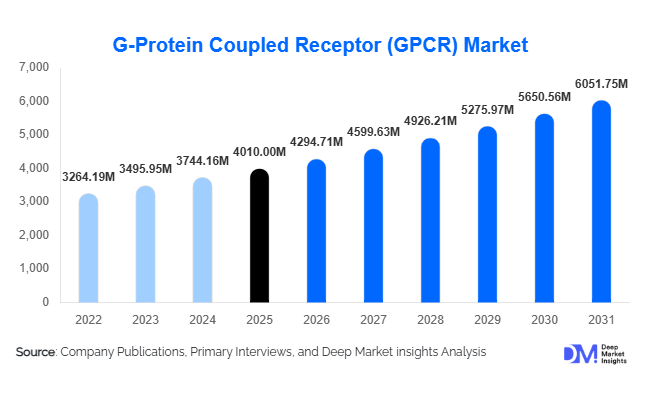
According to Deep Market Insights,the global G-Protein Coupled Receptor (GPCR) market size was valued at USD 4,010 million in 2025 and is projected to grow from USD 4,294.71 million in 2026 to reach USD 6,051.75 million by 2031, expanding at a CAGR of 7.1% during the forecast period (2026–2031). Growth in the GPCR market is primarily driven by rising pharmaceutical drug discovery activities, increasing adoption of high-throughput screening technologies, and expanding research into receptor signaling pathways across multiple therapeutic areas including oncology, cardiovascular disorders, metabolic diseases, and neurological conditions.
Key Market Insights
- GPCRs represent one of the most important drug target families, with a significant portion of approved pharmaceuticals interacting with these receptors.
- Pharmaceutical companies dominate demand for GPCR assays, cell lines, and screening technologies due to expanding drug discovery pipelines.
- North America remains the leading regional market, supported by strong pharmaceutical R&D investments and advanced biotechnology infrastructure.
- Asia-Pacific is the fastest-growing region, driven by rising pharmaceutical innovation in China, India, Japan, and South Korea.
- High-throughput screening platforms and AI-assisted drug discovery are transforming GPCR research and accelerating therapeutic development.
- Growing research into orphan GPCRs is creating new opportunities for targeted therapeutics and next-generation medicines.
What are the latest trends in the GPCR market?
Rising Interest in Biased GPCR Signaling
Biased signaling is emerging as a key research trend in the GPCR market. Instead of activating all signaling pathways linked to a receptor, biased agonists selectively stimulate specific intracellular responses. This approach enables pharmaceutical researchers to design therapies that deliver therapeutic benefits while minimizing adverse side effects. As scientific understanding of receptor conformations improves, drug developers are increasingly exploring selective ligands and biased agonists targeting GPCR pathways. This trend is particularly important in neurological disorders, cardiovascular disease, and inflammatory conditions, where receptor selectivity can dramatically improve drug efficacy and safety.
Integration of Artificial Intelligence in Drug Discovery
Artificial intelligence and machine learning are rapidly transforming GPCR research. Advanced computational platforms are now capable of modeling receptor structures, predicting ligand binding behavior, and identifying potential drug candidates through virtual screening. Pharmaceutical companies are using AI tools to accelerate lead optimization and reduce the cost and time required for early-stage drug discovery. AI-driven approaches also allow researchers to analyze large biological datasets, enabling deeper insights into receptor pharmacology and signaling networks. As structural biology techniques such as cryo-electron microscopy become more widely used, AI is expected to play an even larger role in GPCR drug discovery.
What are the key drivers in the GPCR market?
Increasing Pharmaceutical Drug Discovery Activities
Pharmaceutical research continues to expand globally, with GPCRs remaining among the most important targets for therapeutic development. Many leading pharmaceutical companies maintain extensive pipelines of GPCR-targeted drugs across multiple disease categories. Drug discovery programs rely heavily on GPCR cell lines, receptor assays, and screening platforms to evaluate thousands of compounds during early research stages. As pharmaceutical R&D spending continues to grow worldwide, the demand for GPCR technologies is increasing rapidly. The expansion of personalized medicine and targeted therapeutics is further accelerating investment in receptor biology research.
Growing Prevalence of Chronic Diseases
The increasing incidence of chronic diseases such as diabetes, cancer, cardiovascular disorders, and neurological conditions is creating strong demand for innovative treatment strategies. GPCR signaling pathways play a central role in regulating many biological functions, making them ideal targets for therapeutic intervention. Researchers are actively studying receptor activity in metabolic regulation, immune response, and neurotransmission. As healthcare systems worldwide focus on improving treatment outcomes for chronic diseases, pharmaceutical companies are investing heavily in GPCR-based research platforms.
What are the restraints for the global market?
High Cost of GPCR Research Technologies
GPCR research requires advanced laboratory infrastructure, specialized assay kits, and highly trained scientific personnel. High-throughput screening systems, receptor libraries, and recombinant cell lines can involve significant investment. These costs may limit adoption among smaller biotechnology firms and academic institutions with restricted research budgets. In addition, maintaining high-quality laboratory environments and specialized equipment adds to operational expenses.
Complexity of GPCR Signaling Pathways
GPCR biology is highly complex, with receptors often displaying multiple signaling behaviors depending on ligand binding and cellular context. Many receptors interact with different intracellular proteins, leading to diverse physiological outcomes. This complexity can slow drug discovery processes and increase development costs. Researchers must conduct extensive validation studies to understand receptor pharmacology, which can extend development timelines for GPCR-targeted drugs.
What are the key opportunities in the GPCR industry?
Expansion of Precision Medicine
Precision medicine represents a major opportunity for GPCR-based drug discovery. By identifying specific receptor subtypes associated with disease mechanisms, pharmaceutical companies can develop targeted therapies designed for particular patient populations. Advances in genomic research and biomarker discovery are enabling scientists to better understand receptor-disease relationships. This trend is expected to significantly expand the development of highly selective GPCR therapeutics in oncology, neurology, and metabolic diseases.
Growing Pharmaceutical R&D in Emerging Economies
Emerging markets such as China, India, and South Korea are rapidly expanding their pharmaceutical research capabilities. Government initiatives aimed at promoting domestic drug development are encouraging companies to invest in biotechnology infrastructure and receptor biology research. These countries are building advanced laboratories and research facilities capable of supporting GPCR screening and drug discovery programs. As pharmaceutical innovation accelerates across Asia-Pacific, demand for GPCR research tools and technologies is expected to increase substantially.
Report Scope
| Report Metric | Details |
|---|---|
| Market Size in 2025 | USD 4010 Million |
| Market Size in 2026 | USD 4294.71 Million |
| Market Size in 2031 | USD 6051.75 Million |
| CAGR | 7.1% (2026-2031) |
| Base Year for Estimation | 2025 |
| Historical Data | 2022-2024 |
| Forecast Period | 2026-2031 |
| Report Coverage | Revenue Forecast, Competitive Landscape, Supply Chain Disruption, Growth Factors, Environment & Regulatory Landscape and Trends |
| Geographies Covered | North America, Europe, APAC, Middle East and Africa, LATAM |
| Countries Covered | U.S., Canada, U.K., Germany, France, Spain, Italy, Russia, Nordic, Benelux, Rest of Europe, China, Korea, Japan, India, Australia, Singapore, Taiwan, South East Asia, Rest of Asia-Pacific, UAE, Turky, Saudi Arabia, South Africa, Egypt, Nigeria, Rest of MEA, Brazil, Mexico, Argentina, Chile, Colombia, Rest of LATAM |
Explore more data points, trends and opportunities Download Free Sample Report
Product Type Insights
The product type landscape of the global GPCR market is led by GPCR cell lines, which accounted for nearly 45% of total revenue in 2025. The dominance of this segment is primarily driven by the growing need for reliable and reproducible in vitro models for studying receptor signaling mechanisms during drug discovery and pharmacological research. GPCR cell lines provide stable expression of receptors and allow scientists to analyze receptor activation, ligand binding, and downstream signaling pathways under controlled laboratory conditions. Their ability to mimic physiological receptor behavior makes them an essential tool for pharmaceutical and biotechnology companies developing receptor-targeted therapeutics. The increasing number of drug candidates targeting GPCR pathways in areas such as neurology, oncology, and metabolic diseases continues to drive strong demand for these specialized cell lines.
Detection kits and assay kits also represent a significant portion of the GPCR research tools market, particularly those designed to measure intracellular signaling responses such as cAMP accumulation, calcium flux, and β-arrestin recruitment. These assays are widely used in high-throughput screening environments where pharmaceutical companies evaluate thousands of compounds for receptor activity during early drug discovery stages. Continuous advancements in assay sensitivity, automation compatibility, and multiplex screening capabilities are improving the efficiency of receptor pharmacology studies and expanding the adoption of these kits across academic and industrial laboratories. In addition, ligands including agonists, antagonists, and allosteric modulators play a critical role in receptor characterization and pharmacological profiling. These molecules allow researchers to evaluate receptor selectivity, signaling bias, and therapeutic potential of candidate compounds.
Another emerging product category includes GPCR libraries and screening panels, which are becoming increasingly important for exploring orphan receptors and identifying novel therapeutic targets. These libraries provide access to a wide range of receptor constructs that can be used in systematic screening programs aimed at discovering new drug mechanisms. As pharmaceutical companies expand their focus on precision medicine and receptor-specific therapeutics, the demand for comprehensive GPCR screening tools is expected to grow significantly over the coming years.
Application Insights
Drug discovery and target identification represent the leading application segment in the GPCR market and serve as the primary driver of overall industry demand. GPCRs are among the most widely targeted receptor families in modern pharmacology, with a large proportion of currently approved drugs acting on GPCR signaling pathways. Pharmaceutical companies rely extensively on receptor assays, cell-based screening platforms, and ligand-binding studies to identify promising therapeutic compounds during the early stages of drug development. The increasing focus on developing treatments for chronic diseases such as neurological disorders, cardiovascular conditions, and metabolic syndromes continues to stimulate extensive GPCR-related research activity across pharmaceutical and biotechnology companies.
Central nervous system research represents another major application area due to the essential role GPCRs play in neurotransmission, synaptic signaling, and neural communication. Many neurological disorders including depression, schizophrenia, Parkinson’s disease, and Alzheimer’s disease involve dysfunction of GPCR-mediated signaling pathways. As a result, academic researchers and pharmaceutical developers are increasingly investigating these receptors to identify novel therapeutic targets that can improve treatment outcomes for patients with complex neurological conditions.
Oncology research is also emerging as an important area of GPCR investigation. Recent studies have demonstrated that GPCR signaling pathways can influence tumor growth, metastasis, immune system interactions, and angiogenesis. These findings have encouraged pharmaceutical companies to explore receptor-targeted therapies that may help regulate tumor progression or enhance the effectiveness of immunotherapies. In addition, GPCR research is expanding into metabolic disease studies, particularly diabetes and obesity, where receptor activity influences hormone secretion, glucose metabolism, and energy regulation. As the global burden of metabolic disorders continues to increase, research efforts aimed at understanding GPCR involvement in endocrine signaling are expected to accelerate.
Distribution Channel Insights
Direct sales remain the dominant distribution channel within the GPCR research tools market, primarily because pharmaceutical and biotechnology companies require consistent supply chains, technical support, and customized research solutions when conducting complex receptor studies. Major manufacturers of GPCR cell lines, assay kits, and screening technologies maintain dedicated sales teams that work directly with research laboratories to provide specialized reagents, experimental protocols, and product training. This direct engagement enables suppliers to build long-term partnerships with pharmaceutical companies conducting large-scale drug discovery programs.
Scientific equipment distributors also play a vital role in expanding market accessibility by supplying GPCR research tools to academic institutions, contract research organizations, and smaller biotechnology firms. These distributors help bridge the gap between manufacturers and laboratories by providing logistical support, regional product availability, and technical guidance. Their extensive distribution networks allow research organizations to access a broad portfolio of GPCR-related reagents and assay technologies from multiple suppliers.
Online purchasing platforms are becoming increasingly influential in the research tools industry as laboratories seek convenient and efficient procurement options. Digital marketplaces enable scientists to browse detailed product catalogs, review technical specifications, compare assay technologies, and access pricing information before placing orders. Many manufacturers are also investing in proprietary digital platforms designed to streamline product selection and provide integrated technical resources such as experimental guides and troubleshooting support. The continued digitalization of laboratory procurement processes is expected to further strengthen online distribution channels in the coming years.
End-User Insights
Pharmaceutical companies represent the largest end-user segment in the GPCR market, accounting for nearly 48% of global demand. This dominance is primarily driven by the critical role GPCR targets play in modern drug development. A substantial portion of marketed drugs interact with GPCR signaling pathways, making these receptors a central focus of pharmaceutical research programs. Large pharmaceutical companies invest heavily in receptor-based screening platforms, structural biology research, and ligand optimization studies aimed at developing innovative treatments for chronic and complex diseases.
Biotechnology companies are among the fastest-growing end users in the GPCR market. Many emerging biotech firms are focusing specifically on GPCR-based biologics, peptide therapeutics, and novel receptor modulators designed to improve therapeutic specificity and reduce adverse effects. These companies often rely on advanced cell lines, receptor libraries, and high-throughput screening technologies to accelerate early-stage discovery programs. The increasing number of biotech startups focused on precision medicine and receptor-targeted therapies is expected to further stimulate demand for GPCR research tools.
Contract research organizations are also expanding their involvement in GPCR-related research as pharmaceutical companies increasingly outsource early-stage discovery activities to specialized service providers. CROs provide comprehensive research services including receptor assay development, compound screening, pharmacological profiling, and preclinical evaluation. This outsourcing trend allows pharmaceutical companies to reduce operational costs while maintaining access to advanced laboratory technologies and scientific expertise.
Academic institutions and government research organizations contribute significantly to the GPCR market through fundamental research programs focused on receptor signaling mechanisms, structural biology, and cellular communication pathways. Universities often conduct pioneering research that leads to the identification of new GPCR targets and signaling pathways, providing valuable scientific insights that later support pharmaceutical drug development. Government-funded biomedical research initiatives also play an important role in expanding the scientific understanding of GPCR biology.
Explore more data points, trends and opportunities Download Free Sample Report
G-Protein Coupled Receptor (GPCR) Market Segmentations
By Product Type
- GPCR Cell Lines
- Detection & Assay Kits
- Cell Culture Reagents
- Ligands (Agonists, Antagonists, Modulators)
- GPCR Libraries & Screening Panels
By Application
- Drug Discovery & Target Identification
- Central Nervous System Research
- Oncology Research
- Cardiovascular Disease Research
- Metabolic Disorder Research
- Inflammation & Immunology Research
- Respiratory Disease Research
By End-User
- Pharmaceutical Companies
- Biotechnology Companies
- Contract Research Organizations (CROs)
- Academic & Research Institutes
- Government Research Laboratories
By Technology Platform
- Cell-Based GPCR Assays
- Label-Free Assays
- Reporter Gene Assays
- Fluorescence-Based Assays
- Luminescence-Based Assays
- Biosensor-Based Assays
Regional Insights
North America
North America dominates the global GPCR market, accounting for approximately 38% of total revenue in 2025. The region’s leadership is largely driven by the presence of a highly developed pharmaceutical industry, substantial investments in biomedical research, and advanced laboratory infrastructure supporting drug discovery activities. The United States represents the largest contributor to regional market growth due to strong funding from both private pharmaceutical companies and public research agencies. Major biotechnology clusters located in Boston, California, and North Carolina provide a highly collaborative environment where academic institutions, biotechnology firms, and pharmaceutical companies work together on advanced receptor research programs.
In addition to strong industry presence, the region benefits from significant government funding for biomedical research through national health agencies and scientific research programs. These initiatives support extensive studies focused on receptor pharmacology, structural biology, and therapeutic development. Canada also contributes to regional growth through its expanding biotechnology ecosystem, increasing venture capital investments, and supportive government policies aimed at strengthening life sciences research and innovation.
Europe
Europe represents the second-largest regional market with approximately 28% share of global revenue. The region benefits from a strong network of pharmaceutical manufacturers, biotechnology startups, and world-renowned academic research institutions. Countries such as Germany, the United Kingdom, and France play a central role in advancing GPCR research through their established pharmaceutical industries and well-funded scientific research programs. European universities and research institutes are particularly active in GPCR structural biology and receptor signaling studies, contributing to major scientific discoveries that support drug development efforts.
Regional growth is further supported by collaborative research initiatives funded by multinational programs that encourage cross-border scientific partnerships. These collaborations enable researchers to share advanced technologies, data resources, and expertise in receptor pharmacology. Additionally, Europe’s strong regulatory framework for biomedical innovation and increasing investment in biotechnology infrastructure are expected to continue driving GPCR market expansion across the region.
Asia-Pacific
Asia-Pacific is the fastest-growing regional market for GPCR research tools, with growth expected to exceed 8% annually during the forecast period. Rapid expansion of pharmaceutical manufacturing capabilities, increasing research funding, and growing biotechnology innovation are major factors contributing to regional market growth. China has emerged as a key driver of this expansion due to significant government investments in biotechnology research infrastructure and drug discovery initiatives. The country is rapidly strengthening its capabilities in receptor pharmacology, molecular biology, and high-throughput screening technologies.
Japan remains a global leader in advanced pharmaceutical research and has a long history of innovation in receptor biology and drug development. Japanese pharmaceutical companies continue to invest heavily in GPCR-targeted therapeutics, particularly for neurological and metabolic diseases. South Korea is also emerging as an important biotechnology hub, supported by strong government initiatives promoting life sciences innovation and research commercialization. Meanwhile, India is gradually expanding its research capabilities through government-backed programs that support pharmaceutical innovation, academic research collaborations, and biotechnology startup development.
Latin America
Latin America currently accounts for a smaller share of the global GPCR market but is experiencing steady growth as regional healthcare systems expand and research capabilities improve. Brazil and Mexico represent the largest markets within the region due to their growing pharmaceutical manufacturing sectors and increasing participation in international research collaborations. Pharmaceutical companies operating in these countries are gradually expanding their involvement in drug discovery programs that incorporate receptor-based screening technologies.
Regional growth is also supported by increasing investments in clinical research infrastructure and partnerships between local research institutions and global biotechnology companies. As governments across Latin America continue to prioritize healthcare innovation and scientific development, the region is expected to witness gradual expansion of GPCR-related research activities.
Middle East & Africa
The Middle East and Africa represent the smallest regional market for GPCR research tools but are gradually gaining momentum as governments increase investments in biomedical research and healthcare innovation. Countries such as the United Arab Emirates and Saudi Arabia are actively developing advanced biomedical research centers and life sciences hubs aimed at supporting pharmaceutical development and biotechnology research.
Regional growth is being driven by national strategies focused on diversifying economies beyond traditional industries while strengthening healthcare systems. Investments in research universities, biotechnology parks, and international scientific collaborations are helping to establish a foundation for advanced biomedical research. As infrastructure and research funding continue to expand, the Middle East and Africa are expected to play a gradually increasing role in the global GPCR research landscape.
Key Players in the GPCR Market
- Thermo Fisher Scientific
- Merck KGaA
- PerkinElmer
- Danaher Corporation
- Becton Dickinson
- Eurofins Scientific
- Promega Corporation
- Abcam plc
- QIAGEN N.V.
- Charles River Laboratories
- Lonza Group
- Enzo Biochem
- Corning Incorporated
- DiscoverX Corporation
- Tocris Bioscience