Global Fruit Powders Market Size
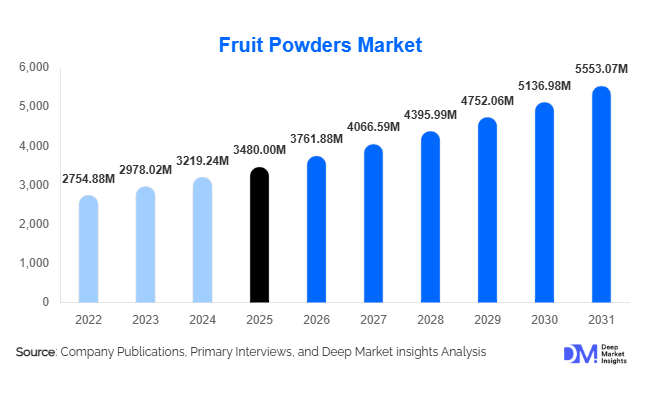
According to Deep Market Insights,the global fruit powders market size was valued at USD 3,480 million in 2026 and is projected to grow from USD 3,761.88 million in 2026 to reach USD 5,553.07 million by 2031, expanding at a CAGR of 8.1% during the forecast period (2026–2031). The fruit powders market growth is primarily driven by rising demand for natural and convenient ingredients in food & beverages, bakery, nutraceuticals, and functional foods, alongside the expansion of freeze-dried and organic powders in global industrial and retail applications.
Key Market Insights
- Freeze-dried and organic fruit powders are dominating global demand, offering superior nutrient retention, flavor preservation, and clean-label benefits that appeal to health-conscious consumers.
- Food & beverage applications account for the majority of market consumption, including bakery products, beverages, dairy alternatives, and confectionery items.
- North America and Europe hold the largest shares, driven by high disposable incomes, functional food trends, and growing interest in natural and organic ingredients.
- Asia-Pacific is the fastest-growing region, supported by increasing urbanization, rising middle-class incomes, and government initiatives promoting food processing and export-oriented fruit powder production.
- Technological advancements in drying methods, such as freeze-drying, vacuum-drying, and spray-drying, are enhancing product quality and expanding the range of applications.
What are the latest trends in the fruit powders market?
Rise of Clean-Label and Functional Products
Consumers are increasingly demanding minimally processed, nutrient-rich products, which has fueled the growth of organic and freeze-dried fruit powders. These powders are widely used in functional beverages, protein bars, bakery items, and nutraceutical formulations to provide natural flavor, color, and vitamins. The trend toward clean-label and antioxidant-rich products is driving product innovation, including blends of berries for immunity support and tropical fruits for vitamin fortification.
Technological Advancements in Drying Methods
Emerging technologies like freeze-drying, vacuum-drying, and spray-drying are being adopted to preserve nutrients, flavor, and color of fruit powders. Low-energy drying techniques and improved vacuum processes are enhancing product stability and quality, making high-value powders suitable for premium food and nutraceutical applications. Companies are investing in R&D to produce powders with enhanced solubility, texture, and shelf life, catering to industrial and retail demand.
What are the key drivers in the fruit powders market?
Growing Health and Wellness Awareness
Consumers are increasingly prioritizing immunity, digestive health, and antioxidant intake, boosting demand for fruit powders in functional foods, beverages, and dietary supplements. Freeze-dried and organic powders are preferred due to superior nutrient retention and natural sourcing. The rise of plant-based diets and preventive health trends is expanding the addressable market for fruit powders globally.
Convenience and Shelf-Life Advantages
Fruit powders offer longer shelf life, reduced storage costs, and easier transport compared to fresh fruits. This makes them ideal for large-scale industrial use and export-driven demand. The convenience factor also supports incorporation into instant drinks, smoothies, bakery mixes, and ready-to-eat meals, widening adoption across multiple sectors.
Expansion of Functional Foods & Beverages
The growing market for fortified and functional foods is driving consumption of fruit powders. They are widely used in protein shakes, smoothies, dietary supplements, confectionery, and dairy alternatives. Blended powders, combining multiple fruits for targeted health benefits, are witnessing strong adoption, further supporting growth in this segment.
What are the restraints for the global market?
High Processing and Operational Costs
Advanced drying methods, particularly freeze-drying, require substantial capital investment and energy expenditure. Smaller manufacturers may struggle to compete, limiting market penetration in cost-sensitive regions. This restricts rapid scaling of high-value powder production despite rising demand.
Raw Material Seasonality and Supply Constraints
Dependence on seasonal fruit harvests and susceptibility to climate variability affects consistent supply and pricing of high-quality powders. Crop failures, pest infestations, and fluctuating agricultural yields can disrupt production cycles, potentially slowing market growth.
What are the key opportunities in the fruit powders market?
Emerging Markets in APAC and LATAM
Rapid urbanization and rising disposable incomes in countries such as India, China, Brazil, and Mexico are creating new demand for fruit powders in beverages, bakery, and nutraceutical products. Governments are supporting exports and improving food processing infrastructure, enabling manufacturers to tap into these high-growth markets.
Integration into Functional Foods and Nutraceuticals
Fruit powders are increasingly incorporated into immunity-boosting, antioxidant-rich, and digestive health-oriented products. Companies leveraging blends of berries and tropical fruits for functional benefits are poised to gain significant market share. This trend presents a profitable niche for both established players and new entrants in the health-focused segment.
Technological Innovation and Sustainability
Advances in drying technologies, including low-energy freeze-drying and vacuum-drying, allow manufacturers to produce powders with higher nutrient retention and longer shelf life. Sustainable practices, such as eco-friendly packaging and energy-efficient processes, also provide a competitive advantage and appeal to environmentally conscious consumers.
Report Scope
| Report Metric | Details |
|---|---|
| Market Size in 2025 | USD 3480 Million |
| Market Size in 2026 | USD 3761.88 Million |
| Market Size in 2031 | USD 5553.07 Million |
| CAGR | 8.1% (2026-2031) |
| Base Year for Estimation | 2025 |
| Historical Data | 2022-2024 |
| Forecast Period | 2026-2031 |
| Report Coverage | Revenue Forecast, Competitive Landscape, Supply Chain Disruption, Growth Factors, Environment & Regulatory Landscape and Trends |
| Geographies Covered | North America, Europe, APAC, Middle East and Africa, LATAM |
| Countries Covered | U.S., Canada, U.K., Germany, France, Spain, Italy, Russia, Nordic, Benelux, Rest of Europe, China, Korea, Japan, India, Australia, Singapore, Taiwan, South East Asia, Rest of Asia-Pacific, UAE, Turky, Saudi Arabia, South Africa, Egypt, Nigeria, Rest of MEA, Brazil, Mexico, Argentina, Chile, Colombia, Rest of LATAM |
Explore more data points, trends and opportunities Download Free Sample Report
Product Type Insights
Single fruit powders continue to dominate the global fruit powder market, accounting for approximately 28% of the total market share in 2025, with apple and mango powders leading due to their broad applicability, consumer familiarity, and cost-effectiveness. The dominance of this segment is primarily driven by strong demand from food and beverage manufacturers seeking consistent flavor profiles, standardized nutritional content, and ease of formulation in bakery, dairy, beverage, and snack applications. Their longer shelf life and year-round availability compared to fresh fruit further strengthen their industrial appeal. In terms of processing form, freeze-dried powders lead the market with nearly 40% of global share, supported by superior retention of flavor, color, aroma, and micronutrients. The leading driver for this segment is the rising demand for premium-quality ingredients in functional foods, nutraceuticals, and clean-label products where nutrient preservation and minimal thermal degradation are critical. Natural and organic fruit powders collectively capture around 65% of the market, reflecting growing consumer preference for minimally processed, non-GMO, and additive-free ingredients. The shift toward plant-based diets and transparency in ingredient sourcing continues to accelerate adoption. Meanwhile, mixed fruit powders are gaining momentum in functional and fortified food applications, particularly in immunity-boosting beverages and dietary supplements, where synergistic nutrient blends provide added value and product differentiation.
Application Insights
The food and beverage sector dominates the application landscape, representing approximately 55% of global demand in 2025. The leading growth driver in this segment is the increasing incorporation of fruit powders as natural flavoring, coloring, and nutritional enhancement agents in bakery products, smoothies, dairy alternatives, confectionery, breakfast cereals, and ready-to-mix beverages. Manufacturers are replacing artificial additives with fruit-based ingredients to align with clean-label trends and regulatory standards. Nutraceutical applications are witnessing strong expansion, particularly in immunity support, antioxidant formulations, digestive health supplements, and sports nutrition products. The rising consumer focus on preventive healthcare and daily supplementation is propelling this growth. Functional foods and beverages are emerging as the fastest-growing application area, driven by innovation in fortified blends, plant-based formulations, and superfruit combinations that cater to health-conscious urban populations. Product innovation in ready-to-drink beverages and fortified snacks is further strengthening application diversity.
Distribution Channel Insights
B2B channels remain dominant, with industrial buyers across food processing, beverage manufacturing, nutraceutical production, and cosmetic formulation accounting for the majority of procurement volumes. The primary driver of this segment is bulk purchasing by large-scale manufacturers requiring standardized quality, traceability, and long-term supply agreements. Online direct-to-business platforms are expanding rapidly, enabling manufacturers and suppliers to streamline procurement, improve price transparency, and directly engage with global buyers. Export-oriented trade plays a crucial role in overall distribution dynamics, particularly with strong shipments to North America, Europe, and Japan, where demand for premium, organic, and freeze-dried powders remains high. In parallel, social media visibility, digital catalogs, and influencer-driven product awareness are increasingly influencing both retail and industrial purchasing decisions, enhancing brand positioning and global outreach.
End-Use Insights
Food and beverage manufacturers represent the largest end-use segment, accounting for roughly 50% of total market demand. The leading driver for this segment is the continuous innovation in processed foods, convenience products, and health-oriented formulations that require stable, nutrient-rich fruit ingredients. Nutraceutical companies are rapidly increasing adoption of fruit powders in capsules, gummies, tablets, and functional drink mixes to support immunity, detoxification, and digestive health claims. Additionally, the cosmetic and personal care industries are exploring fruit-based powders for natural skincare, antioxidant-rich face masks, and botanical formulations, driven by consumer demand for plant-derived ingredients. Export-driven end-use demand is also rising, particularly in developed economies where high-quality fruit powders are incorporated into premium consumer goods and private-label health products.
Explore more data points, trends and opportunities Download Free Sample Report
Fruit Powders Market Segmentations
By Product Type
- Single Fruit Powders
- Mixed Fruit Powders
By Form
- Freeze-Dried Fruit Powders
- Spray-Dried Fruit Powders
- Vacuum-Dried Fruit Powders
- Oven/Hot Air-Dried Fruit Powders
By Application
- Food & Beverages
- Nutraceuticals & Dietary Supplements
- Functional Foods
- Flavors & Fragrances
By Source
- Natural / Organic Fruit Powders
- Synthetic / Fortified Fruit Powders
By End-Use Industry
- Food & Beverage Manufacturers
- Nutraceutical Companies
- Culinary & Foodservice Industry
- Cosmetics & Personal Care
Regional Insights
North America
North America holds the largest market share, accounting for approximately 35% in 2025, led by the U.S. and Canada. Regional growth is driven by high disposable income levels, strong penetration of functional foods, and widespread consumer preference for organic and clean-label products. The expanding plant-based food industry, increasing demand for natural ingredients in beverages and snacks, and well-established nutraceutical manufacturing infrastructure further strengthen regional dominance. Advanced cold-chain logistics, robust retail networks, and continuous product innovation by domestic manufacturers also contribute to sustained growth. Regulatory clarity regarding food labeling and organic certifications enhances consumer confidence and market expansion.
Europe
Europe accounts for approximately 28% of the global market, with Germany, France, and the U.K. serving as leading consumption hubs. Regional growth is primarily driven by strong consumer awareness regarding natural ingredients, sustainability, and traceability. Strict regulatory frameworks encouraging clean-label and organic certifications support demand for high-quality fruit powders. The growing vegan and vegetarian population, coupled with rising interest in functional and fortified foods, fuels industrial demand. Sustainability initiatives and carbon footprint reduction strategies are also encouraging adoption of responsibly sourced and minimally processed fruit ingredients across the region.
Asia-Pacific
Asia-Pacific is the fastest-growing region, projected to expand at approximately 9.5% CAGR, led by India, China, and Japan. Rapid urbanization, rising middle-class income, increasing health awareness, and expanding food processing industries are key growth drivers. Government initiatives promoting domestic food manufacturing and export competitiveness, including programs such as “Make in India” and “Made in China 2025,” are strengthening processing capabilities and encouraging technological modernization. Growing demand for functional beverages, instant drink mixes, and fortified traditional foods is boosting consumption of grouped and blended fruit powders. Expanding e-commerce penetration further enhances product accessibility across urban and semi-urban markets.
Latin America
Latin America, led by Brazil and Mexico, is emerging as both a production powerhouse and a growing consumption market. Abundant fruit production, favorable climatic conditions, and expanding agro-processing infrastructure provide a strong supply-side advantage. Regional growth is driven by increasing investments in value-added fruit processing, rising domestic demand for packaged foods, and expanding export opportunities to North America and Europe. Organic and freeze-dried powders are gaining particular traction due to their premium positioning and higher export margins.
Middle East & Africa
The Middle East market is driven by countries such as the UAE, Saudi Arabia, and Qatar, where rising disposable incomes and demand for premium imported food ingredients support growth. Increasing adoption of health supplements and fortified beverages is accelerating demand for high-quality fruit powders. In Africa, several countries serve as important production hubs due to rich agricultural output and cost-competitive labor. Export-oriented supply chains, supported by improving processing infrastructure and foreign direct investments, are strengthening the region’s role in the global fruit powder ecosystem.
Key Players in the Global Fruit Powders Market
- Ingredion Inc.
- Chr. Hansen Holding A/S
- Glanbia plc
- PepsiCo, Inc.
- Archer Daniels Midland Company (ADM)
- Euromed S.A.
- Herbaland Naturals
- Raisio Oyj
- Frutarom Industries Ltd.
- Naturex SA
- Kerry Group plc
- SanLucar Fruit
- Bühler Group
- Olam International
- Puratos NV