Fruit Infused Water Market Size
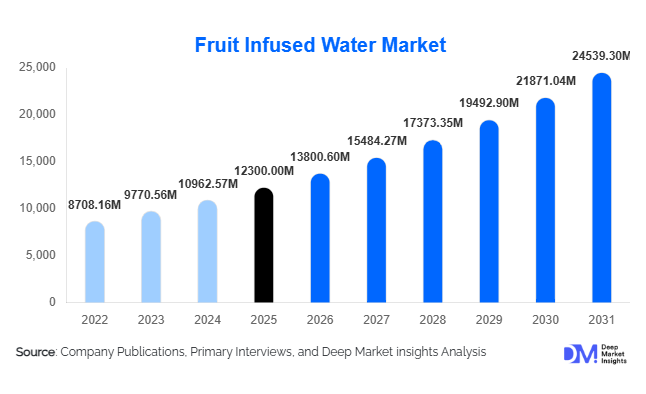
According to Deep Market Insights, the global fruit infused water market size was valued at USD 12,300 million in 2025 and is projected to grow from USD 13,800.60 million in 2026 to reach USD 24,539.30 million by 2031, expanding at a CAGR of 12.2% during the forecast period (2026–2031). The fruit infused water market growth is primarily driven by increasing consumer preference for low-calorie beverages, rising awareness of health and wellness, and the global shift away from sugar-sweetened carbonated drinks toward natural hydration alternatives.
Key Market Insights
- Consumers are increasingly shifting toward clean-label and sugar-free beverages, boosting demand for naturally flavored infused water products.
- Premiumization is a key trend, with brands introducing exotic flavors, botanical infusions, and functional ingredients.
- North America dominates the global market, driven by strong health awareness and established beverage innovation ecosystems.
- Asia-Pacific is the fastest-growing region, supported by rising urbanization and increasing disposable incomes.
- Retail distribution through supermarkets and hypermarkets leads sales, though e-commerce is rapidly gaining traction.
- Sustainable packaging innovations, including recyclable bottles and eco-friendly materials, are becoming critical for brand differentiation.
What are the latest trends in the fruit infused water market?
Functional and Fortified Infused Water
The integration of functional ingredients such as vitamins, minerals, antioxidants, and adaptogens is reshaping the fruit infused water market. Consumers are increasingly seeking beverages that offer health benefits beyond hydration, including immunity support, energy enhancement, and digestive health. This trend is particularly strong among urban populations and fitness-focused consumers. Brands are launching fortified variants with added electrolytes and plant-based extracts, positioning infused water within the broader functional beverage category. The demand for “better-for-you” drinks is pushing manufacturers to innovate with clean-label, additive-free formulations that deliver both taste and health benefits.
Flavor Innovation and Premium Positioning
Flavor innovation remains a central trend, with manufacturers introducing unique combinations such as cucumber-mint, ginger-lemon, and tropical fruit blends. These premium offerings appeal to consumers seeking variety and sensory experiences. Seasonal and limited-edition flavors are also gaining traction, encouraging repeat purchases and brand loyalty. Premium packaging, including glass bottles and sleek aluminum cans, further enhances product appeal, particularly among younger consumers and urban professionals. The combination of aesthetic packaging and exotic flavors is driving the premiumization of the fruit infused water market.
What are the key drivers in the fruit infused water market?
Rising Health Consciousness
Growing awareness of the health risks associated with high sugar consumption is a major driver of the fruit infused water market. Consumers are actively replacing sugary beverages with low-calorie, naturally flavored alternatives. The increasing prevalence of lifestyle diseases such as obesity and diabetes is accelerating this shift, making infused water a preferred choice for daily hydration.
Urbanization and On-the-Go Consumption
Rapid urbanization and busy lifestyles are fueling demand for convenient, ready-to-drink beverages. Fruit infused water offers portability and ease of consumption, making it ideal for on-the-go consumers. Compact packaging formats and widespread availability across retail channels are further supporting market growth.
Product Innovation and Clean-Label Demand
Manufacturers are investing heavily in research and development to introduce innovative products with natural ingredients and no artificial additives. Clean-label products are gaining popularity, as consumers prioritize transparency and ingredient authenticity. This trend is driving the adoption of unsweetened and naturally sweetened infused water variants globally.
What are the restraints for the global market?
Premium Pricing Constraints
Fruit infused water products are generally priced higher than conventional bottled water, which limits their adoption in price-sensitive markets. While premium positioning enhances brand value, it can restrict penetration in developing economies where affordability remains a key concern.
Shelf-Life and Preservation Challenges
The use of natural ingredients without preservatives creates challenges in maintaining product shelf life. Manufacturers must invest in advanced processing and packaging technologies to ensure freshness and safety, increasing production costs and operational complexity.
What are the key opportunities in the fruit infused water industry?
Expansion in Emerging Markets
Emerging economies in Asia-Pacific, Latin America, and the Middle East present significant growth opportunities. Rising disposable incomes, urbanization, and increasing exposure to global health trends are driving demand for premium beverages. Countries such as India, China, and Brazil offer substantial untapped potential for market expansion.
Sustainable Packaging Innovations
The growing emphasis on environmental sustainability is encouraging companies to adopt eco-friendly packaging solutions. Investments in recyclable, biodegradable, and reusable packaging can enhance brand image and align with regulatory requirements, creating a competitive advantage.
Direct-to-Consumer and E-commerce Growth
The expansion of e-commerce platforms and direct-to-consumer models is enabling brands to reach a wider audience. Subscription-based services and personalized hydration solutions are emerging as innovative business models, offering convenience and customization to consumers.
Report Scope
| Report Metric | Details |
|---|---|
| Market Size in 2025 | USD 12300.00 Million |
| Market Size in 2026 | USD 13800.60 Million |
| Market Size in 2031 | USD 24539.30 Million |
| CAGR | 12.2% (2026-2031) |
| Base Year for Estimation | 2025 |
| Historical Data | 2022-2024 |
| Forecast Period | 2026-2031 |
| Report Coverage | Revenue Forecast, Competitive Landscape, Supply Chain Disruption, Growth Factors, Environment & Regulatory Landscape and Trends |
| Geographies Covered | North America, Europe, APAC, Middle East and Africa, LATAM |
| Countries Covered | U.S., Canada, U.K., Germany, France, Spain, Italy, Russia, Nordic, Benelux, Rest of Europe, China, Korea, Japan, India, Australia, Singapore, Taiwan, South East Asia, Rest of Asia-Pacific, UAE, Turky, Saudi Arabia, South Africa, Egypt, Nigeria, Rest of MEA, Brazil, Mexico, Argentina, Chile, Colombia, Rest of LATAM |
Explore more data points, trends and opportunities Download Free Sample Report
Product Type Insights
The global fruit infused water market is predominantly led by still fruit infused water, which accounts for approximately 62% of the total market share in 2025. This dominance is largely attributed to its strong alignment with evolving consumer preferences toward natural, clean-label, and minimally processed beverages. Still infused water closely resembles traditional drinking water in taste and texture, making it a seamless transition for consumers seeking healthier alternatives to sugary drinks. The absence of carbonation further enhances its appeal among individuals who prefer mild, easy-to-consume beverages without the bloating or acidity often associated with carbonated drinks.The leading segment driver for still fruit infused water lies in its positioning as a functional hydration solution that combines wellness benefits with simplicity. Consumers are increasingly prioritizing hydration products that deliver subtle flavor enhancement without artificial additives, and still infused water effectively meets this demand. Additionally, its compatibility with a wide range of natural ingredients such as citrus fruits, herbs, and botanicals enhances its versatility, making it suitable for daily consumption across diverse age groups and lifestyles.On the other hand, sparkling fruit infused water is witnessing rapid growth, particularly among younger consumers and urban populations. These beverages provide a sensory experience similar to traditional carbonated soft drinks while maintaining a healthier profile, often containing zero or low calories and no added sugars. The rising demand for guilt-free indulgence is a key factor driving the adoption of sparkling variants. Furthermore, brands are increasingly innovating with unique flavor combinations and premium packaging to attract consumers seeking both taste and sophistication. While still variants continue to dominate, the sparkling segment is expected to gain incremental share over the forecast period due to its strong appeal in social and on-the-go consumption occasions.
Flavor Type Insights
Flavor innovation remains a critical factor influencing consumer purchasing decisions in the fruit infused water market. Among the various flavor categories, citrus-based flavors lead the market, accounting for approximately 34% of the total share. Lemon, lime, and orange variants are widely preferred due to their refreshing taste profiles, natural tanginess, and strong association with detoxification and immunity-boosting properties. Citrus fruits are also widely available and culturally accepted across regions, making them a staple ingredient in infused water products.The leading segment driver for citrus flavors is their strong health perception combined with universal taste acceptance. Consumers often associate citrus ingredients with cleansing, vitamin C enrichment, and digestive benefits, which significantly enhances their appeal in the functional beverage space. Moreover, citrus flavors provide a crisp and revitalizing experience that aligns well with hydration-focused consumption occasions, further reinforcing their market leadership.In addition to citrus, berry-based flavors such as strawberry, blueberry, and raspberry are gaining traction due to their naturally sweet taste and antioxidant properties. These flavors are particularly popular among younger consumers and those seeking a slightly indulgent yet healthy beverage option. Tropical flavors, including mango, pineapple, and coconut, are also witnessing strong growth, driven by their exotic appeal and association with premiumization. These variants cater to consumers looking for novel taste experiences and are often positioned as lifestyle beverages.The increasing demand for flavor diversity is encouraging manufacturers to experiment with hybrid combinations, such as citrus-mint or berry-basil blends, which offer a more sophisticated taste profile. This trend is further supported by the growing influence of wellness culture and culinary innovation, where consumers are more open to trying unique and artisanal flavor pairings.
Packaging Insights
Packaging plays a crucial role in shaping consumer perception and purchase behavior in the fruit infused water market. PET bottles currently dominate the segment, holding approximately 55% of the market share. Their widespread adoption is driven by their affordability, lightweight design, durability, and convenience for on-the-go consumption. PET packaging also allows for easy mass production and distribution, making it a preferred choice for manufacturers aiming to achieve scale and cost efficiency.The leading segment driver for PET bottles is their unmatched convenience and accessibility, particularly in emerging markets and high-volume retail environments. Consumers prioritize portability and ease of use, especially in urban settings where busy lifestyles demand quick and practical hydration solutions. PET bottles effectively meet these requirements, reinforcing their dominance in the market.However, there is a noticeable shift toward alternative packaging formats such as glass bottles and aluminum cans, particularly in the premium segment. Glass packaging is often associated with purity, quality, and sustainability, making it an attractive option for environmentally conscious consumers. Aluminum cans, on the other hand, offer recyclability and a modern aesthetic, appealing to younger demographics and urban consumers.The growing emphasis on sustainability is prompting brands to adopt eco-friendly packaging solutions, including recycled materials and biodegradable options. Regulatory pressures and increasing consumer awareness regarding plastic waste are further accelerating this transition. As a result, while PET bottles will continue to dominate in terms of volume, alternative packaging formats are expected to gain significant traction in value terms, particularly in developed markets.
Distribution Channel Insights
The distribution landscape of the fruit infused water market is characterized by a strong presence of traditional retail channels, with supermarkets and hypermarkets accounting for nearly 38% of total sales. These outlets provide extensive product visibility, a wide assortment of brands and flavors, and the convenience of one-stop shopping, making them the preferred choice for consumers.The leading segment driver for supermarkets and hypermarkets is their ability to offer a comprehensive shopping experience combined with strategic product placement and promotional activities. Consumers often rely on these retail formats for their regular grocery needs, and the presence of fruit infused water alongside other beverages enhances its accessibility and visibility. In-store marketing, discounts, and sampling campaigns further contribute to higher sales through this channel.Meanwhile, online retail is emerging as the fastest-growing distribution channel, driven by increasing internet penetration, smartphone usage, and the growing popularity of e-commerce platforms. Consumers are increasingly turning to online channels for their convenience, wider product selection, and the ability to compare prices and read reviews. Subscription-based models and direct-to-consumer strategies are also gaining traction, allowing brands to build stronger relationships with their customers.Convenience stores and specialty health stores also play a significant role in the distribution ecosystem, particularly in urban areas. These outlets cater to impulse purchases and health-focused consumers, respectively, further expanding the market reach of fruit infused water products.
End-Use Insights
In terms of end-use, household consumption dominates the fruit infused water market, accounting for approximately 52% of the total share. This dominance is driven by the increasing emphasis on daily hydration and the growing awareness of the health risks associated with sugary beverages. Consumers are incorporating infused water into their daily routines as a healthier alternative to traditional soft drinks and juices.The foodservice sector, including restaurants, cafés, and hotels, is the fastest-growing end-use segment. Infused water is increasingly being offered as a premium beverage option in dining establishments, often presented in aesthetically appealing formats with fresh fruit garnishes. This trend is particularly prominent in upscale and health-focused venues, where infused water enhances the overall dining experience and aligns with the growing demand for clean-label offerings.The expansion of the hospitality industry and the increasing adoption of wellness-oriented menus are further driving the growth of this segment. As consumers seek unique and refreshing beverage experiences outside the home, the foodservice sector is expected to play an increasingly important role in market development.
Explore more data points, trends and opportunities Download Free Sample Report
Fruit Infused Water Market Segmentations
By Product Type
- Still Fruit Infused Water
- Sparkling Fruit Infused Water
By Flavor Type
- Citrus-Based
- Berry-Based
- Exotic & Botanical
- Mixed/Blended Flavors
By Distribution Channel
- Supermarkets/Hypermarkets
- Convenience Stores
- Online Retail
- Specialty Stores
- Foodservice
- HoReCa
Regional Insights
North America
North America remains the largest market for fruit infused water, accounting for approximately 36% of the global market share in 2025, with the United States serving as the primary growth engine. The region’s dominance is supported by high consumer awareness regarding health and wellness, as well as a well-established beverage industry that активно promotes innovation and product differentiation.Key growth drivers in North America include the strong shift away from sugary beverages toward healthier alternatives, widespread availability of products across retail channels, and continuous innovation in flavors and packaging. The presence of leading beverage companies and startups alike has created a highly competitive environment that fosters rapid product development. Additionally, the growing trend of functional beverages, including those offering added vitamins and antioxidants, is further boosting demand in the region.
Europe
Europe holds a significant share of approximately 27%, with countries such as Germany, the United Kingdom, and France leading the market. The region is characterized by a strong emphasis on sustainability, clean-label products, and premium quality, which aligns well with the positioning of fruit infused water.Regional growth in Europe is driven by stringent regulations on sugar content in beverages, increasing environmental awareness, and a growing preference for organic and natural products. Consumers in this region are highly conscious of ingredient transparency and packaging sustainability, prompting brands to adopt eco-friendly practices. The rising popularity of wellness trends, including detox diets and hydration-focused routines, is also contributing to market expansion.
Asia-Pacific
The Asia-Pacific region is the fastest-growing market, expanding at a CAGR of over 14%, with major contributions from countries such as China and India. Rapid urbanization, increasing disposable incomes, and changing lifestyles are key factors driving demand in this region.Growth in Asia-Pacific is fueled by a rising middle-class population, growing health awareness, and the increasing influence of Western consumption patterns. The expansion of modern retail infrastructure and e-commerce platforms is enhancing product accessibility, while aggressive marketing strategies by global and local brands are driving consumer adoption. Additionally, the region’s hot climate and large population base create a strong demand for refreshing and hydrating beverages, further supporting market growth.
Latin America
Latin America is experiencing steady growth, with countries such as Brazil and Mexico leading the market. The region is witnessing a gradual shift toward healthier beverage options, driven by increasing awareness of lifestyle-related health issues.Key drivers of regional growth include rising urbanization, expanding retail networks, and the introduction of affordable product variants. Government initiatives aimed at reducing sugar consumption, such as taxes on sugary drinks, are also encouraging consumers to switch to healthier alternatives like fruit infused water. The growing popularity of premium beverages and the influence of global trends are further contributing to market development.
Middle East & Africa
The Middle East & Africa region is emerging as a promising market for fruit infused water, with countries such as the UAE and South Africa at the forefront of growth. The region’s increasing focus on premium lifestyles and wellness is driving demand for high-quality, aesthetically appealing beverages.Regional growth is supported by the rapid expansion of the hospitality and tourism sectors, which активно promote infused water as a premium offering. The rising number of health-conscious consumers, coupled with increasing disposable incomes in urban areas, is further boosting demand. Additionally, the hot climate in many parts of the region creates a natural demand for refreshing and hydrating beverages, positioning fruit infused water as an ideal choice.Overall, while developed regions continue to lead in terms of market share, emerging economies are expected to drive future growth, supported by favorable demographic trends, rising health awareness, and expanding distribution networks.
Key Players in the Fruit Infused Water Market
- PepsiCo Inc.
- The Coca-Cola Company
- Nestlé S.A.
- Danone S.A.
- Hint Inc.
- Talking Rain Beverage Company
- Spindrift Beverage Co.
- National Beverage Corp.
- Keurig Dr Pepper Inc.
- Nongfu Spring Co. Ltd.
- Suntory Holdings Limited
- Tata Consumer Products Limited
- Bisleri International Pvt. Ltd.
- Britvic plc
- VOSS Water AS