Fresh Cherries Market Size
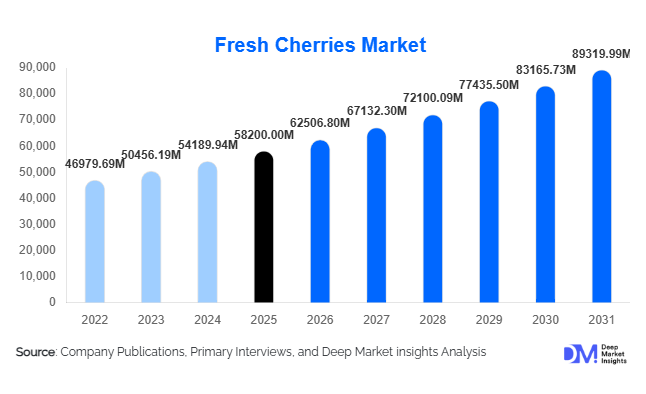
According to Deep Market Insights, the global fresh cherries market size was valued at USD 58,200 million in 2025 and is projected to grow from USD 62,506.80 million in 2026 to reach USD 89,319.99 million by 2031, expanding at a CAGR of 7.4% during the forecast period (2026–2031). The fresh cherries market growth is primarily driven by increasing consumer demand for nutrient-rich fruits, rising global trade of premium horticultural products, and expanding cold chain infrastructure enabling longer shelf life and wider distribution. Additionally, the growing preference for organic produce and the rising popularity of cherries as a premium seasonal fruit are accelerating global market expansion.
Key Market Insights
- Sweet cherries dominate global consumption, accounting for nearly 68% of the market, driven by their superior taste and widespread fresh consumption.
- Asia-Pacific leads demand growth, with China emerging as the largest importer due to strong gifting culture and premium fruit consumption.
- Modern retail channels dominate distribution, supported by better cold storage, packaging, and consistent quality standards.
- Premium-grade cherries account for over 55% of trade, reflecting strong export demand and strict quality benchmarks.
- Organic cherries are the fastest-growing segment, driven by health-conscious and environmentally aware consumers.
- Technological advancements in cold chain logistics are significantly reducing post-harvest losses and enabling global market reach.
What are the latest trends in the fresh cherries market?
Premiumization and Export-Led Demand Growth
The fresh cherries market is increasingly driven by premiumization, particularly in export-oriented economies. High-quality, large-sized cherries with superior color and firmness are commanding premium prices in international markets. Countries such as Chile and the United States are focusing on export-grade production, targeting high-demand markets like China and Southeast Asia. Seasonal gifting trends, especially during festive periods, are significantly boosting demand for premium cherries. Exporters are investing in branding, packaging innovation, and quality differentiation to enhance global competitiveness and maximize profitability.
Advancements in Cold Chain and Storage Technologies
Technological improvements in cold chain logistics are transforming the fresh cherries market. Controlled atmosphere storage, modified atmosphere packaging (MAP), and real-time temperature monitoring are extending product shelf life and maintaining fruit quality during long-distance transportation. These advancements are enabling year-round availability and reducing spoilage rates. Additionally, digital supply chain solutions are improving traceability and inventory management, allowing producers and distributors to optimize logistics and minimize losses, particularly in export markets.
What are the key drivers in the fresh cherries market?
Rising Health Awareness and Functional Food Demand
Consumers are increasingly incorporating fresh fruits into their diets, driven by awareness of health benefits. Cherries are rich in antioxidants, vitamins, and anti-inflammatory compounds, making them a preferred choice among health-conscious consumers. This trend is particularly strong in North America and Europe, where functional foods are gaining popularity. The perception of cherries as a “superfruit” is further boosting consumption across both developed and emerging markets.
Expansion of Global Trade and Export Infrastructure
The globalization of agricultural trade is significantly driving the fresh cherries market. Exporting countries such as Chile, Turkey, and the United States have expanded their production and logistics capabilities to meet international demand. Investments in port infrastructure, refrigerated transport, and trade agreements are facilitating seamless global supply. This has enabled producers to tap into high-growth markets in Asia-Pacific, particularly China and India, where demand for imported fruits is rising rapidly.
What are the restraints for the global market?
High Perishability and Post-Harvest Losses
Fresh cherries are highly perishable, requiring precise temperature control and rapid distribution. Any disruption in the supply chain can lead to significant losses, impacting profitability. Despite advancements in storage technology, maintaining consistent quality across long-distance exports remains a challenge, especially for smaller producers lacking infrastructure.
Climate Sensitivity and Yield Variability
Cherry production is highly dependent on climatic conditions such as temperature, rainfall, and frost. Unfavorable weather can significantly impact yield and quality, leading to supply shortages and price volatility. Climate change is further exacerbating these risks, making production increasingly unpredictable.
What are the key opportunities in the fresh cherries industry?
Expansion in Emerging Markets
Emerging economies in Asia-Pacific and the Middle East present significant growth opportunities. Rising disposable incomes and changing dietary preferences are increasing demand for premium fruits. Countries such as India, Vietnam, and the UAE are witnessing growing imports of fresh cherries, supported by expanding retail infrastructure and e-commerce platforms.
Growth of Organic and Sustainable Farming
The demand for organic cherries is rising rapidly, particularly in Europe and North America. Consumers are willing to pay a premium for chemical-free and sustainably produced fruits. This presents opportunities for producers to invest in organic certification and eco-friendly farming practices, enhancing both market positioning and profitability.
Report Scope
| Report Metric | Details |
|---|---|
| Market Size in 2025 | USD 58200.00 Million |
| Market Size in 2026 | USD 62506.80 Million |
| Market Size in 2031 | USD 89319.99 Million |
| CAGR | 7.4% (2026-2031) |
| Base Year for Estimation | 2025 |
| Historical Data | 2022-2024 |
| Forecast Period | 2026-2031 |
| Report Coverage | Revenue Forecast, Competitive Landscape, Supply Chain Disruption, Growth Factors, Environment & Regulatory Landscape and Trends |
| Geographies Covered | North America, Europe, APAC, Middle East and Africa, LATAM |
| Countries Covered | U.S., Canada, U.K., Germany, France, Spain, Italy, Russia, Nordic, Benelux, Rest of Europe, China, Korea, Japan, India, Australia, Singapore, Taiwan, South East Asia, Rest of Asia-Pacific, UAE, Turky, Saudi Arabia, South Africa, Egypt, Nigeria, Rest of MEA, Brazil, Mexico, Argentina, Chile, Colombia, Rest of LATAM |
Explore more data points, trends and opportunities Download Free Sample Report
Product Type Insights
Sweet cherries continue to dominate the global cherries market, accounting for approximately 68% of the total market share in 2025, a position that is reinforced by their widespread consumer appeal, superior flavor profile, and versatility across consumption formats. Their naturally sweet taste, vibrant color, and firm texture make them highly attractive for fresh consumption, which remains the primary mode of intake across both developed and emerging markets. Leading varieties such as Bing, Rainier, Lapins, and Sweetheart have gained substantial traction due to their consistency in quality and extended shelf life, which makes them suitable for both domestic retail and international exports. The expansion of cold chain logistics and improved post-harvest handling techniques has further strengthened the market penetration of sweet cherries, enabling exporters to reach distant markets without compromising freshness.On the other hand, sour cherries, although representing a smaller portion of the market, play a critical role in the processing segment. These cherries are primarily utilized in the production of juices, jams, preserves, bakery fillings, and alcoholic beverages. Their tart flavor profile makes them ideal for culinary applications where balanced sweetness is required. The demand for sour cherries is largely driven by the growth of the global food processing industry, particularly in regions with strong bakery and confectionery sectors. Furthermore, increasing consumer interest in functional foods has boosted the use of sour cherries in nutraceuticals and dietary supplements, owing to their high concentration of anthocyanins and health benefits related to sleep improvement and muscle recovery. While the segment remains niche compared to sweet cherries, its stable demand base and industrial applications ensure consistent growth over the forecast period.
Nature Insights
Conventional cherries dominate the global market, holding an estimated 82% share, primarily due to their large-scale production capabilities, lower cultivation costs, and established supply chains. Conventional farming methods enable growers to achieve higher yields and meet the volume demands of global markets, especially in price-sensitive regions. The widespread availability of conventional cherries across supermarkets, hypermarkets, and wholesale markets further reinforces their dominance. Additionally, the relatively lower price point compared to organic cherries makes them accessible to a broader consumer base, particularly in developing economies.The transition toward organic farming is further supported by government initiatives and certification programs that encourage sustainable agricultural practices. Financial incentives, subsidies, and technical support are being provided to farmers to facilitate this shift. Moreover, advancements in organic farming techniques, such as integrated pest management and soil health improvement strategies, are helping to overcome traditional challenges associated with organic cultivation. As a result, the organic segment is expected to grow at a faster pace compared to conventional cherries, gradually increasing its share in the global market.
Distribution Channel Insights
Modern retail channels, including supermarkets and hypermarkets, account for approximately 46% of global cherry sales, making them the leading distribution segment. These retail formats offer several advantages, including better product visibility, standardized quality, and efficient supply chain management. Consumers prefer purchasing cherries from these outlets due to the assurance of freshness, proper storage conditions, and the availability of a wide variety of options. The presence of well-established retail chains in developed regions further strengthens this segment’s dominance.The growth of modern retail is closely linked to urbanization and changing lifestyles, as consumers increasingly seek convenience and a one-stop shopping experience. Retailers are also investing in advanced refrigeration and packaging technologies to extend the shelf life of cherries, thereby reducing wastage and improving profitability. Promotional strategies, such as seasonal discounts and premium product displays, further enhance consumer engagement and drive sales.Traditional retail channels, such as local grocery stores and wet markets, continue to play a significant role, particularly in developing regions. These channels offer affordability and accessibility, catering to price-sensitive consumers. However, their growth is relatively slower compared to modern and online retail formats, as they often lack advanced storage facilities and standardized quality control measures.
End-Use Insights
Direct consumption remains the dominant end-use segment, contributing nearly 72% of total demand in the global cherries market. This dominance is primarily driven by the fruit’s appeal as a fresh, healthy, and convenient snack. The increasing awareness of the health benefits associated with cherries, including their antioxidant content and potential to reduce inflammation, has further boosted their consumption. Consumers are incorporating cherries into their daily diets, either as standalone snacks or as part of salads, desserts, and breakfast meals.The strong demand for direct consumption is also supported by rising disposable incomes and the growing preference for premium fruits, particularly in urban areas. Seasonal availability and the perception of cherries as a luxury fruit contribute to their high demand during peak seasons, especially in festive and gifting contexts in certain regions. Packaging innovations, such as resealable containers and portion-sized packs, are further enhancing the convenience of fresh cherry consumption.The processing segment also benefits from the utilization of lower-grade fruits that may not meet the standards for fresh consumption, thereby reducing overall wastage and improving supply chain efficiency. As innovation in food processing continues to evolve, the demand for cherries as a key ingredient is expected to increase further.
Explore more data points, trends and opportunities Download Free Sample Report
Fresh Cherries Market Segmentations
By Product Type
- Sweet Cherries
- Sour (Tart) Cherries
By Nature
- Conventional Fresh Cherries
- Organic Fresh Cherries
By Form
- Whole Fresh Cherries (Stemmed)
- Stemless Fresh Cherries
By Grade / Quality
- Premium Grade
- Standard Grade
By Application
- Direct Consumption
- Food Processing
Regional Insights
North America
North America accounts for approximately 28% of the global cherries market share, with the United States serving as the primary contributor. The region’s growth is driven by strong domestic consumption, advanced agricultural practices, and a well-established export infrastructure. High levels of consumer awareness regarding the health benefits of cherries have led to increased demand for both fresh and processed products. The presence of large-scale commercial farms and the adoption of modern farming techniques, including precision agriculture and mechanization, enable efficient production and high-quality output.Additionally, the region benefits from a robust cold chain network, which ensures the efficient transportation and storage of cherries, thereby minimizing post-harvest losses. Government support in the form of research and development initiatives and agricultural subsidies further strengthens the industry. The growing demand for organic produce and premium fruits is also contributing to market expansion, as consumers are willing to pay higher prices for quality and sustainability.
Europe
Europe holds nearly 22% of the global market share, characterized by strong demand for organic and premium fruits. Countries such as Germany, France, Italy, and the United Kingdom are key markets, driven by high consumer purchasing power and stringent quality standards. The region’s emphasis on food safety and traceability has led to the widespread adoption of certification systems, which enhance consumer confidence and drive demand for high-quality cherries.The growth of the cherries market in Europe is also supported by increasing health consciousness and the popularity of plant-based diets. Consumers are actively seeking natural and nutrient-rich foods, positioning cherries as a preferred choice. Additionally, the expansion of retail networks and the growing presence of organic food stores are facilitating market growth. Seasonal imports from countries like Chile ensure year-round availability, further supporting consumption levels.
Asia-Pacific
Asia-Pacific dominates demand growth, accounting for around 35% of the global market, making it the fastest-growing region. China is the largest importer of cherries, driven by strong consumer demand and a well-established gifting culture, particularly during festive seasons such as the Chinese New Year. The rising middle-class population, increasing disposable incomes, and growing urbanization are key factors contributing to the region’s growth.In addition to China, countries such as India, Japan, and South Korea are emerging as significant markets. The increasing exposure to international cuisines and the growing influence of Western dietary habits are driving the consumption of cherries. Improvements in logistics and cold storage infrastructure are also facilitating the import and distribution of cherries across the region. Furthermore, the rapid expansion of e-commerce platforms is enabling greater access to premium imported fruits, thereby boosting market growth.
Latin America
Latin America plays a crucial role in the global cherries market, particularly as a leading supplier. Chile stands out as the largest exporter of fresh cherries, benefiting from favorable climatic conditions and a counter-seasonal production cycle that allows it to supply cherries to Northern Hemisphere markets during their off-season. This strategic advantage has positioned Chile as a key player in global trade.The region’s growth is driven by increasing investments in agricultural technology, improved farming practices, and the expansion of export-oriented production. Trade agreements and strong partnerships with major importing countries, particularly in Asia, further enhance market opportunities. The focus on quality improvement and adherence to international standards has enabled Latin American producers to maintain a competitive edge in the global market.
Middle East & Africa
The Middle East is emerging as a promising market for cherries, with countries such as the United Arab Emirates and Saudi Arabia witnessing increasing import demand. The region’s high disposable income levels and preference for premium imported fruits are key drivers of growth. Cherries are often considered a luxury product, making them popular during festive occasions and among affluent consumers.Overall, the Middle East & Africa region is expected to witness steady growth, supported by expanding trade networks, improving supply chains, and rising consumer demand for high-quality fruits.
Key Players in the Fresh Cherries Market
- Driscoll’s Inc.
- Stemilt Growers LLC
- Rainier Fruit Company
- Zirkle Fruit Company
- Chelan Fresh
- Northwest Cherry Growers
- Sage Fruit Company
- Domex Superfresh Growers
- Vitin Fruits
- SanLucar Group
- Leelanau Fruit Company
- Reid Fruits
- Smelterz Orchard Company
- Cherry Growers Australia
- Del Monte Fresh Produce